

Before the Image Became Data
How cheap digital cameras became a quiet rebellion against the perfected, networked photograph


The light inside the recycling warehouse on the industrial edge of Chiba is the flat, metallic gray of an unwashed window. On a low conveyor belt flanked by workers in anti-static smocks sits a scuffed plastic tote filled with the physical remains of Japan’s late-digital domesticity. Inside are several silver Sony Cyber-shots from 2004, two translucent purple Olympus Stylus units with battery doors held shut by oxidized rubber bands, and an assortment of unbranded digital point-and-shoots whose internal liquid crystal displays have begun to bleed purple ink from the corners.
To a municipal waste technician, these objects are an environmental liability, a dense concentration of lithium-ion cells and flame-retardant circuit boards destined for specialized recycling or smelting.
To Ren, a twenty-two-year-old independent reseller from Osaka who is currently leaning over the sorting line with a loupe tucked into his denim jacket, this bin represents unmined resource wealth.
Ren is a composite character. His profile and the warehouse setting are drawn from salvage-industry sourcing practices, vintage tech marketplace listings, and interviews with young buyers in Japan’s second-hand electronics ecosystem. He buys these old compacts by the kilogram. He rarely checks whether the zoom motors still function. Dead pixels do not concern him. Cosmetic damage is almost irrelevant.
What he is looking for is something harder to manufacture: the aesthetic footprint of an uncorrected lens and an obsolete processor.
Within forty-eight hours, the cameras that still possess the structural integrity to hold a charge will be listed on peer-to-peer marketplaces under specialized nostalgia tags that barely existed a few years ago. TikTok did not create the movement, but it accelerated the signal, giving names to the look: CCD aesthetic, digicam flash, Y2K camera. What began as an aesthetic tag became a market signal. Models once treated as drawer junk now routinely sell for $100 to $300 online, with cult models climbing higher. The buyers come from Seoul, Paris, Los Angeles, Bangkok, London, and São Paulo, many too young to remember when these pocket devices were new.
Uncovering the DIGICAM Hype
The Return of the Bad Camera
The point-and-shoot revival is not a rejection of image quality. It is a rejection of the image as a managed object: processed before it is seen, optimized before it is remembered, and networked before it is chosen.
Mainstream commentary surrounding this re-emergence treats it as a superficial retro trend, a brief fashion cycle comparable to the revival of cassette tapes or low-rise denim. This analysis frames the movement as an isolated lifestyle choice driven by social media influence.
Official shipment data from the Camera and Imaging Products Association (CIPA) shows a broader shift that complicates this simplistic narrative. CIPA shipment data showed fixed-lens digital cameras rising by roughly 30% in 2025. The category remains far below its pre-smartphone peak, but the reversal matters because it contradicts the long-held assumption that casual, dedicated cameras are finished.
To be precise, CIPA’s fixed-lens category includes more than cheap vintage point-and-shoots. It also includes premium fixed-lens compacts such as the Fujifilm X100 series and Ricoh GR line, which have experienced severe retail scarcity and soaring secondary-market markups over the mid-2020s. At the premium end, these modern tools show the same hunger in a more expensive form: a desire for dedicated photographic tools that are separate from the mobile device. The old digicam boom and the premium compact boom are not the same market, but they rhyme. Both point toward the same desire: a camera that is not also a phone.
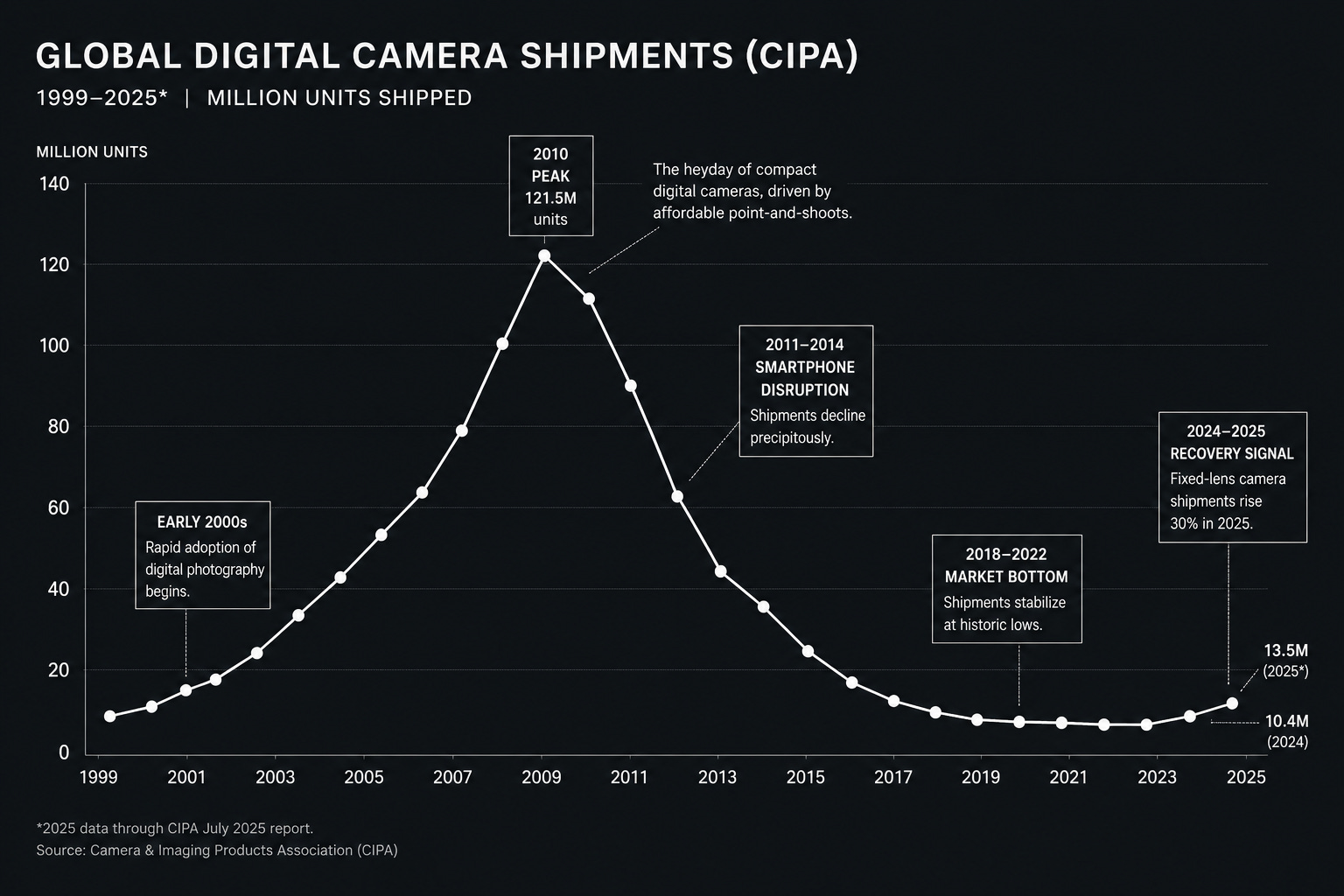
The smartphone did not kill the camera. It turned the camera into a social-media input device. The resurgence of dedicated cameras may be less a revival of photography than a rejection of photography’s absorption into the attention economy. The consumers driving this market may not describe their choices in political language. They are not necessarily staging a conscious rebellion against data mining when they pack a plastic camera for a night out. Yet their behavior reveals a distinct preference for devices that feel less managed, less perfected, and less immediately absorbed into networks.
The Ghost in the Software
None of this means smartphone photography is unworthy. It is one of the most remarkable consumer-technology achievements of the past twenty years, representing an extraordinary engineering feat that allows tiny modules to capture clean scenes under conditions that would challenge traditional film. For parents, travelers, journalists, and ordinary users, this has made photography more democratic than at any point in history. The problem is not capability. The problem is that capability arrived bundled with standardization, connectivity, and the possibility of behavioral tracking.
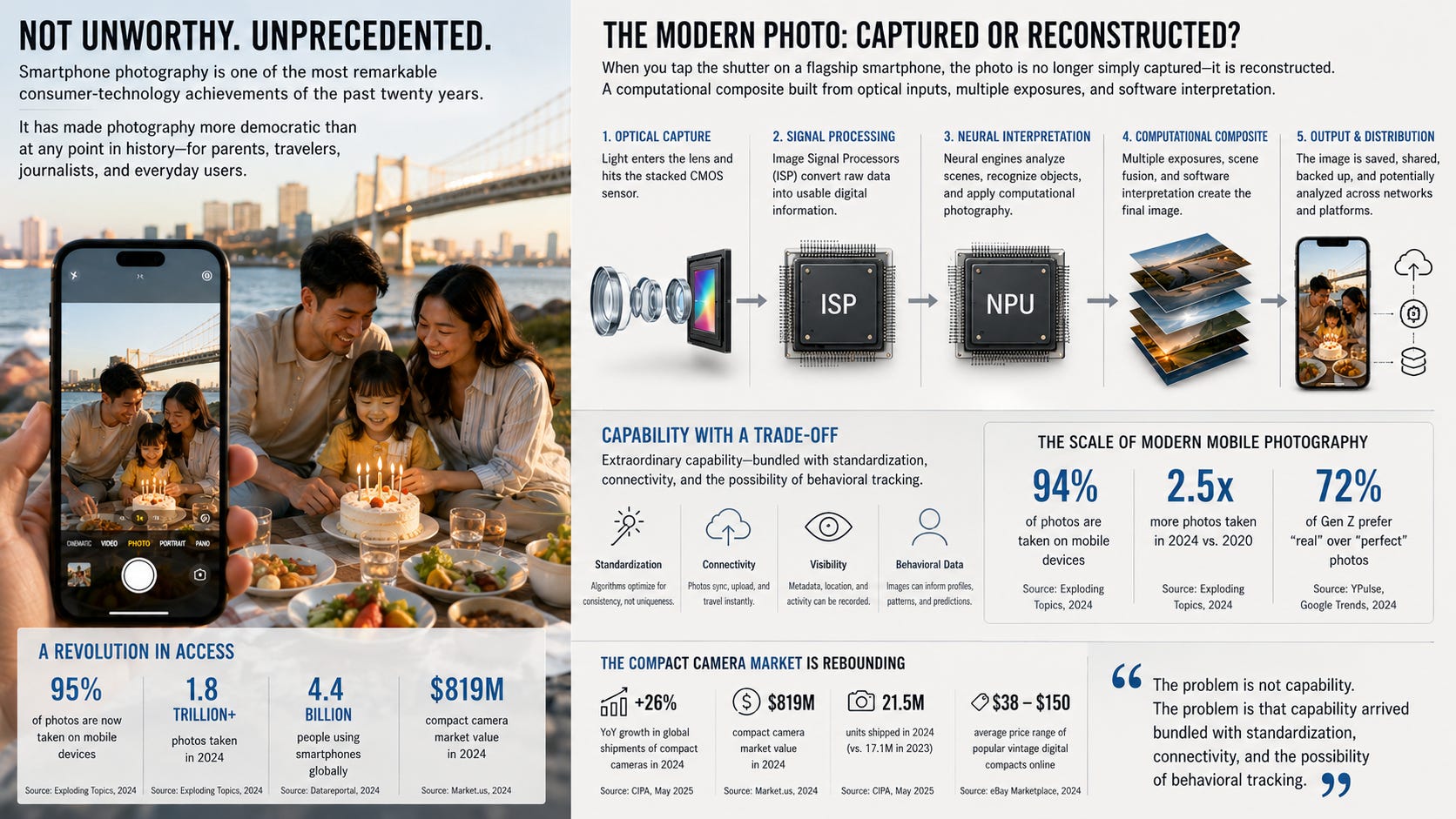
When a user taps the shutter button on a flagship mobile device, the photograph is no longer simply captured; it is reconstructed. The small physical lens system transfers optical information to a stacked CMOS sensor, where image-signal processors and neural engines begin interpreting the data. The image becomes a computational composite built from optical inputs, multiple exposures, and software interpretation.
The imaging pipeline draws on models trained to recognize and optimize common scenes. It identifies the human faces within the frame, may smooth skin texture, shifts the balance of the sky toward a standardized blue hue, and applies predictive contrast adjustments to shadows. The software eliminates the unexpected glare, the dark shadow, and the soft lens flare to enforce an aesthetic consistency where different environments begin to share a recognizable texture.
Critics of computational photography argue that this process produces a subtle form of visual standardization. Colors become more predictable. Shadows become less dramatic. Imperfections disappear. The photograph becomes easier to consume, and sometimes less interesting to remember.
Photography Is No Craft Any More? –What Automation And Computational Is Doing To Photography?
The Fingerprints of the Machine
When light hits the older charge-coupled device (CCD) sensor of a mid-2000s compact camera, the information is processed by basic, fixed firmware. There are no predictive neural networks or cloud-connected upscaling scripts to manage the file. Instead, the machine records what it can and leaves its technical limitations fully exposed.
The appeal lies in the flaw pattern. Fluorescent rooms go sickly green. Highlights rupture into white. Flash turns a party into evidence. The camera does not rescue the scene from itself. It leaves the failure visible. The compact old camera leaves its fingerprints on the image, and for younger generations raised in an era of relentless software correction, those flaws feel authentic.
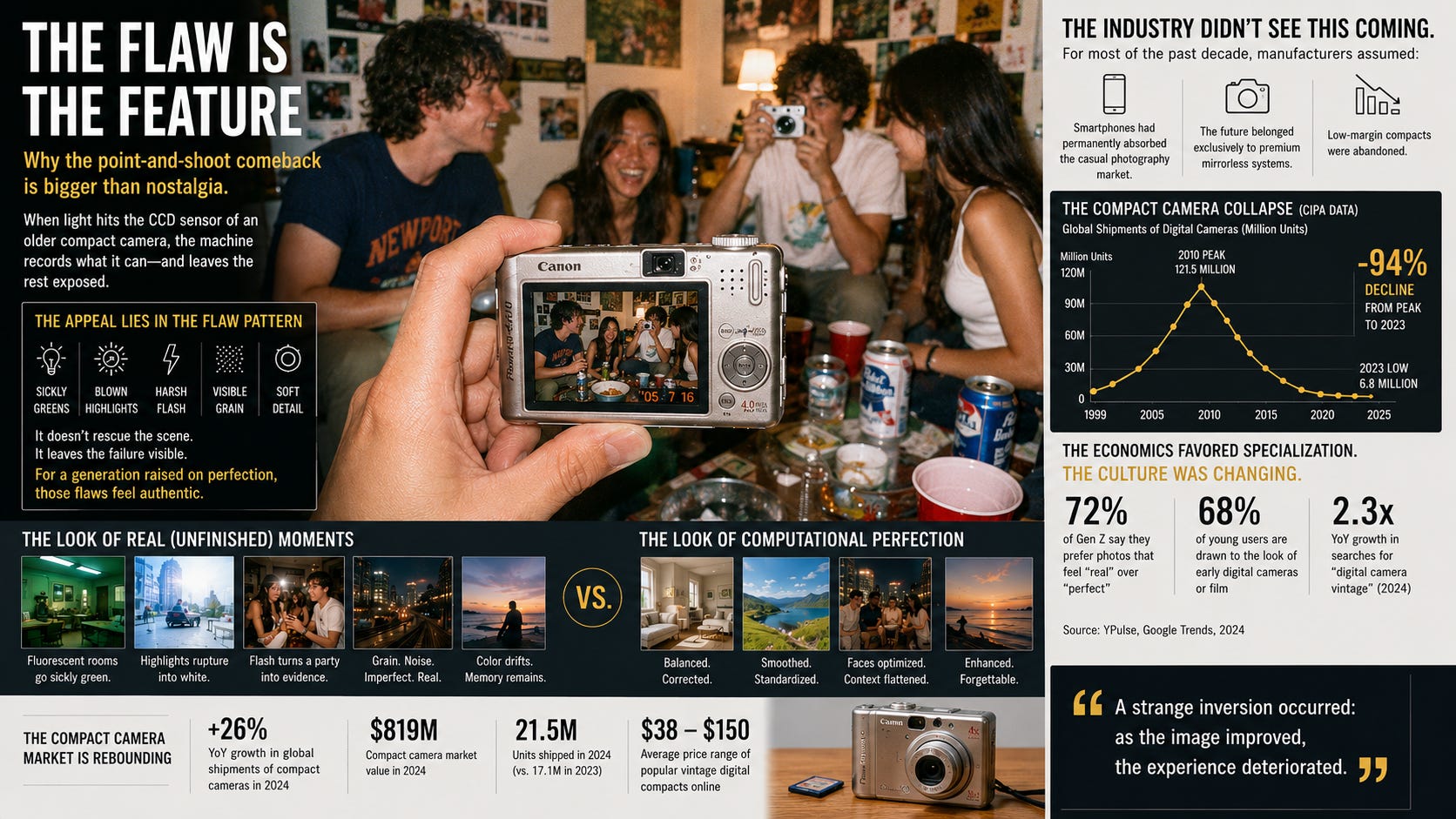
The industry did not see this shift coming. For most of the past decade, major camera manufacturers operated under a shared assumption: smartphones had permanently absorbed the casual photography market, and the future belonged exclusively to premium mirrorless systems. Manufacturers responded by abandoning low-margin consumer compacts and concentrating on enthusiast and professional equipment.
The economics favored specialization. The culture, however, was changing in a different direction.
As mobile device photography became more capable, many users stopped viewing technical quality as the primary objective. A strange inversion occurred: as the image improved, the experience deteriorated.
The industry kept solving for better images. But the market was beginning to reveal a different hunger: not for worse cameras, but for a less mediated act of seeing. The real divide is not between old cameras and new cameras. It is between technologies designed to preserve experience and those designed to accelerate distribution. Photography gradually shifted from memory creation toward content production, and images became less likely to live in family albums and more likely to enter feeds, stories, recommendation systems, and engagement loops.
The camera evolved into part of a larger technical ecosystem. The manufacturers did not simply miss a trend. They optimized their businesses for the post-smartphone market and then watched as the culture asked for something their new cost structures were poorly built to supply.
The Layers of the Captured Image
To understand how the modern photograph was captured by this system, one must separate the transition into four distinct structural layers that are often blended together in cultural analysis.
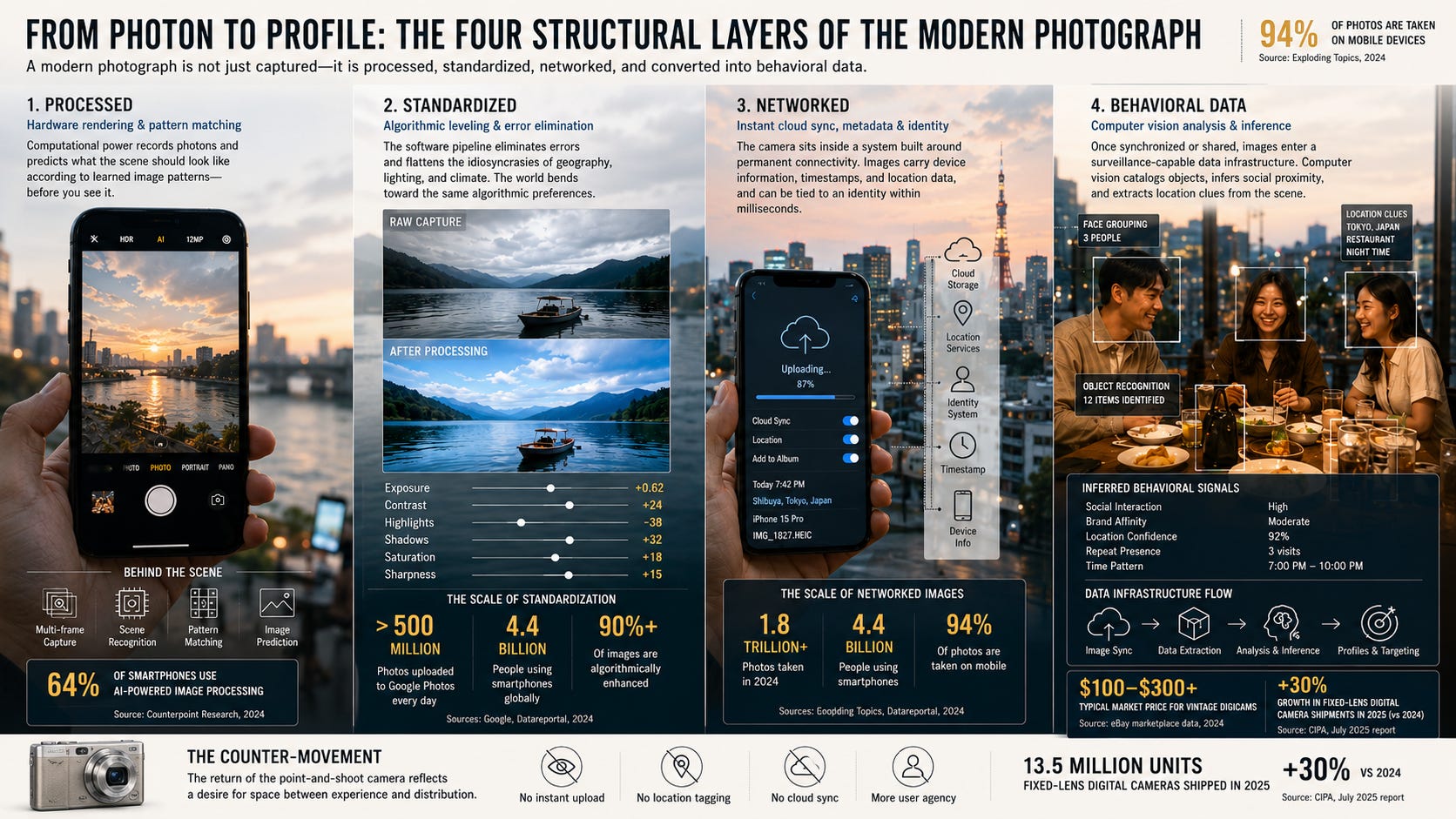
First, the image is processed. The calculation happens at the hardware level before the human eye even sees the file on the screen. The device uses computational power not just to record photons but to predict what the scene should look like according to learned image patterns.
Second, the image is standardized. Because the software pipeline is tuned to eliminate errors, it flattens the specific idiosyncrasies of geography, lighting, and climate. The visual language of the world begins to bend toward the same algorithmic preferences.
Third, the image is networked. The modern device camera sits inside a system built around permanent connectivity. Location services, automatic cloud synchronization, and background transmission turn the device into an active node. The image may include device information, a timestamp, and, when location services are enabled, geographic data. If it syncs to a cloud account, it can also become tied to an identity system within milliseconds of creation.
Fourth, the image becomes behavioral data. When these files synchronize or share across platforms, they enter a surveillance-capable data infrastructure. Computer vision programs process the visual content to catalog consumer products visible on a table, infer social proximity through face grouping, tagging, or repeated co-presence, and add location clues from landmarks, architecture, signage, and background context.
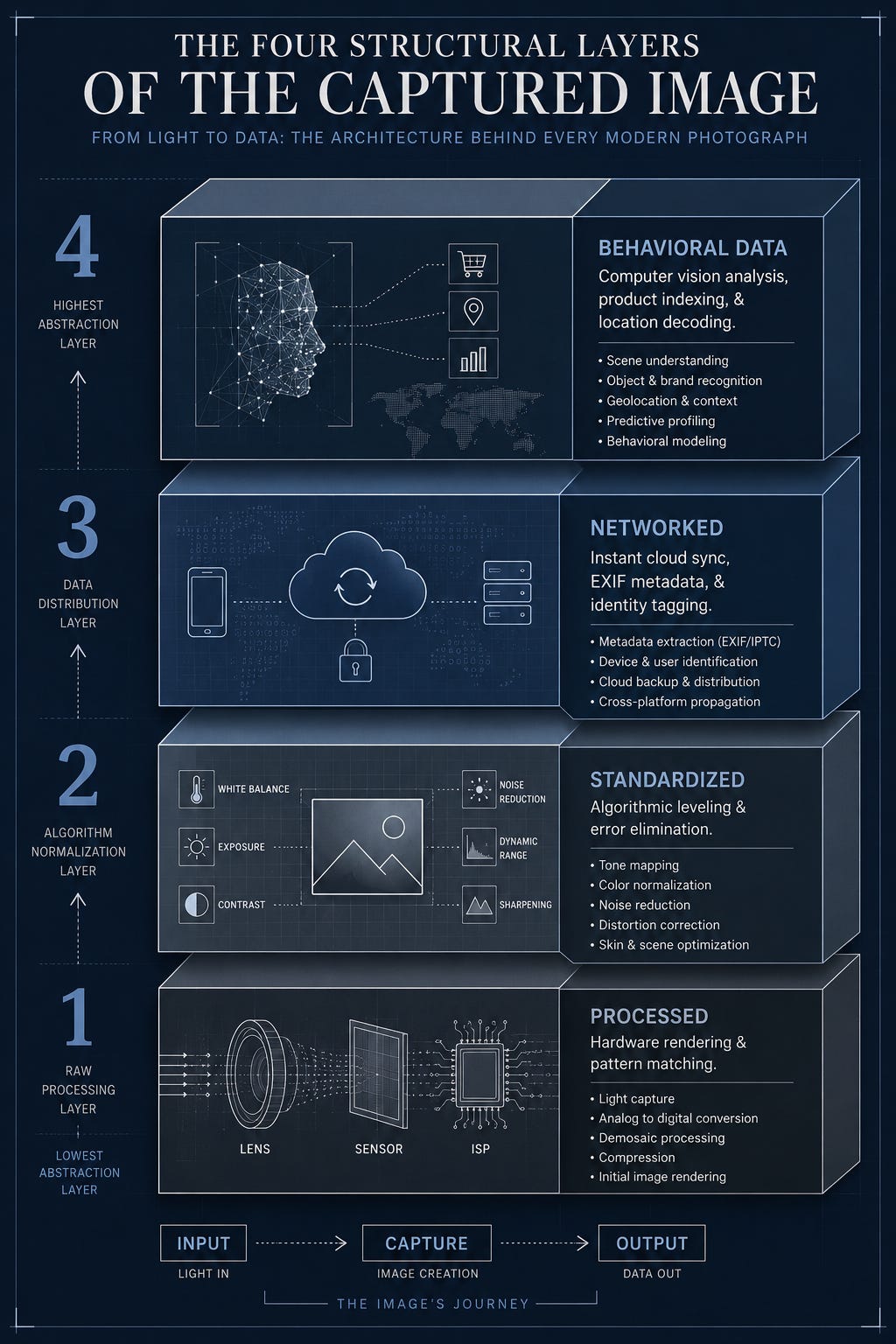
The photograph has become more than just a photo. It has become a data object.
The Protection of Friction
Many communication technologies create their own counter-movements. The faster newspapers became, the more valuable books became. The faster television became, the more valuable long-form cinema became. The faster digital communication became, the more valuable slowness became. This point-and-shoot revival is not nostalgia for old technology. It is nostalgia for the space between experience and distribution.
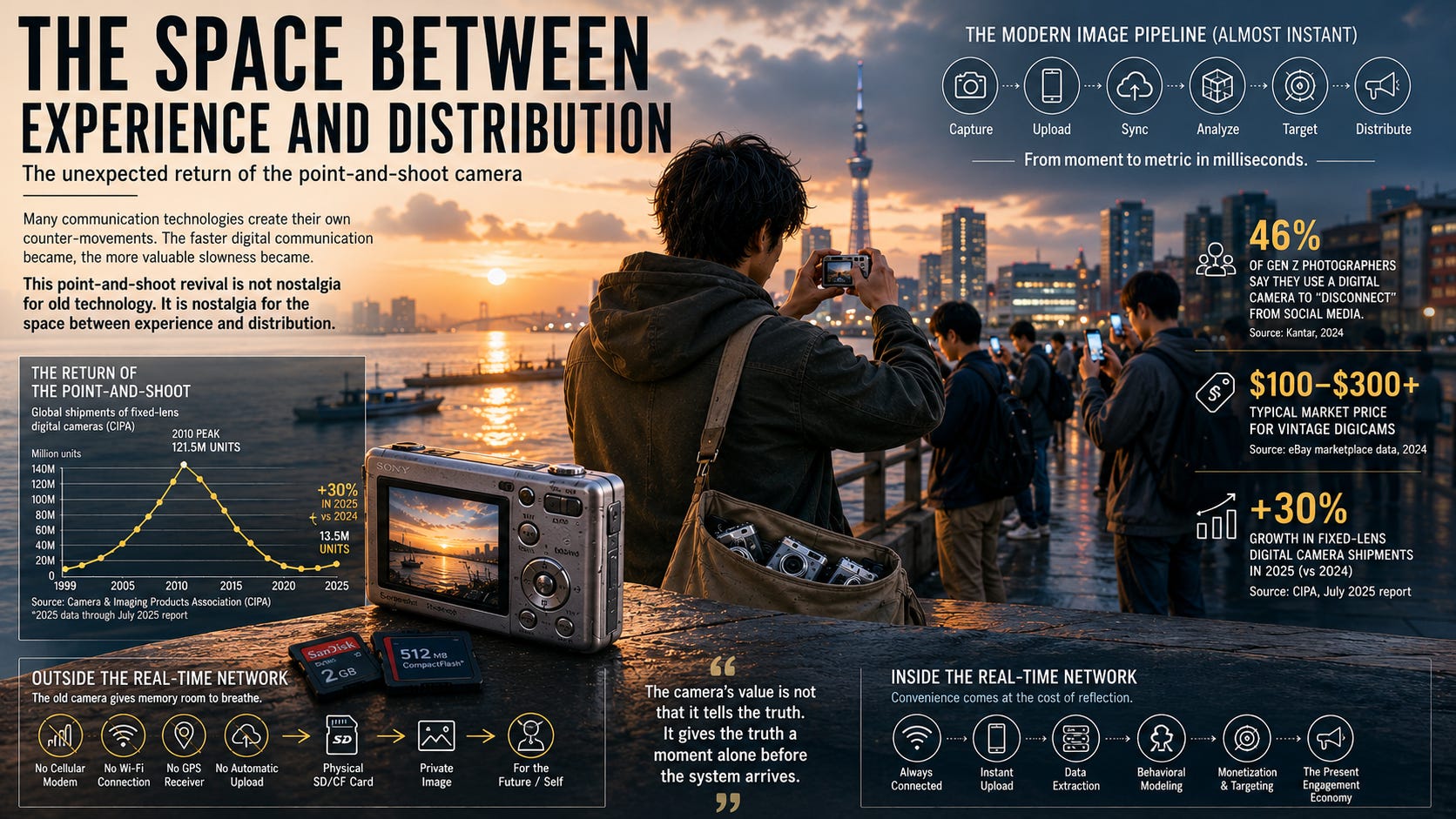
An older compact digital camera begins outside the real-time network. It does not possess a cellular modem, a Wi-Fi card, or a localized GPS receiver. The file it generates is a comparatively raw asset: a basic arrangement of pixels saved onto a physical Secure Digital or CompactFlash memory card. This distance matters, not because it guarantees absolute privacy, but because it restores user agency.
The appeal of the old camera is procedural rather than political. It introduces friction into a world that treats smoothness as an absolute virtue. Photographs remain trapped on memory cards until someone deliberately transfers them. Sharing requires intention, and the image exists privately before it becomes public. This delay changes the psychological experience of photography; the moment is captured first, and the audience arrives later.
The missing interval is the story. For most of photographic history, a gap existed between the moment and the audience. Film had to be developed. Prints had to be made. Albums had to be assembled. Even early digital cameras imposed a delay. The smartphone collapsed in that interval. The image now enters circulation almost simultaneously with its creation. Something was gained in convenience. Something was lost in reflection. The camera’s value is not that it tells the truth. It is that it offers the truth a moment alone before the system arrives.
I Used a 20 Year Old Camera for 14 Days
There is a danger in romanticizing inferior technology. Old cameras were not morally purer. They were cheaper, slower, less capable, and often annoying. Some produced terrible images. Some recorded basic metadata details like timestamps, camera models, and exposure settings. Of course, many of the same people buying these old digital compacts still post the images to Instagram a few hours later. That misses the point. The value is not where the image ends up. The value is that the image takes a different route to get there. The point is not purity; the point is distance.
The old camera does not offer a total escape from the digital network, but it creates a vital gap in the real-time tracking loops. The snapshot taken on a twenty-year-old device at a weekend party is less immediately available to systems that shape recommendations, targeting, and behavioral models. It remains an offline asset until the user decides to extract it.
The Simplicity of the Shutter
Most photographs throughout human history were taken for the future. They were messages sent to an older version of us. Increasingly, photographs are taken for the present. They are optimized for immediate reaction rather than long-term remembrance.
Back inside the Chiba recycling warehouse, Ren pulls a silver camera from the bin. It is a Sony Cyber-shot DSC-W5, released in 2005. Its brushed aluminum casing is scarred from a life its next owner will never know, and the rubber terminal cover for the USB port has rotted away, leaving an open copper port. He inserts a pair of AA batteries into the base handle and presses the power switch.
The lens barrel extends with a metallic sound. The small, low-resolution screen on the back illuminates, displaying a date prompt set to January 1, 2005. There is no user agreement to sign, no firmware updates to download over an infrastructure network, and no telemetry data transmission checkboxes to clear. The screen flickers awake, the display is dim, and the camera simply waits.
Ready to record light.
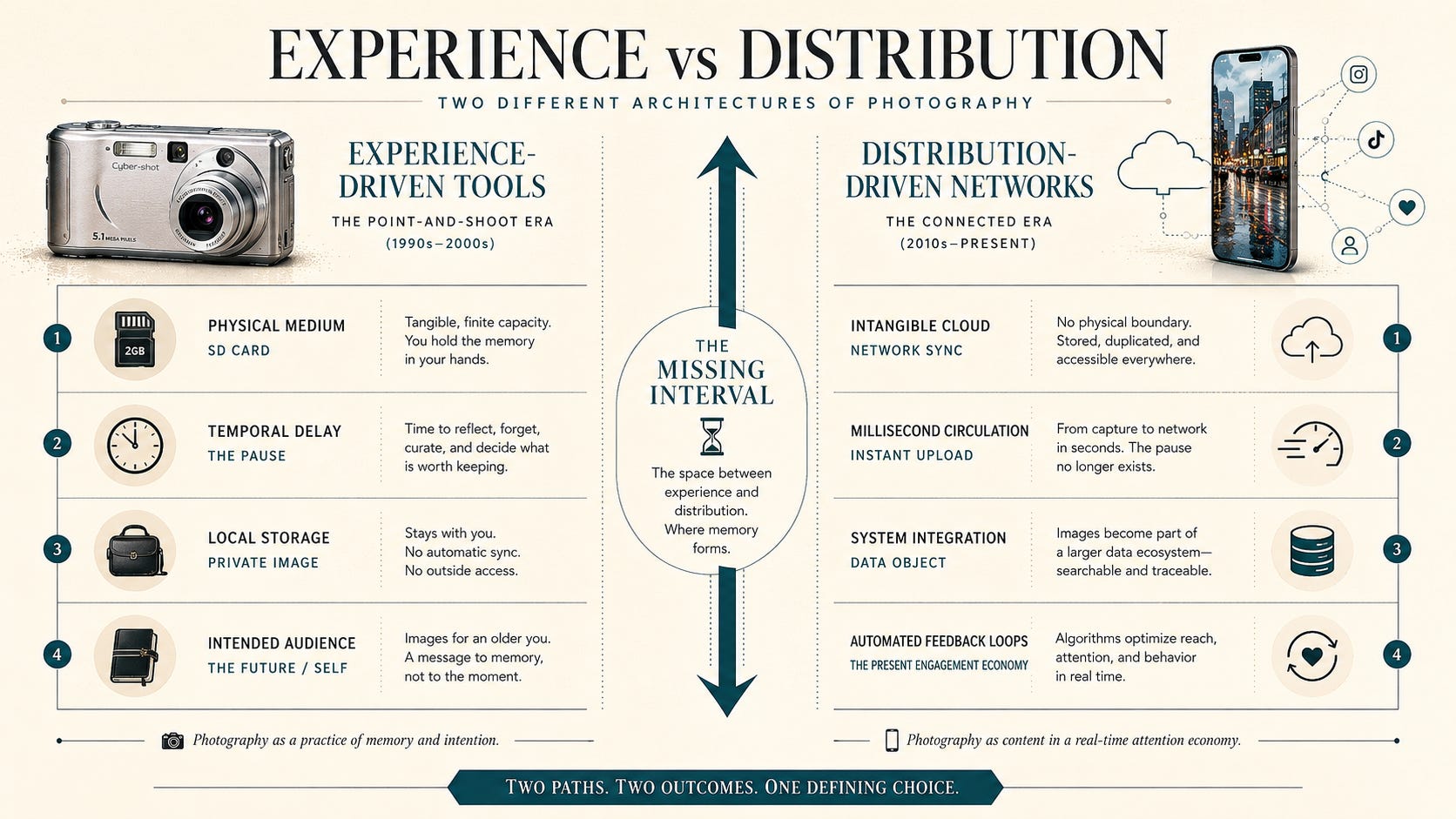
That simplicity is becoming surprisingly valuable. The unexpected return of the point-and-shoot camera suggests a broader truth about our relationship with modern tools: human beings do not always want the most efficient version of an experience. Occasionally they want evidence that a machine did not completely finish the job. The old camera’s value is not that it tells the truth. It is that it gives the truth a moment alone before the system arrives.
Ren exits the warehouse as the evening rain begins to fall on the shipping containers lined up along Tokyo Bay. He carries his bag of unlinked, offline compact cameras through the security gate, stepping into the damp twilight. Around him, thousands of commuters are holding smartphones to the gray sky, using devices already correcting the color, sorting the faces, recording the location, and preparing the image for the network before the memory has even settled.
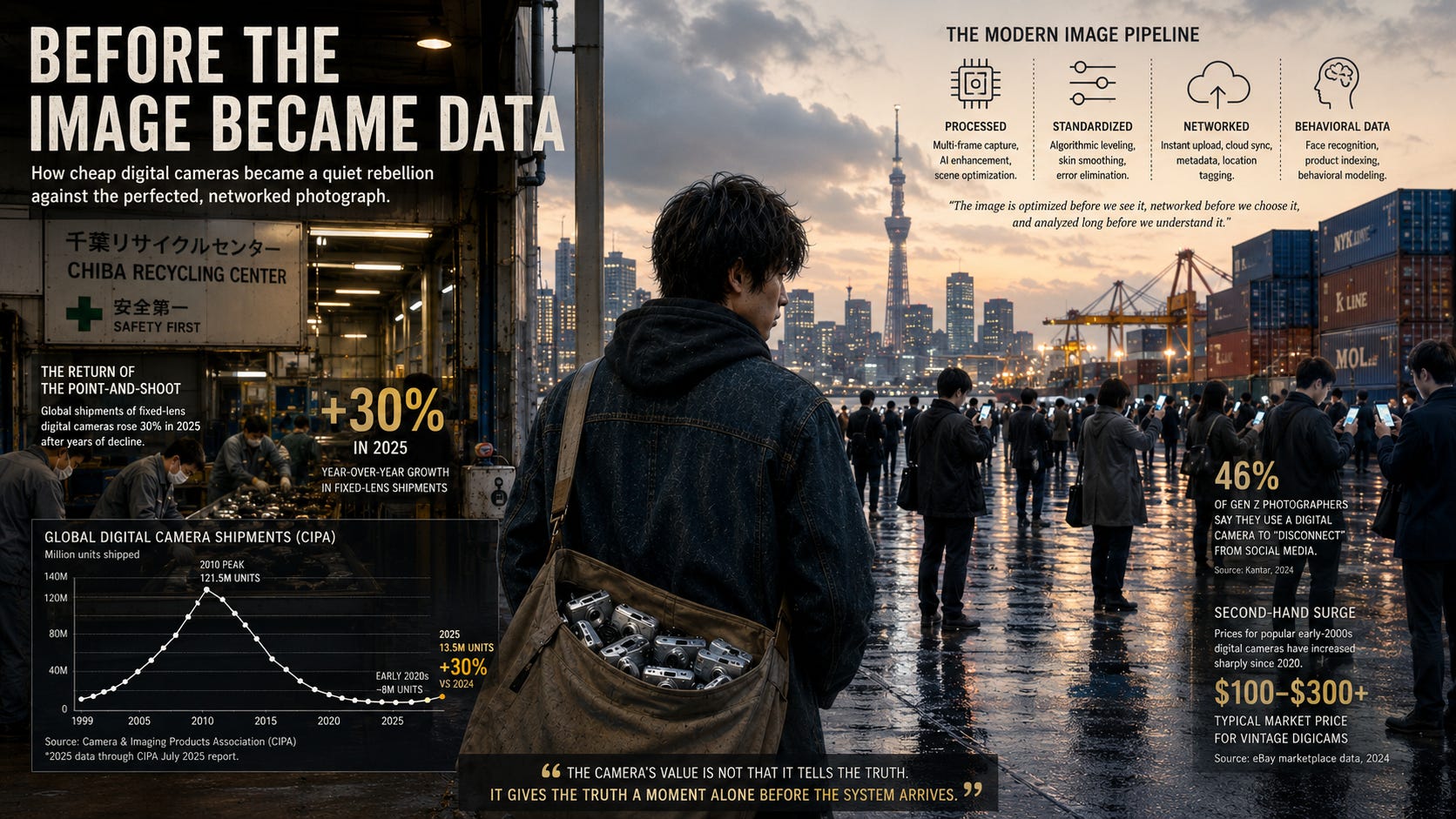
His cameras remain silent inside the canvas pack. Dark. Disconnected. Waiting for someone to pick them up and look through an unguided lens at a world not yet processed by a machine.