

Measuring the Unmeasurable
Why the State’s Most Sophisticated Systems Fail the Living World

How the modern obsession with legibility turns ecology into accounting, and why survival depends on building a humbler infrastructure.
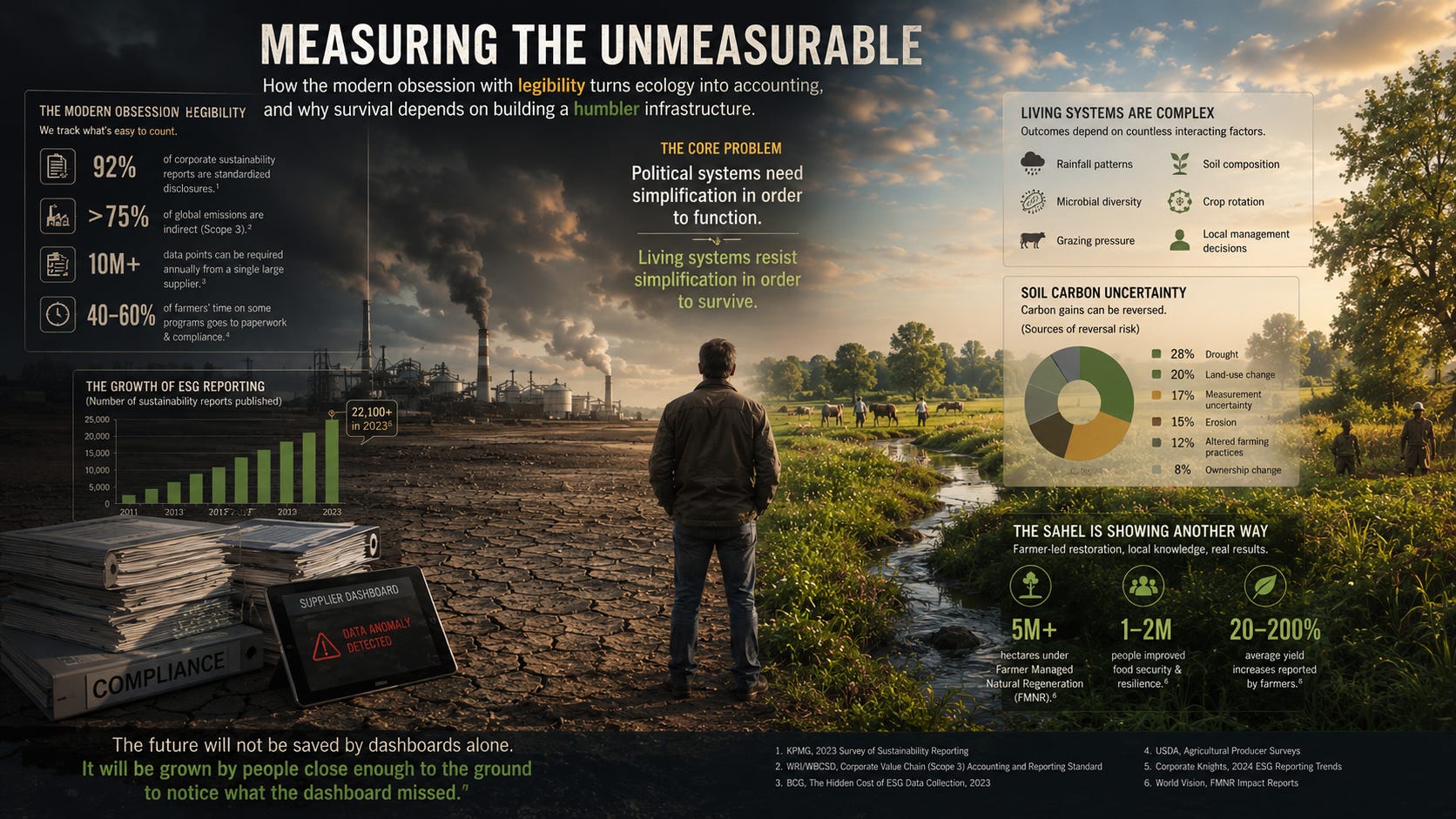
In 1935, the United States government launched one of the largest environmental interventions in modern history. The Dust Bowl had turned millions of acres of farmland into an airborne catastrophe. Entire towns across the Great Plains watched their topsoil lift into the sky. Black blizzards rolled across Oklahoma, Kansas, Colorado, and Texas with such force that people stuffed wet towels beneath their doors to keep from choking in their sleep.
Washington responded the only way a modern state could. It built institutions.
The Soil Conservation Service was created that same year. Experts were dispatched into farming communities. Contour plowing was promoted. Windbreaks were planted. Rotational practices were encouraged. Over time, federal conservation programs expanded into an enormous administrative ecosystem of subsidies, technical assistance, compliance frameworks, and land management incentives.
Some of it worked remarkably well. Erosion declined in many regions. Shelterbelts helped stabilize vulnerable land. Irrigation projects stabilized agricultural production across huge stretches of the country. Conservation became a permanent, productive feature of American agricultural policy.
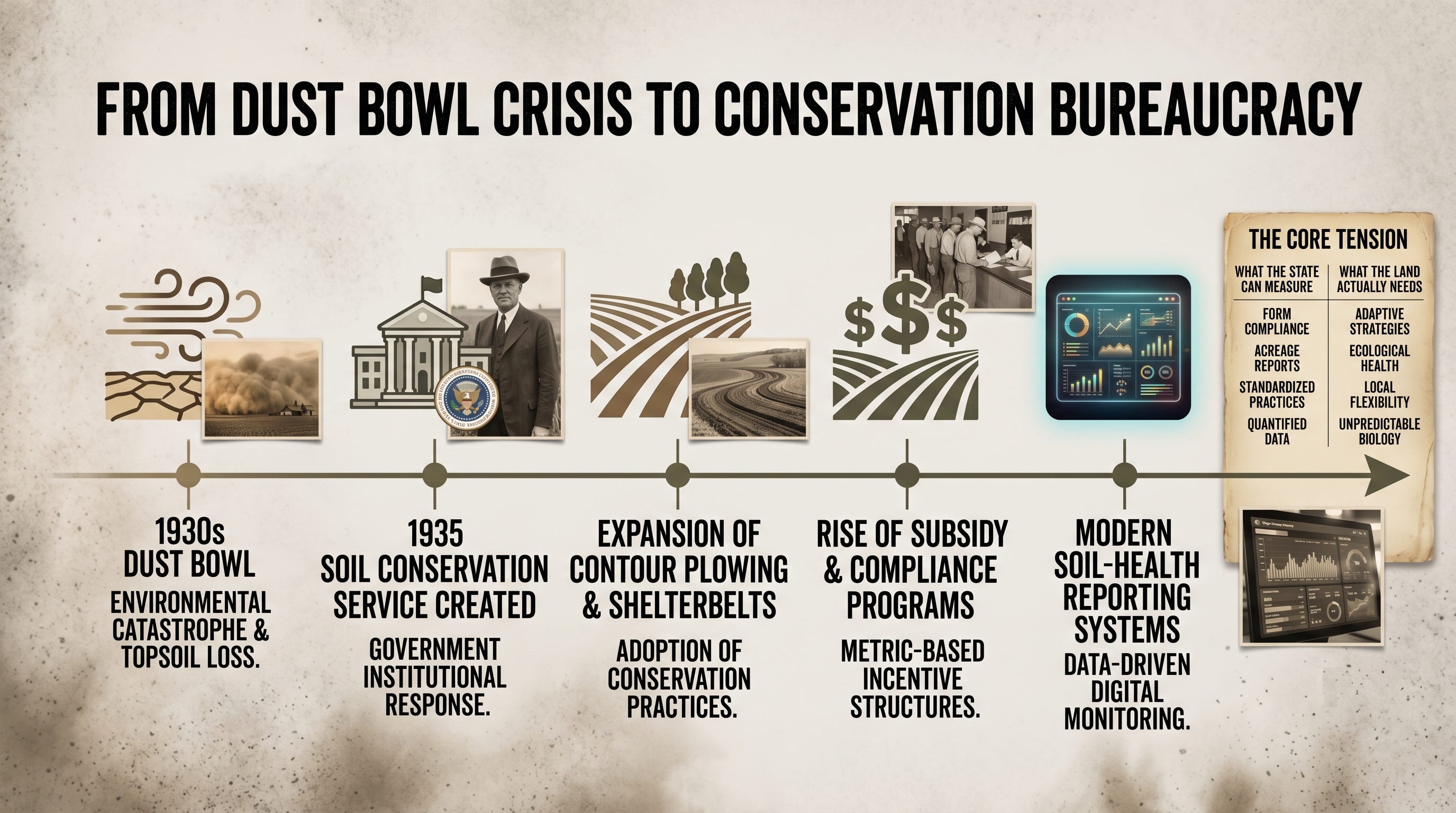
But hidden inside that success was a quieter pattern that has only become more visible with time. The larger the system grew, the more the institution itself began shaping the behavior it was trying to measure.
Farmers learned how to optimize for compliance. Consultants emerged to navigate subsidy structures. Conservation increasingly became something documented through forms, acreage reports, and approved practices. And while many farms genuinely improved, others learned a different lesson: if the metric determines the reward, the metric eventually becomes the goal.
That tension now sits at the center of nearly every major institutional system in modern life. Schools optimize around standardized testing and quietly erode curiosity. Hospitals optimize around billing architecture and bury doctors beneath administrative work. Corporations optimize around quarterly earnings and quietly sacrifice long-term resilience. Governments optimize around measurable compliance and struggle to detect deterioration that cannot be easily quantified.
We have built a civilization that is extraordinarily sophisticated at measurement. What we are much less sophisticated at is distinguishing measurement from reality.
The political scientist James C. Scott warned about this decades ago in his landmark book Seeing Like a State. Large institutions, he argued, survive by simplifying the world into categories they can administratively process. Forests become timber inventories. Citizens become census units. Farms become production statistics.
James C. Scott on The Perils of State Power
The simplification is not stupidity. It is necessity. No government can manage hundreds of millions of people through intuition alone. But every system of simplification creates blindness at the edges. And the more complex the environment becomes, the more dangerous that blindness gets.
The Illusion of Legibility
You can see this tension unfolding right now in the global obsession with regenerative agriculture. Over the last decade, regenerative farming has evolved from a fringe ecological movement into a corporate and political phenomenon. Food giants including Cargill, Nestlé, and General Mills have all announced major commitments tied to soil health, carbon reduction, and regenerative supply chains.
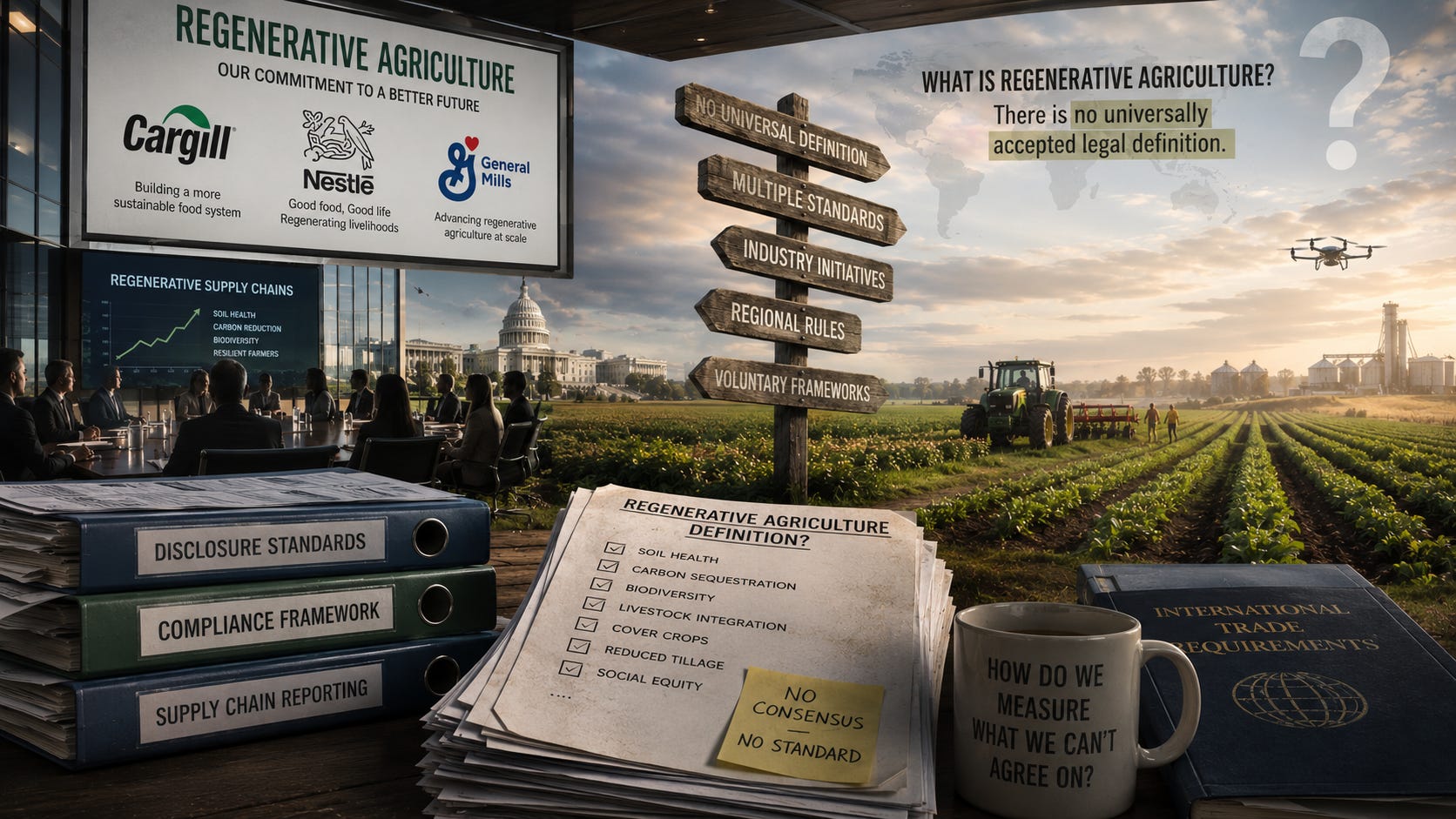
At the same time, governments and industry groups have struggled with a surprisingly basic question: what exactly qualifies as regenerative agriculture? There is still no universally accepted legal definition.
That ambiguity creates a profound institutional problem. Modern bureaucracies require categories. Investors require disclosure standards. Regulators require compliance structures. International trade requires definitions. Without standardized language, large systems cannot coordinate behavior at scale.
So the system naturally gravitates toward what it can count. Did the farmer reduce tillage? Did they plant cover crops? Did they maintain continuous ground cover?
Those are measurable actions. They fit inside software systems. They can be audited, standardized, and scaled.
But biology does not operate through administrative categories. Two farms can implement the exact same checklist and produce completely different ecological outcomes depending on rainfall patterns, microbial diversity, grazing pressure, soil composition, crop rotation, and local management decisions accumulated over decades. Living systems are shaped by interaction effects that spreadsheets struggle to capture.
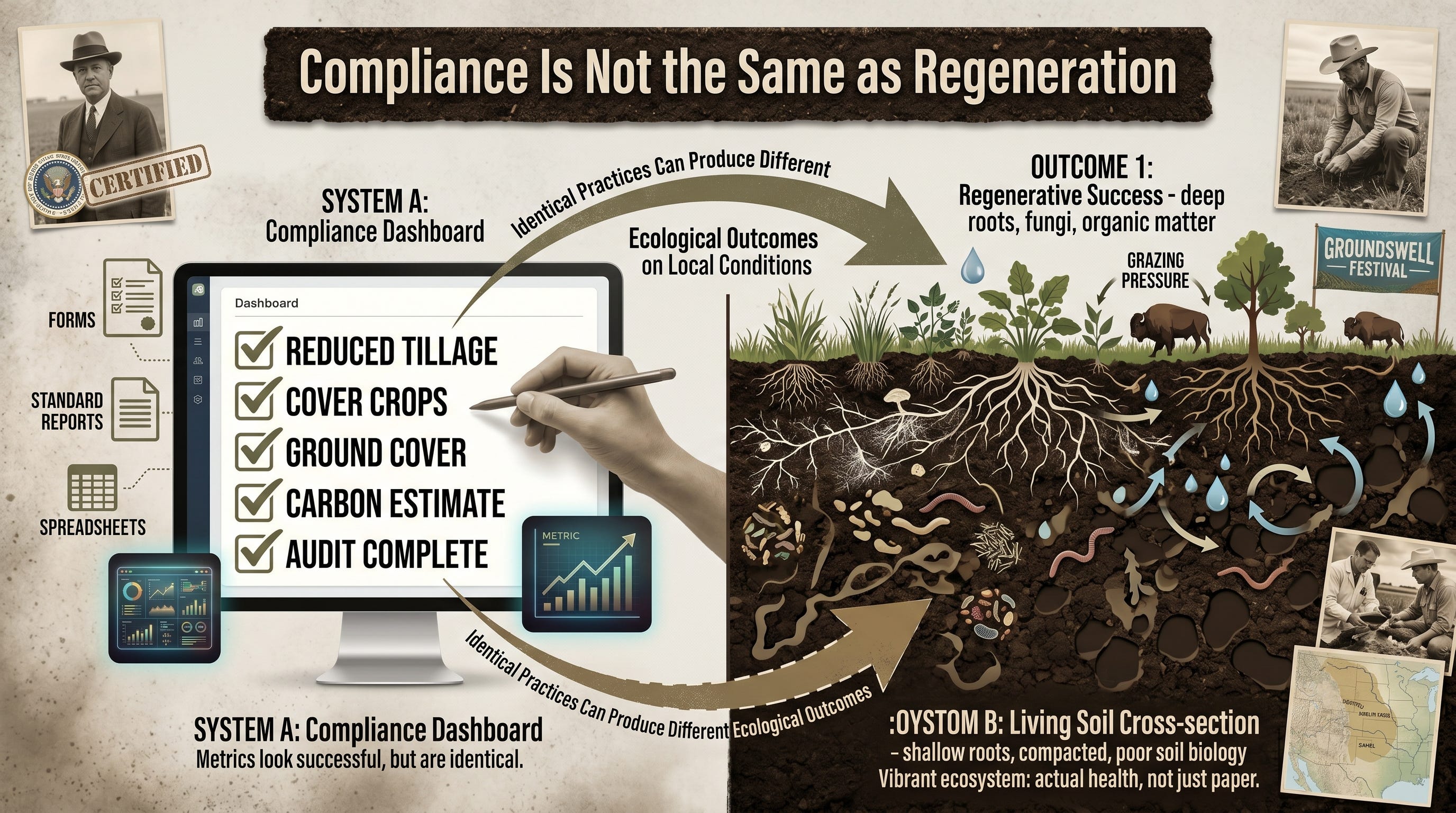
That is where the modern institutional crisis begins. Once a metric becomes tied to money, regulation, or prestige, people inevitably begin optimizing around the metric itself.
The phenomenon appears everywhere. Teachers teach to the test. Police departments optimize around arrest statistics. Social platforms optimize around engagement even when engagement corrodes public trust. And agricultural systems optimize around sustainability reporting that may or may not reflect biological reality underneath the soil.
The problem is not measurement. The problem begins when institutions mistake legibility for truth.
When Sustainability Becomes Accounting
That distinction matters because biological systems are not machines. They are adaptive networks.
Over the last several years, corporations have increasingly focused on Scope 3 emissions, the indirect emissions embedded across their supply chains. Investors want cleaner reporting. Regulators want transparency. Consumers want proof that environmental commitments are real.
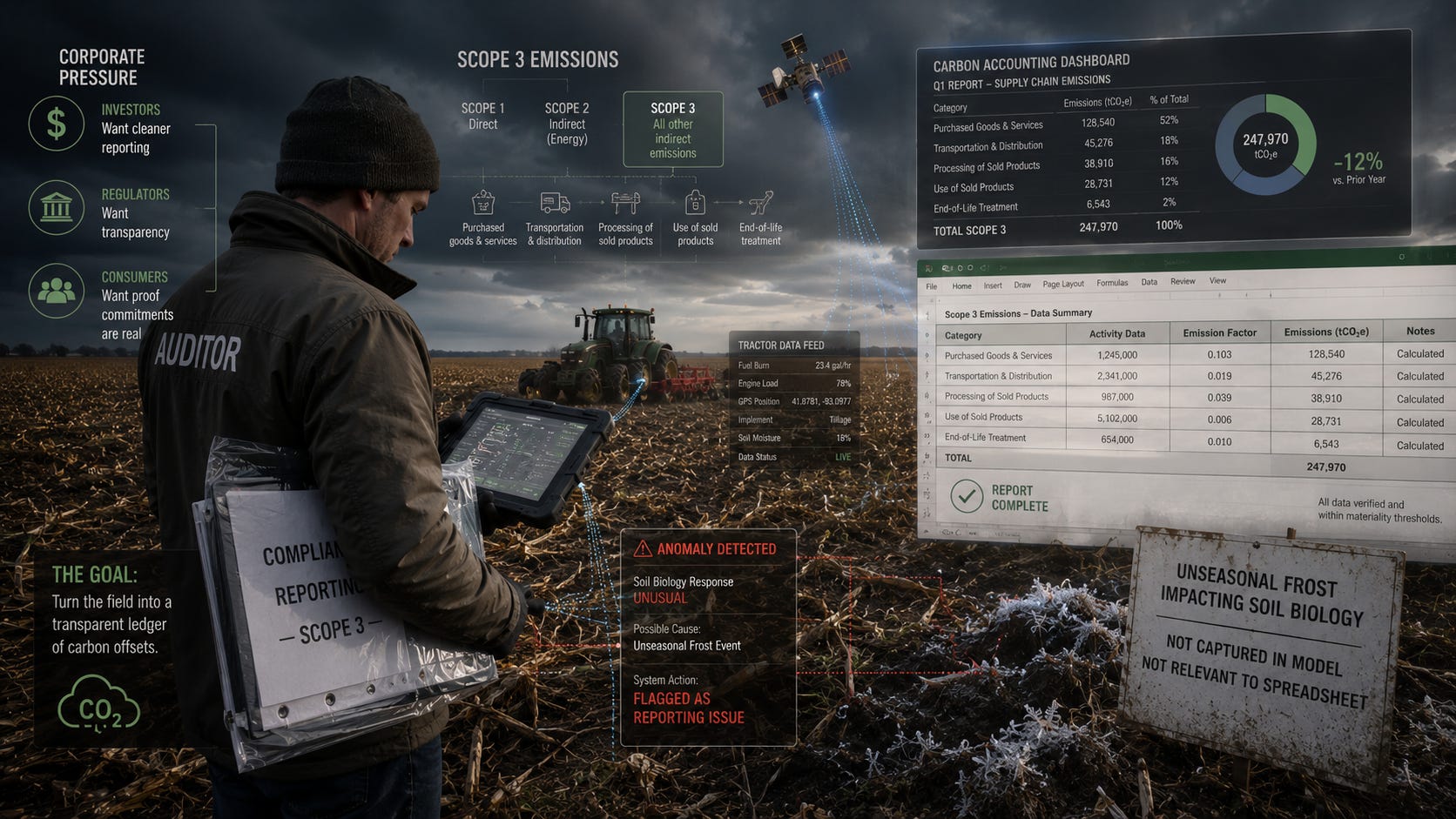
Again, the intention is understandable. But translating ecological complexity into global accounting systems creates strange distortions.
Picture an auditor standing in an open field in Iowa, carrying a heavy three-ring compliance binder wrapped in plastic to protect it from the wind, trying to cross-reference satellite imagery on a ruggedized tablet with digital data logs beamed from automated tractor sensors. The technology is designed to turn the field into a transparent ledger of carbon offsets. But if the soil biology behaves erratically due to an unseasonal frost, the system treats the anomaly as a reporting problem. The reality on the ground is filtered out to satisfy the formatting demands of a spreadsheet thousands of miles away.
Large suppliers with sophisticated compliance departments gain advantages from this rigidity. Smaller producers often face growing administrative burdens. Farmers are increasingly asked to upload data, satisfy certification software, and document land management practices in ways designed primarily for institutional visibility.
The irony is difficult to ignore. Systems intended to decentralize environmental responsibility frequently end up consolidating power into the hands of organizations large enough to manage the bureaucracy.
Peer Networks vs. Universal Templates
Meanwhile, some of the most instructive land restoration efforts in the world remain deeply resistant to standardization.
Across parts of the Sahel region in Africa, locally adapted agroecological movements have restored degraded land through farmer-led experimentation, regional knowledge sharing, and water retention techniques tailored to specific environmental conditions. In northern Burkina Faso and parts of Niger, networks of local growers have used traditional zaï pits, small hand-dug holes filled with organic matter, and Managed Natural Regeneration of native trees to reclaim thousands of hectares of desertified soil.
FMNR: Everything is Connected
Organizations such as Groundswell International have supported these efforts by emphasizing peer learning and local experimentation rather than rigid, imported templates. Some projects transformed degraded land. Others quietly failed. But the larger lesson matters more than any individual outcome. Complex environments require forms of intelligence that cannot be fully centralized in advance.
Political systems need simplification in order to function.
Living systems resist simplification in order to survive.
This basic conflict becomes acute when bureaucracies attempt to turn fluid environmental processes into liquid financial commodities. You can see the collision clearly in the growing enthusiasm surrounding soil carbon markets.
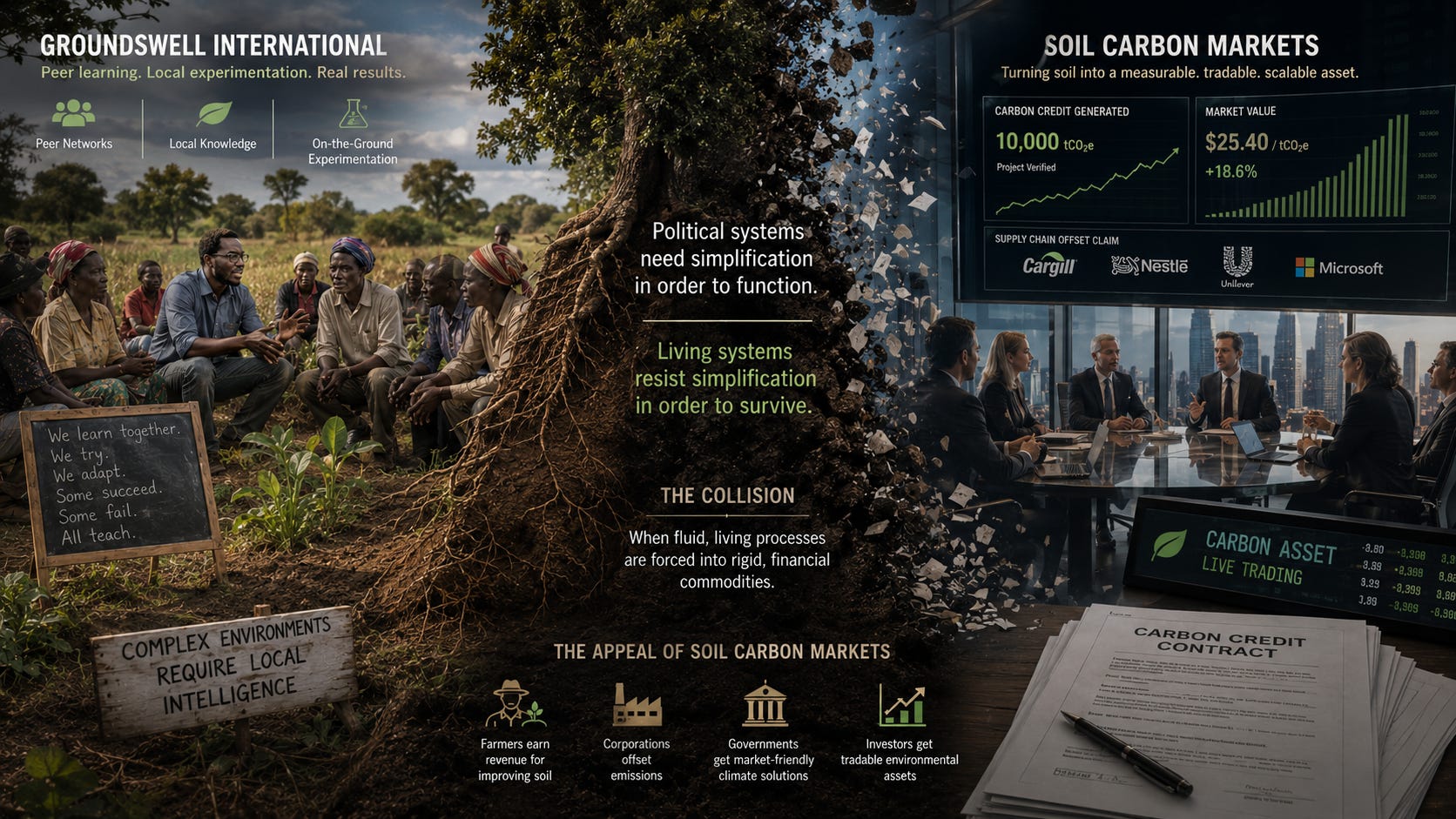
The idea is politically irresistible. If carbon stored in soil can be accurately measured, then farmers could potentially earn revenue for improving land management while corporations offset emissions through carbon purchases. Governments get a market-friendly climate solution. Corporations get measurable sustainability targets. Investors get tradable environmental assets.
It is elegant. Reality is less cooperative.
Scientists continue debating how stable, measurable, and permanent soil carbon storage actually is across different climates and management systems. Carbon gains can reverse through drought, land-use change, erosion, or altered farming practices. Measurement remains expensive and inconsistent. Even advocates of regenerative grazing frequently disagree over how scalable or climatically significant the long-term benefits truly are.
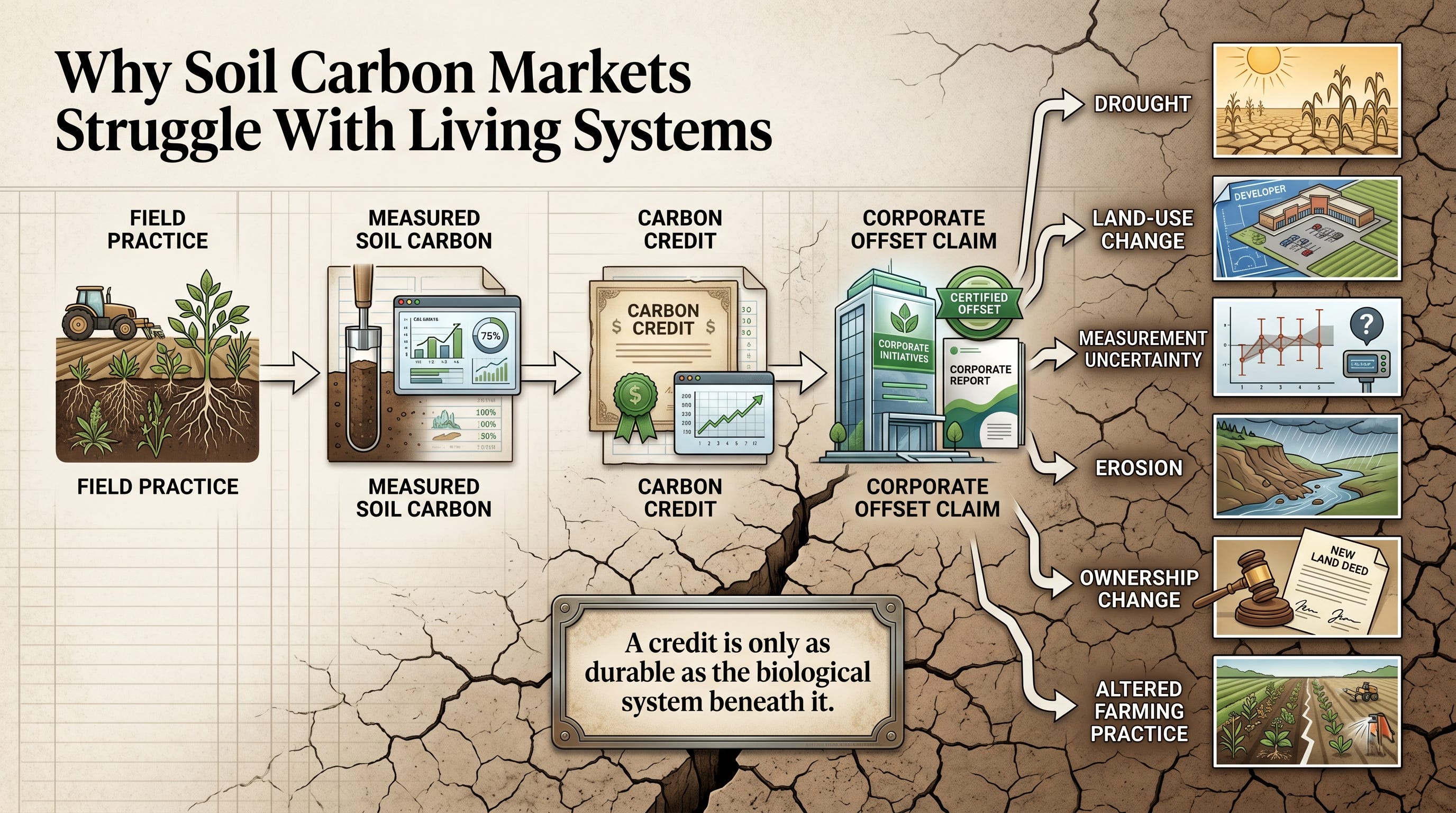
The deeper problem is philosophical. Modern institutions are extraordinarily attracted to solutions that can be converted into accounting systems. What they struggle with are realities that remain stubbornly alive.
Cultural Narrative vs. Bureaucratic Translation
This disconnect explains why even the most potent cultural movements lose momentum when they enter the administrative pipeline. Over the past decade, influential environmental documentaries, including Kiss the Ground and Common Ground, have succeeded in shifting public awareness by treating soil not as an industrial input, but as a complex biological community. This storytelling injected immense energy into the climate conversation and captured the imagination of consumers and policymakers alike.
Common Ground documentary - Official Trailer
Yet, when that raw cultural energy collides with the reality of the political apparatus, it undergoes a predictable translation. To scale the concept, institutions strip away the localized nuance and systemic complexity featured in the narratives.
A holistic vision is flattened into a sanitized corporate tax credit or a marketing label. The political system naturally favors solutions that are legible from a distance, even if that legibility comes at the expense of the deeper transformation the movement originally sought to achieve.
The Strength of the Unregulated Margin
That may explain why some of the most interesting conversations around resilience are increasingly happening outside formal institutions altogether.
Events such as the annual Groundswell festival in the United Kingdom have become an unlikely nexus for dissent. Farmers, ecologists, policymakers, investors, soil scientists, and critics all collide in the same physical space. Some attendees believe regenerative agriculture can help transform food systems. Others believe parts of the movement are oversold. Some advocate high technology. Others reject industrial agriculture almost entirely.
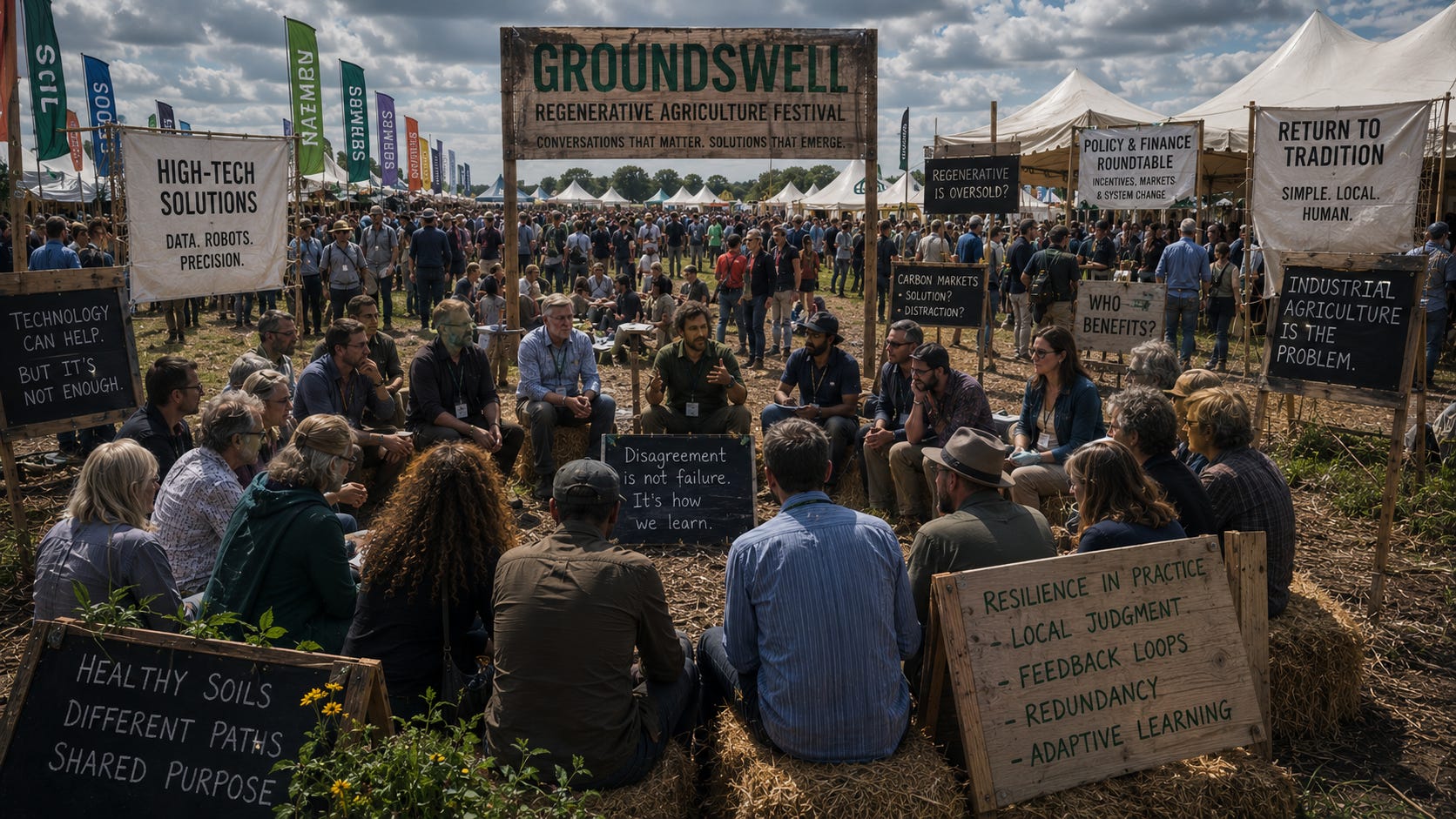
The disagreement is part of the value. Healthy adaptive systems rarely look tidy from the outside.
Spend enough time around resilient communities and one thing becomes obvious very quickly: they often contain far more contradiction than modern institutions are comfortable tolerating. They rely on local judgment. They evolve through feedback. They preserve redundancy. They adapt faster than centralized systems can update the manual.
From the perspective of a spreadsheet, that messiness can appear inefficient. From the perspective of survival, it can be essential.
This is the great blind spot of the modern age. We assumed that the world would become more manageable as our systems became more sophisticated. Instead, many of our systems became so optimized for administrative visibility that they lost sensitivity to the realities unfolding underneath the dashboard.
A field can satisfy every compliance target while quietly losing biological resilience. A hospital can hit efficiency metrics while burning out its physicians. A school can improve testing performance while producing disengaged students. A society can become flooded with data and still fail to understand itself.
The danger is not bureaucracy itself. The danger is forgetting that every model eventually becomes incomplete. Civilizations survive when they preserve enough humility to notice what their metrics cannot see.
Why Large Systems Need Friction
For leaders trying to steer large organizations through this landscape, the challenge is not how to get rid of charts or data points, but how to stop them from becoming traps.
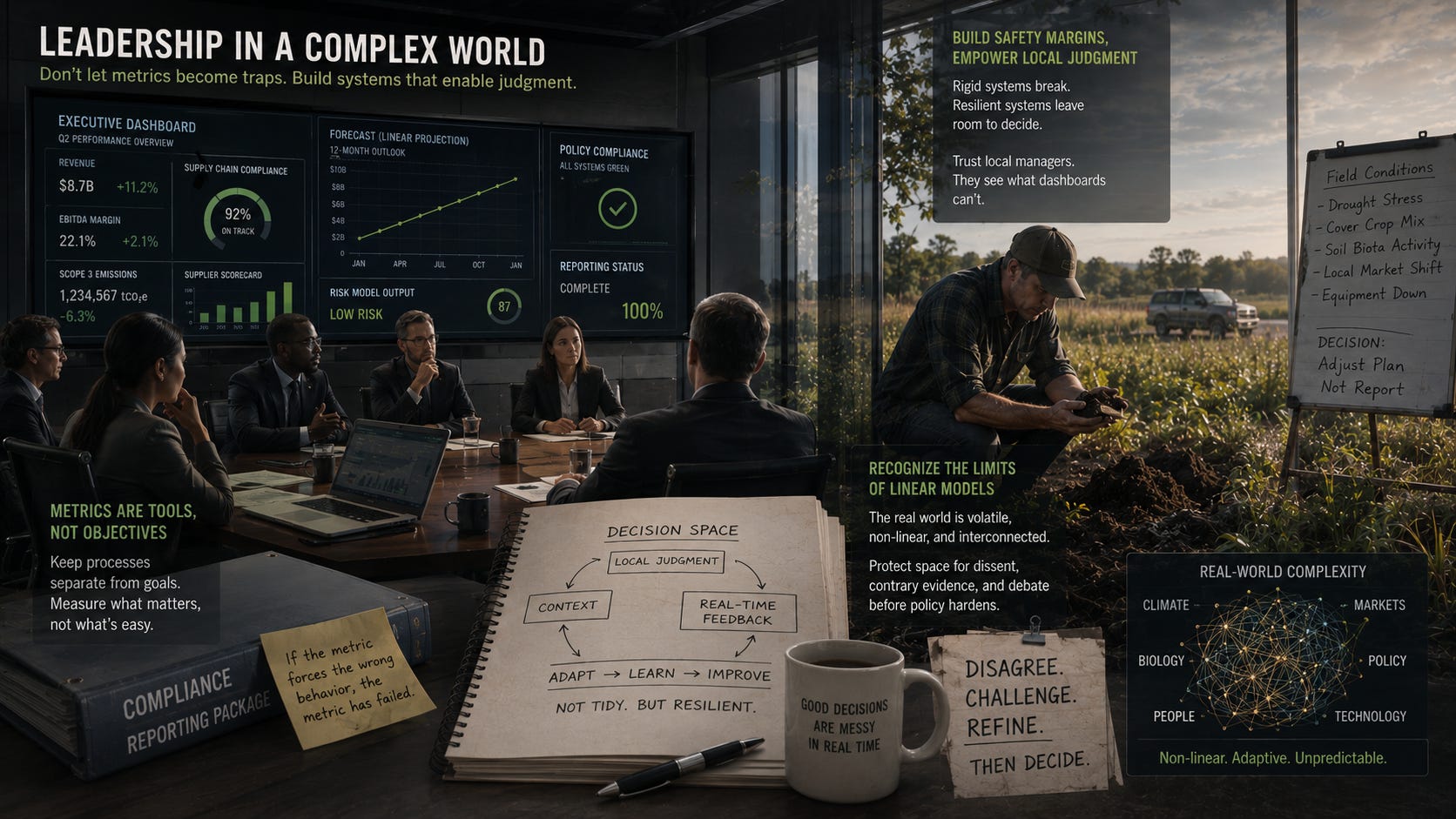
A smart framework needs to keep its processes separate from its ultimate goals. If your compliance metrics are so rigid that a supplier has to choose between filling out a form correctly or doing what makes sense for their specific environment, the metric has failed. True operational health means building in safety margins that allow local managers to make real-time decisions, even if those decisions look untidy to central offices.
At the same time, we have to recognize where our formulas hit a wall. Linear projections cannot handle the volatility of real-world networks, whether you are dealing with environmental carbon assets or supply chain logistics. To keep an enterprise from growing brittle, the structure must protect spaces where people can actively disagree, bring in contrary evidence, and challenge the primary operating dashboard before it hardens into unyielding policy.
The Path Toward Institutional Humility
The answer to the Grid Paradox is not to abandon institutions. It is to make them humbler.
When large frameworks attempt to absorb complex living realities without changing their own internal architecture, they inevitably default to a defensive, box-checking posture. For decades, the dominant corporate and political response to uncertainty has been to measure harder, to build thicker manuals, and to insist that any failure is simply a symptom of insufficient data. But true resilience requires us to acknowledge that some variables can be lived through, felt, and responded to, yet never entirely captured on a dashboard.
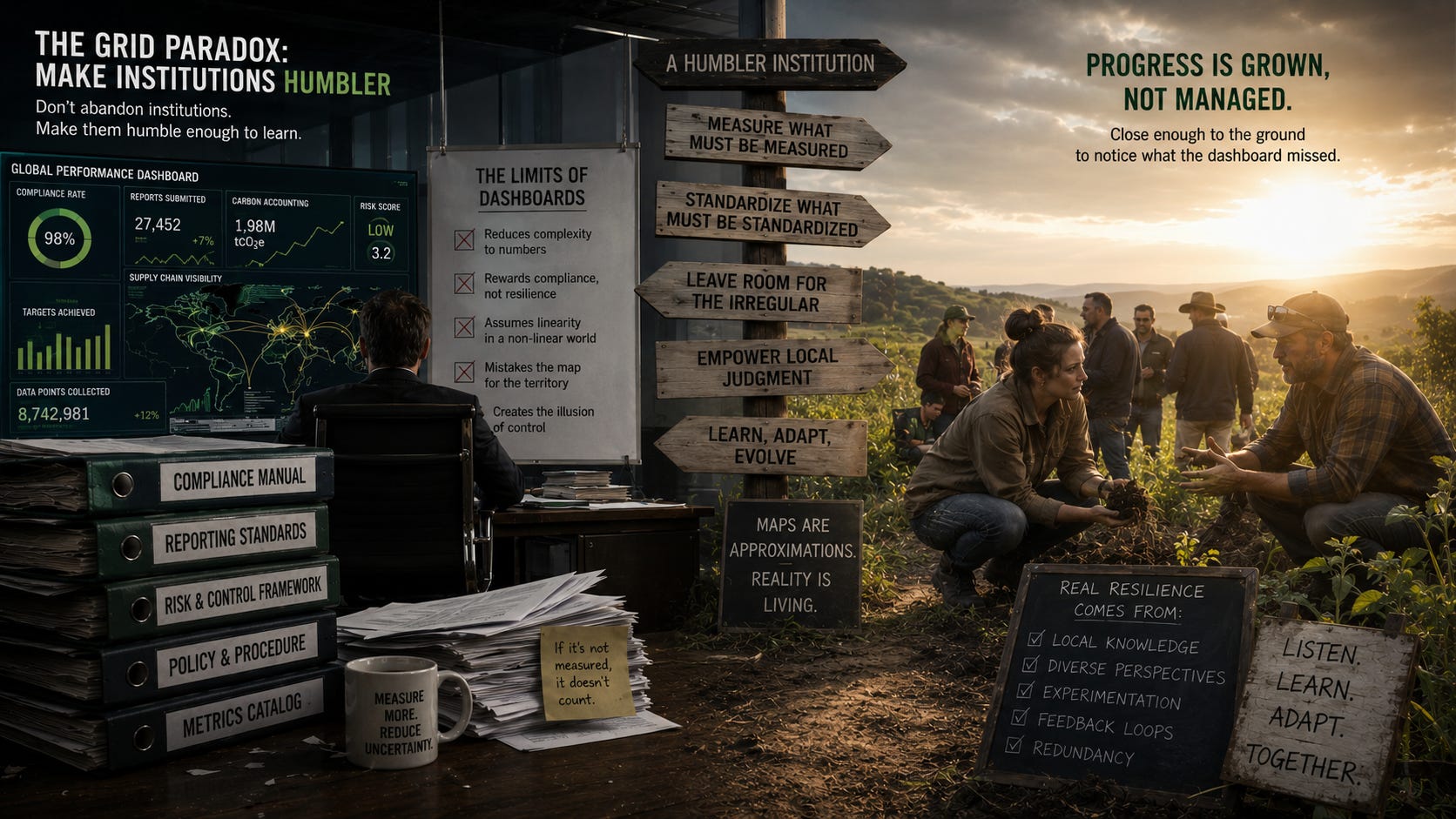
To bridge this divide, global governance systems must deliberately cultivate a structural tolerance for the irregular. This means designing policy structures that measure what must be measured and standardize what must be standardized, while intentionally leaving enough room for the local, the adaptive, and the inconveniently human. It requires institutions to treat their own administrative maps not as literal terrain, but as crude, evolving approximations of reality.
Ultimately, progress cannot be managed entirely from a distance. The future will not be saved by dashboards alone. It will be grown by people close enough to the ground to notice what the dashboard missed.
Ken, this was powerful because some of the most important things in life truly cannot be measured on a spreadsheet. Like my love for you and Sandy.
You can measure revenue, valuations, followers, engagement, and analytics all day long, but you cannot easily measure trust, loyalty, resilience, love, leadership, mentorship, or the impact someone has on another human being.
Throughout my life and career, some of the greatest opportunities and relationships came from things that would never fit into a KPI dashboard. A conversation. A moment of kindness. Someone believing in me before I deserved it. Someone opening a door when I had no experience, no degree, and honestly no reason to be in the room except work ethic and determination.
As I have gotten older, I have realized the things we leave behind are rarely the numbers themselves. It is how we made people feel, what we helped build, who we helped believe in themselves, and whether we created something meaningful beyond ourselves.
Some of the greatest value in life is invisible until years later.
Beautifully written, my friend.