

The Attention Monopoly
Why Hollywood No Longer Controls the Audience

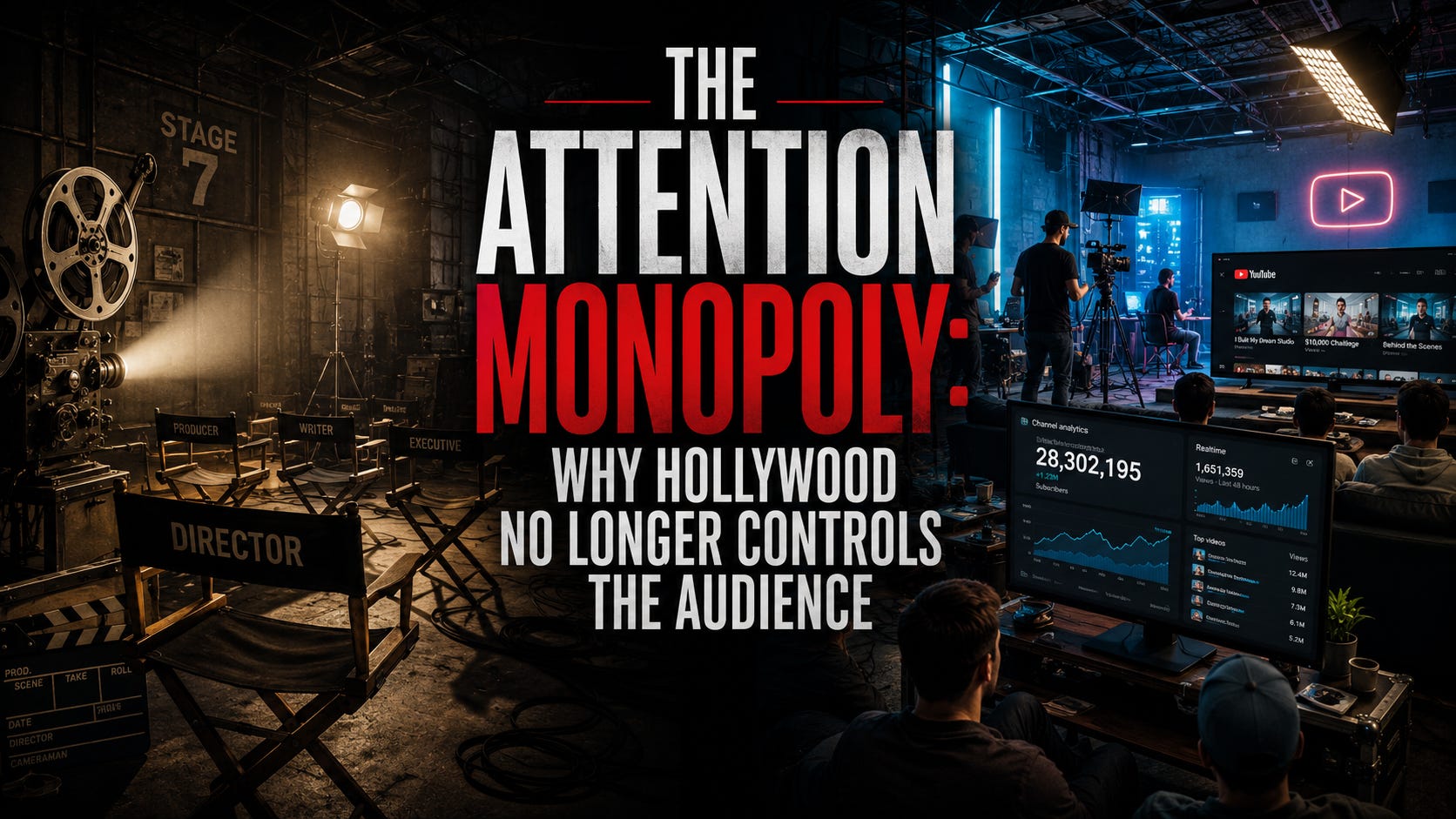
Inside a sprawling production warehouse just outside of Charlotte, North Carolina, the air smells of fresh plywood and static electricity as a young crew fine-tunes the lighting grids over an elaborate, custom-built labyrinth. The facility is run by an independent digital production banner that grew out of a series of bedroom video essays a decade ago. On a monitor in the makeshift control room, an internal dashboard tracks live engagement metrics across the company’s online channels, showcasing a volume of simultaneous traffic that matches or exceeds a network television prime-time broadcast.
A few miles away, inside an empty writers’ room in a mid-sized production office, the silence is telling. The whiteboards are wiped clean, placeholders for a prestige cable drama that was abruptly canceled weeks before principal photography was scheduled to begin.
By the summer of 2024, the floor of the traditional television business had effectively dropped out. According to data published by FX Research, the volume of scripted adult series in the United States plummeted to 481, down from an unprecedented peak of 600 shows during the height of the “Peak TV” boom in 2022. This marked a contraction of nearly 20 percent in less than twenty-four months.
The dual strikes of the Writers Guild of America (WGA) and SAG-AFTRA had concluded, but the return to work revealed a landscape fundamentally altered by capital flight. Warner Bros. Discovery, navigating a severe debt load, took billions in content write-downs, famously shelving completed feature films like Coyote vs. Acme amid restructuring and write-down decisions. Disney trimmed billions from its linear and streaming content budgets, placing strict annual caps on its most reliable franchise extensions.
The prevailing narrative across Burbank boardrooms was one of cyclical correction. The industry, executives argued, was simply adjusting to the end of the streaming subsidy era, that frantic decade during which Wall Street rewarded pure subscriber acquisition at the expense of free cash flow, allowing platforms to lose billions annually to secure digital real estate.
But the correction masked a deeper, more permanent shift in how human beings choose what to watch. While legacy entertainment conglomerates retrenched, a parallel economy was expanding into the vacuum. According to a comprehensive media sector report, the creator economy has matured into an estimated $250 billion ecosystem, with financial models positioning it to scale toward $480 billion by 2027.
Inside The 2024 Top Creators List
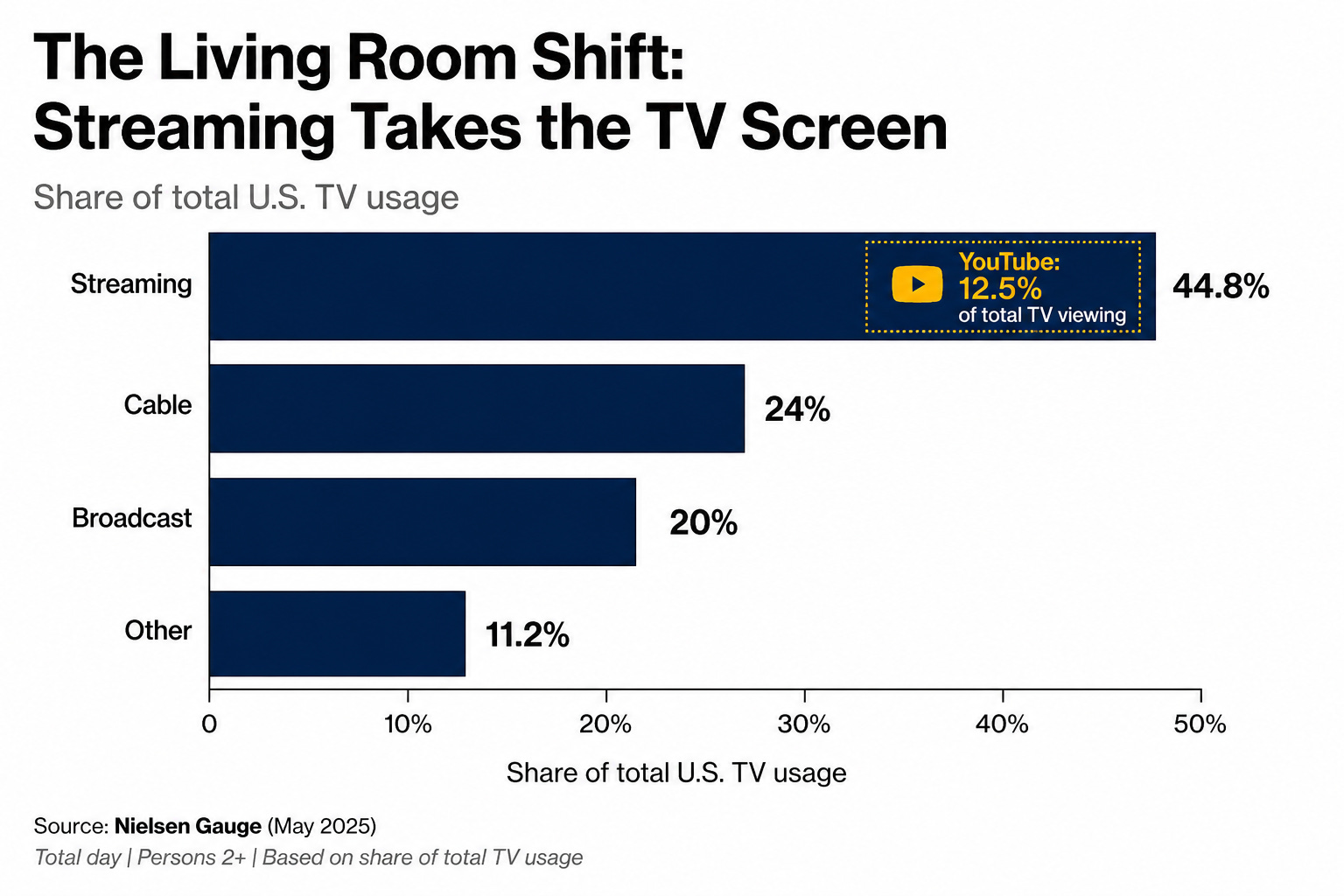
Crucially, this capital now flows beyond smartphone screens. Nielsen’s ongoing Gauge reports indicate that streaming regularly accounts for over 40 percent of total television usage in the United States. Within those figures, YouTube consistently captures the largest single share of TV viewing time among all streaming platforms, routinely outperforming major standalone services like Netflix and Hulu in terms of monthly viewership share. In platform performance disclosures, YouTube reported that global audiences now consume well over one billion hours of its content on actual television screens every single day.
The traditional entertainment industry is discovering that its greatest weakness is not a scarcity of capital, production infrastructure, or premium intellectual property. For a century, Hollywood’s hegemony rested on an ironclad triopoly: the exclusive control over high-end production, global physical and digital distribution, and centralized marketing.
The internet dismantled the distribution monopoly. Generative engineering tools are rapidly compressing the cost of production. What remains is the battle for human attention. Hollywood still holds the strongest advantage in manufacturing massive global spectacles. What it no longer owns is the daily habit of watching.
The emerging reality suggests that internet creators are not replacing Hollywood. Rather, creators are replacing the fundamental function that made Hollywood powerful in the first place: the direct relationship with the audience. Hollywood used to decide what America watched. Now creators decide what America gets in the habit of watching.
The Great Economic Inversion
To understand why this power dynamic shifted so aggressively, it is necessary to look past the individual personalities of the internet and focus on a deeper structural mutation in media economics. In the twentieth century, content was scarce and attention was abundant. In the twenty-first century, content became functionally infinite and attention became scarcer.
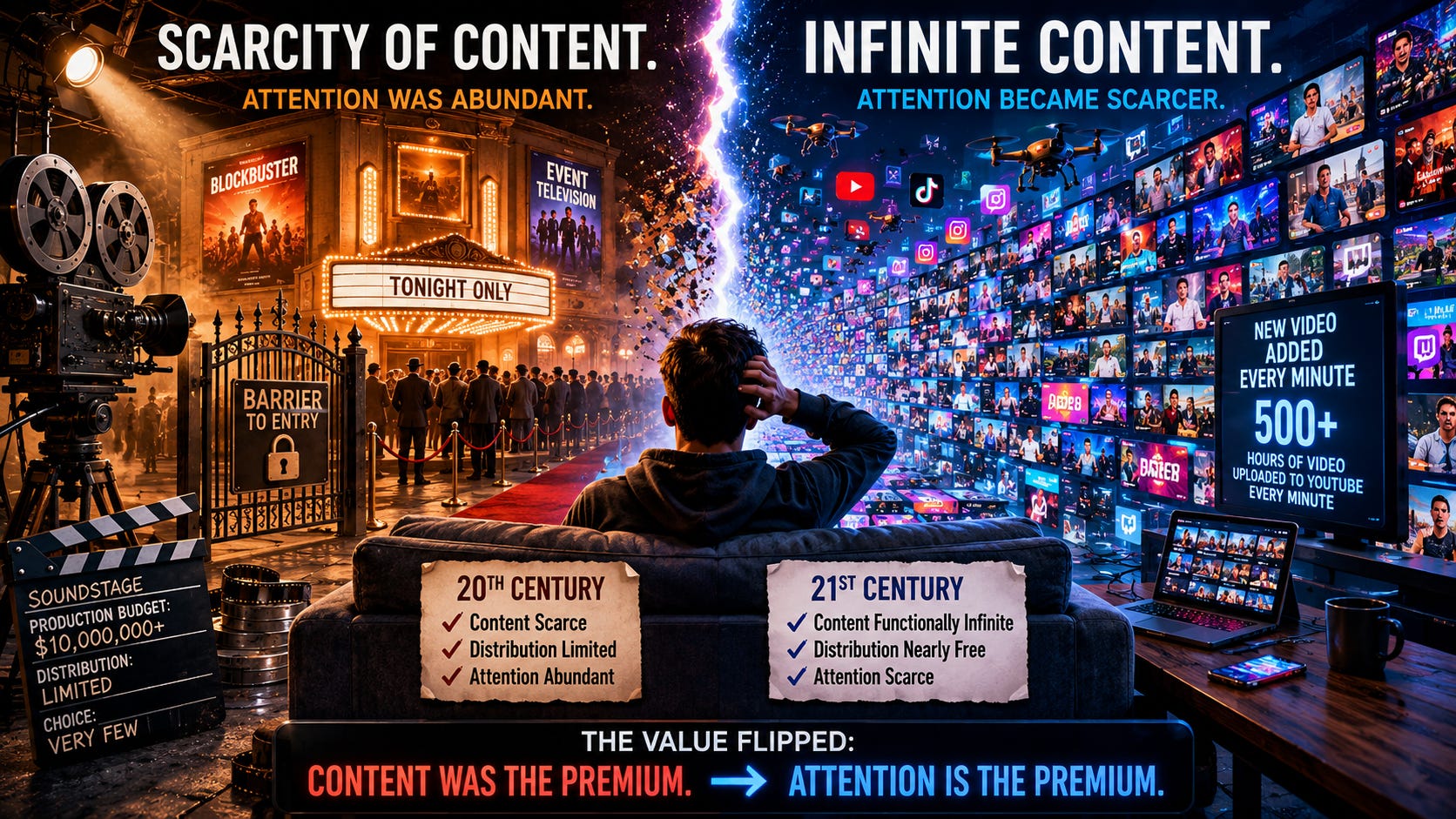
Under the old economic order, the high cost of production and the physical limits of distribution created a natural barrier to entry. Because it required millions of dollars to rent a soundstage, buy film stock, and secure a spot on a limited broadcast spectrum or a physical theater circuit, the sheer existence of a finished piece of video was a rare commodity. A studio simply had to manufacture the asset and purchase standard advertising, and the audience’s attention would follow automatically because there were very few alternative directions for that attention to go.
The modern internet dissolved those barriers, creating a state of overwhelming abundance. When distribution costs dropped to near zero and high-fidelity video tools became universally accessible, the media marketplace was flooded with millions of hours of new video every day. In an environment of infinite choice, the economic value flipped upside down. The content itself ceased to be the premium commodity. The premium commodity became the scarce human focus required to locate it.
This inversion completely exposes the traditional studio model. Hollywood is still structured around the assumption that the value is in the manufacturing of the object. A studio spends $100 million to build a film or a television series and then must spend tens of millions more on a marketing campaign to pull an increasingly distracted audience away from their daily routines.
A modern creator operates on the opposite economic premise. They do not start with production; they start with attention. By spending years consistently speaking to a community, a creator builds a stable baseline of direct human trust. They do not have to pay heavily to acquire a customer when they release a new project, because the relationship is already active.
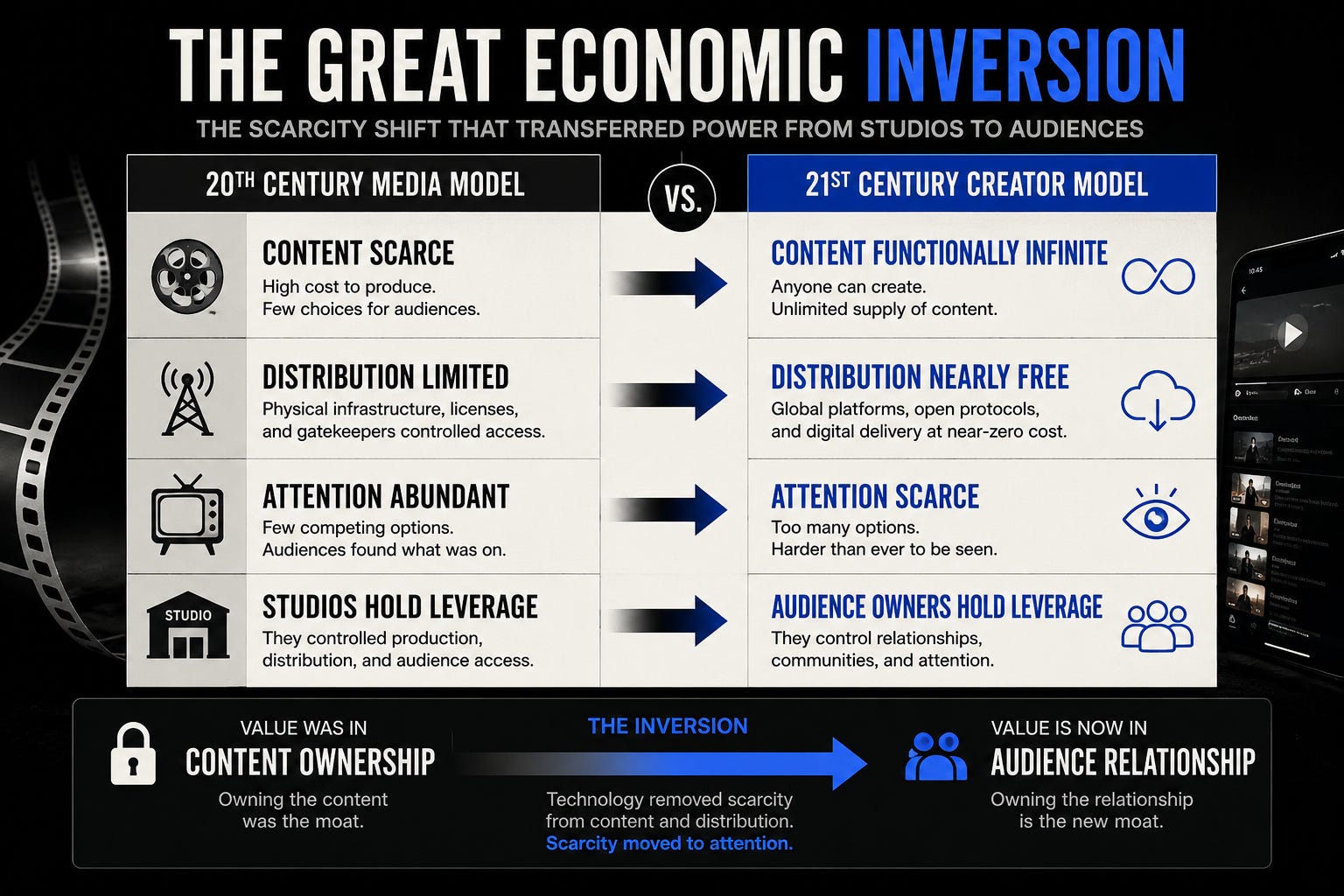
In a world where anyone can make a movie but nobody can find an audience, the entity that owns the direct, ongoing connection to the viewer holds all the leverage.
The Ghost in the Pipeline
This economic reality manifests below the line as a quiet, systemic contraction. For decades, the middle class of entertainment workers, including mid-level writers, visual effects compositors, camera operators, and dialogue editors, sustained their careers through a predictable cadence of production cycles and residual structures. The direct-to-consumer streaming model dismantled the back-end syndication ecosystems that historically funded these long-tail careers, replacing them with flat, upfront buyout fees.
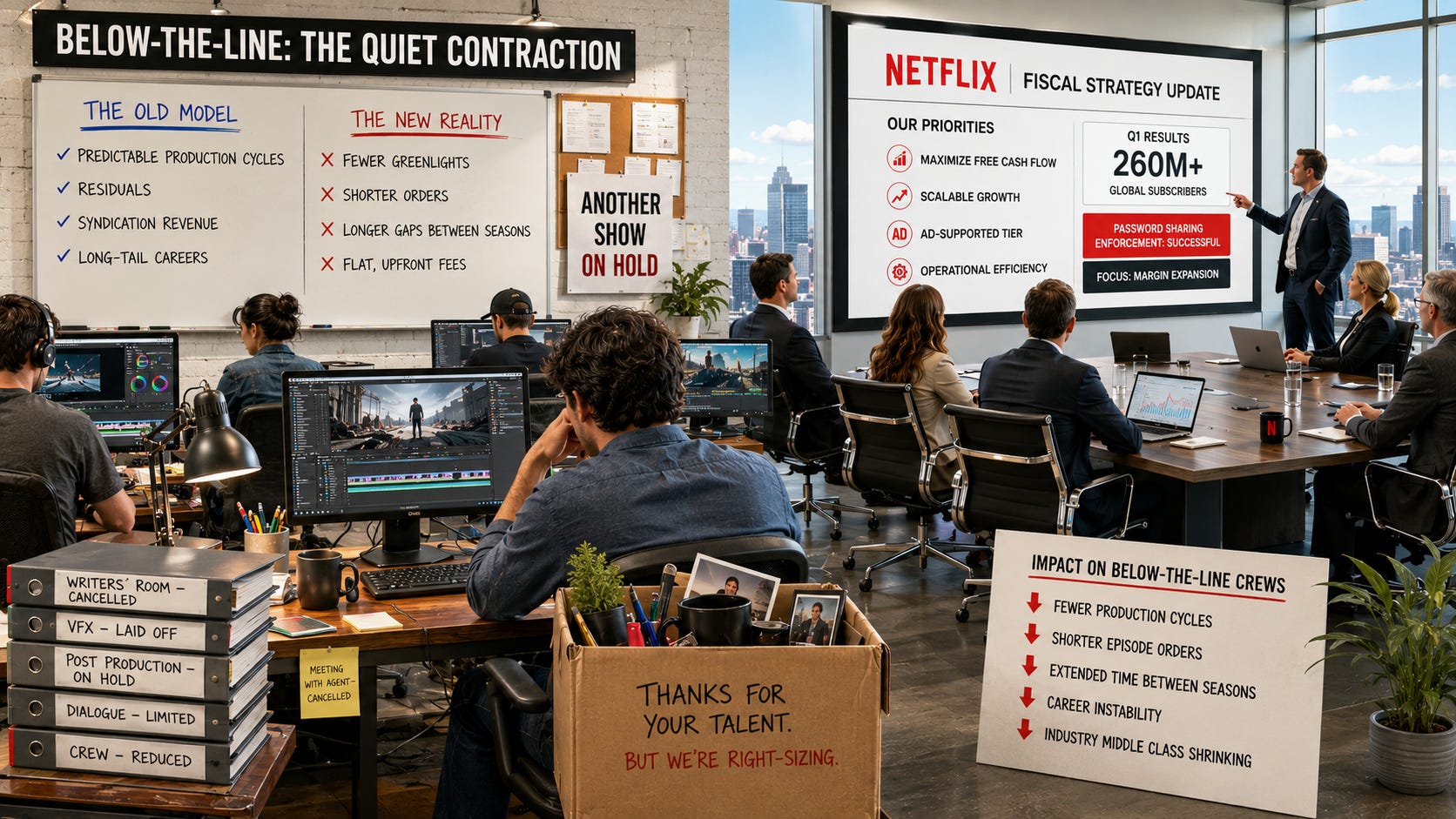
After the labor agreements were finalized, the industry expected employment to stabilize. Instead, corporate balance sheets dictated an aggressive pivot toward margin preservation. Netflix, having successfully executed a global password-sharing enforcement action to boost its subscriber base past 260 million, reoriented its metrics toward maximizing free cash flow and scaling its nascent advertising tier. For below-the-line crews, this financial discipline translated into fewer greenlights, shorter episode orders, and extended intervals between seasons.
Simultaneously, the production pipeline began integrating machine-learning infrastructure at an operational layer far beneath the public anxieties of the writers’ room. While union contracts successfully restricted the use of artificial intelligence to generate principal photography assets or script pages without consent, automated utilities quietly took over the unglamorous mechanics of post-production.
Software platforms specialized in automated dialog replacement (ADR), algorithmic rotoscoping, and voice localization have transformed from experimental beta tools into standard infrastructure. High-fidelity voice-cloning technology can now ingest a performer’s vocal timbre and emotional cadence, translating an entire performance into multiple foreign languages while maintaining precise synchronization with the actor’s mouth movements.
Industry analysis suggests these automated workflows can reduce traditional localization and dubbing costs, long a major line item for multi-territory releases, by up to 80 percent in certain setups. However, the secondary effect is the immediate contraction of the regional voice-acting and technical synchronization labor markets globally.
AI-driven automation accelerates the profound economic inversion. By drastically lowering the technical friction and execution costs of post-production, technology continues to compress the value of pure manufacturing. If software can handle the routine tasks of compositing, color correction, and sound editing, the act of assembling a high-fidelity video becomes an open, inexpensive commodity.
As a result, the studio’s old defensive moat, the ability to afford elite technical execution, shrinks every year. As the technical cost of making things falls, the marketplace grows more crowded, attention becomes even scarcer, and the creator’s direct relationship with the viewer becomes the only defensible asset left standing.
The Sovereignty of the Direct Audience
In November 2021, Jimmy Donaldson, the digital entrepreneur known as MrBeast, produced a real-world recreation of the hit Netflix series Squid Game. According to public production disclosures, the video cost approximately $3.5 million to produce, ran for twenty-five minutes, and accumulated over 100 million views in less than five days, achieving a velocity of scale that outpaced the premier broadcast networks of Western television.
$456,000 Squid Game In Real Life!
Donaldson’s operation in Greenville, North Carolina, does not function as an auxiliary talent pool for traditional studios. It operates as a vertically integrated media and consumer goods conglomerate that completely bypasses the legacy talent-agency and distribution apparatus. Utilizing his digital scale, Donaldson launched a global consumer product footprint, Feastables, which internal company statements and retail tracking estimated cleared over $100 million in sales during its initial expansion, leveraging direct access to an audience of over 200 million subscribers.
Where Hollywood’s legacy model is capital-intensive, requiring a studio to raise nine figures in venture or debt capital, invest heavily in production infrastructure, and spend millions more on advertising just to hope an audience materializes, the creator model turns the pipeline on its head. It is attention-intensive. The creator builds a direct community first, captures daily focus, and only then deploys targeted production or commerce at a dramatically lower customer-acquisition cost.
This architecture also applies to smaller creators, not just mega-creators. This architecture systematically rewires how cultural capital converts into economic independence. Consider the trajectory of companies like Dhar Mann Studios. Operating out of a purpose-built, multi-soundstage production facility in Burbank, Mann’s company produces short-form, moralistic digital dramas that regularly generate hundreds of millions of monthly views across Facebook and YouTube. The operation features its own stable of recurring actors, internal production crew, and dedicated editing wings, largely independent of traditional studio syndication or theatrical exhibition networks.
Similarly, the media brand built by Zach Kornfeld, Keith Habersberger, and Ned Fulmer, The Try Guys, demonstrated the power of total platform independence. Following their departure from BuzzFeed’s corporate umbrella, the group established an independent production banner, retained absolute control of their intellectual property, managed direct-to-consumer merchandising operations, and ultimately launched 2nd Try TV, a proprietary subscription streaming app supported directly by their core fandom.
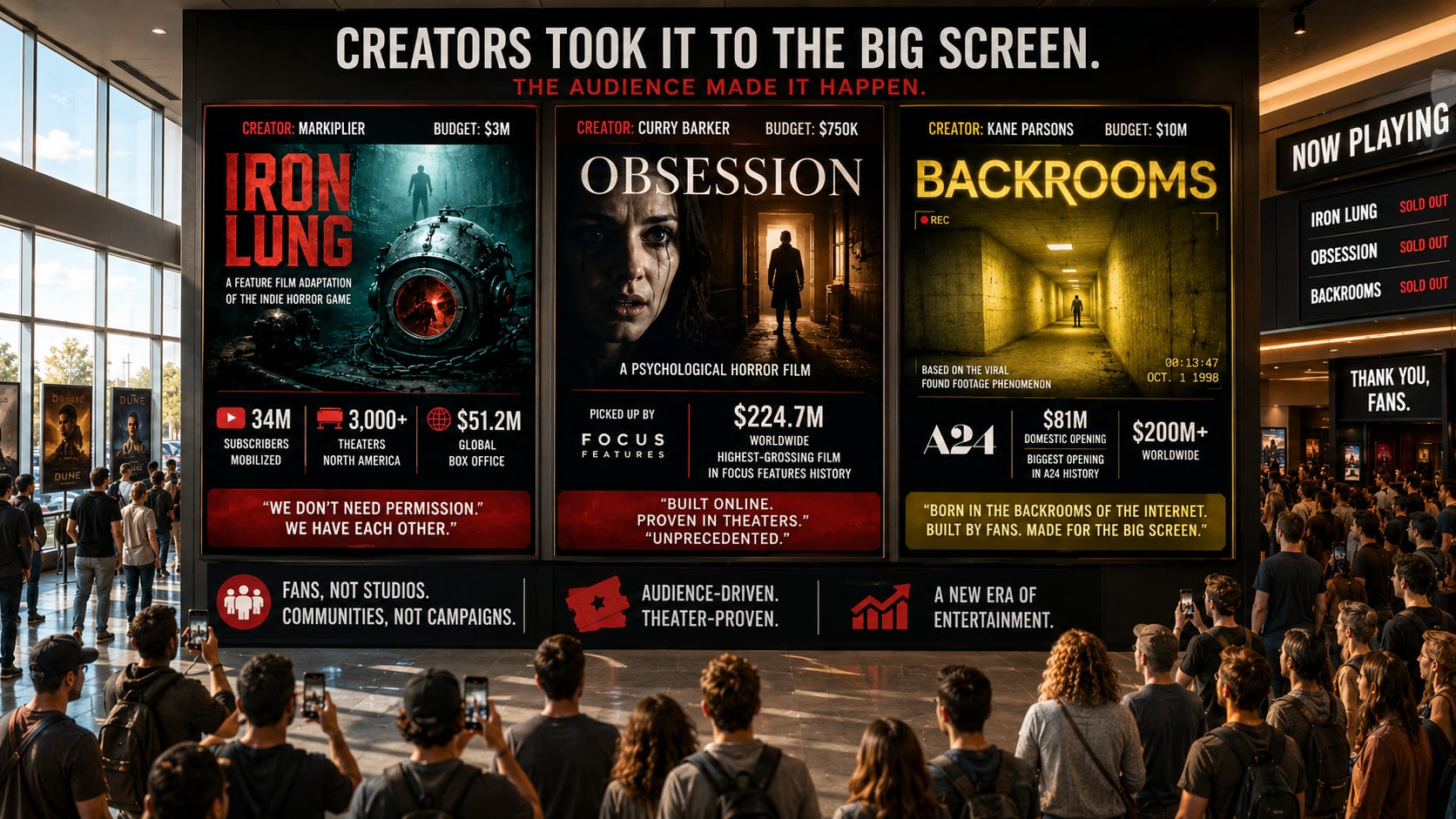
The depth of this baseline shift becomes clear when tracking how this architecture has forced its way onto physical theater screens. In early 2026, YouTube creator Mark “Markiplier” Fischbach self-financed a $3 million feature film adaptation of the indie horror game Iron Lung. Sidestepping traditional studio promotional pipelines entirely, Fischbach mobilized his thirty-four million subscribers to directly lobby exhibitors across North America. He bypassed the legacy gatekeepers, got the film booked into over 3,000 theaters, and watched his audience drive it to a global theatrical gross of $51.2 million.
This was not an isolated lightning strike; it was the vanguard of an entirely restructured ecosystem. A few months later, Curry Barker, a 26-year-old creator known for low-budget digital comedy sketches, directed a psychological horror film called Obsession for just $750,000. It built a grassroots wave of online attention before Focus Features picked it up. According to trade tracking data, Obsession pulled off a historically unprecedented run, crossing $224.7 million worldwide to officially become the highest-grossing film in Focus Features history.
Simultaneously, A24 released Backrooms, a $10 million feature film based on a hyper-viral found-footage web universe directed by twenty-year-old creator Kane Parsons, who first built the concept in his bedroom. Long before Hollywood producers took notice, the foundational mythology of The Backrooms began as an obscure internet creepypasta that emerged on the image board 4chan in 2019. Driven by an audience that had spent years actively decoding the lore, the film recorded the biggest opening weekend in A24’s history, with an $81 million domestic debut and ultimately climbing to more than $200 million worldwide.
The important detail here is not the box office performance on its own. Hollywood has always generated breakout successes and unexpected genre hits. What makes these projects unusual is that the audience existed before the first frame was shot. Traditional studios spend enormous sums introducing a story to the public and generating demand from scratch. Creator-led projects reverse the sequence. The community comes first; the content arrives later. The underlying economics change fundamentally because the most expensive and unpredictable part of the process - attracting human attention - has already been solved.
MrBeast Reflects on Beast Games, Feastables, and the State of YouTube
The old guard still views YouTube as a digital farm system to scout talent for traditional film and television. They are missing the shift. The creator economy is not an entry point to Hollywood. For talent like Barker and Parsons, Hollywood represents a luxury brand alignment, while the creator economy is where they maintain direct audience loyalty and derive enterprise value.
The commercial leverage generated by this direct audience ownership extends far beyond media consumption. When digital creators KSI (Olajide Olatunji) and Logan Paul leveraged their combined audience to launch Prime Hydration, beverage industry reports noted that the line generated over $250 million in retail sales within its first year of operation. It disrupted traditional beverage conglomerates through purely organic, platform-native placement, with far less reliance on traditional television or billboard advertising. The product’s distribution achieved global retail relevance entirely through the structural ownership of consumer attention.
The Studio System Was the Anomaly
Analysts frequently describe the contemporary fragmentation of American media as an unprecedented consequence of the internet age. However, historical perspective reveals that the hyper-centralized studio system of mid-century Hollywood was actually the anomaly, not the historical default.
Before the codification of the classic studio system in the 1920s and 1930s, the American media landscape was deeply fragmented, localized, and volatile. Early cinema relied on independent states’-rights distributors, regional theater circuits, and itinerant exhibitors who tailored content to hyper-specific immigrant and working-class communities.
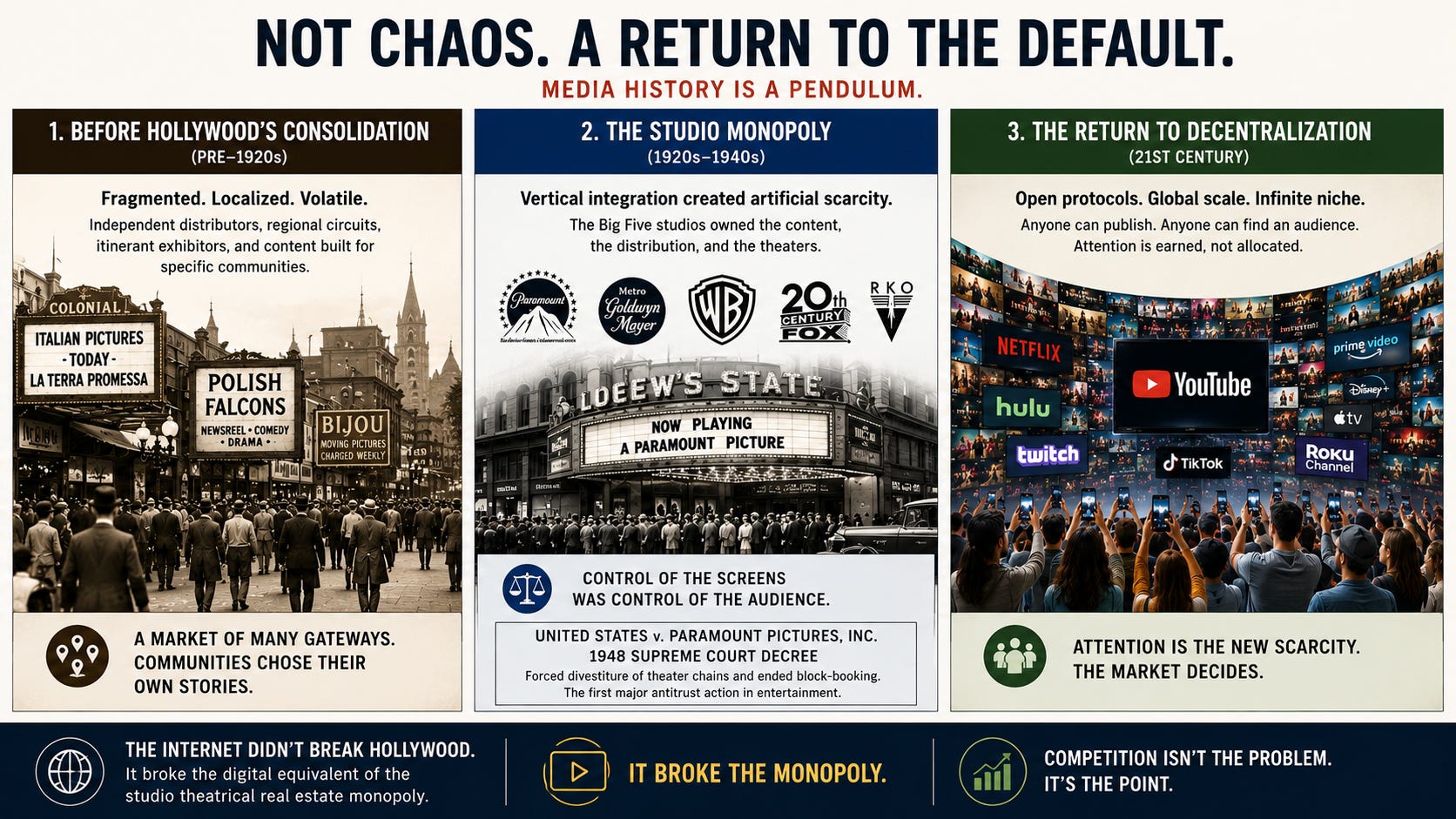
The consolidation of Hollywood only occurred when the major studios, Paramount, Metro-Goldwyn-Mayer, Warner Bros., Twentieth Century-Fox, and RKO, integrated vertically by acquiring their own prestigious theatrical chains. By controlling the physical screens in America’s major urban centers, the “Big Five” created an artificial scarcity of exhibition space. This monopoly was so absolute that it required the intervention of the federal government via the 1948 Supreme Court decree United States v. Paramount Pictures, Inc., which forced the studios to divest their theatrical interests and outlawed the practice of block-booking.
For the remainder of the twentieth century, television networks maintained a second era of artificial scarcity through the physical limitations of the broadcast spectrum. The three-network monoculture of ABC, CBS, and NBC was an economic architecture created by federal licensing limits, not an organic consensus of consumer desire.
Viewed through this historical lens, the current transformation is not a descent into chaos but a return to the natural state of cultural consumption: decentralized, competitive, and split into distinct communities of interest. The internet did not break Hollywood’s ability to make high-quality moving images; it broke the digital equivalent of the studio theatrical real estate monopoly.
The open protocol of the modern streaming video pipeline has returned the media ecosystem to a state of open competition where attention must be won on an open market rather than forced through bundled infrastructure.
The Counter-Thesis: The Indelible Moat
It is easy to overstate the decline of legacy institutions. If independent digital creators are successfully rewriting the laws of media economics, the question remains: why does Hollywood continue to command the global box office and dictate the elite echelons of cultural prestige?
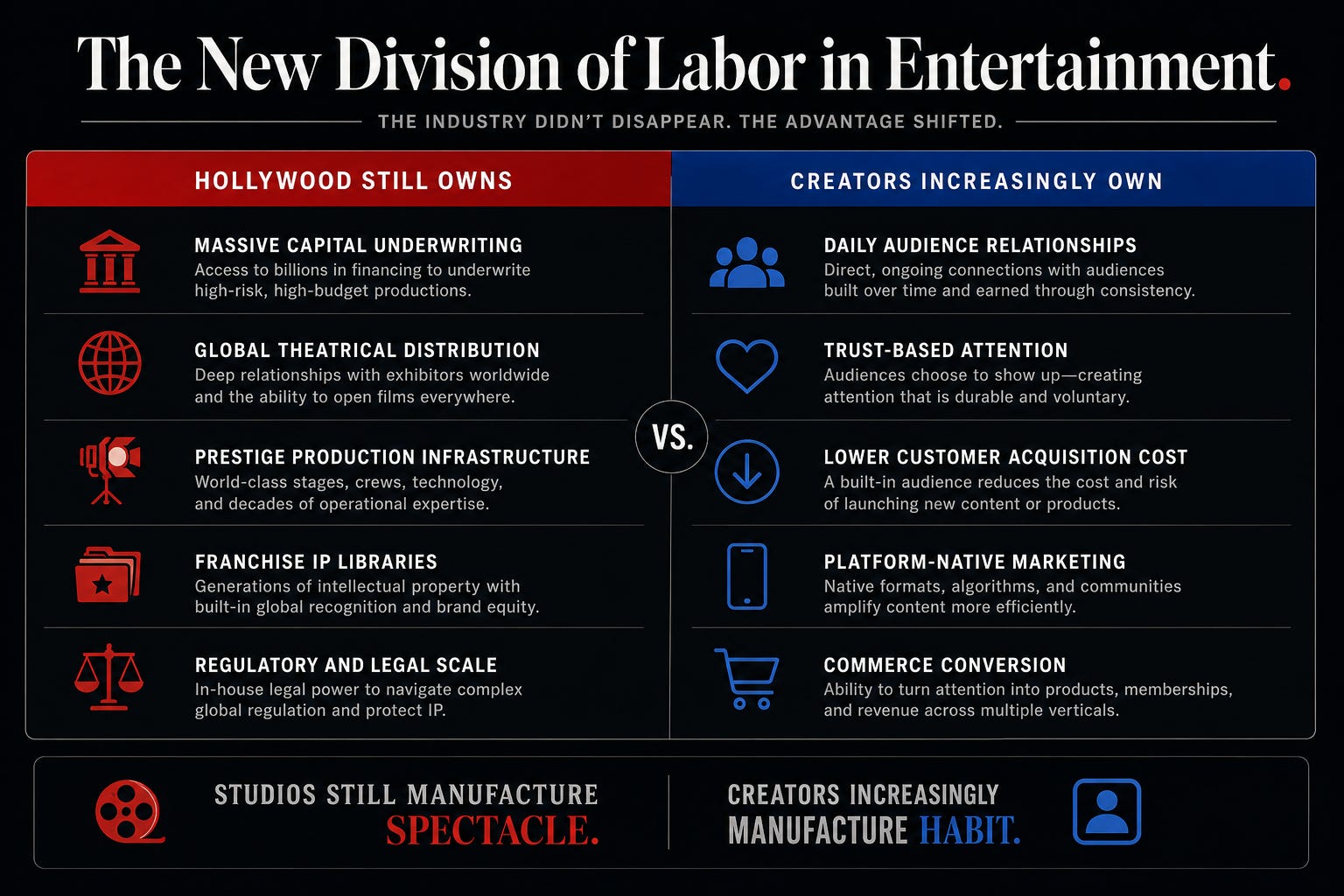
The answer lies in the massive capital moats required to execute and distribute world-scale spectacle. While a creator can capture hundreds of millions of views from a studio in North Carolina, the production architecture required to manufacture a global theatrical event like Universal’s Oppenheimer or Disney’s Inside Out 2 demands an industrial scale that no single creator organization can sustain.
Global theatrical distribution requires deep institutional relationships with international exhibition syndicates, complex multi-territory regulatory navigations, and massive financial underwriting capabilities that remain the exclusive domain of legacy studios. Even when disruptors like Barker and Parsons achieve massive theatrical breakthroughs, their path to global multiplex screens still runs directly through the established machinery of Focus Features and A24.
Furthermore, the creator economy itself regularly hits an operational ceiling. When top-tier digital talent seeks to scale their projects into long-form narrative features or high-budget serialized dramas, they almost invariably pivot back toward traditional studio partnerships.
MrBeast contracted with Amazon Prime Video to produce and distribute his high-budget reality competition series Beast Games, an admission that even the largest independent digital footprint requires the backend technical infrastructure and capital allocation of a trillion-dollar tech conglomerate to execute long-form television infrastructure.
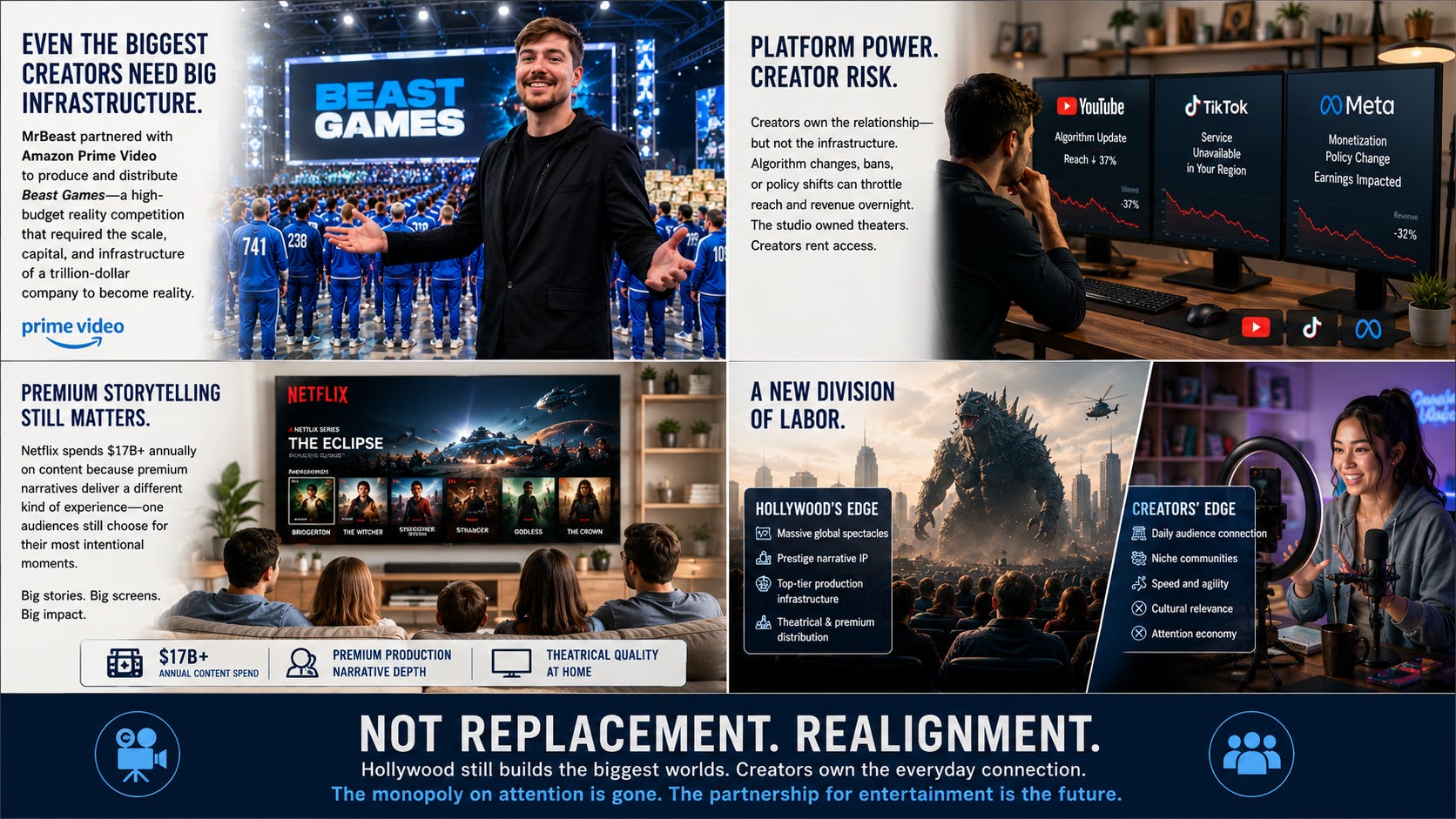
Creators also remain structurally vulnerable to platforms they do not control. While a creator may own the relationship with their audience in terms of trust and cultural alignment, they are ultimately tenants on rented infrastructure. A sudden algorithmic recalibration by YouTube, a localized ban or forced divestiture of TikTok, or a monetization policy shift by Meta can immediately throttle a creator’s distribution and jeopardize their core revenue streams. The studio system owned its physical theaters; the modern creator is always vulnerable to the shifting rules of the digital platforms.
Netflix continues to spend upwards of $17 billion annually on content development, according to its corporate financial guidance, because premium, high-production-value narratives remain a distinct tier of entertainment consumption. A consumer may watch three hours of user-generated content on their phone while commuting or making dinner, but when they sit down in front of a living room television for an intentional evening viewing experience, their baseline expectation for narrative structure, sound design, and visual prestige remains tied to the standards established by Burbank over a century of production refinement.
The paradigm shift is therefore not one of complete institutional replacement but of a clear division of labor. Hollywood still holds the strongest advantage in manufacturing massive global spectacles and prestige narrative asset classes. What it has lost is the monopoly on the day-to-day attention of the viewing public.
The Return to the Dark Room
The modern media landscape presents a paradox. As the options for individual consumption multiply into infinity, the human impulse for collective orientation remains intact. In an era where every mobile device can function as an isolated, personalized entertainment stream, the act of entering a physical auditorium to experience a narrative in synchronization with strangers has transformed from a passive consumer habit into an intentional cultural statement.
The fundamental transformation facing the entertainment industry is not a technological transition from film grain to digital pixels, nor is it a simple corporate migration from linear television schedules to streaming home screens. The shift is deeply structural, forcing an answer to a more profound question: what happens to the economics of culture when the ownership of an audience becomes significantly more valuable than the ownership of the content itself?
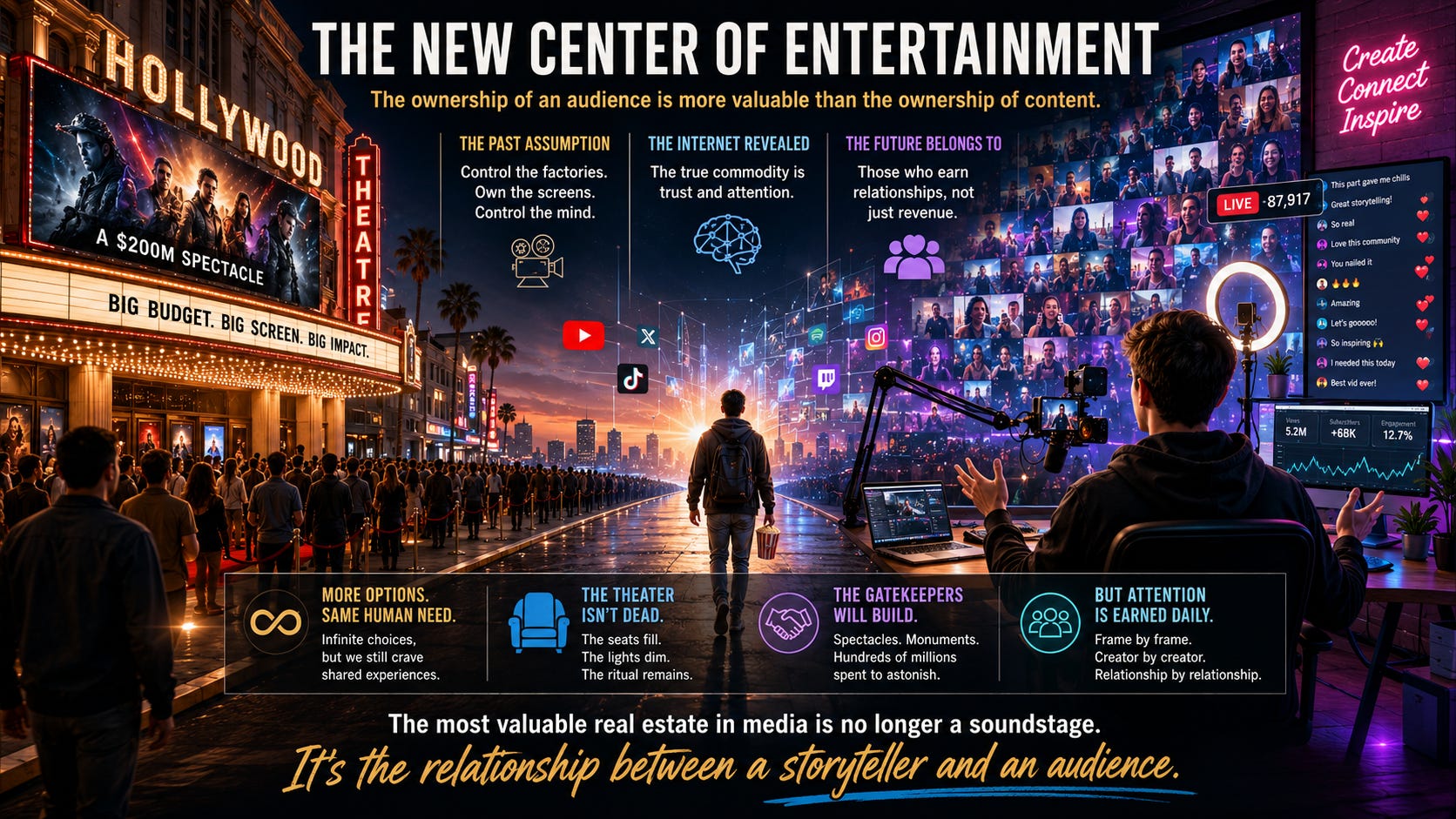
For a century, Hollywood operated under the assumption that if you controlled the factories that manufactured the film prints and owned the screens that projected them, you controlled the human mind. The internet dismantled that illusion, revealing that the true commodity of the modern age is not the file format or the delivery vehicle, but the trust and attention of the community at the other end of the pipe.
The projector still runs in independent movie houses across the country. The seats still fill, the lights still dim, and the room falls silent. What has changed is who gets to decide what appears on the screen. The traditional gatekeepers will continue to manufacture their spectacles, spending hundreds of millions of dollars to build massive, ornate monuments to the twentieth-century monoculture.
But the daily attention of the next generation of consumers is being won on an open landscape, frame by frame, by creators who understand that the most valuable real estate in media is no longer a soundstage in Burbank. It is the daily relationship between a storyteller and an audience.