

The Autonomous Cloud Above Earth
The Strange Geopolitics of Orbital AI

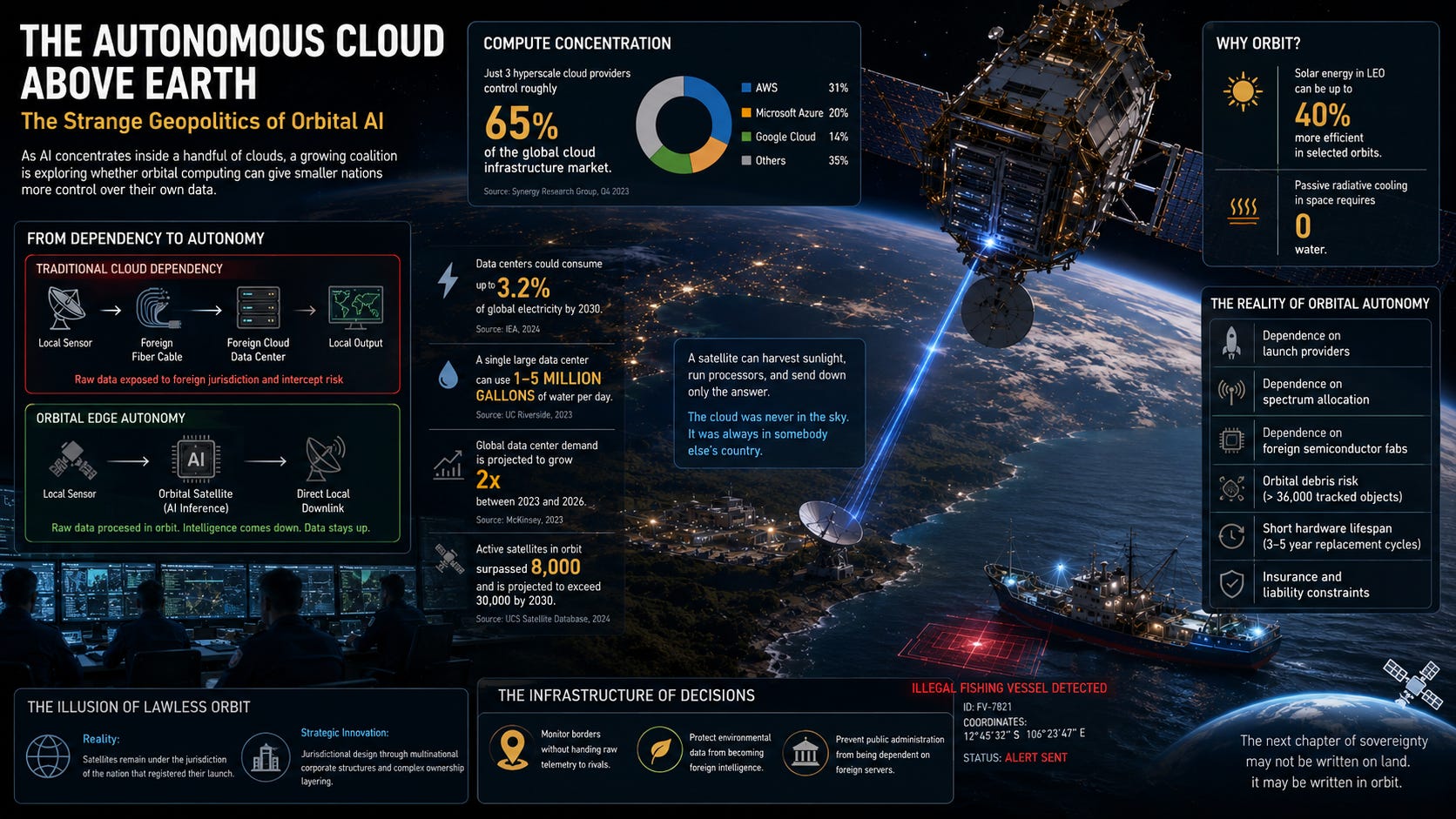
As artificial intelligence concentrates inside a handful of clouds, a growing coalition of aerospace companies and policy strategists is exploring whether orbital computing can give smaller nations more control over their data.
Consider a scenario where a developing maritime state wants to monitor illegal fishing fleets encroaching on its protected waters. The raw data often travels far deeper into foreign territory than the poaching vessels ever do.
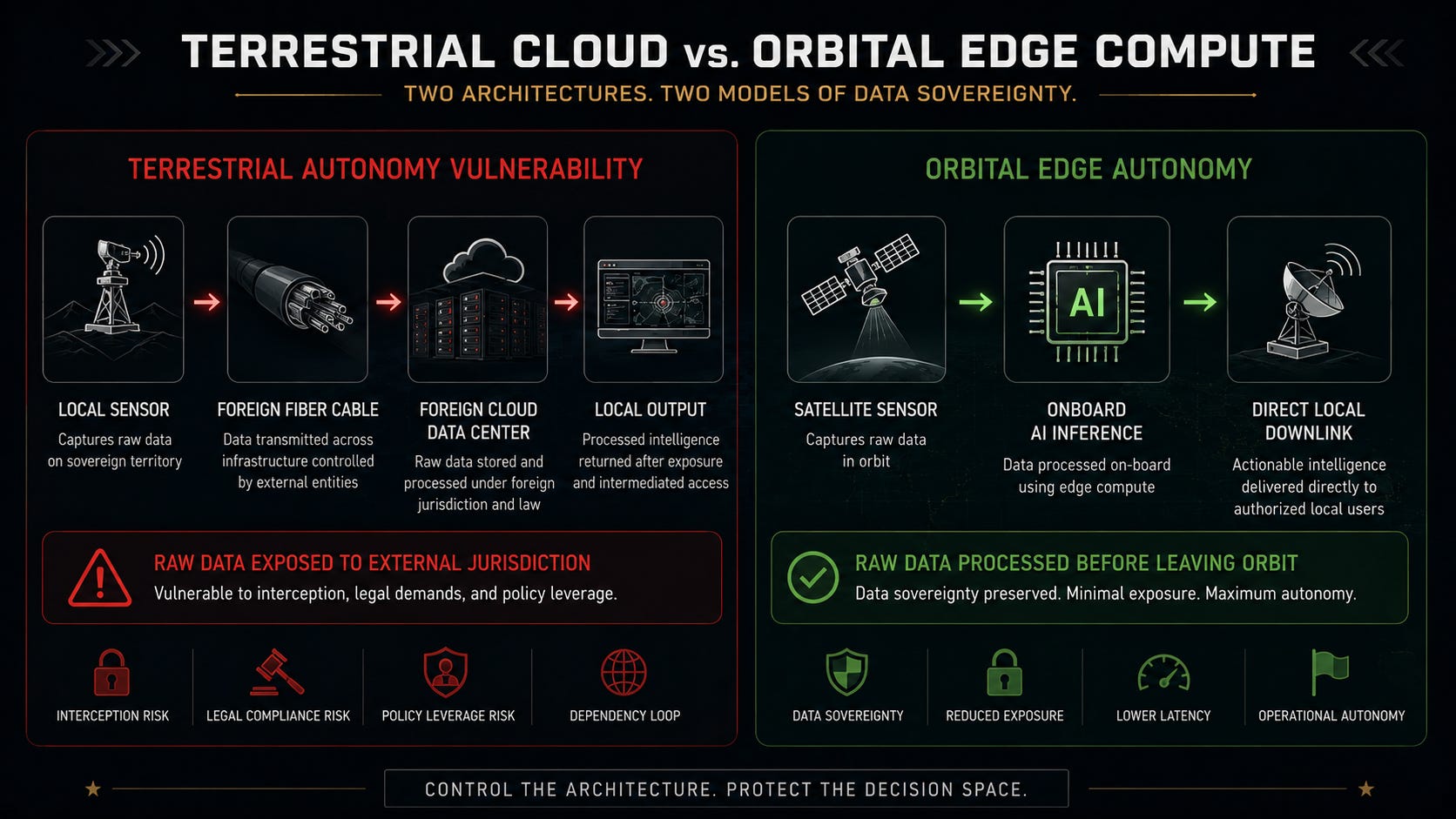
The radar and satellite images capture the area directly above the nation’s sovereign waters. But from there, the raw digital assets are flashed across an undersea fiber network, routed through landing stations controlled by regional powers, and processed inside a proprietary cloud facility owned by an international tech conglomerate. Hours later, the company sells the processed intelligence, now compressed into clean, actionable coordinates, back to the coast guard.
The cloud was never in the sky. It was always in somebody else’s country.
The state owned the ocean. It did not own the computation.
Every conversation about digital autonomy eventually runs into this physical constraint. The compute is always owned by a specific corporate entity, the data center sits in a distinct municipal jurisdiction, and fiber-optic cables land on specific beaches. If a state does not sit near the top of that hardware supply chain, its digital autonomy is profoundly compromised.
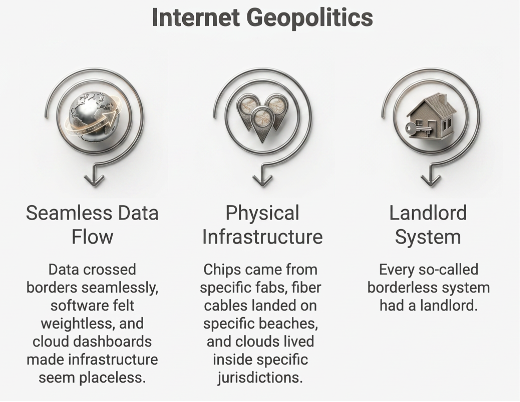
For two decades, the geopolitics of the internet looked deceptively flat. Data crossed borders seamlessly, software felt weightless, and cloud dashboards made infrastructure seem placeless. But the physical system underneath was never neutral. Chips came from specific fabs, fiber cables landed on specific beaches, and clouds lived inside specific jurisdictions. Every so-called borderless system had a landlord.
Now, the explosive rise of artificial intelligence has turned this hidden dependency into an acute policy crisis. The strategic challenge of modern statecraft is Compute Concentration, a structural consolidation where just three hyperscale cloud providers control roughly 65% of the global cloud infrastructure market. As AI moves from being a corporate tool to the main operating system of modern governance, most countries must route their national security, logistical, and administrative workflows through digital infrastructure controlled by a minimal group of foreign operators.
How AI Datacenters Eat the World
To break this stranglehold, an alternative logic is taking hold among a loose alliance of middle-power policy analysts, international lawyers, and aerospace entrepreneurs: the only way to protect territorial data from the reach of land-bound empires is to remove it from the surface of the Earth entirely.
The New Straits of Malacca
This migration to the upper atmosphere is the modern continuation of an ancient geopolitical pattern.
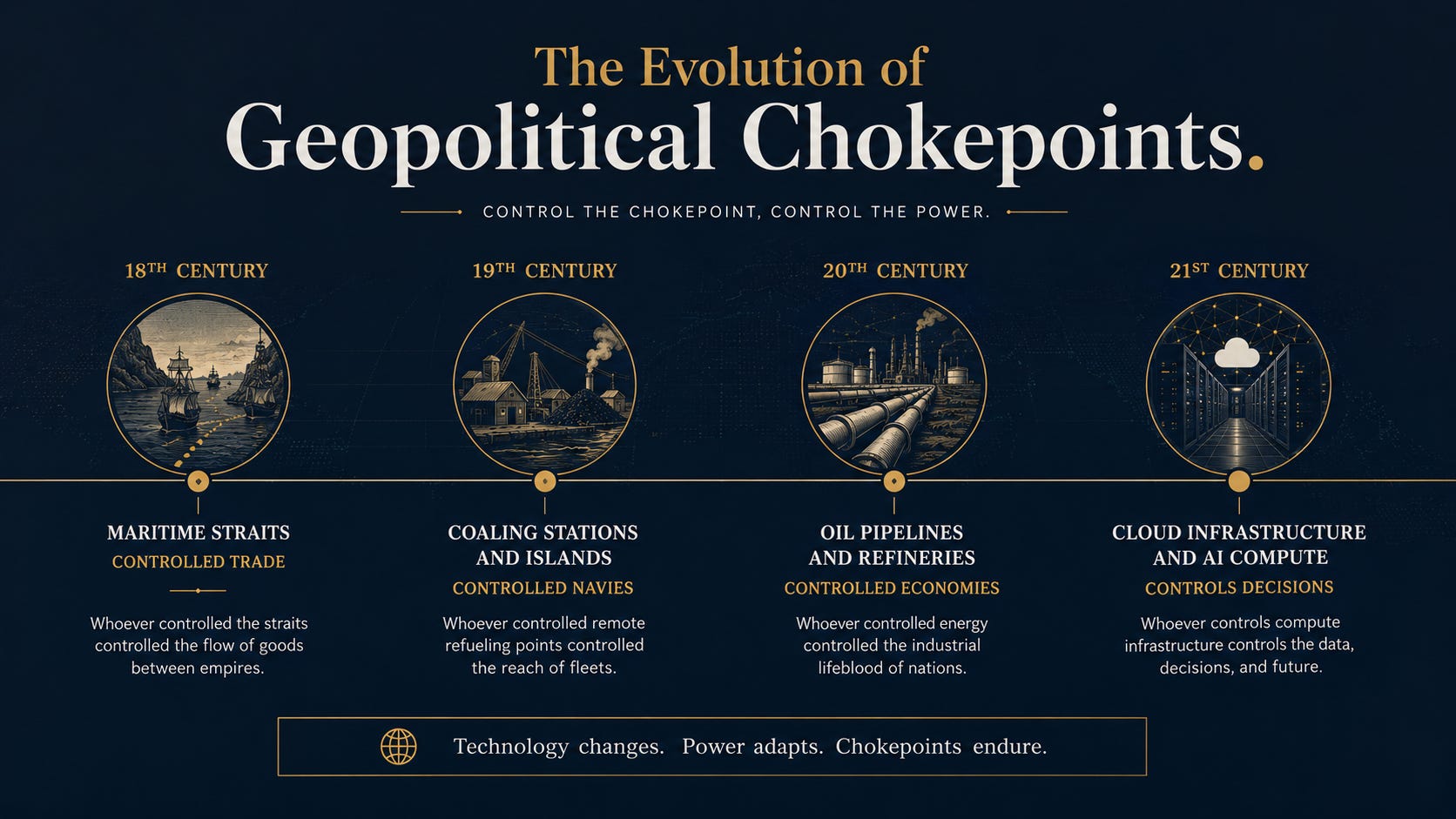
For centuries, the geometry of physical chokepoints defined global power. Whoever controlled the stone fortresses along the Strait of Malacca controlled the trade lanes between empires. Whoever controlled the remote, rocky islands of the Atlantic and Pacific controlled the coal refueling stations that powered nineteenth-century navies. In the twentieth century, that geometry shifted to oil pipelines and deep-water ports.
Today, the architecture of power is computational. The modern equivalent of a coaling station is a multi-megawatt server cluster.
The stakes have changed because artificial intelligence has altered what data represents. Data is no longer just static records or archived emails; it is the raw fuel for real-time institutional decisions. A government that relies entirely on a foreign cloud infrastructure to run its public services, secure its diplomatic communications, or train its domestic agricultural models remains inherently dependent on foreign tech ecosystems. This dynamic deepens the grip of Compute Concentration, leaving nations that do not manufacture their hardware trapped in a cycle of digital dependency.
On Earth, ground-based digital infrastructure faces mounting challenges in scaling due to severe energy constraints, cooling requirements, and community opposition to new data center builds. Industrial expansion is colliding with grid delays, water fights, and permitting battles. Denmark, for instance, has rationed grid access as an unprecedented buildout of data infrastructure floods Nordic power systems. In the American West, agricultural cooperatives and hyperscale server farms are increasingly fighting municipal battles over water rights.
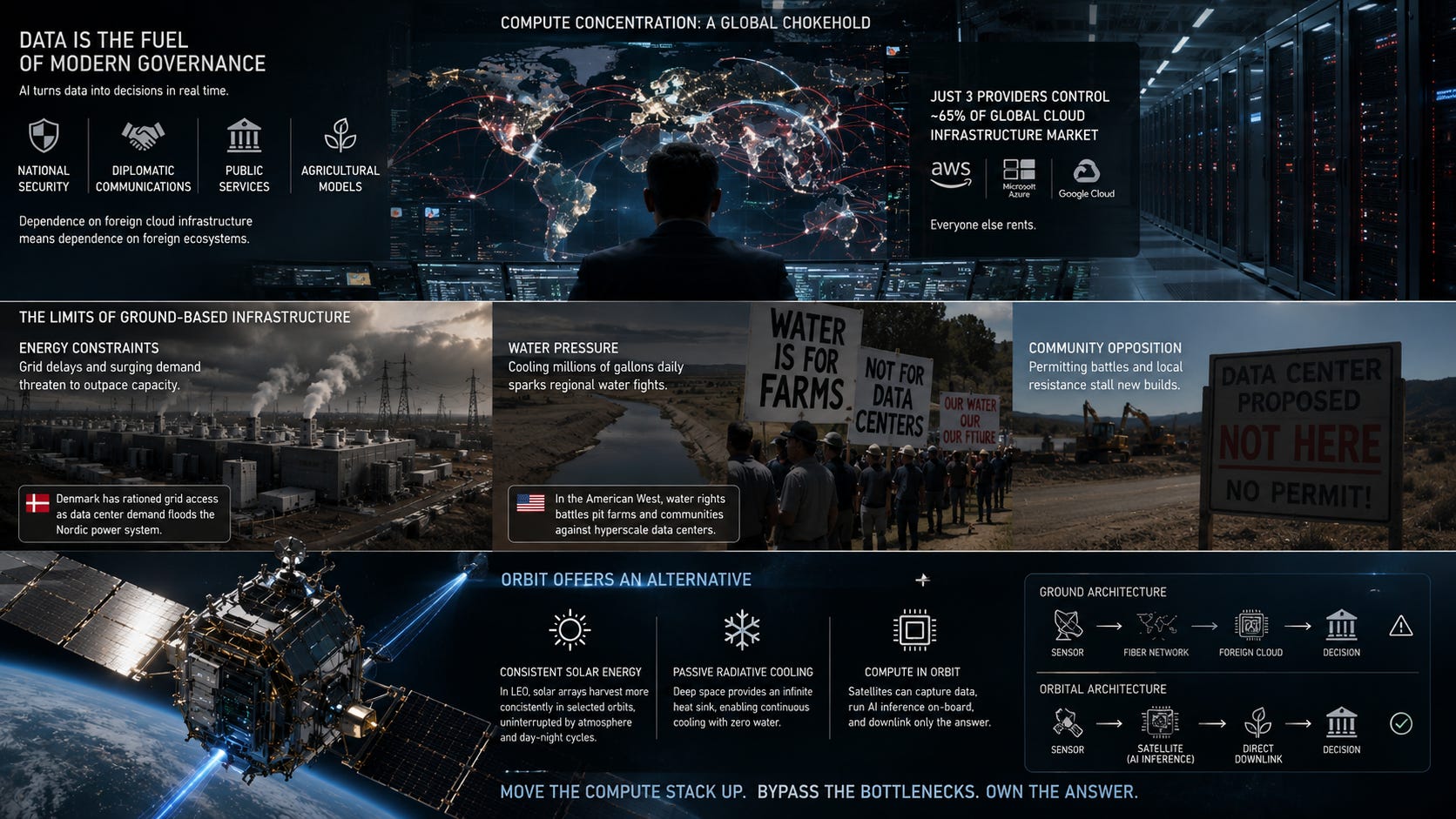
Orbit offers an alternative to some terrestrial constraints, but it also creates new ones. In low Earth orbit, outside the atmosphere, solar arrays can harvest solar energy more consistently in selected orbits, liberated from atmospheric interference and the standard day-night cycle. The infinite heat sink of deep space provides a continuous environment for passive radiative cooling, requiring zero water.
By shifting the compute stack upward, nations can bypass certain terrestrial infrastructure bottlenecks. A satellite can harvest sunlight, run processors, and send down only the answer.
Inverting the Eye in the Sky
The historical phrase “eye in the sky” has always carried the heavy scent of asymmetric surveillance. It implied the strong looking down upon the weak superpower reconnaissance platforms mapping the fields, movements, and resources of the developing world; transmitting raw telemetry back to home bases; and selling the processed intelligence back to the target countries at a premium.
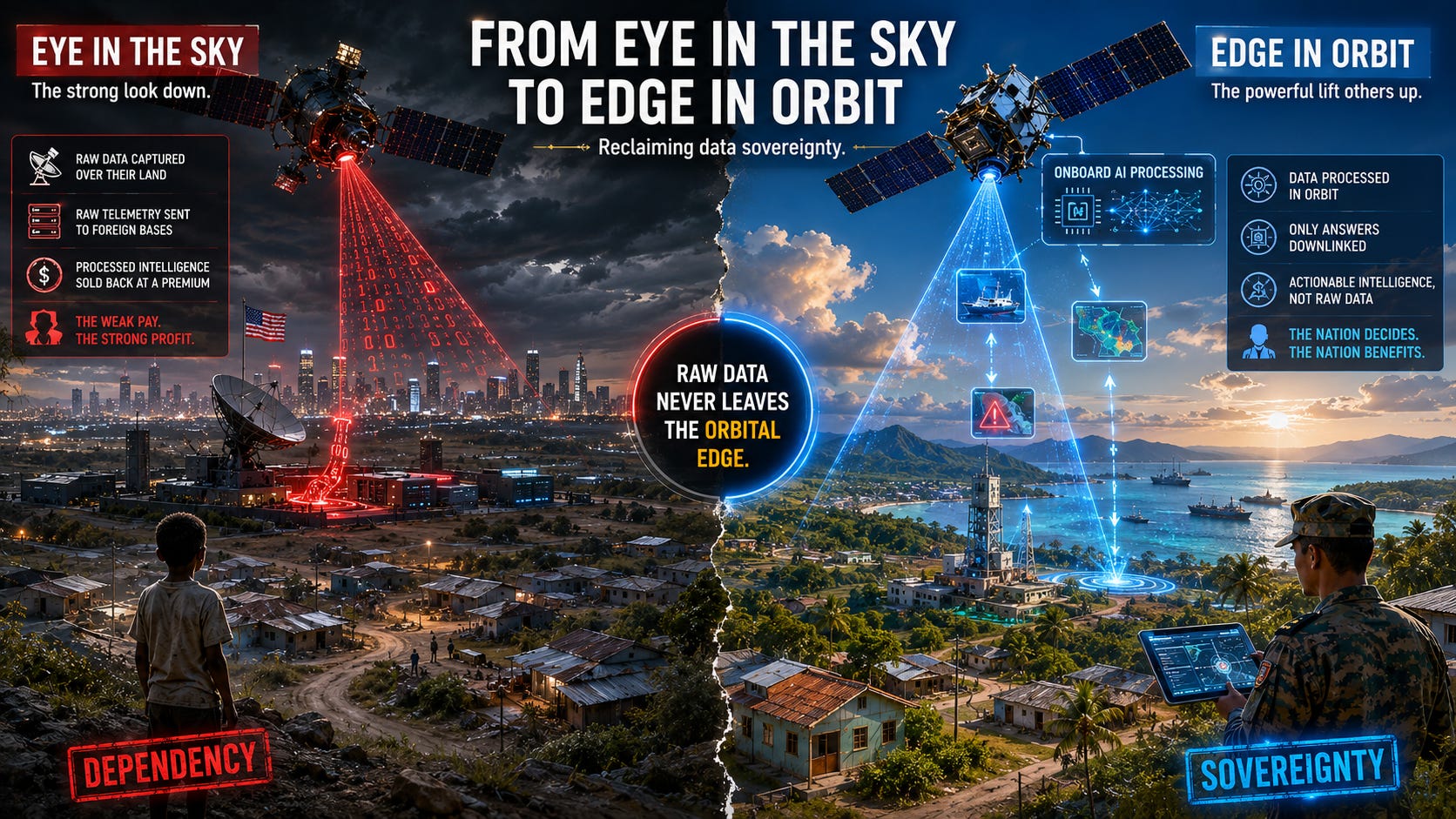
The orbital edge model undercuts this relationship. Edge compute in orbit means processing data directly aboard a satellite rather than transmitting raw data streams back to a distant ground station for external analysis.
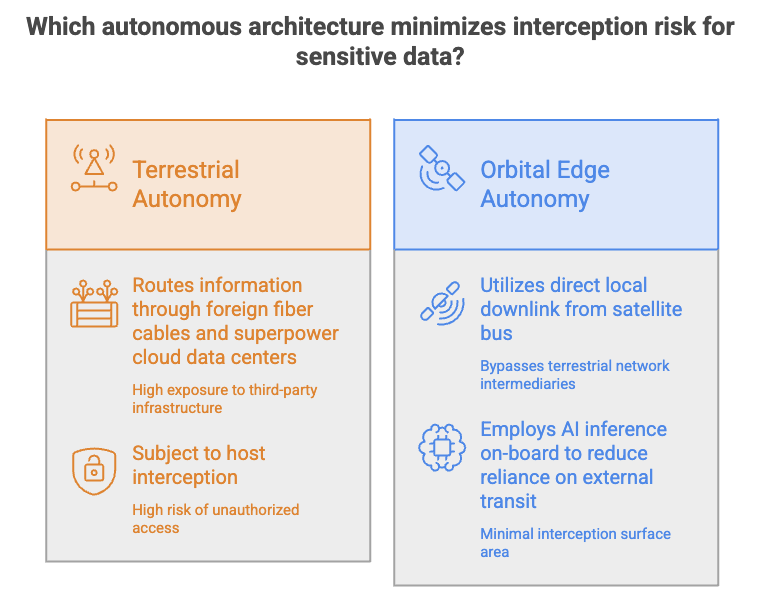
Under this architecture, a satellite passing over a territory can capture high-resolution imagery, feed it directly into an onboard neural network, calculate the coordinates of an illegal logging operation or an unregistered vessel, and downlink the actionable alert directly to a local operator’s device. The raw image, the high-value digital asset containing the unedited truth of a territory, never needs to leave the orbital pass. The intelligence comes down; the national data stays up.
This is no longer a purely theoretical exercise. The technology has broken through its demonstration phase. In early 2026, SpaceX filed applications with the Federal Communications Commission to deploy a solar-powered orbital data center constellation designed to support AI workloads.
Simultaneously, commercial startups like Starcloud have contracted SpaceX launches to validate data-center-grade processors in the low Earth orbit environment. Lonestar Data Holdings has successfully operated data center payloads en route to the moon aboard Intuitive Machines’ Athena lander to test secure, off-world data archiving. Meanwhile, the European Space Agency’s ASCEND feasibility study analyzed the architecture to see if space-based data centers could be technically and environmentally feasible, and how such networks might reduce the environmental and electrical strains on terrestrial infrastructure.
First AI Datacenters In Space! EXCLUSIVE Starcloud Tour
The Structural Realities of the Void
Yet, the strategic reality of this space race forces a sharp counterargument. The physics of the void are far less forgiving than the polished diagrams of a pitch deck. There is a distinct possibility that the entire orbital computing thesis will face severe scaling constraints under the weight of its own mechanical contradictions.
The Thermal Trap
While space is cold, it contains no air. On Earth, servers survive because mechanical fans push air past hot components, a convective luxury that removes heat efficiently. In a vacuum, convection is non-existent. A processor running at high utilization must bleed its heat away entirely through thermal radiation, emitting infrared waves from black-surfaced plates.
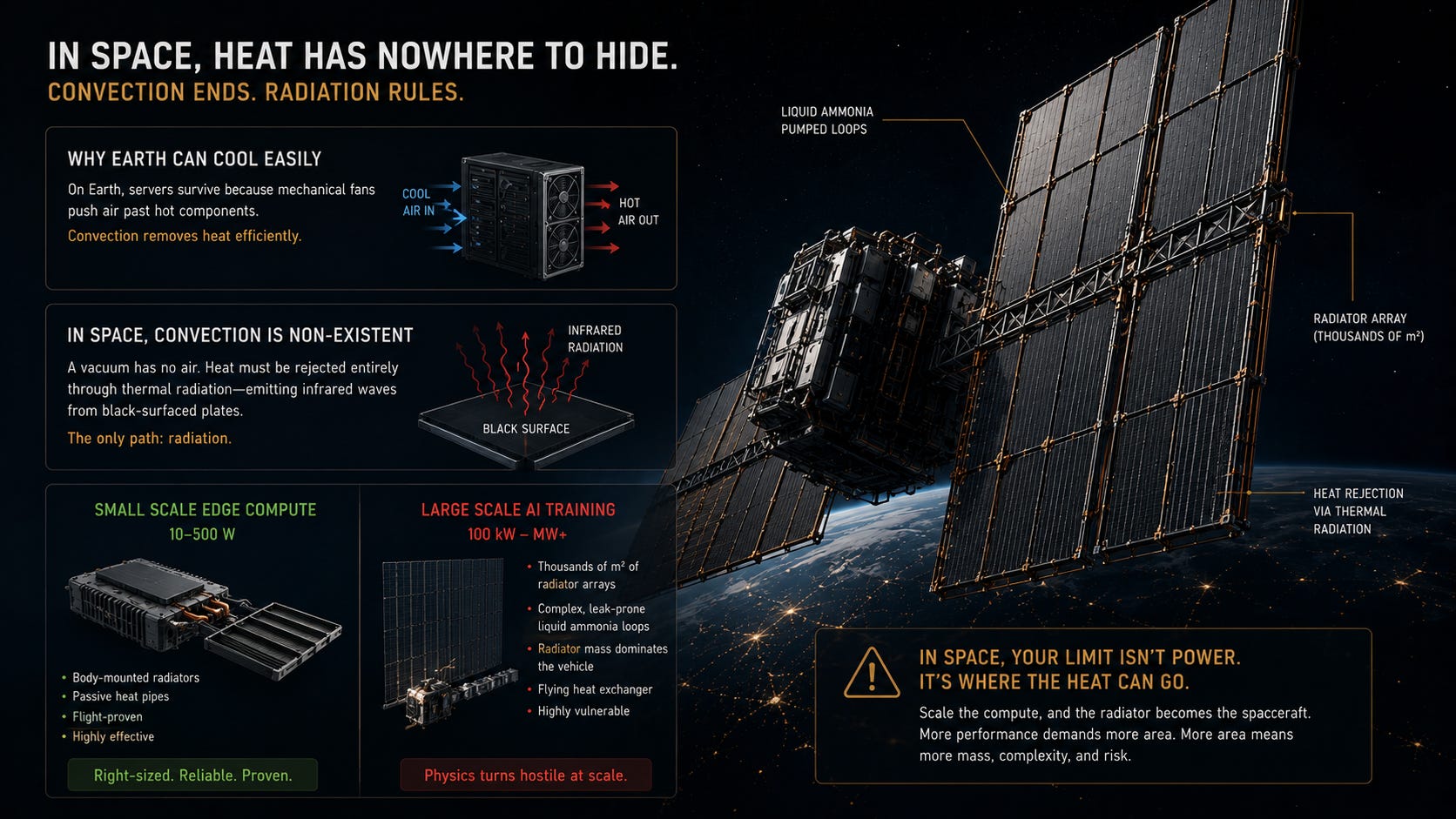
At an edge computing scale of 10 to 500 watts, body-mounted radiators and passive heat pipes are flight-proven and highly effective. But if operators attempt to scale these platforms to handle massive AI training workloads, the physics turn hostile. To reject large amounts of waste heat, a spacecraft needs thousands of square meters of radiator arrays and complex, leak-prone liquid ammonia-pumped loops. At that scale, the radiator dominates the vehicle mass, turning the platform into a flying heat exchanger highly vulnerable to mechanical failure.
The Silicon Shooting Gallery
Modern commercial graphics processors are engineered for air-conditioned, terrestrial bunkers. In low Earth orbit, they are exposed to a relentless bombardment of high-energy protons and galactic cosmic rays.
When a stray cosmic particle strikes a transistor, it can cause a single-event upset, flipping a zero to a one mid-calculation. Over months of exposure, total ionizing dose effects can permanently degrade the silicon, leading to current leaks that may destroy the chip.
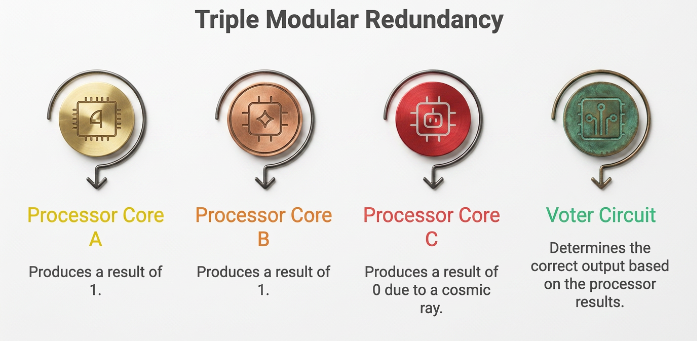
Traditional aerospace engineering solved this with radiation-hardened chips, but those components are highly specialized, extremely expensive, and lag generations behind modern processing speeds. The current wave of orbital startups is gambling on software-defined hardening, running identical calculation loops simultaneously across commercial chips and using a voting system to catch and isolate bit flips. But software triage cannot grant immortality. Radiation degradation strictly caps the lifespans of these orbital edge nodes, requiring constant capital-intensive deployment cycles.
The Kinetic Threat and the Debris Wall
The low-Earth orbit environment is a crowded, hyperkinetic arena. There are tens of thousands of tracked pieces of space debris traveling at seven to eight kilometers per second. A collision with even a minor fragment carries enough kinetic energy to catastrophically disrupt or puncture a computing node. Because these systems serve critical data security and intelligence-gathering functions, they also inherit a massive strategic target footprint. In a geopolitical crisis, an orbital data network could face direct terrestrial interference, from ground-based electronic jamming to anti-satellite cyber operations.
Moving space debris out of the way with OMLET
The Illusion of Lawless Orbit
The legal architecture governing this orbital frontier is just as fragile as the silicon flying through it. A persistent misunderstanding suggests that because space is international territory, territorial data stored there exists outside the reach of Earth-bound law.
The Outer Space Treaty of 1967 does declare outer space a global commons immune to national appropriation or claims of sovereignty. This creates an initial appeal for digital infrastructure: if a server rack sits in a facility on Earth, it is completely subject to the domestic surveillance laws, administrative wiretaps, and national security subpoenas of the host nation. The state can compel the cloud operator to hand over data streams or encryption keys.
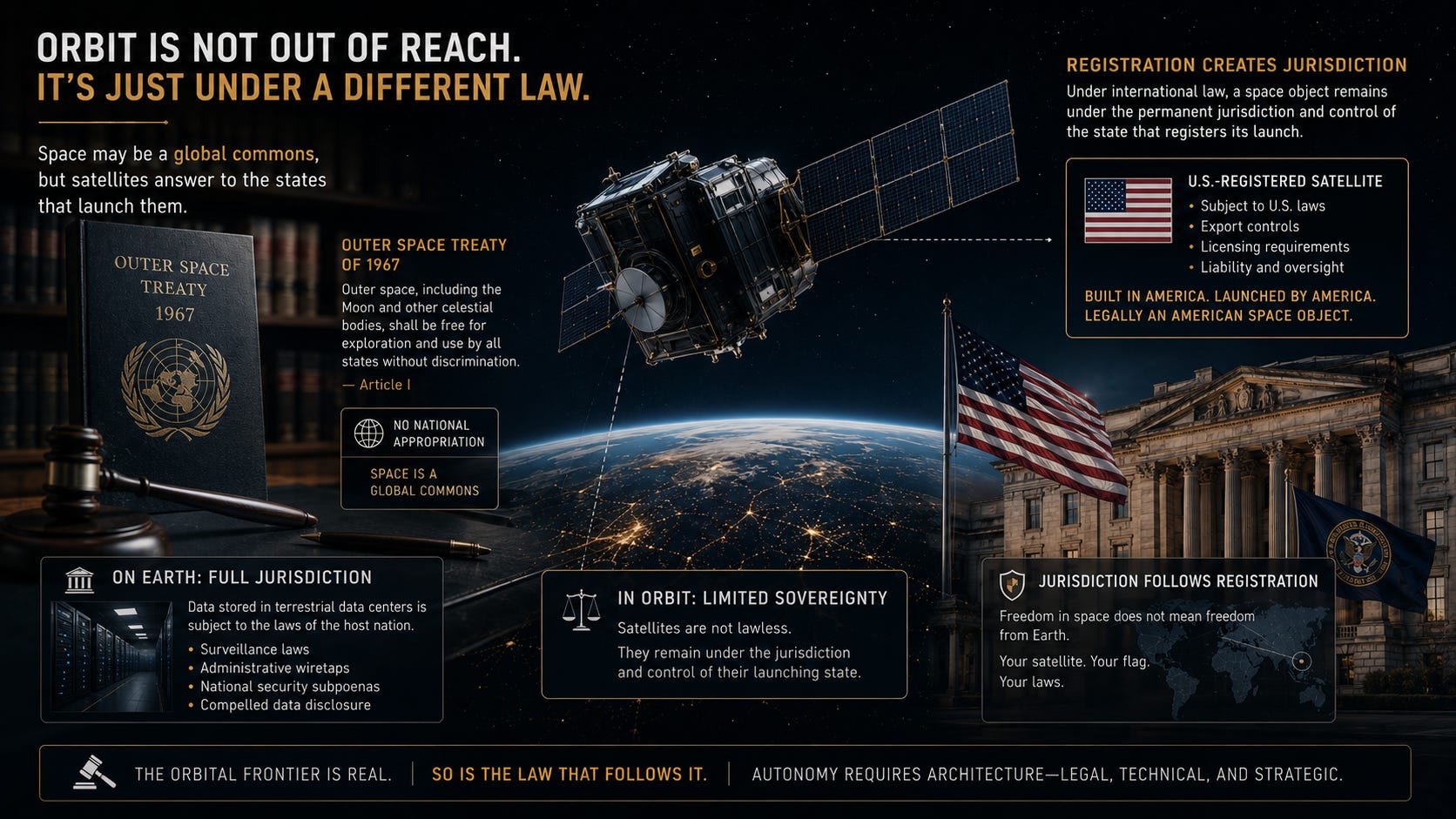
However, orbital assets are never truly jurisdictionless. Under the established international treaty framework, a space object remains under the permanent jurisdiction and control of the specific nation that registered its launch. A satellite built by an American firm and launched on an American rocket is legally considered an American space object, subject to its domestic export controls, licensing laws, and liability chains.
The strategic innovation occurring in the space cloud market is not jurisdictional escape but jurisdictional design.
Companies are structuring projects through complex multinational layerings: incorporating the parent entity in one country, financing it through an international venture consortium, integrating the satellite bus in a European aerospace hub, utilizing hardware manufactured in Asia, and launching from an equatorial pad. When an administrative subpoena, a catastrophic data breach, or an act of digital espionage occurs on a platform with that corporate pedigree, the traditional machinery of domestic law does not vanish, but it becomes immensely harder to enforce.
This is why the historical micronation fantasy of Sealand, the abandoned anti-aircraft platform in the North Sea that tried to claim sovereign statehood, is the wrong metaphor. European courts rejected Sealand’s sovereignty because an artificial platform does not constitute natural territory. Orbit will not produce floating, lawless micro-states either. Instead, it is producing distributed infrastructure whose political importance outruns the legacy legal categories built to contain it.
The Infrastructure of Decisions
As this orbital cloud scales, Compute Concentration will remain the central friction point. Legacy earthly powers will simply follow the compute stack upward. The transition will not result in a flawless digital utopia. The sky will have its own version of maritime chokepoints: tightly regulated spectrum allocations governed by the International Telecommunication Union, launch monopolies held by a handful of heavy-lift rocket providers, extreme insurance constraints, and intense corporate consolidation.
THE REALITY OF ORBITAL AUTONOMY:

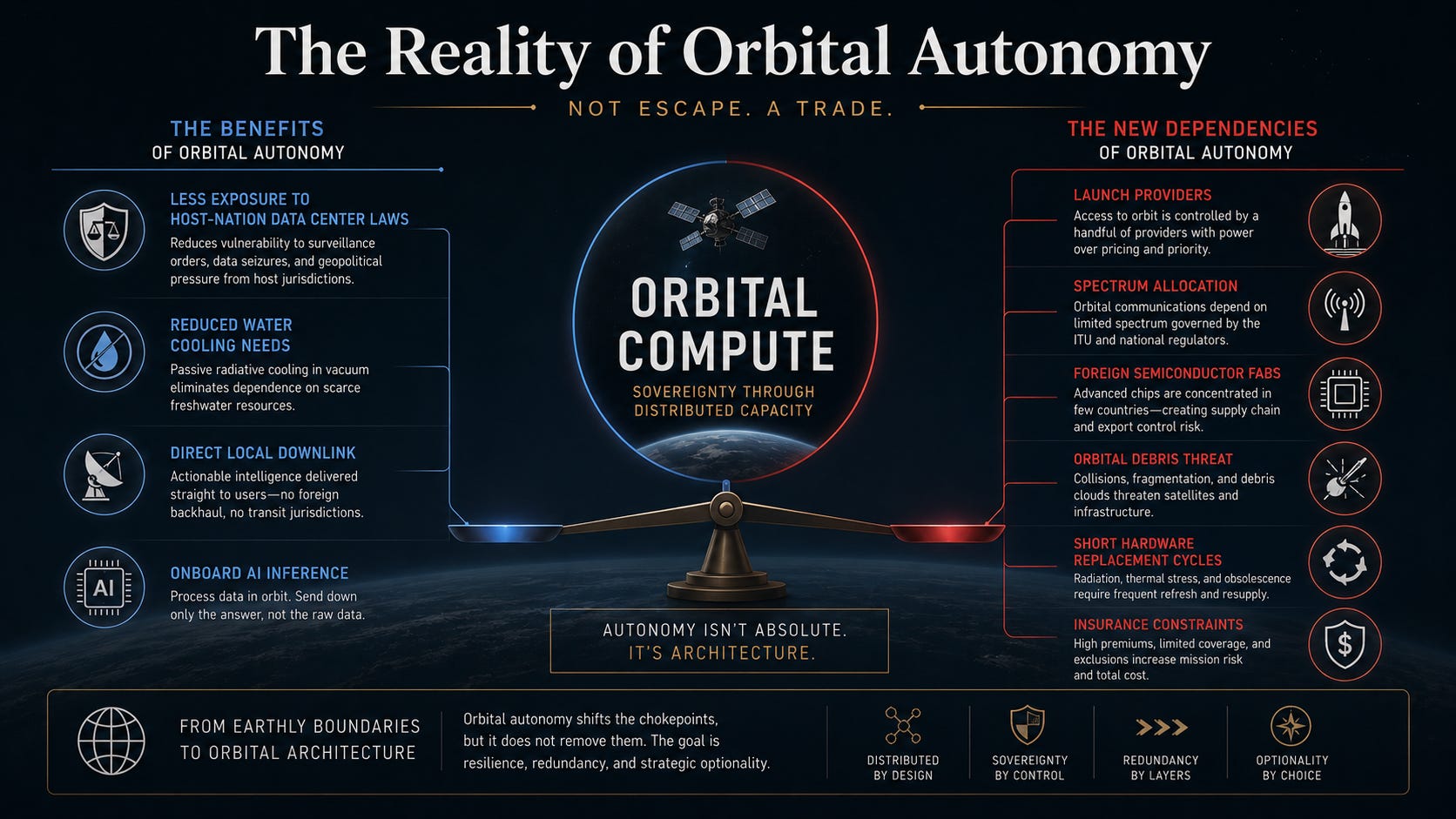
But for smaller and mid-sized nations, the objective is not to build a permanent empire in the stars. The objective is bargaining power.
They do not need to own an entire global, gigawatt-scale satellite mega-constellation to change their geopolitical standing. They merely require a dedicated, trusted layer of distributed orbital edge capacity that can process sovereign data on their terms, enough to monitor their borders without handing raw telemetry over to a rival power; enough to protect their domestic environmental data from becoming foreign intelligence products; enough to prevent their entire public administration from becoming permanently dependent on a landlord’s servers.
The deeper shift here is fundamentally philosophical. For centuries, autonomy was defined entirely by land, by physical borders, deep-water ports, roads, electrical grids, and standing armies. Then, autonomy became partly digital: a frantic race to control fiber-optic cables, localized server banks, encryption protocols, and foundational models. Now, even that definition is moving.
The state that cannot compute cannot fully govern. The state that cannot protect its data cannot fully decide.
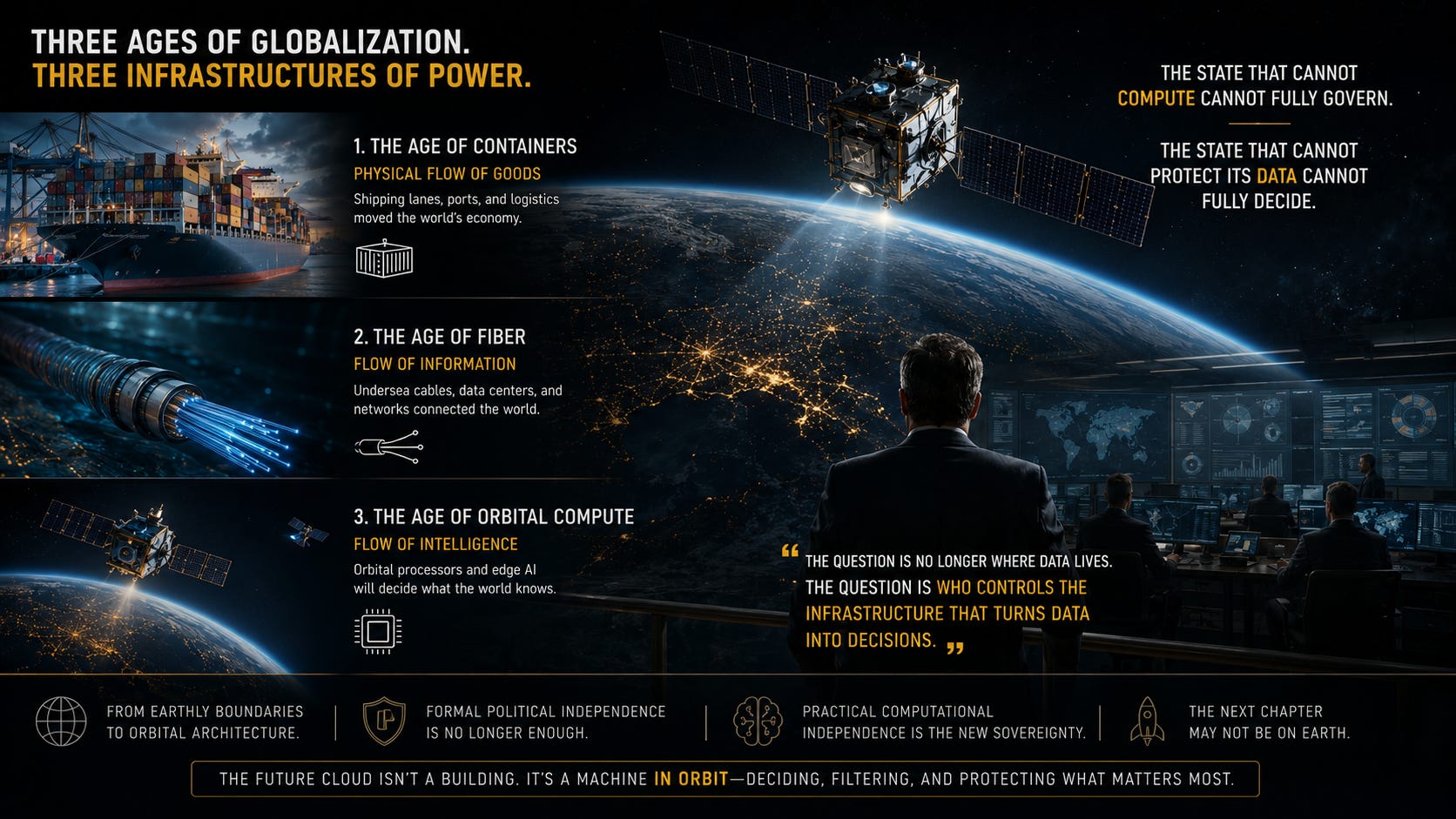
The first age of globalization was built on shipping containers. The second was built on fiber-optic cables. The third is being built on orbital processors. And the countries that fail to secure independent access to them may soon discover that formal political independence and practical computational independence are no longer the same thing.
The future cloud will not be an anonymous concrete building in Oregon, Virginia, or Dublin. It will be a small, hot, fragile machine crossing the night side of the Earth at seventeen thousand miles per hour, silently deciding what must be known, what can be forgotten, and who is permitted to receive the answer.
The question is no longer where data lives. The question is who controls the infrastructure that turns data into decisions. For most of the digital age, that infrastructure sat firmly on the ground. The next chapter may not.