

The Bamboo Uprising
Eco-Schools That Are Hacking Education for a Sustainable Tomorrow

In the humid embrace of Bali’s Ayung River valley, where the air hums with cicadas and the scent of frangipani, a cluster of towering bamboo spires defies the concrete sprawl of modern schooling. This is Green School Bali, a place where classrooms dissolve into the jungle and lessons unfold amid rustling leaves. Founded in 2008 by jewelry magnate John Hardy—fresh off a TED stage where he sketched his vision of kids wielding machetes instead of iPads—the school now draws over 500 students from 41 countries, a mosaic of expat families and local scholars. Half of its 70 Indonesian pupils attend on full scholarships, a quiet rebellion against the velvet-rope exclusivity that often shadows elite education. But Green School isn’t an anomaly; it’s the vanguard of a global pivot.

By September 2025, UNESCO reports more than 80,000 schools across 87 countries have embraced “green practices,” from solar-powered labs to curricula that treat climate models like multiplication tables. These aren’t feel-good footnotes—they’re reshaping how a generation computes risk, reward, and the very math of survival.
The numbers tell a story of exponential creep, the kind that starts with a handful of visionaries and snowballs into systemic shift. Enrollment in sustainability-focused programs has surged 25% year-over-year since 2020, outpacing traditional international schools by a factor of three. Eco-Schools, a UNESCO-backed network, now boasts 52,552 member institutions worldwide, educating 13.7 million students in everything from permaculture to policy advocacy. It’s as if the planet’s fever dream has infected the blackboard, turning passive learners into active architects of resilience.
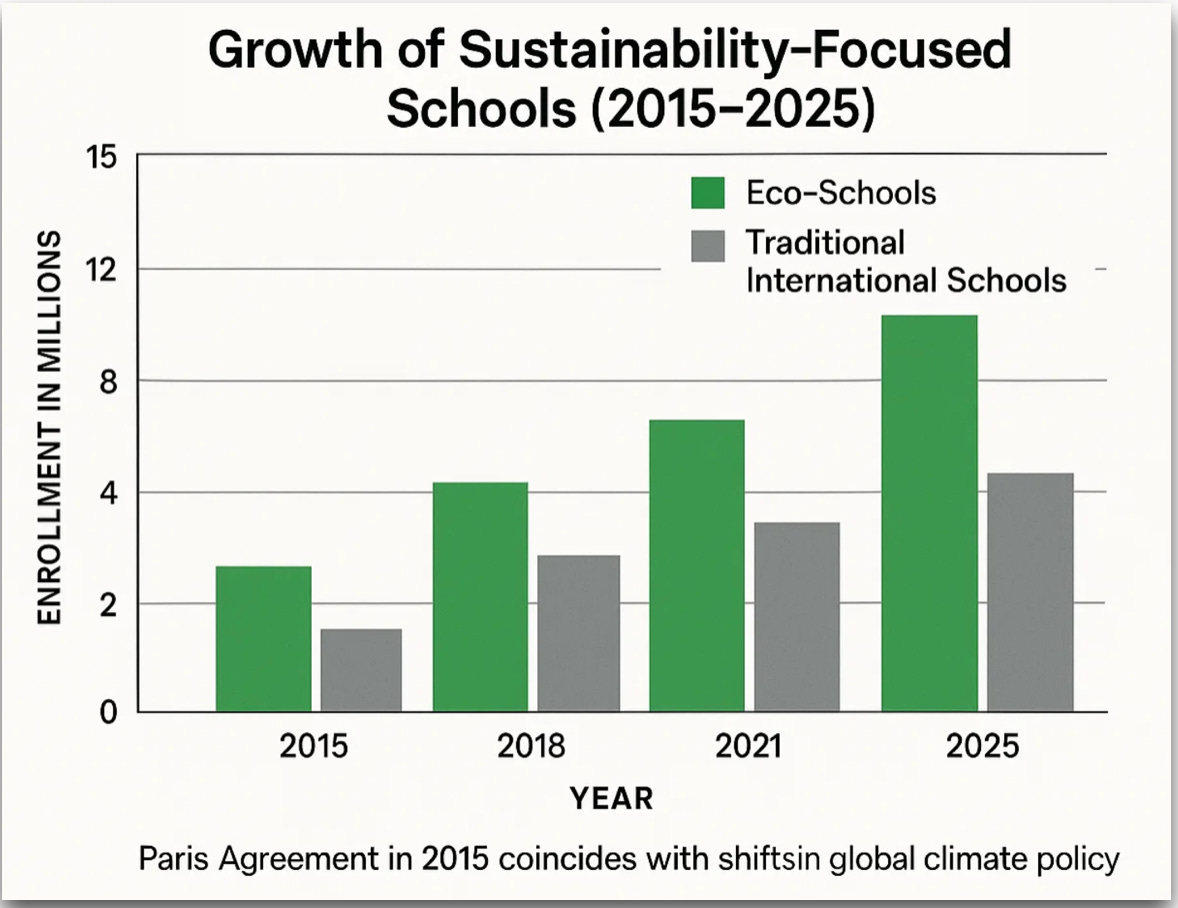
This bar chart illustrates the sharp trajectory of enrollment in innovative school models over the past decade, a proxy for the green wave sweeping education—from Bali’s bamboo groves to urban outposts in Cape Town and Seattle. Notice how the lines kink upward around 2015, coinciding with the Paris Agreement’s ink drying on the page. It’s not coincidence; it’s contagion.
What propels this? Consider the ripple from a single outlier. Melati and Isabel Wijsen, sisters who matriculated through Green School’s verdant halls, launched a nationwide plastic bag ban in Indonesia at ages 12 and 10. Their TEDx talk, viewed millions of times, didn’t just echo in echo chambers—it pierced boardrooms, inspiring bans from California to Kenya. Today, as young adults, they’re advising the likes of the Ellen MacArthur Foundation on circular economies, proving that a jungle-forged curriculum can outmaneuver Ivy League polish.
