

The Compliance Paradox
How the Pursuit of Perfect Oversight Is Weakening Government’s Ability to Act

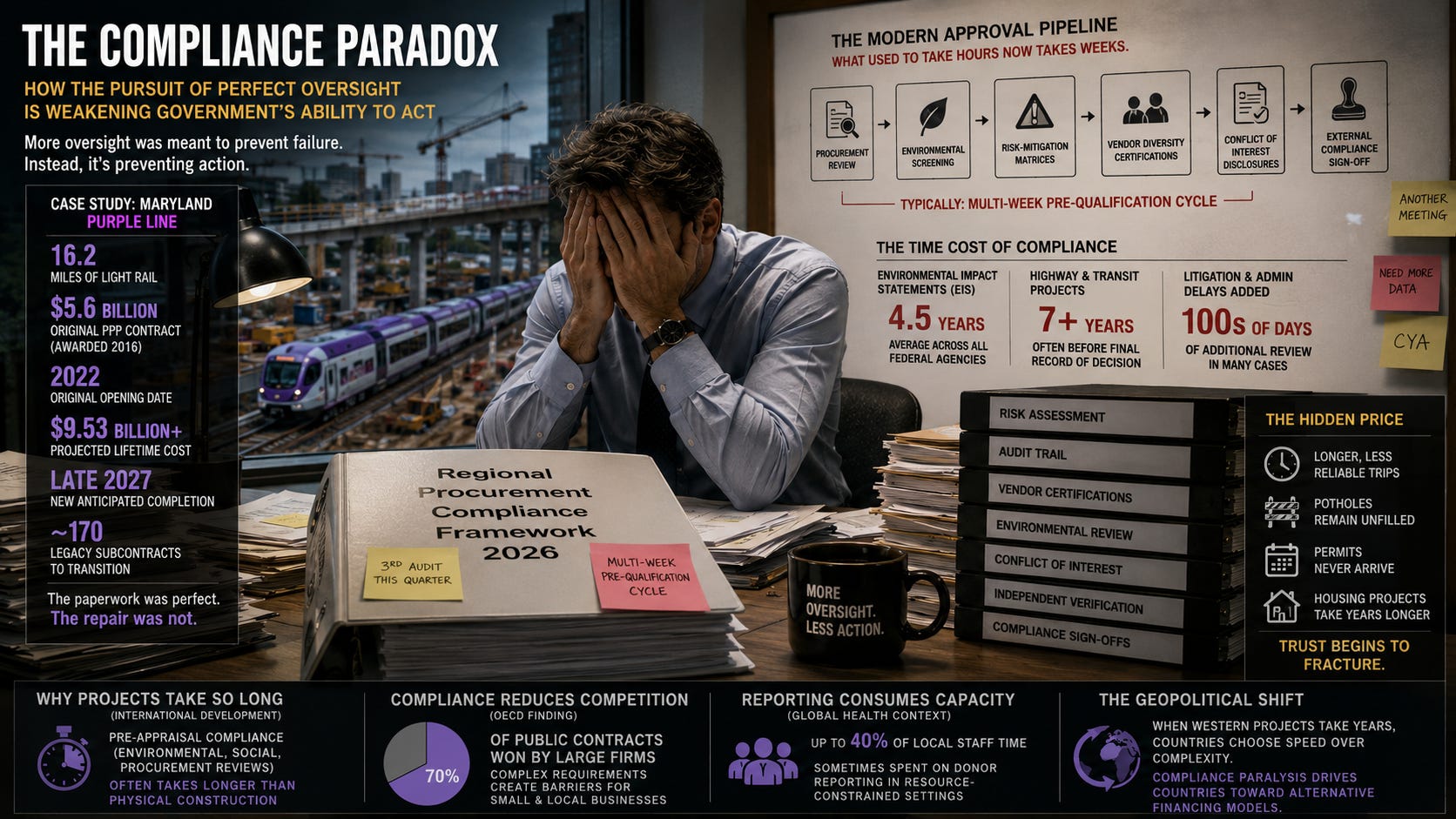
The conference room on the fourth floor of a regional transportation authority office smelled faintly of stale coffee, damp carpet, and high-end printer toner. A three-inch white binder sat precisely in the middle of the laminated table. Its spine read: Regional Procurement Compliance Framework 2026.
Across from me sat a procurement official with nearly a quarter-century of public service experience. He rubbed his eyes, his knuckles catching the glare of the fluorescent tubes overhead, and glanced toward the binder with a look of quiet exhaustion. His department was currently managing a regional transit maintenance upgrade, and they were simultaneously in the middle of their third external performance audit of the fiscal year.
He pointed to a laminated wall chart covered in a labyrinth of arrows, signatures, review gates, and color-coded decision trees.
“Twenty years ago, if a track joint failed or a signal cabinet flooded, we had approved contractors on speed dial,” he said, keeping his voice flat, almost clinical. “We checked their basic rates, made a few calls, and had crews working before the day was over. The contract size might have been fifty thousand dollars, and the delay was measured in hours.”
He paused, tapping his pen against the edge of the table.
“Today, for that same emergency patch, we have a mandatory multi-week pre-qualification cycle. We conduct procurement reviews, environmental impact screenings, risk-mitigation matrices, vendor diversity certifications, conflict-of-interest disclosures, and an external compliance sign-off from a third-party consulting firm. The paperwork is extraordinary. The failed signal cabinet or cracked rail remains unaddressed while the file moves through the queue.”
This opening scene is a composite drawn from recurring complaints across public agencies and infrastructure systems. Yet versions of this conversation are occurring inside government agencies, public hospitals, school systems, infrastructure authorities, development banks, and international organizations across the globe.
The complaint is remarkably consistent. The system has become exceptionally effective at documenting action, but it is becoming noticeably less capable of taking action. The problem is not too much accountability. It is accountability designed around institutional self-protection rather than public performance.
Many commuters lose time every day to longer, less reliable trips, while potholes remain unfilled, permits never arrive, and housing projects take years longer than promised. The gap between administrative success and lived reality is where trust begins to fracture.
That distinction sits at the heart of a significant structural crisis facing modern governance. For decades, democratic governments have embraced a simple, intuitive idea: when institutions underperform, increase oversight. If there is corruption, add reporting requirements. If there is waste, we should add audits. If there is public distrust, it would be beneficial to include transparency metrics. If a scandal arises, it would be beneficial to implement an additional layer of independent review.
Each individual reform appears sensible. In isolation, many of them are entirely defensible. Yet taken together, they have created a frustrating structural contradiction. The modern administrative state has become increasingly auditable, yet it has often become less capable of executing large, complex public missions.
The Rise of the Audit Society
This shift did not happen by accident. In his foundational study, The Audit Society: Rituals of Verification (Oxford University Press, 1997), sociologist Michael Power documented how modern institutions became obsessed with demonstrating accountability rather than delivering substance. Power observed that organizations increasingly judged themselves not by their real-world outcomes but by their ability to prove they were diligently following approved processes.
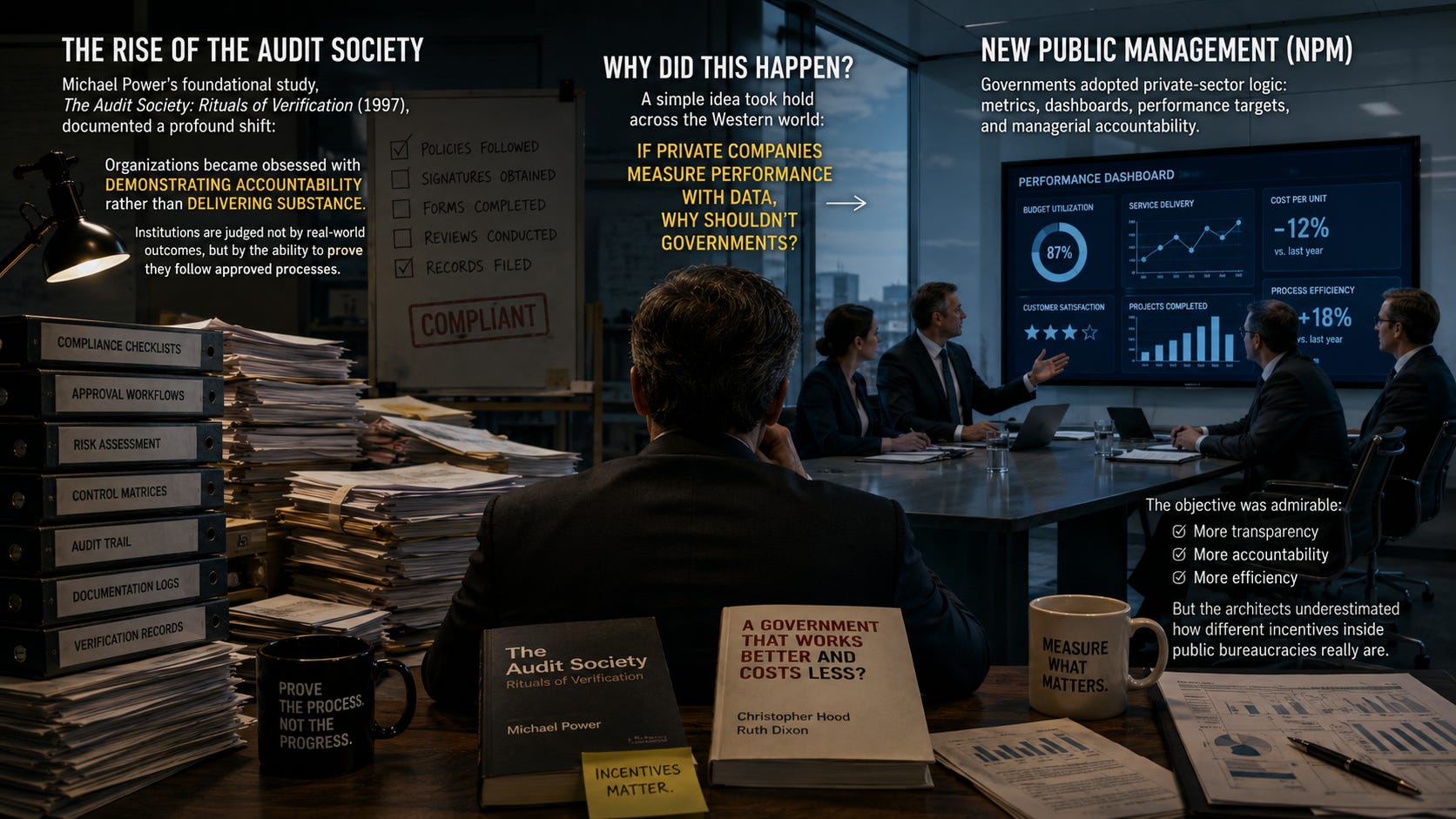
At roughly the same time, governments throughout the Western world embraced a broader reform movement known as New Public Management (NPM). The logic seemed obvious to the point of banality: private companies measured performance, tracked quantitative metrics, and evaluated managers using data dashboards. Why shouldn’t governments do the same?
The objective was admirable. Public institutions would become more transparent, more accountable to the taxpayer, and fundamentally more efficient. What the architects of these reforms underestimated, as Christopher Hood and Ruth Dixon detailed in their comprehensive retrospective, A Government that Works Better and Costs Less? (Oxford University Press, 2015), was how differently incentives operate inside public bureaucracies compared with private businesses.
A corporate executive who takes a calculated risk may receive a handsome reward if it succeeds. A public official who takes a calculated risk receives no financial bonus if it succeeds but faces potential career ruin, public shaming, or a formal integrity investigation if it fails. That asymmetry fundamentally alters human behavior in administrative settings.
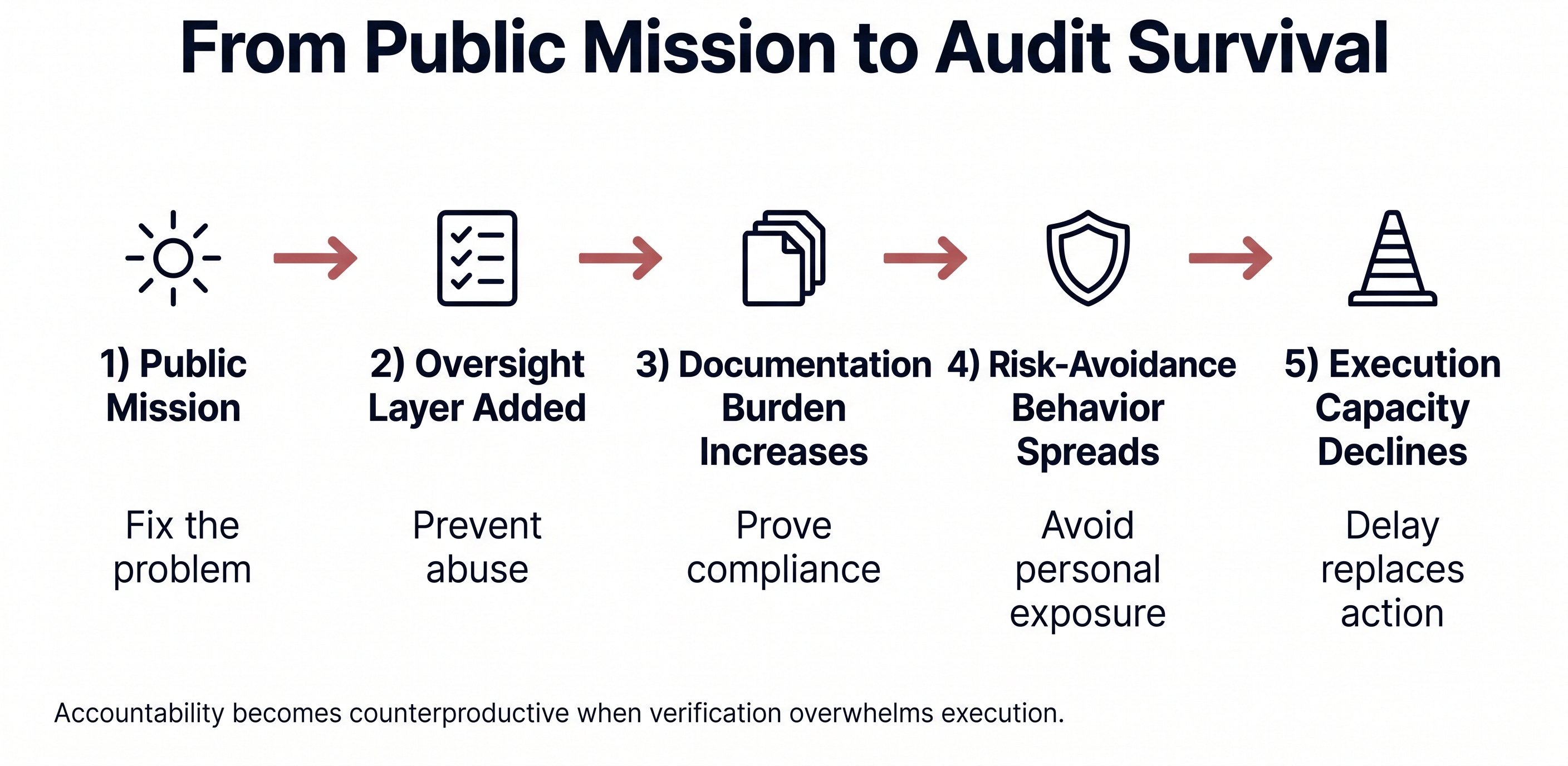
Over time, survival becomes more important than achievement. Avoiding a procedural mistake becomes more important than solving a tangible problem. Documentation replaces discretion. The mission slowly, invisibly shifts. The objective is no longer simply delivering results for citizens; the objective becomes ensuring that no future oversight committee can accuse you of violating procedure.
The Cost of Defensive Administration
Most public discussions of bureaucracy focus on the cliché of red tape. But the deeper, more insidious issue is the management of personal and institutional risk.
Imagine two public project managers. Manager A approves a public housing development six months ahead of schedule by actively cutting through administrative obstacles, bypassing non-essential internal reviews, and resolving vendor disputes with personal discretion. Manager B follows every procedural requirement to the letter, allows every review gate to take its maximum statutory time, delivers the project two years late, and vastly exceeds the budget due to inflation.
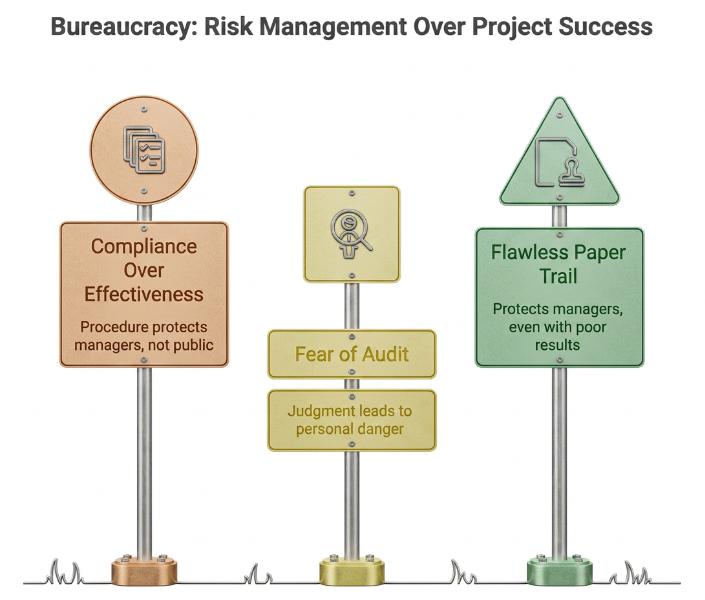
In many high-compliance institutions, it is Manager A who faces greater personal and professional danger. The project manager who exercised judgment created exposure. If a single line item in a subcontractor’s paperwork is flagged during a subsequent audit, Manager A faces a bruising inquiry. Manager B, meanwhile, followed procedure to the letter. Manager B created a flawless paper trail. Manager B is protected, even though the public outcome was objectively worse.
This dynamic gradually produces what organizational theorists call defensive administration. The safest decision becomes delaying. The safest email becomes the longest email, copied to twelve different departments. The safest meeting becomes another meeting. The safest response to an urgent problem becomes requesting an additional independent feasibility study.
No individual bureaucrat intends to create paralysis. The paralysis emerges organically from the accumulation of rational, self-protective decisions made by individuals attempting to navigate an unforgiving oversight ecosystem. The result is an institutional architecture that appears increasingly sophisticated on a spreadsheet while becoming progressively slower on the ground.
Case Study: The Anatomy of an Unbuilt Track
To see how this model works outside of a conference room, consider the modern reality of building transit. In 2016, the state of Maryland awarded a $5.6 billion public-private partnership contract to break ground on the Purple Line, a 16.2-mile light-rail system designed to connect suburbs in the Washington, D.C., metropolitan area. The line was originally scheduled to open in 2022. It was hailed as a model framework, which means it was designed as a transparent, heavily audited venture intended to share risk and satisfy rigorous regulatory compliance.
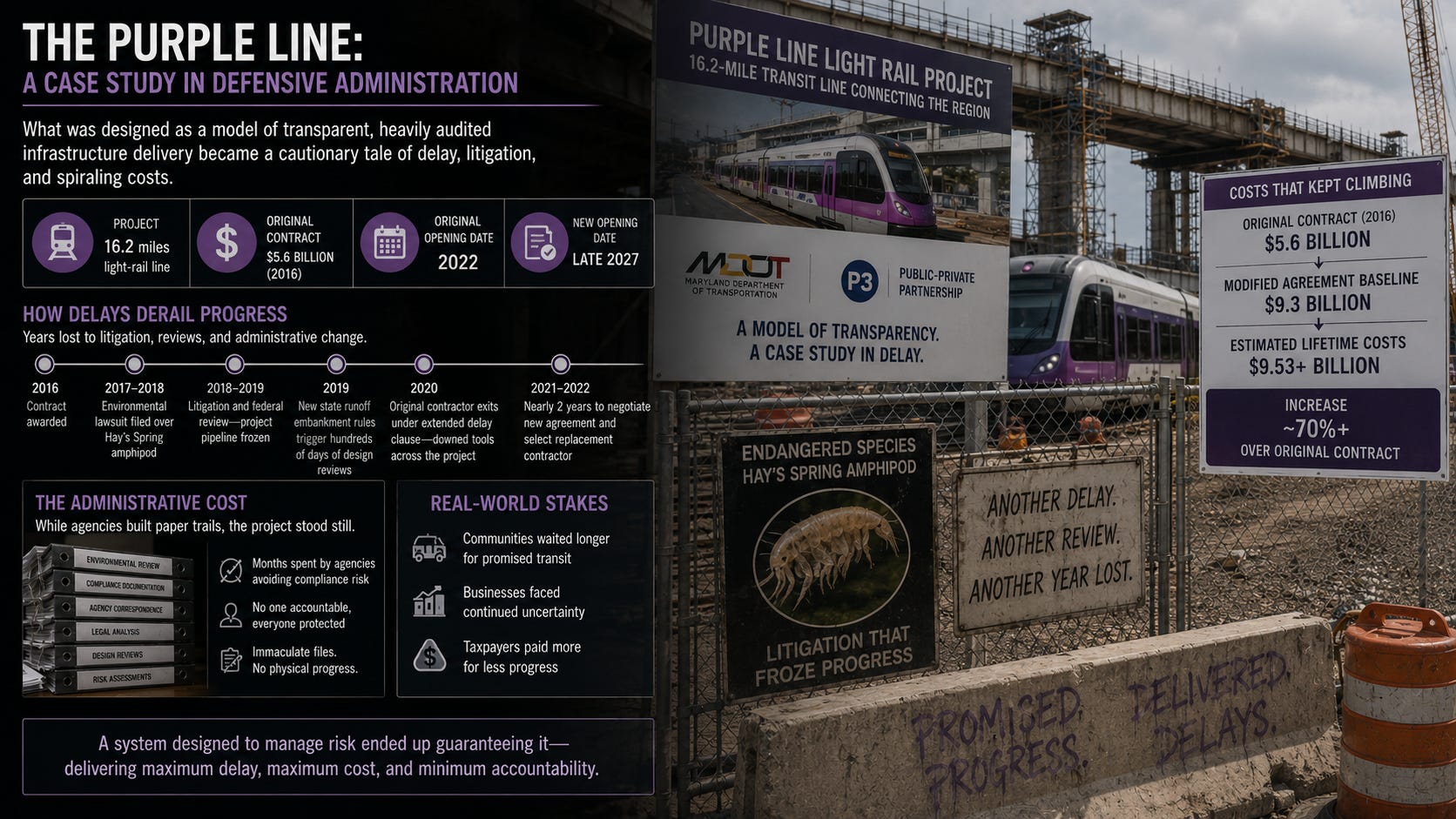
Instead, the Purple Line became a study in defensive administration. Before construction could gain momentum, a lengthy legal and administrative battle erupted when neighborhood opponents utilized federal environmental laws to challenge the project’s impact studies, specifically spotlighting potential threats to the endangered Hay’s Spring amphipod, a rare, tiny crustacean. Though federal wildlife officials ultimately verified that construction would not impact the species, the litigation froze the project pipeline. Compounding matters, a series of local administrative compliance shifts, including newly instituted state environmental rules regarding runoff embankments, triggered hundreds of days of additional design reviews. Every agency involved spent months generating defensive paper trails, avoiding individual responsibility for potential compliance breaches.
While the administrative files grew immaculate, the physical stakes collapsed. Blocked by mounting delays and disputes over who should absorb the costs of these administrative review gates, the project’s original private construction consortium exercised a clause in its contract allowing it to exit for extended delay, walking away from the job in 2020. Downed tools left the state government suddenly managing legacy subcontracts outside its normal operational capacity. It took nearly two years to negotiate a new agreement and select a replacement contractor consortium, a transition that added billions of dollars to the total project baseline.
By the time full-scale construction fully recovered, the modified agreement brought the project’s baseline cost to $9.3 billion, and continuous adjustments pushed long-term lifetime expenditures past $9.53 billion, with the anticipated completion date slipping to late 2027.
The human consequence of this administrative endurance test is felt daily on the ground. For every year the light-rail line sits in a state of rolling review, many commuters lose time every day to longer, less reliable trips across gridlocked highway corridors. Working-class families who chose housing along the promised line watch their transit options vanish, while local businesses, caught behind construction barriers on unfinished roads, quietly go under. The state successfully protected itself from procedural risk, but the public paid for that protection in lost time, failed businesses, and billions of dollars in additional costs.
$10B Maryland Purple Line Is Finally Running Trains
The Infrastructure Toll
The tangible consequences of this paradox shape the macroeconomic reality of modern nations. Consider the evolution of timelines for preparing international development projects.
Analysis from the Center for Global Development highlights that middle-income countries are increasingly reluctant to borrow from multilateral development banks for vital infrastructure due to the high nonfinancial transaction costs involved. Experts emphasize that a key part of resolving global infrastructure funding gaps relies on systematically reducing the administrative cost of doing business with international financial institutions. Researchers tracking institutional efficiency note that the pre-appraisal compliance phase of a project, which encompasses environmental safeguards, social risk assessments, and multi-layered procurement reviews, now frequently takes longer than the actual physical construction of the asset.
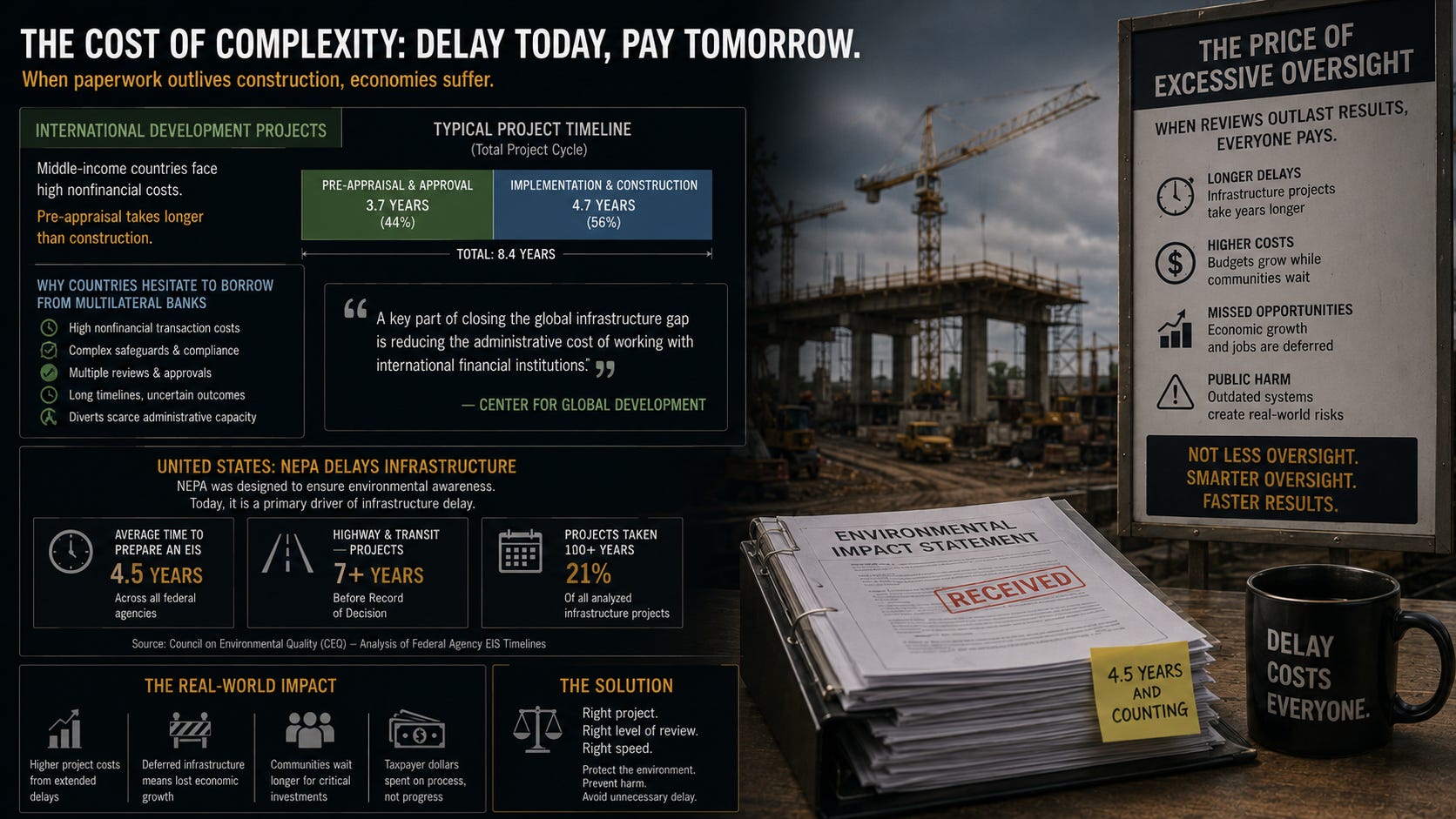
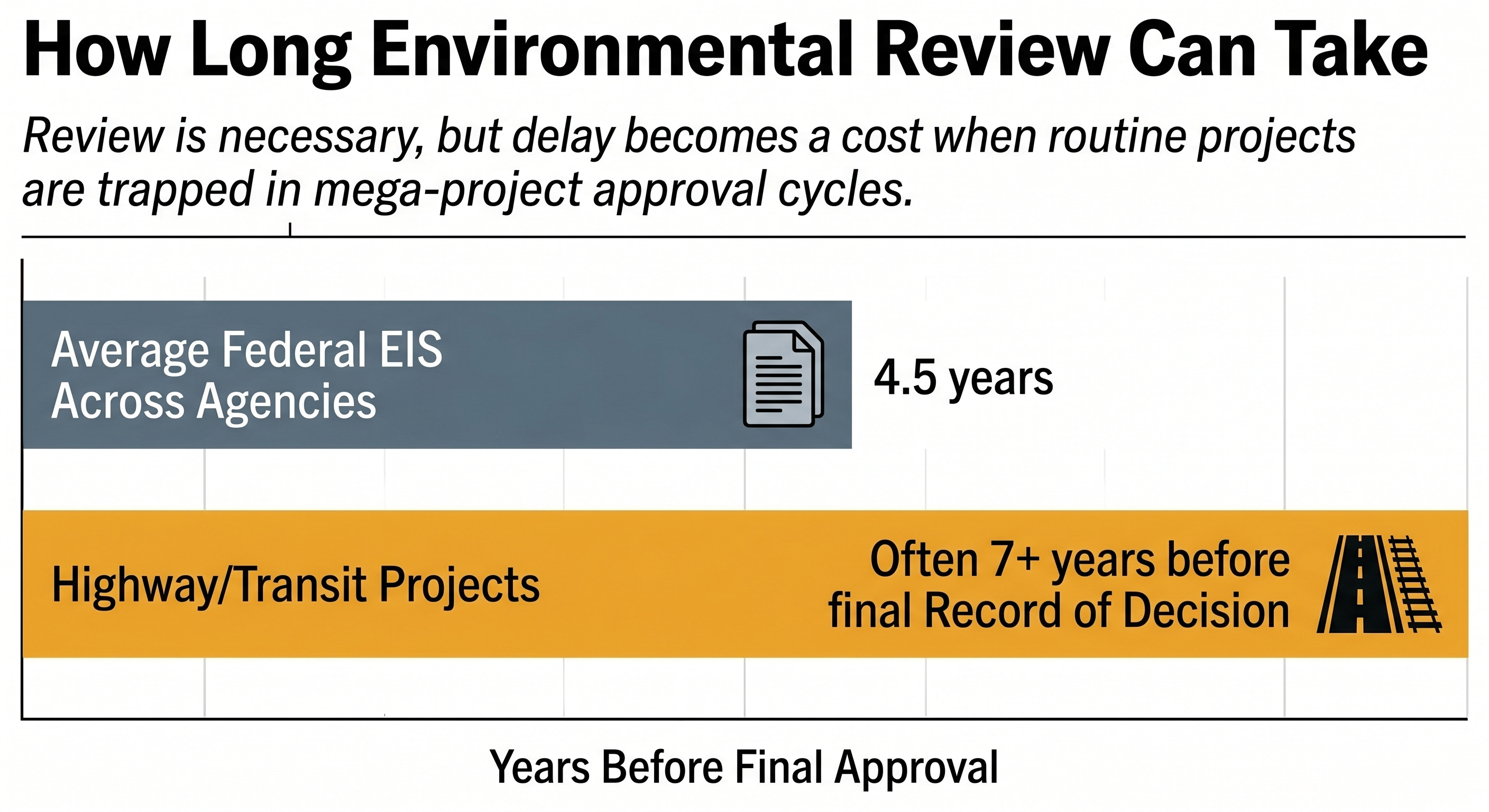
In the United States, a similarly dense oversight architecture constrains infrastructure delivery. The National Environmental Policy Act (NEPA), originally designed to ensure environmental awareness, has evolved into a primary legal battleground. According to data published by the Council on Environmental Quality (CEQ) in its comprehensive analysis of federal agency timelines, the average time required to prepare an Environmental Impact Statement (EIS) across all federal agencies sits at 4.5 years, with highway and transit projects routinely stretching past 7 years before receiving a final Record of Decision. The answer is not to erase environmental review but to distinguish between projects that truly require exhaustive scrutiny and routine maintenance work where delay itself creates public harm.
The administrative overhead of this process means that public funds are systematically drained by the cost of delay itself. Inflation eats away at purchasing power, engineering designs become obsolete before they are approved, and legal fees accumulate. By the time a project is cleared for execution, the total cost has often ballooned, not because the materials became more expensive, but because the process of verification consumed the budget.
The Market for Complexity
Compliance systems create a secondary effect that receives far less attention in political commentary: they often favor scale over agility.
The OECD’s Government at a Glance reporting framework has repeatedly noted that procurement complexity can raise participation costs, establishing structural barriers for smaller economic actors. As compliance requirements multiply, participation in public tenders becomes incredibly expensive. Large, multi-national contractors can easily afford dedicated legal teams, compliance departments, sustainability officers, and specialized audit consultants to complete government applications. Small, local firms, innovative startups, and agile community organizations often cannot.
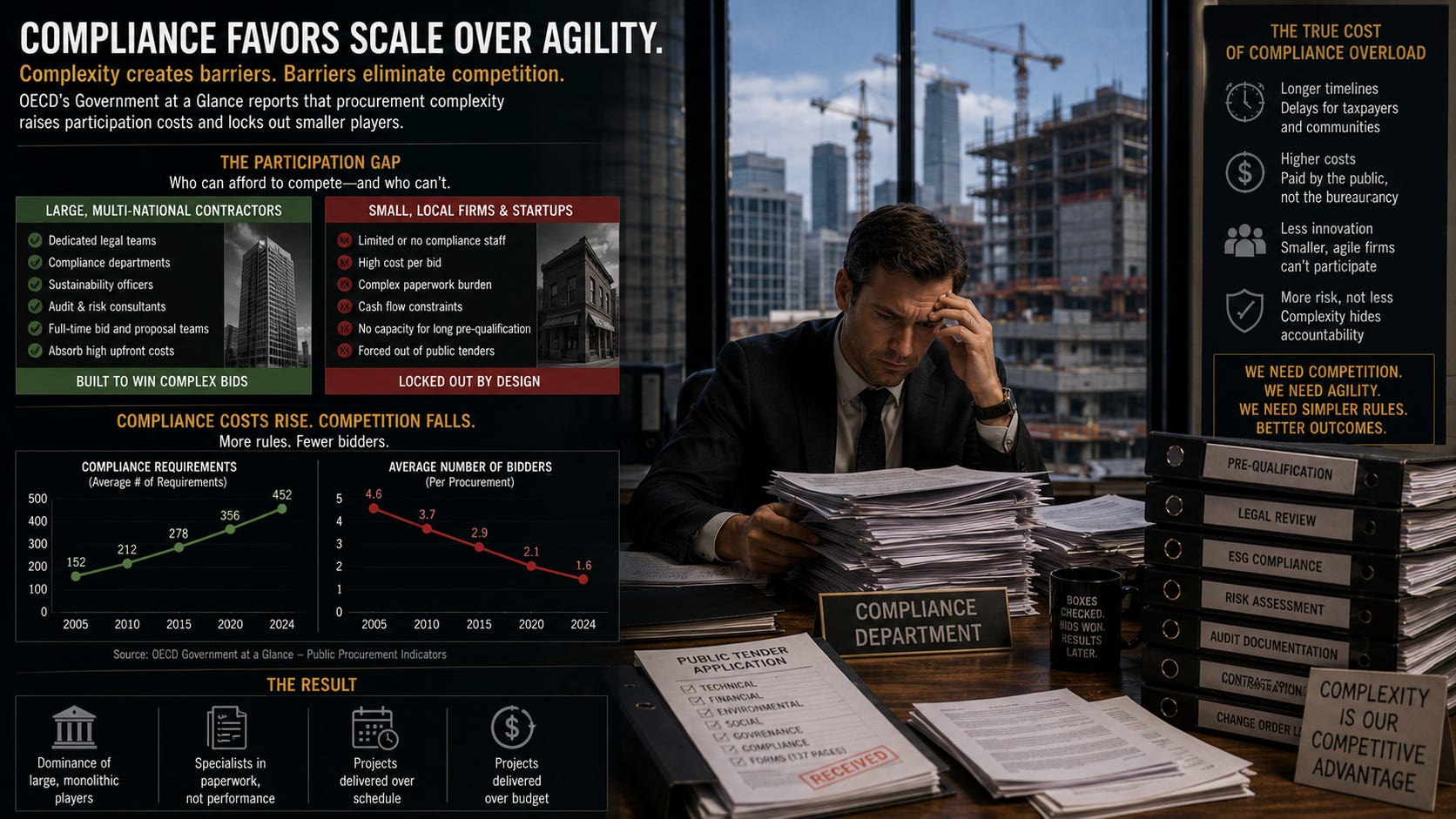
The procurement ecosystem becomes dominated by massive, monolithic organizations that specialize not necessarily in engineering or operational excellence, but in navigating administrative complexity. These compliance experts maintain entire departments dedicated to filling out government forms and checking boxes. They excel at winning bids and securing legal protection, yet they frequently deliver projects over schedule and over budget.
Conversely, agile local firms lack the administrative overhead to track hundreds of shifting metrics simultaneously. They are often highly efficient at physical execution but find themselves structurally locked out of the public bidding ecosystem entirely.
Complexity itself becomes a powerful competitive advantage held by corporate compliance experts. The organizations best equipped to complete the paperwork gain a distinct edge over the organizations best equipped to solve the actual problem. Over time, the state’s procurement mechanisms begin selecting for administrative fluency rather than raw operational capability.
Why Do American Transit Projects Cost So Much?
The Limits of the Metric
Transparency remains one of the defining ideals of modern open societies. Open institutions are structurally healthier than secretive ones; corruption becomes harder to detect in darkness, and public accountability requires visibility. Yet transparency contains an overlooked operational limitation.
The moment a quantitative measurement becomes an institutional target, people begin optimizing for the measurement itself rather than the underlying value it was meant to represent. Economists refer to this as Goodhart’s Law, named after Charles Goodhart, a former advisor to the Bank of England who formulated the principle in 1975.
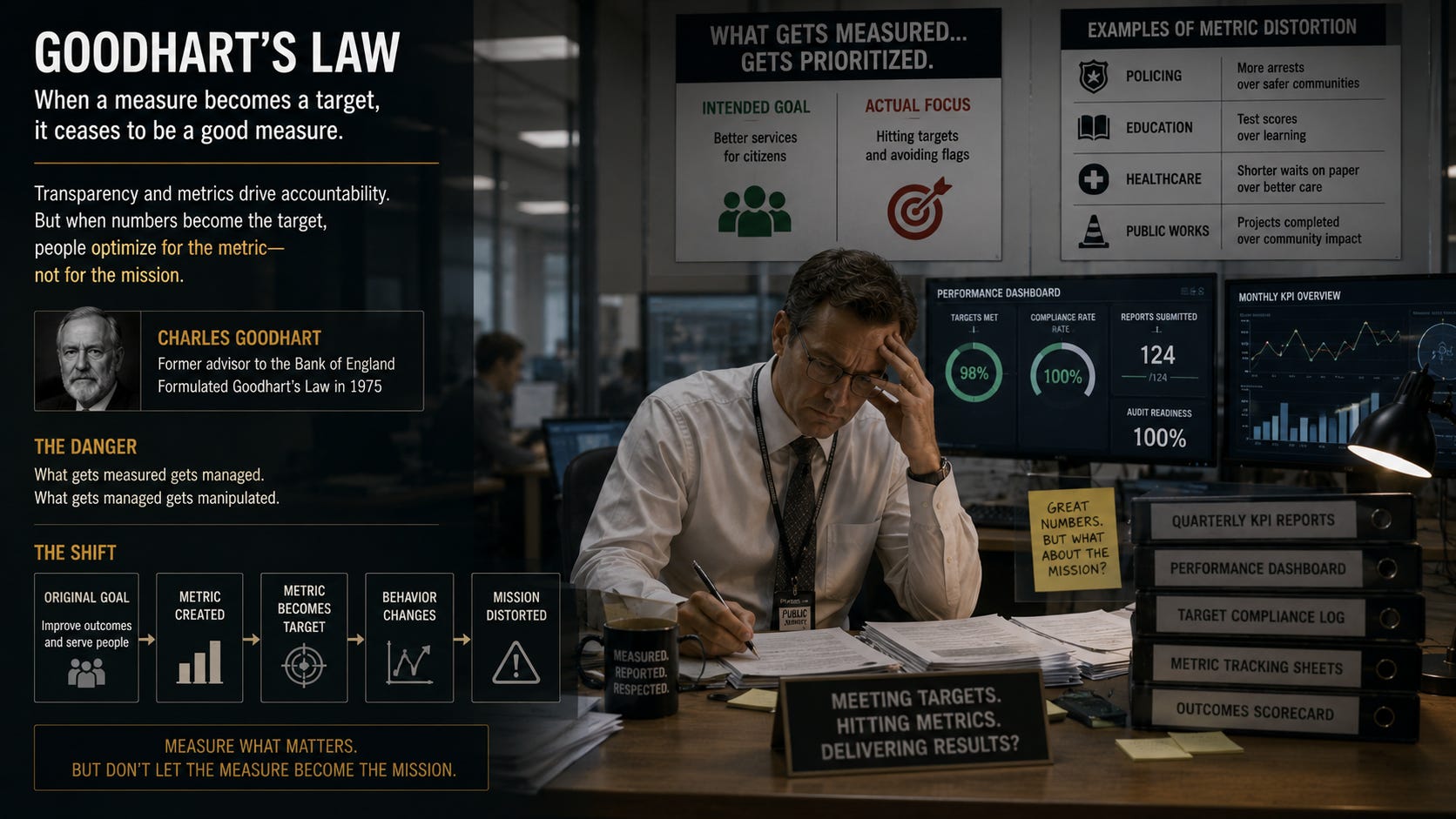
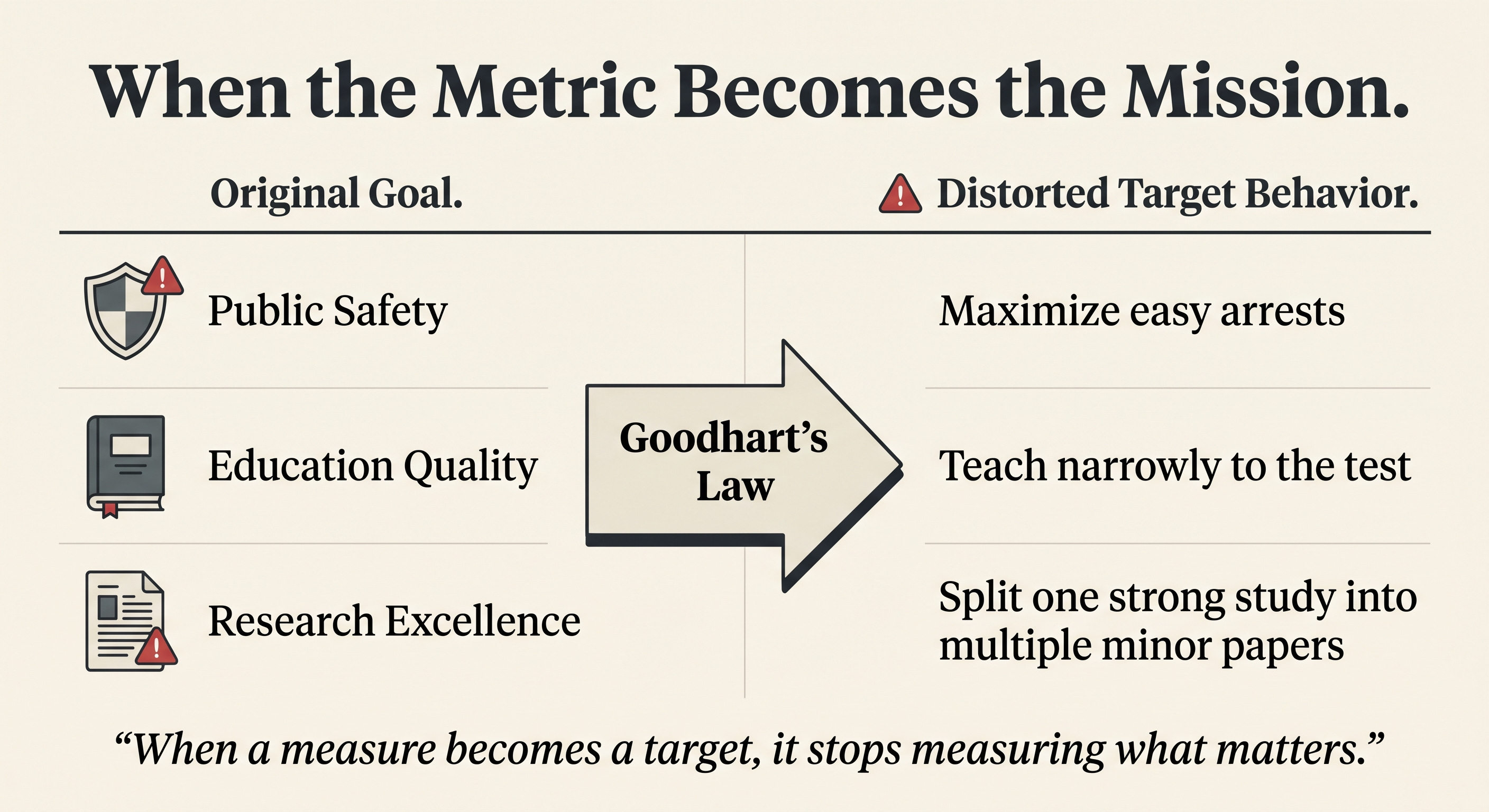
The examples are scattered across every sector of public life. Police departments judged primarily on arrest statistics may focus resources toward low-level, easily processed offenses rather than complex, long-term community safety initiatives. Schools judged strictly on standardized test scores naturally adjust their curricula to teach toward the exam, sacrificing deep critical thinking for rote memorization. University departments evaluated entirely on publication counts face intense pressure to split single, substantial research projects into multiple minor, repetitive papers to artificially inflate their metrics.
The metric starts as a proxy for quality. Then the proxy becomes the mission. Eventually, the metric and the underlying reality drift completely apart.
At that point, institutions can appear dazzlingly successful on paper while fundamentally disappointing the people they exist to serve. Citizens sense this disconnect. They watch public organizations celebrate high-performance indicators on public dashboards while everyday services visibly deteriorate. The official reports insist that progress is occurring; lived experience suggests otherwise. Public trust does not grow in this environment; it erodes in the deep gap between the audited metric and the physical reality.
The Global Dimension
The consequences of this paradox become starkly visible within international development and global governance, where multiple layers of sovereignty intersect. Over the past several decades, global institutions have constructed highly sophisticated systems for monitoring aid programs, development projects, and public sector reforms.
Donors want strict accountability. Taxpayers in donor nations want complete transparency. International development banks want ironclad safeguards against the misuse of funds.
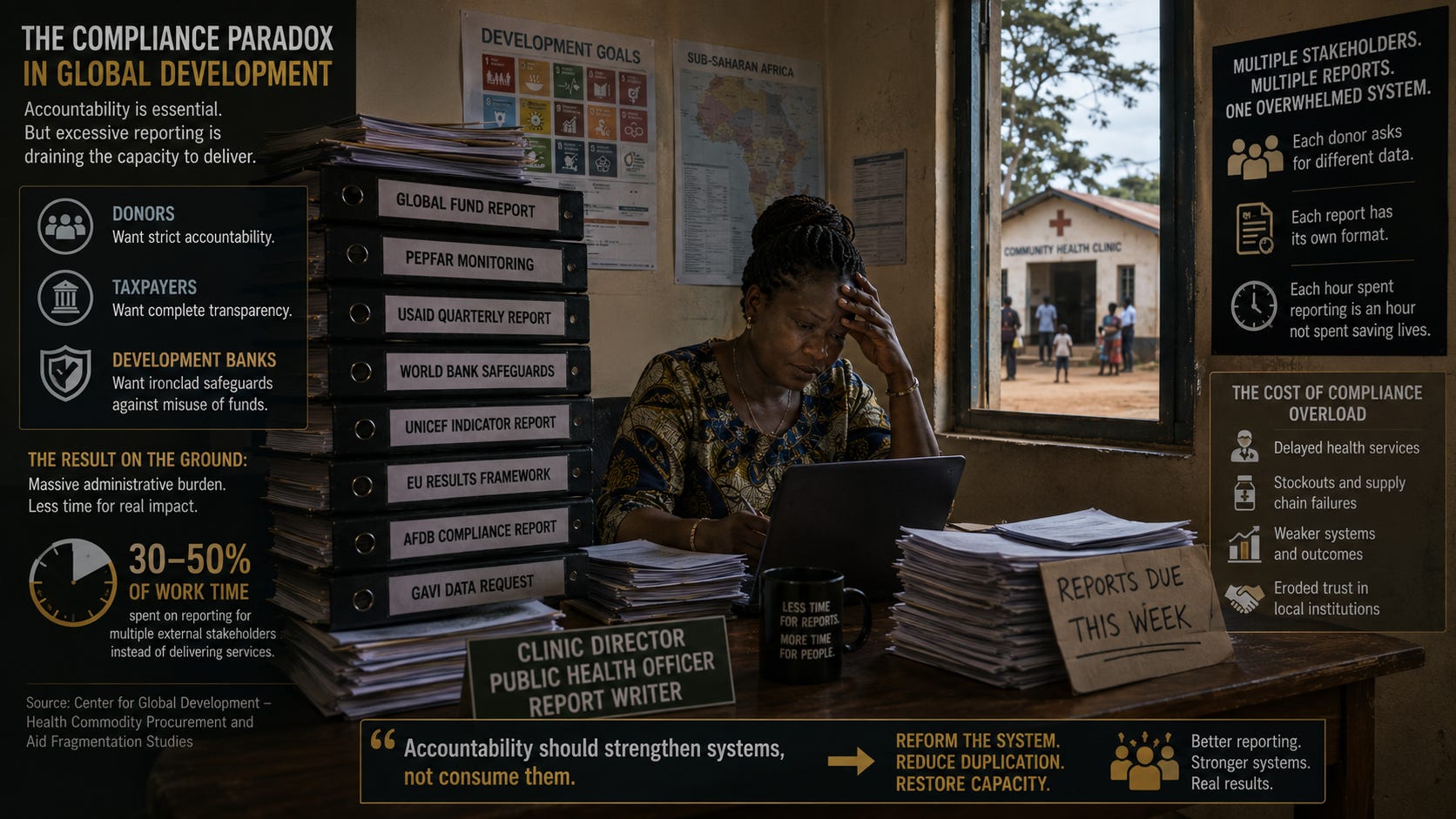
Global health research, including assessments from the Center for Global Development regarding health commodity procurement and aid fragmentation, has documented reporting requirements that consume massive amounts of local administrative capacity. In resource-constrained environments across Sub-Saharan Africa, public health researchers have found that local clinic directors, school administrators, and regional government staff often find themselves devoting significant portions of their working hours to producing distinct reports for multiple external international stakeholders.
Each donor requests slightly different data sets. Each reporting framework utilizes a distinct software interface. Each spreadsheet appears perfectly reasonable to the analyst sitting in Washington, Geneva, or London. Together, they become overwhelming.
The challenge is not that accountability exists; the challenge is that accountability itself consumes finite human resources. Every hour a local doctor or engineer spends compiling compliance data is an hour taken from treating patients or designing clean water infrastructure. At some point, oversight ceases to be a support function and becomes a competing mission.
This dynamic has triggered a profound geopolitical shift. While Western-influenced institutions operate within this slow, hyper-procedural framework, alternative models of development, most notably China’s state-led infrastructure model under the Belt and Road Initiative (BRI), operate on an entirely different set of institutional incentives.
The BRI approach prioritizes rapid physical execution and tangible outputs over meticulous procedural sign-offs. For a developing country government facing a pressing electricity or transportation crisis, the calculation is straightforward. A nation can choose a Western development loan with low interest rates but a long compliance, environmental, and procurement review process that may take years to resolve. Or, it can choose an alternative model with different transactional terms but fewer strings, where construction begins in six months.
To be clear, this alternative model introduces its own substantial complications, frequently exposing recipient nations to structural debt vulnerabilities, environmental degradation, a profound lack of transparency, and long-term political dependency. However by making the Western governance model so procedurally expensive, the international audit boom has inadvertently driven developing nations toward these highly transactional global actors. This outcome is in deep tension with the stated goals of the transparency movement.
Is China a big spender or a loan shark?
The Ground for Restraint
To view this state of affairs clearly, one must acknowledge that the audit society did not emerge from a desire to create paralysis. It emerged as a necessary defense against real and devastating abuses of power.
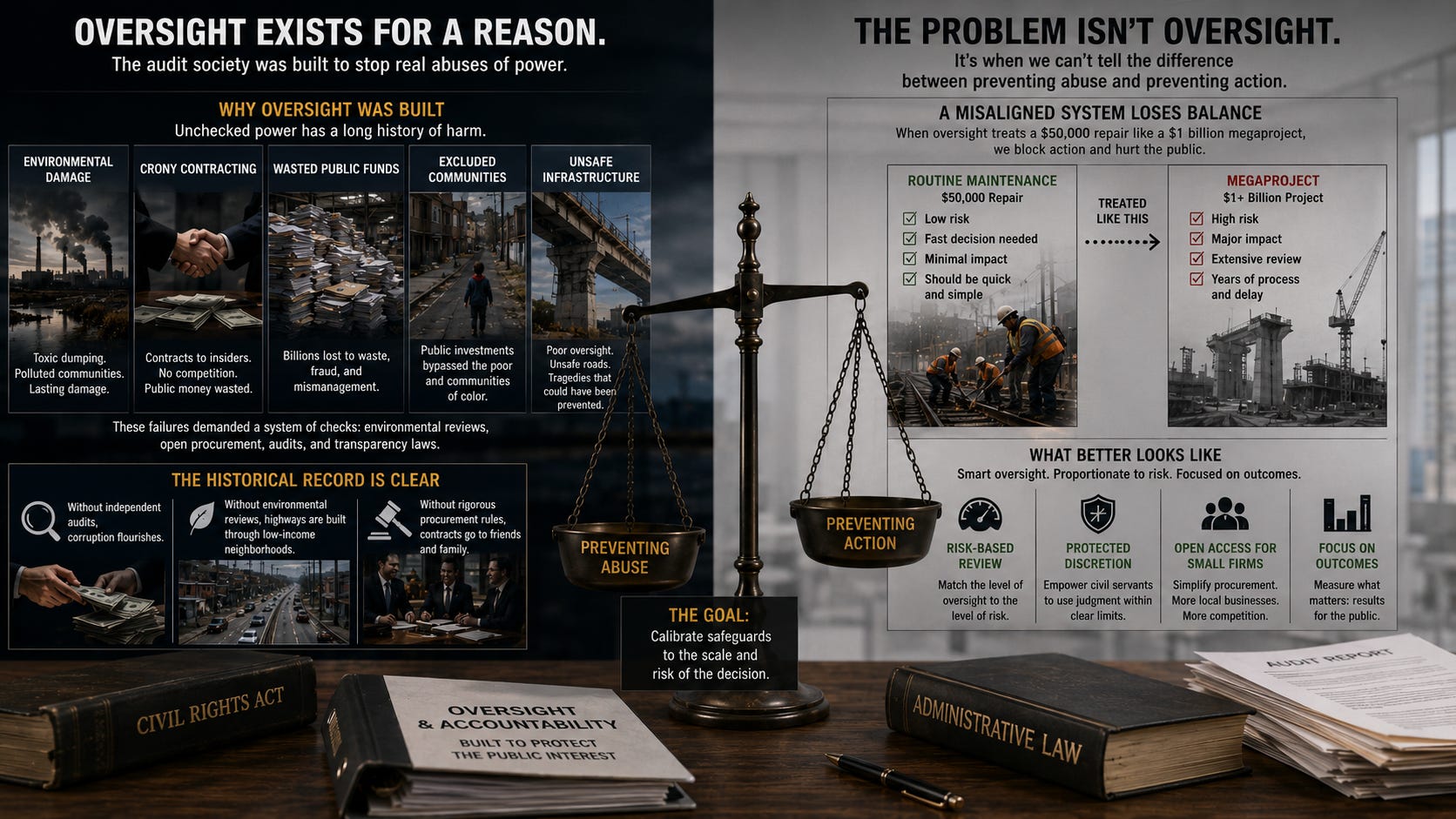
Oversight exists because governments have historically abused their discretion when not subject to external checks. Bureaucracies that aren’t watched have caused environmental damage, toxic dumping, and unsafe infrastructure. They have facilitated crony contracting, wasted billions in public funds, and systematically excluded minority communities from public investments. The entire apparatus of modern administrative law, stretching from environmental impact reviews to open procurement rules, was constructed precisely because unchecked bureaucratic discretion often served the powerful at the expense of the vulnerable.
The historical record on these issues makes them hard to ignore. Without independent audits, corruption flourishes. Without environmental reviews, highways are built through low-income neighborhoods. Without rigorous procurement rules, public contracts are handed to the relatives of politicians.
The problem, therefore, is not the existence of oversight. The problem is an oversight architecture that cannot distinguish between preventing abuse and preventing action. When the mechanism for preventing corruption is designed in a way that treats a routine maintenance patch with the same suspicion as a billion-dollar mega-project, the system loses its ability to prioritize. The goal of modern administrative reform should not be the wholesale destruction of safeguards, but rather the calibration of those safeguards to the scale and risk of the decision at hand.
What Better Oversight Looks Like
Governments exist to build things, address things, and deliver things. Verification matters, but execution matters too. Reversing the compliance paradox requires moving away from the comforting illusion that institutional health can be achieved by piling on more metrics. We need an architecture designed for calibrated accountability.
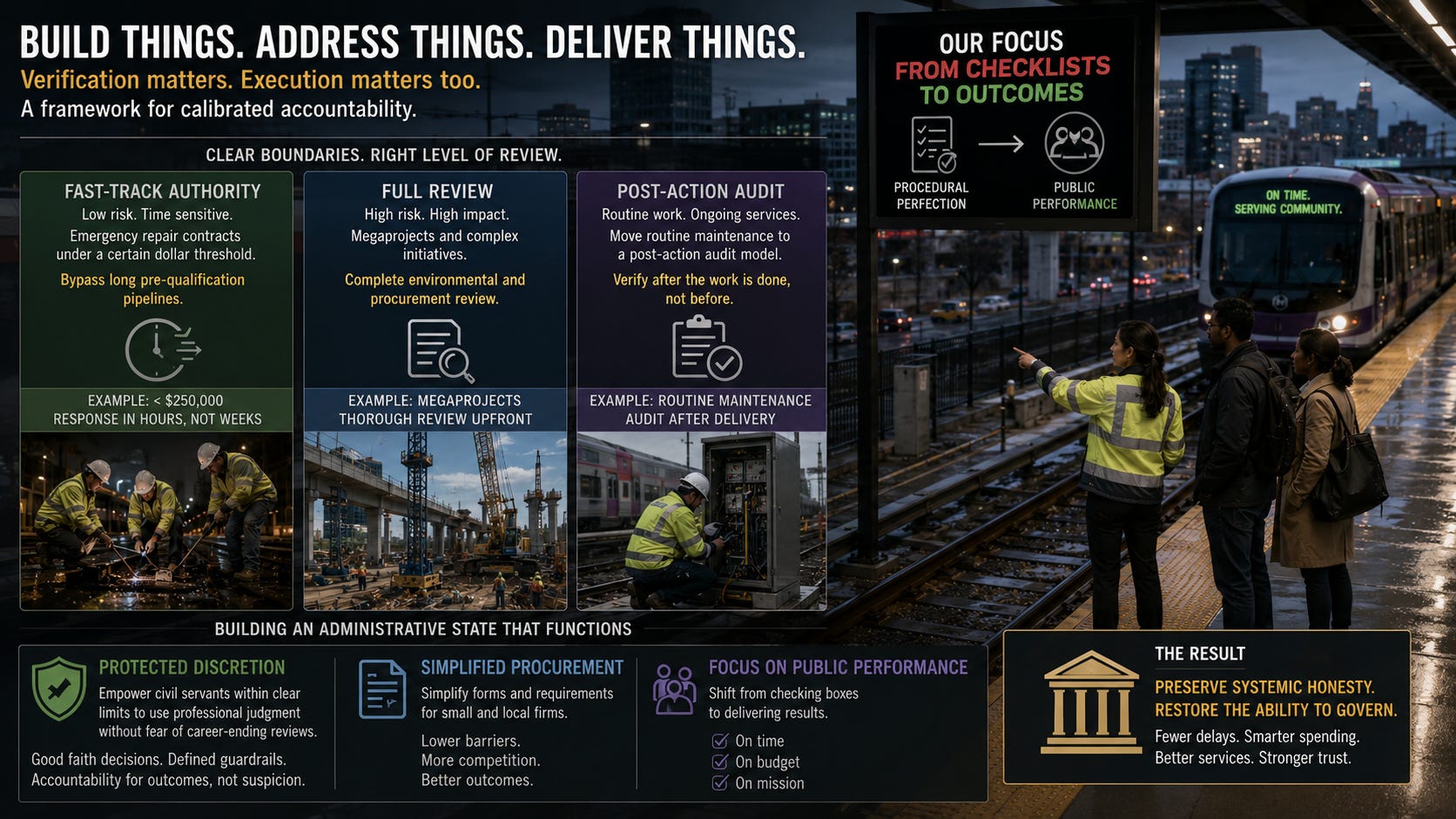
In practice, this means establishing clear boundaries. For example, emergency repair contracts under a certain dollar threshold must receive fast-track authority, allowing managers to bypass long pre-qualification pipelines. High-risk megaprojects should absolutely still receive full environmental and procurement review, but routine maintenance must move to a post-action audit model. Verify the integrity of the process after the track joint is replaced or the signal cabinet is repaired, not while commuters sit stranded on the platform.
To build an administrative state that functions, civil servants must receive protected discretion within clearly defined limits, restoring their ability to use professional judgment without triggering career-ending reviews. Additionally, procurement forms must be simplified for small firms, opening the bidding market up to local companies that can execute work efficiently but cannot afford an internal compliance department. By shifting the administrative focus from procedural checklist perfection to visible public performance, we can preserve systemic honesty while restoring the basic ability to govern.
The Final Metric
As I left the office of the regional transportation authority that afternoon, I passed a sleek, professionally designed poster hanging near the exit. It celebrated the department’s latest international standard certification for organizational excellence and procedural compliance. The logo gleamed under the immaculate fluorescent lights of the lobby.
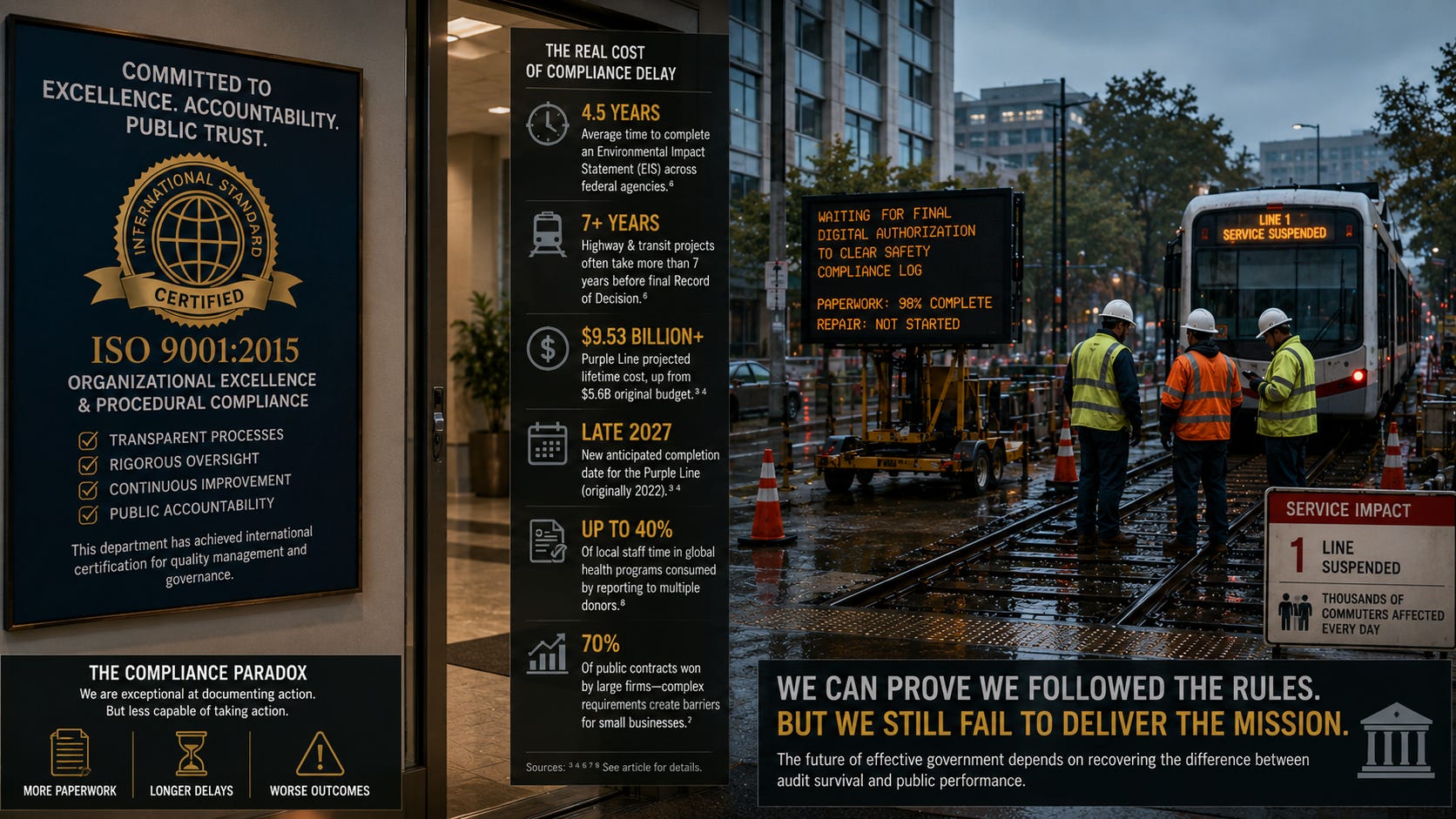
Outside, across the street, a maintenance crew stood beside a deactivated stretch of track where a failed joint had shut down service on one line. They were waiting for final digital authorization to clear the safety compliance log. The paperwork was nearly complete.
The repair was not.
We have built institutions that can prove they followed the rules even when they fail to fulfill the mission. The future of effective government may depend on recovering the difference between audit survival and public performance.