

The Energy Archipelago
California Built the Future. Then It Accidentally Imported Its Weakness

In the Permian Basin of West Texas, the sound is mechanical and relentless. Steel arms dip into the earth all day and all night, pulling crude from shale formations that helped turn the United States into the world’s largest oil producer.
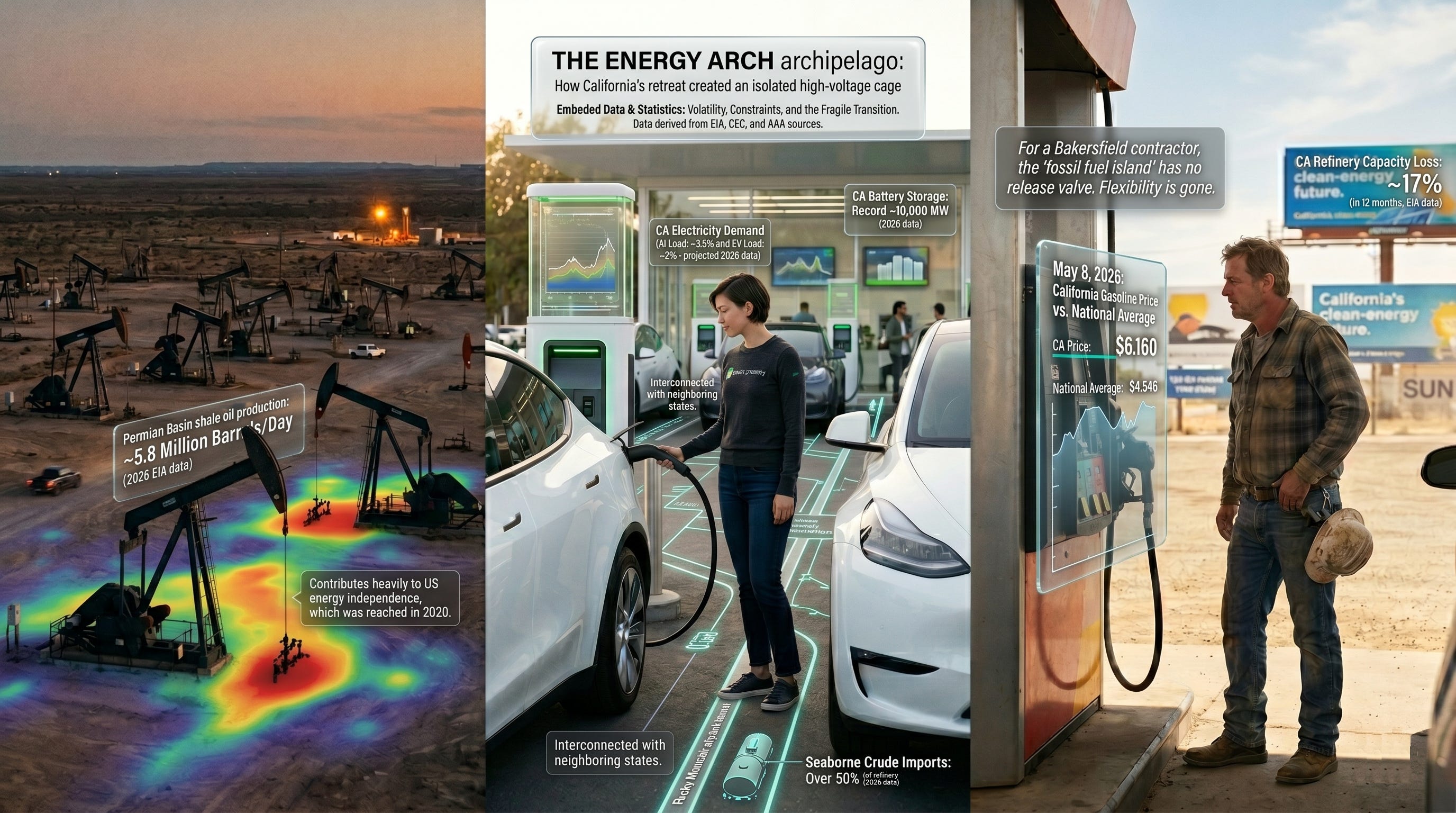
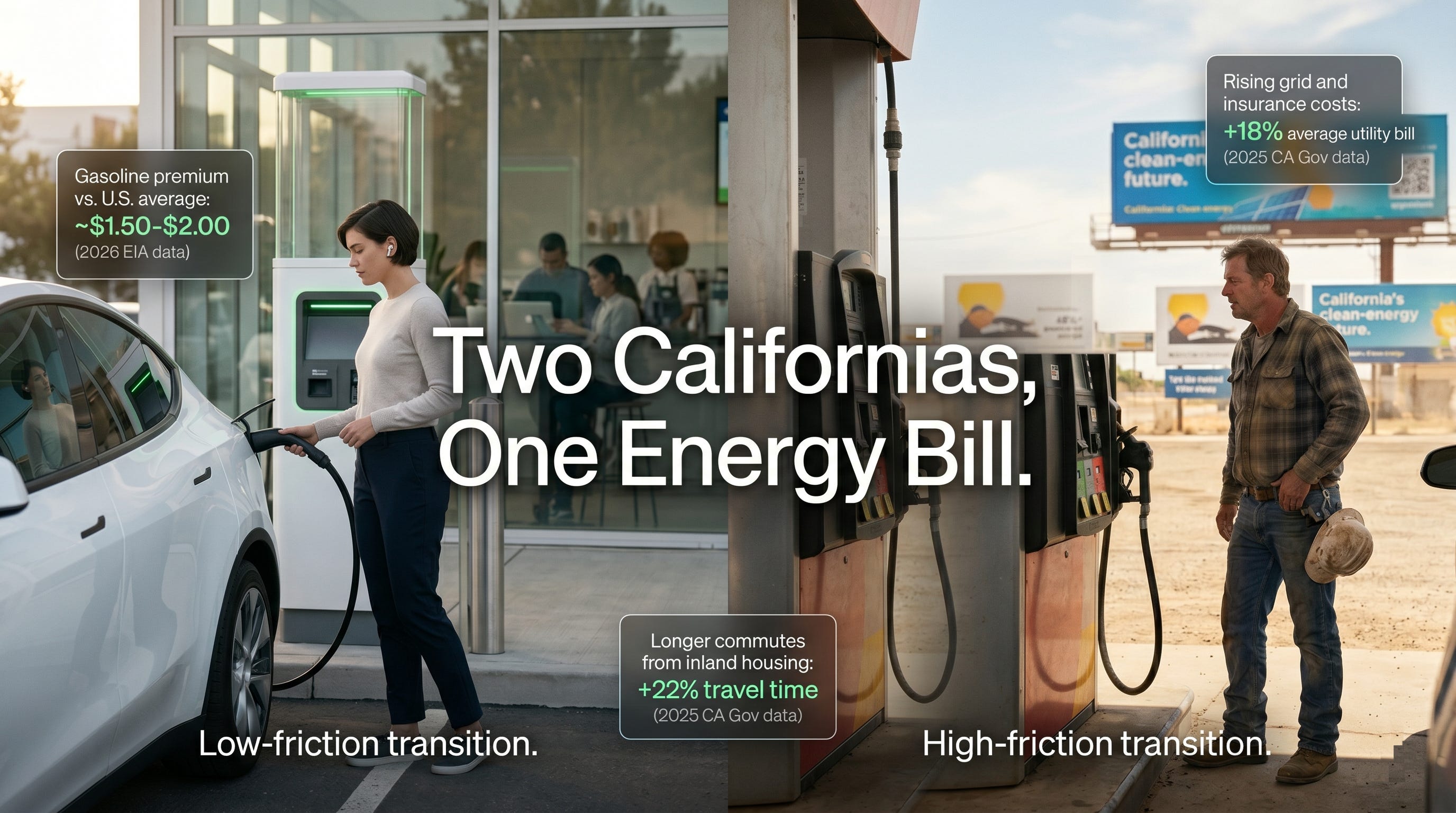
Two time zones away, at a public charging hub in Palo Alto, a software engineer plugs in her electric vehicle. The act feels modern and detached from the old world of pipelines and tankers. But sixty miles east, in the San Joaquin Valley, the view looks different. At a truck stop outside Bakersfield, a contractor stares at a pump readout showing regular gasoline well above the national average. He is surrounded by billboards for California’s clean-energy future, yet he is currently paying some of the highest fuel prices in the nation.
That contradiction sits at the center of the state’s energy story. California exists inside the most energy-abundant nation in modern history, yet parts of its economy still behave like an import-dependent island.
America spent the last fifteen years building extraordinary domestic energy capacity. Oil production surged. Natural gas output exploded. The country became less dependent on foreign energy than almost anyone imagined possible in the early 2000s. California moved in a different direction.
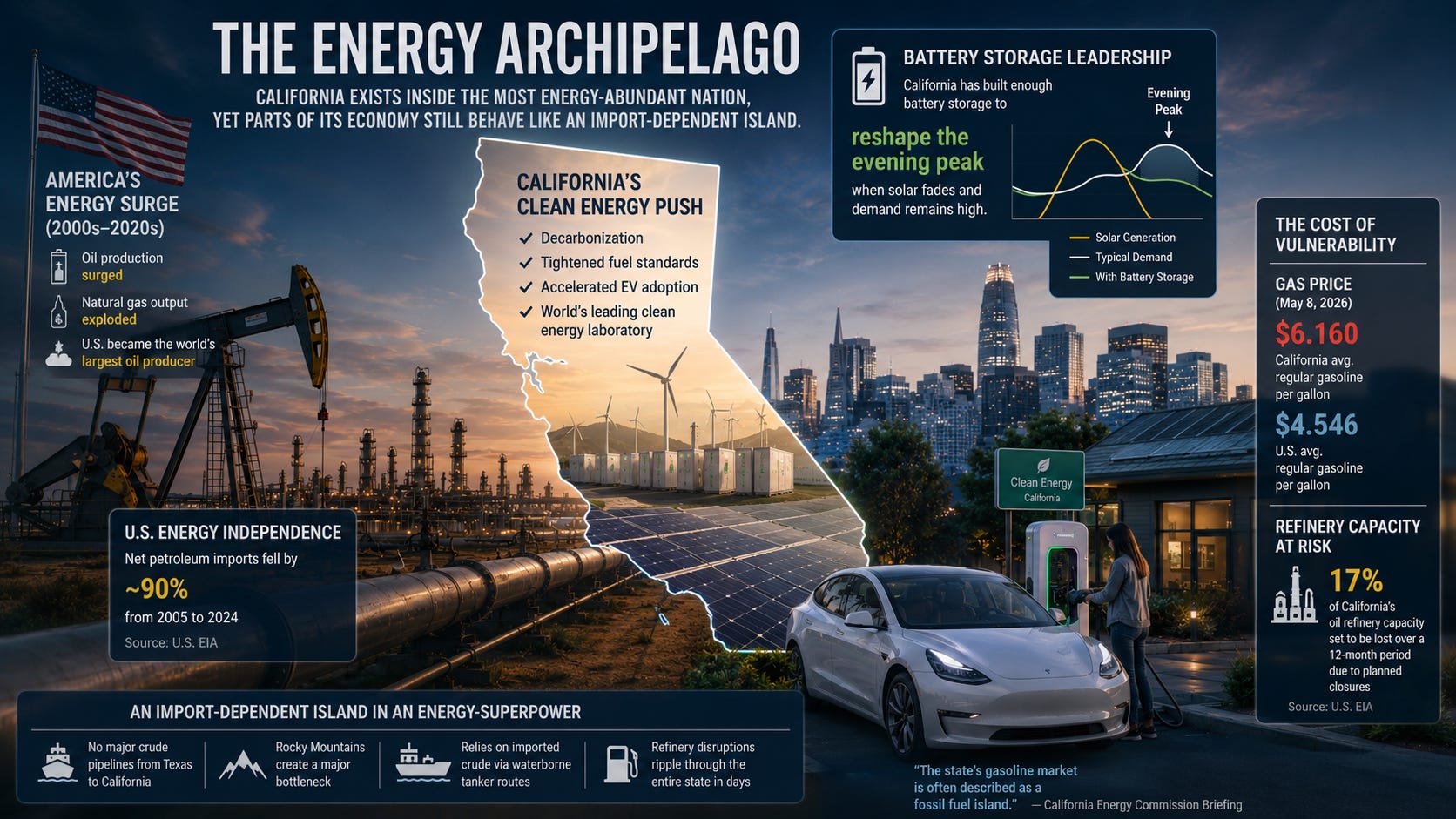
The state aggressively pursued decarbonization, tightened fuel standards, accelerated electric vehicle adoption, and became the world’s most visible laboratory for the clean-energy transition. In many ways, the experiment worked. California has built enough battery storage to meaningfully reshape the evening peak, when solar fades and demand remains high, proving that renewables can move from aspiration to infrastructure.
But there was another side to the transition. California reduced the slack in the system. And energy systems survive on slack. They survive on redundancy, reserve capacity, spare pipelines, backup generation, stored fuel, transmission corridors, and industrial systems most people never think about until the moment they are needed.
The Last Tanker Problem
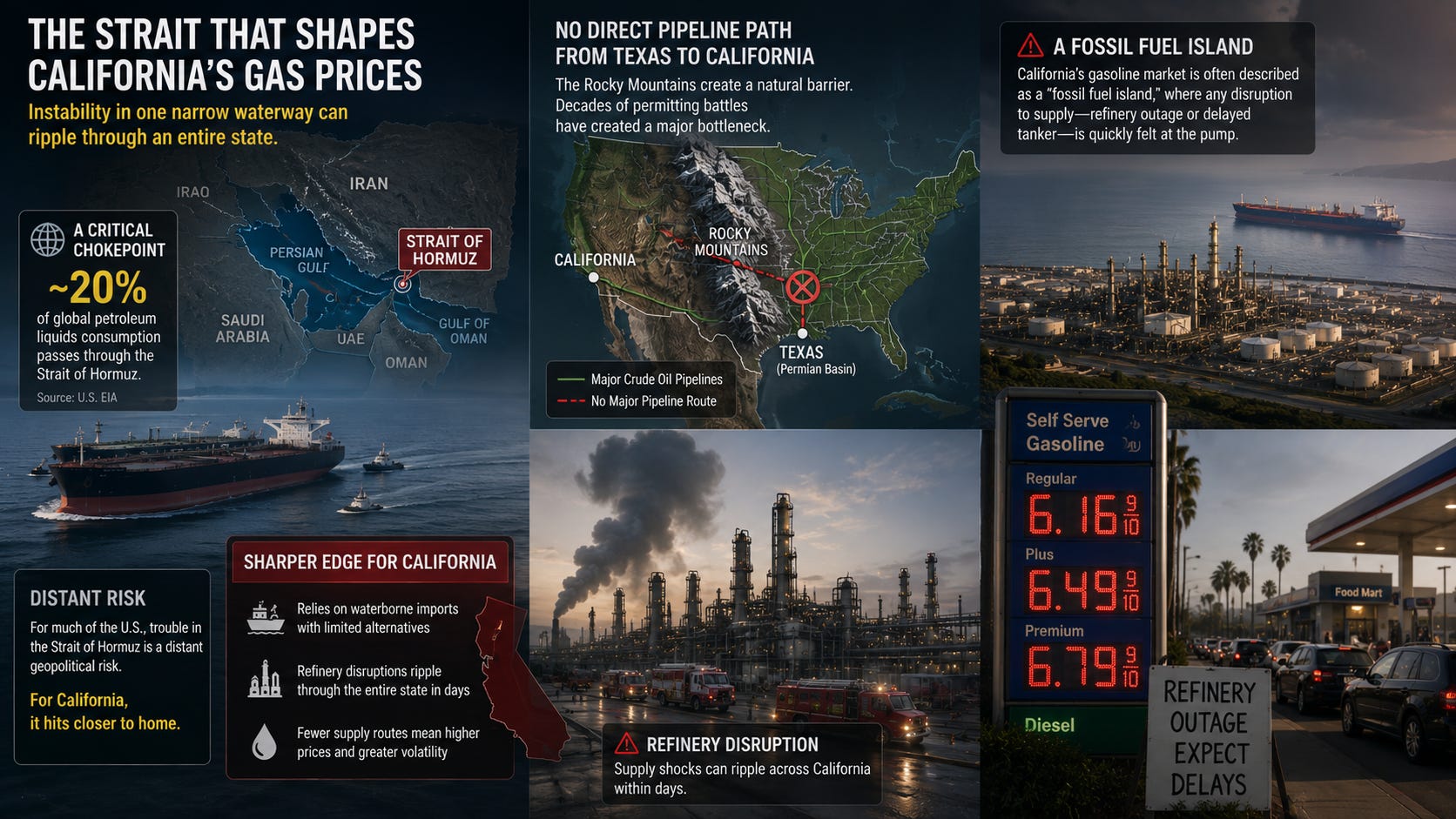
That reality became harder to ignore this spring as renewed instability around the Strait of Hormuz rattled global crude markets. The Strait has long been one of the world’s most important oil chokepoints. The U.S. Energy Information Administration has previously estimated that about one-fifth of global petroleum liquid consumption passed through it.
For much of the United States, trouble there registers as a distant geopolitical risk. For California, it carries a sharper edge.
The reason is simple. California is not an island electrically, but in crude oil logistics, it often behaves like an import-dependent nation. Geography matters. The Rocky Mountains are a physical barrier, and decades of permitting battles have helped create a major bottleneck. There are no major crude pipelines carrying Texas shale oil directly into California’s refinery network.
A refinery disruption in California can ripple through the entire state within days because there are fewer alternative supply routes than most Americans realize. A recent energy commission briefing described the state’s gasoline market as a “fossil fuel island,” where any disruption to supply, from a refinery outage to a delayed tanker, is quickly felt at the pump.
The Strait of Hormuz will never reopen the way it was at the beginning: Goldman Sachs’ Jared Cohen
The Friction of the Clean Future
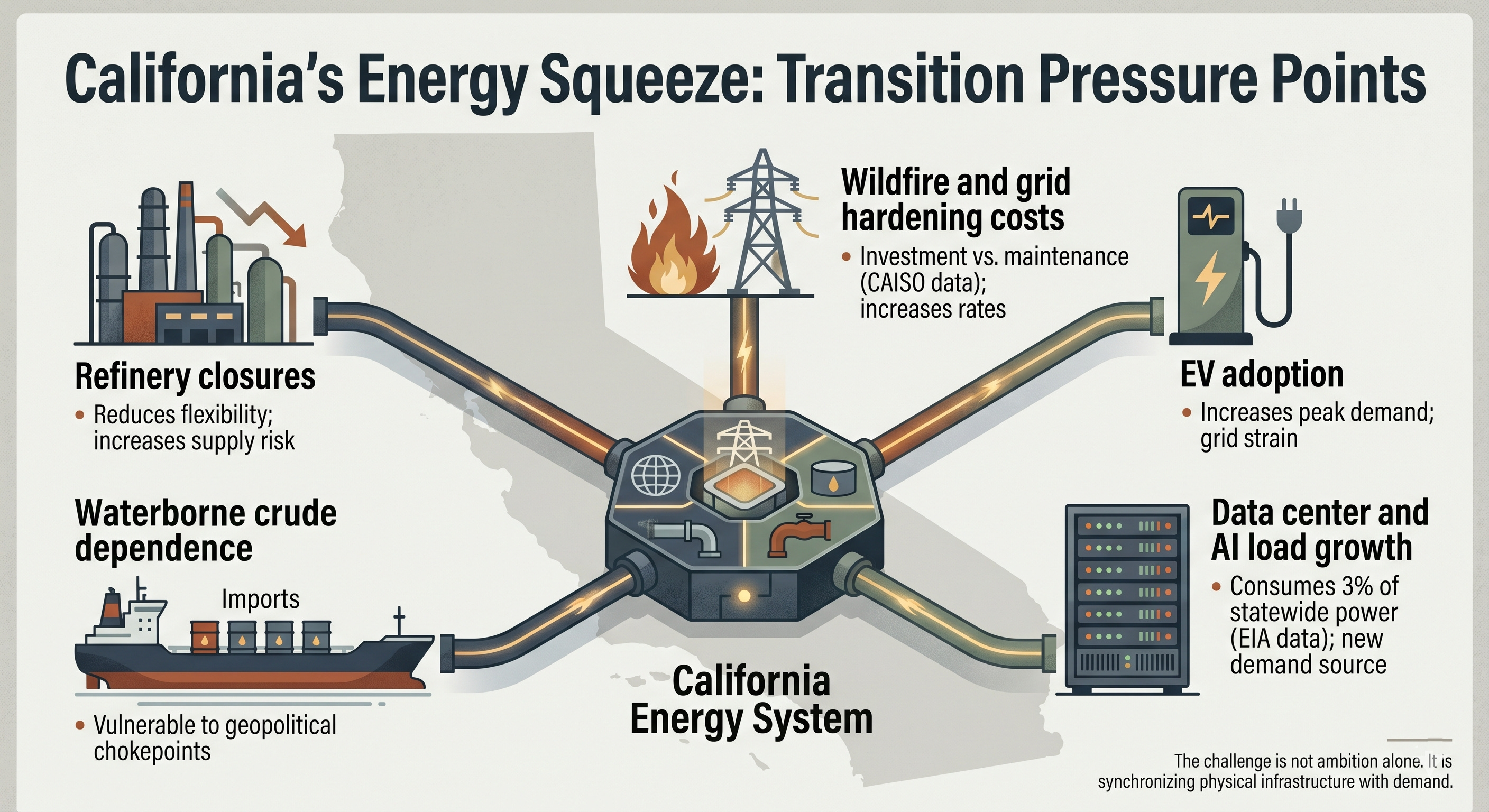
The uncomfortable truth is that California attempted one of the most ambitious energy transitions in modern history while also managing population pressure, wildfire risk, rising electricity demand, and new load from data centers and AI infrastructure.
Every AI query processed in a hyperscale data center ultimately becomes heat, cooling demand, and electricity consumption. The AI boom is not just a software story; it is a physical energy story.
This is a physics problem. You cannot legislate around thermodynamics. You cannot mandate millions of electric vehicles without building the generation and transmission capacity to support them. California’s defenders would argue that maintaining redundancy carries its cost and that keeping older refineries alive means extending emissions and fossil dependence. They are not entirely wrong. The question is not whether the old system should last forever. It is whether the new one can arrive before the old one disappears.
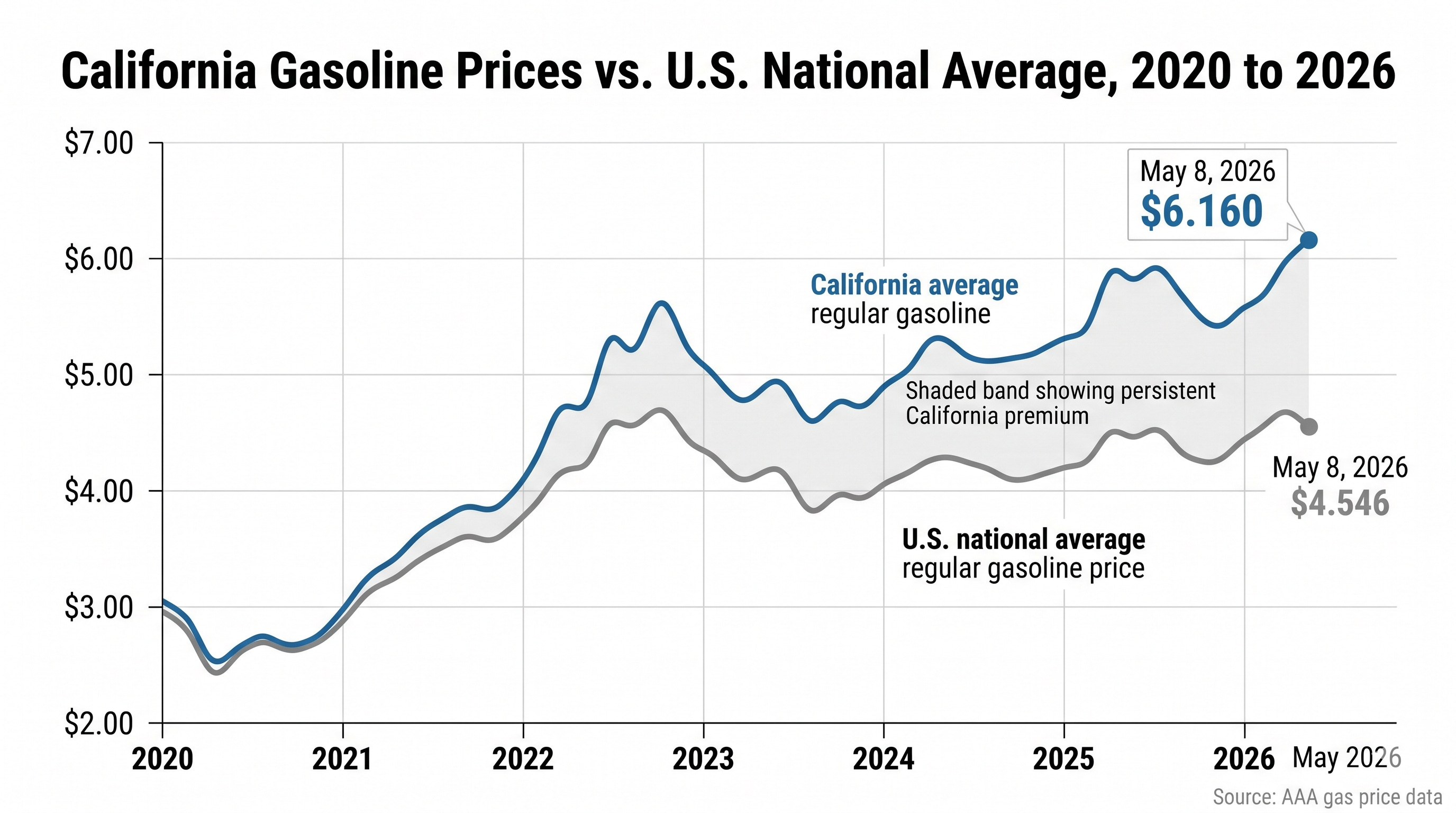
Gasoline remains the clearest example of this tension. On May 8, 2026, AAA listed California’s average regular gasoline price at $6.160 per gallon, compared with a national average of $4.546. That gap reflects a state operating with very little margin for error.
Refineries, Risk, and the Loss of Buffers
Refinery closures make the problem more volatile. The U.S. Energy Information Administration warned that California was set to lose 17 percent of its oil refinery capacity over a twelve-month period due to planned closures, a shift likely to increase fuel price volatility on the West Coast.
Energy systems do not fail only when supply disappears. They become expensive when flexibility disappears. California has become very good at describing the future. It has been less consistent at building the physical machinery beneath that future at the same speed: the wires, steel, transformers, storage, and generation that make the promise real. Transmission lines can now take longer to approve than startups take to reach billion-dollar valuations.
“The rhetoric moves at software speed; the infrastructure moves at permitting speed.”
California pushes out another refinery as gas prices climb
Ambition Is Not Infrastructure
The real fight is between ambition and execution. California is right to care about climate risk. Wildfires and extreme heat are real threats. But ambition does not build infrastructure.
For many Californians, affordable housing now exists far from where the jobs are, turning energy costs into a monthly survival calculation. For a contractor in Bakersfield or a warehouse worker commuting from Riverside County, the transition is not a policy debate. It is a bill. This is the birth of a new energy inequality: between those who can absorb the cost of transition and those who are asked to finance it with every mile they drive to work.
The Scaffold Has Become Visible
The best infrastructure is invisible. It is the boring stuff that just works. California’s scaffold is becoming visible because it is vibrating under stress.
The state is trying to electrify transportation, reduce emissions, and manage wildfire risk simultaneously. It is an enormous task that requires less symbolic politics and more systems thinking. As Siva Gunda, Vice Chair of the California Energy Commission, noted during a recent reliability briefing: “The pricing will move molecules to California, but it will come at a price.”
From Idea to Reality - Battery Storage Comes of Age on the California Grid
Rebuilding the Scaffold
California does not need smaller ambitions; it needs sturdier machinery.
Infrastructure Realism: Every major clean-energy mandate should be tied to a specific buildout plan. No more mandates without blueprints.
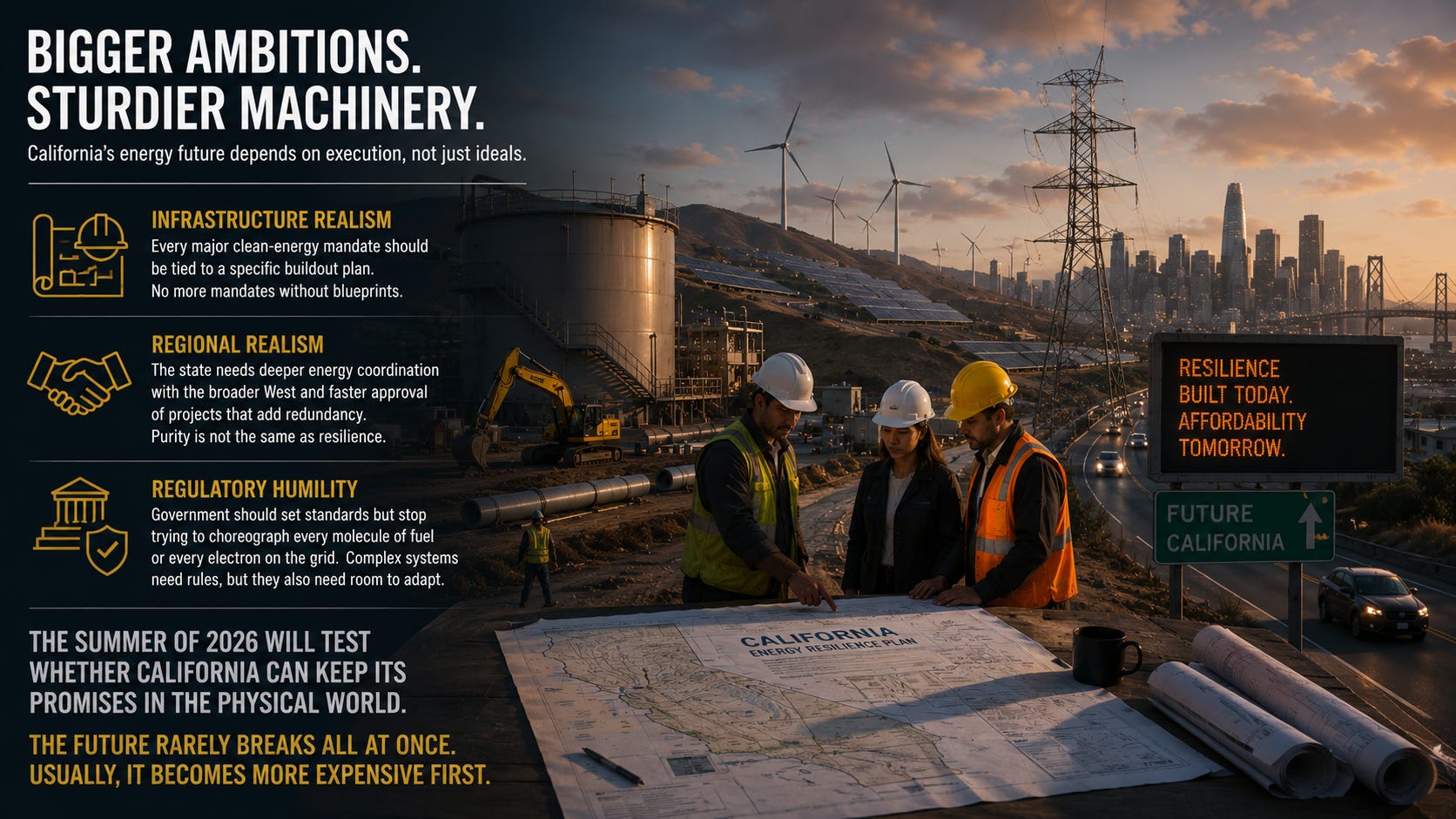
Regional Realism: The state needs deeper energy coordination with the broader West and faster approval of projects that add redundancy. Purity is not the same as resilience.
Regulatory Humility: Government should set standards but stop trying to choreograph every molecule of fuel or every electron on the grid. Complex systems need rules, but they also need room to adapt.
The summer of 2026 will test whether California can keep its promises in the physical world.
The future rarely breaks all at once.
Usually, it becomes more expensive first.