

The Granularity Trap
When Better Media Metrics Produce Worse Decisions

How unit-level media metrics tempt companies to confuse engagement with durable value.
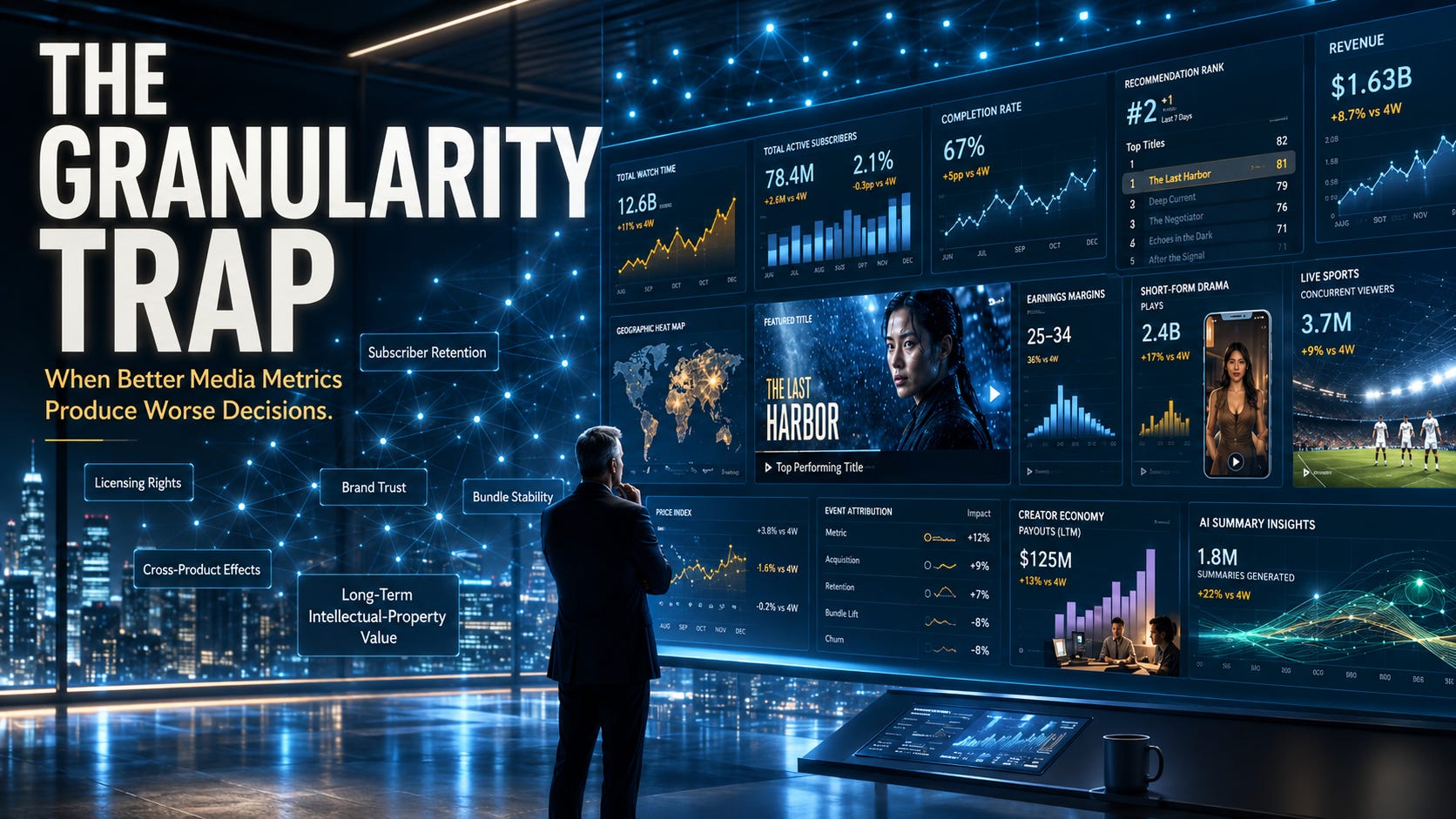
In April 2024, Netflix announced a consequential change in its public reporting. Beginning in 2025, the company explained to shareholders, it would no longer publish quarterly subscriber counts or average revenue per member.
For much of the streaming expansion, net subscriber additions dominated investor attention. A meaningful miss could trigger a sharp selloff in market capitalization before the opening bell on Wall Street, while an unexpected surge could reinforce investor confidence in the company’s broader growth strategy. Yet by the time Netflix reported its full-year 2025 results, crossing 325 million paid memberships globally, generating $45.2 billion in annual revenue, and posting an operating margin of 29.5 percent, the metric that had dominated its public reporting was retired from quarterly reports.
Why would a company at the height of its global reach walk away from the very number that defined its success? Because subscriber counts measured the size of Netflix’s customer base, they did not explain why customers stayed or how profitably the company could serve them.
The challenge facing companies built around discrete media products, such as articles, episodes, tracks, and broadcasts, is no longer simply acquiring users. Executives now possess unprecedented detail about second-by-second consumer behavior, paired with far weaker evidence about what caused the resulting economic value.
Call it the measurement trap.
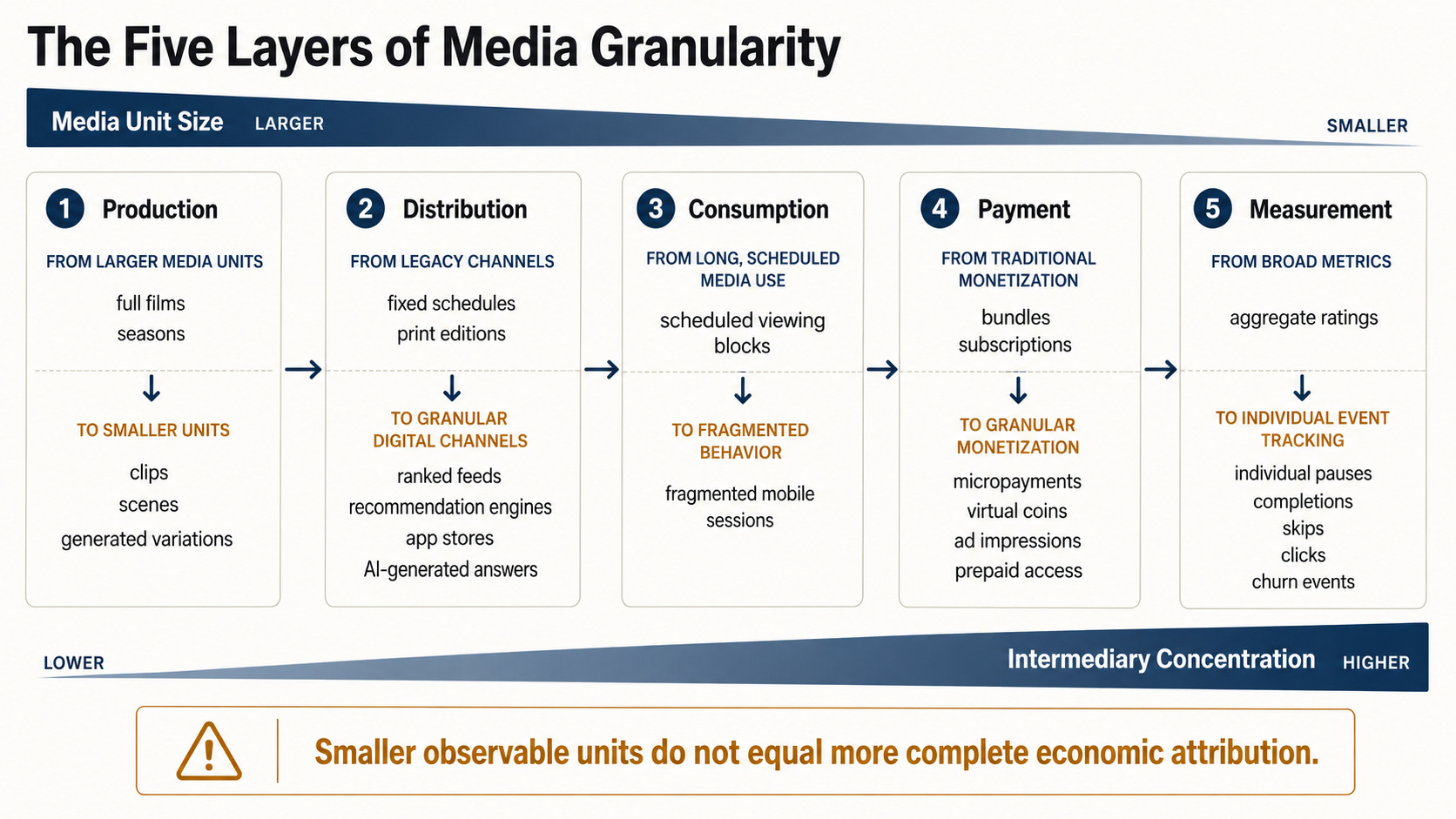
Granularity is the baseline market condition, and the measurement trap is the managerial error it encourages. The trap begins when media is created, distributed, consumed, paid for, and measured in pieces that are progressively smaller, while the broader value those pieces create becomes harder to recognize and finance. Granularity is not inherently destructive; it can expand consumer choice, lower entry barriers, and enable flexible pricing. But it becomes dangerous when the shrinking unit of measurement or payment becomes disconnected from the wider economic system that financed it.
In practice, creation and consumption fragment while payment and measurement become ever finer. Yet distribution power concentrates inside the ranking models, recommendation engines, and ad networks that organize those fragments. Conversational interfaces do not merely rank media units; they can recombine their information into a substitute product that weakens the link between source and audience. As operating layers break down into their smallest constituents, media executives face mounting pressure to assign a direct return to each unit of content, even when its true value remains embedded in a wider portfolio.
The Bundle’s Hidden Subsidy
To understand how granularity dismantles media margins, it helps to examine the architecture of the cable television bundle.
In an illustrative cable model, network profitability relied on aggregate pricing and structural friction. A household might pay $100 a month for a package of 200 channels while regularly viewing only six. High-margin sports networks and general entertainment channels collected subscriber fees from the entire installed base.
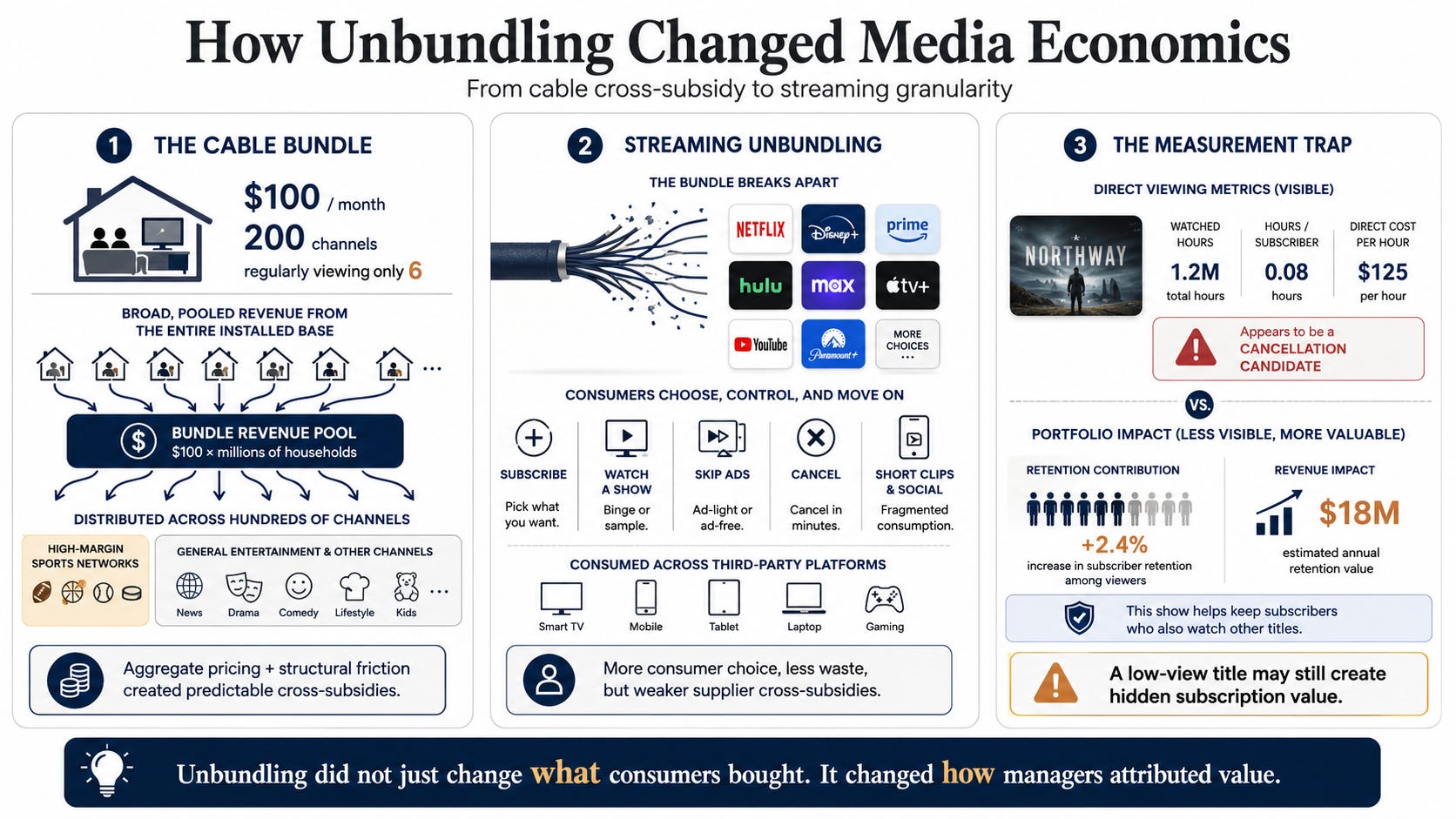
When streaming unbundled the wires, it allowed consumers to select individual services. Viewers gained the freedom to subscribe for a single program, cancel immediately upon completion, skip ad breaks, or consume content in bite-sized fragments on third-party platforms. Unbundling improved choice and reduced waste for consumers, but it stripped suppliers of their predictable cross-subsidies.
Unbundling did not merely change what consumers bought. It changed how managers attributed value to the programs inside the former bundle. A show can appear to be an immediate candidate for cancellation when measured strictly by title-level viewing hours and direct cost-per-hour viewed, even though it may contribute to retention in other areas of the subscription portfolio.
More Data, Less Certainty
Digital telemetry platforms allow executives to observe second-by-second when a user pauses, abandons a video, or churns. Yet digital platforms possess extraordinary behavioral resolution and surprisingly incomplete causal knowledge. High behavioral resolution does not imply accurate causal attribution.
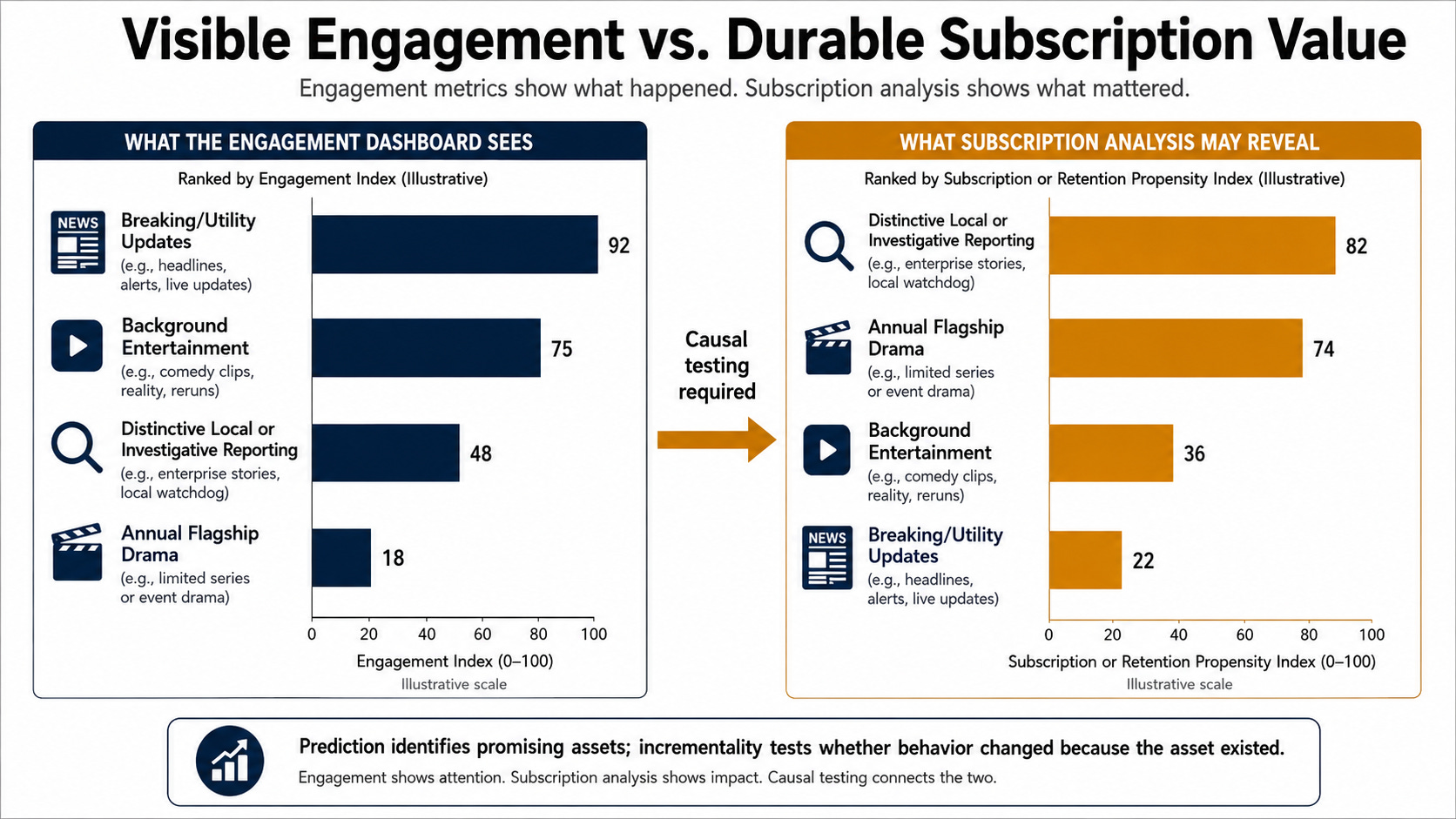
Consider a common measurement mismatch: a subscriber spends dozens of hours watching background television comedy while remaining subscribed specifically for access to a single six-episode annual drama. A dashboard records massive watch time for the comedy and modest watch time for the drama, which tempts management to misidentify the comedy as the primary business driver.
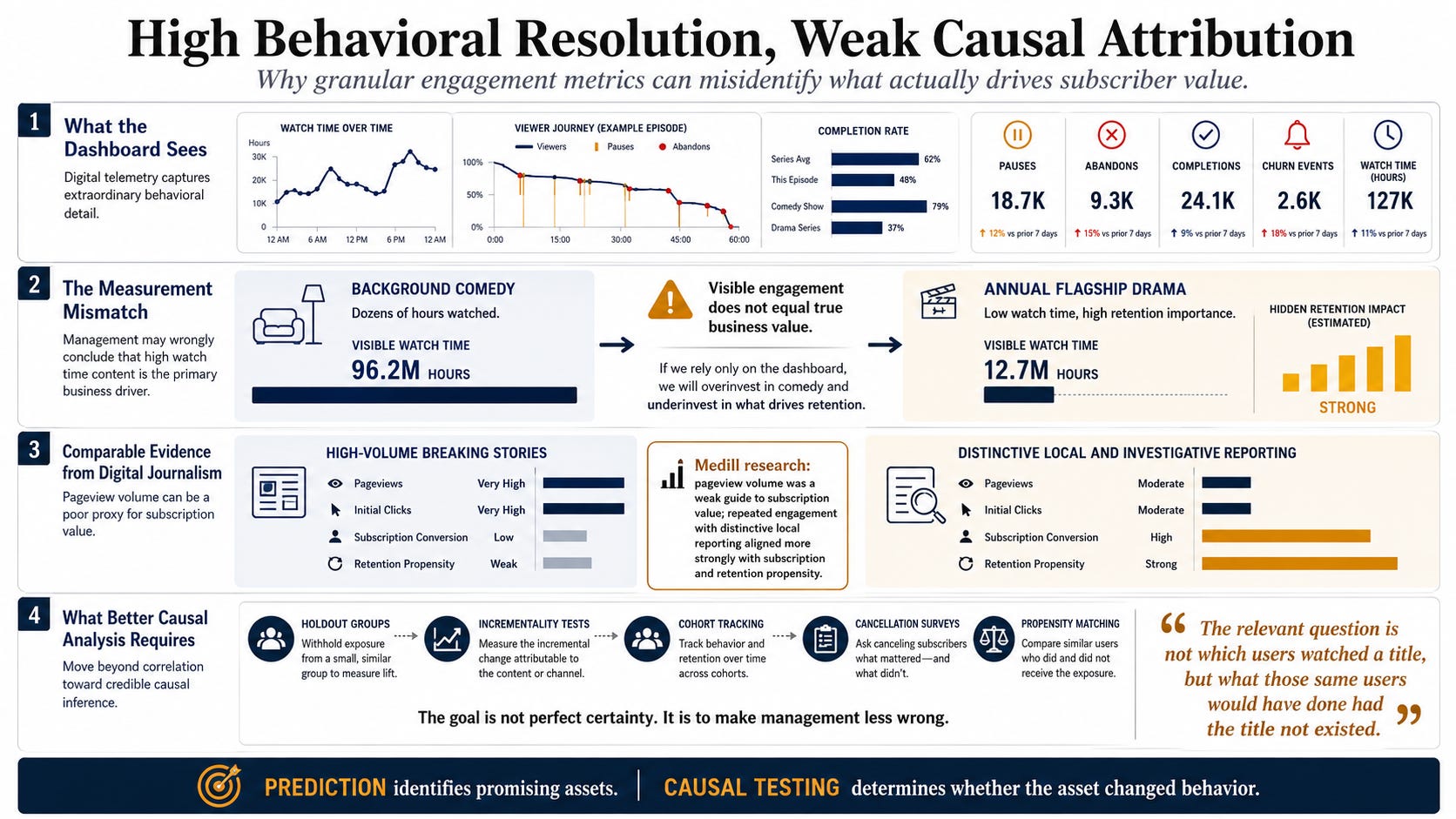
Research from Northwestern University’s Medill Spiegel Research Center found evidence of a comparable disconnect in digital journalism. Analyzing reader and subscriber behavioral data across metropolitan daily newspapers, researchers found that traffic volume was a weak guide to subscription value. High-volume breaking stories routinely dominated dashboards, while distinctive local and investigative work attracted fewer initial clicks.
Yet readers who repeatedly engaged with distinctive local reporting showed a stronger subscription and retention propensity than readers generating high volumes of commodity pageviews. The Medill research revealed that regular engagement with local news content was associated with a retention likelihood materially higher than passive, high-volume pageview consumption. Distinctive reporting was a far stronger predictor of retention than pageview volume alone.
The relevant question is not which users watched a title, but what those same users would have done had the title not existed. Predictive evidence can identify promising assets, but only incrementality testing can establish what changed because the asset existed.
A credible answer requires holdout groups showing what comparable customers did without exposure, incrementality tests asking whether a title actually changed behavior, and cohort studies tracking users beyond the launch window. Cancellation surveys can add context, while propensity matching can reduce selection bias. None of these methods creates perfect certainty. Their purpose is simply to make management less wrong.
Conversely, the language of portfolio value can also preserve expensive projects whose supposed strategic contribution disappears under controlled testing. Portfolio value is an empirical claim, not a narrative for protecting favored titles.
This is not an argument against measurement. Fine-grained telemetry excels at identifying operational waste, detecting early churn signals, optimizing localization, and matching pricing to willingness to pay. As a simple operational example, the same telemetry can reveal whether a foreign-language title loses viewers at a consistent subtitle or dubbing failure point, allowing localization fixes without changing the underlying production. The problem is not granular data. The problem is treating granular observation as complete causal knowledge.
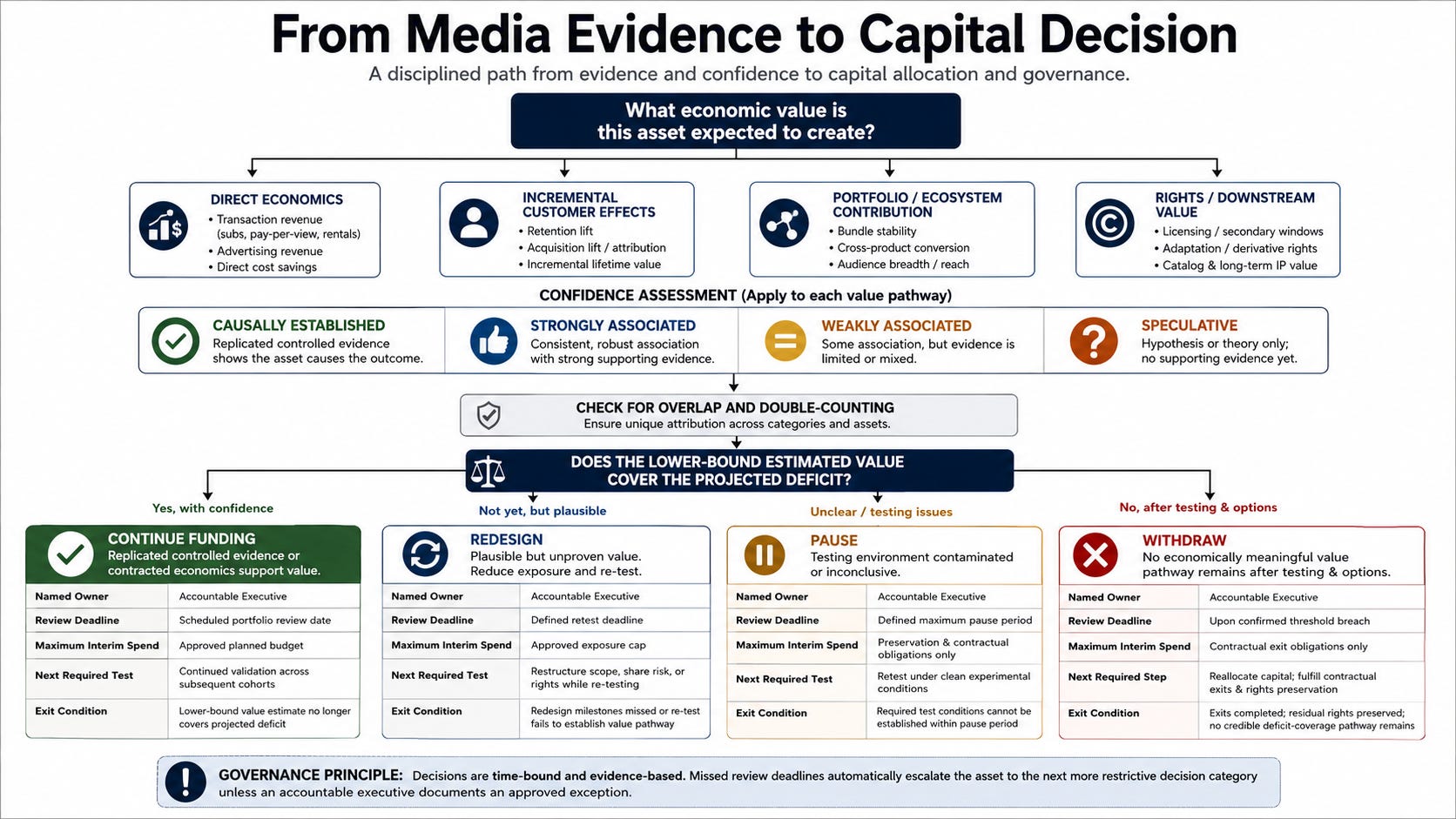
Management requires a balanced valuation framework to audit portfolio assets:
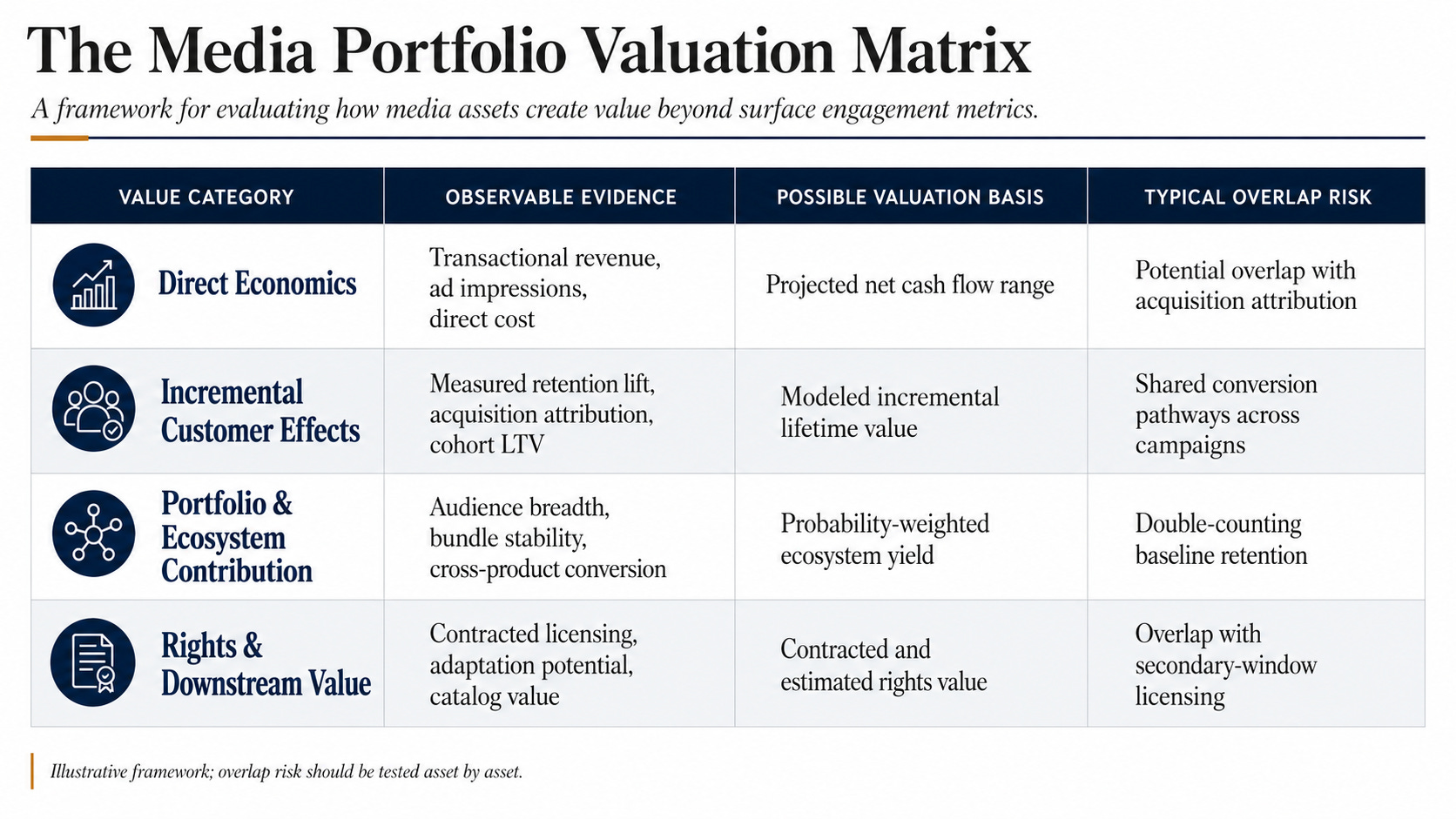
Note: Confidence assessment Causally Established, Strongly Associated, Weakly Associated, or Speculative valuation methodology and overlap risk must be evaluated independently for each asset across all categories. Direct value is not automatically causal, and indirect value is not automatically speculative. Every valuation should have an evidence owner, a measurement date, and a reassessment deadline.
Retention lift, lifetime value, and bundle stability frequently describe overlapping economic effects, not separate pools of value. Speculative ecosystem or rights value cannot offset a current loss unless at least one observable economic pathway, such as contracted licensing, measurable acquisition, or repeatable retention, is already present. Management should probability-weight speculative value using documented assumptions rather than executive judgment alone. The weaker the causal confidence, the larger the discount applied to the estimated value and the smaller the next capital commitment.
Media economics remain fundamentally portfolio-based. Granularity changes not only how content is sold. It changes how management sees value, and what management can see begins to determine what it funds. When companies overvalue what can be measured directly and undervalue content with indirect, delayed, or long-duration portfolio effects, they systematically erode systemic value in pursuit of local engagement metrics.
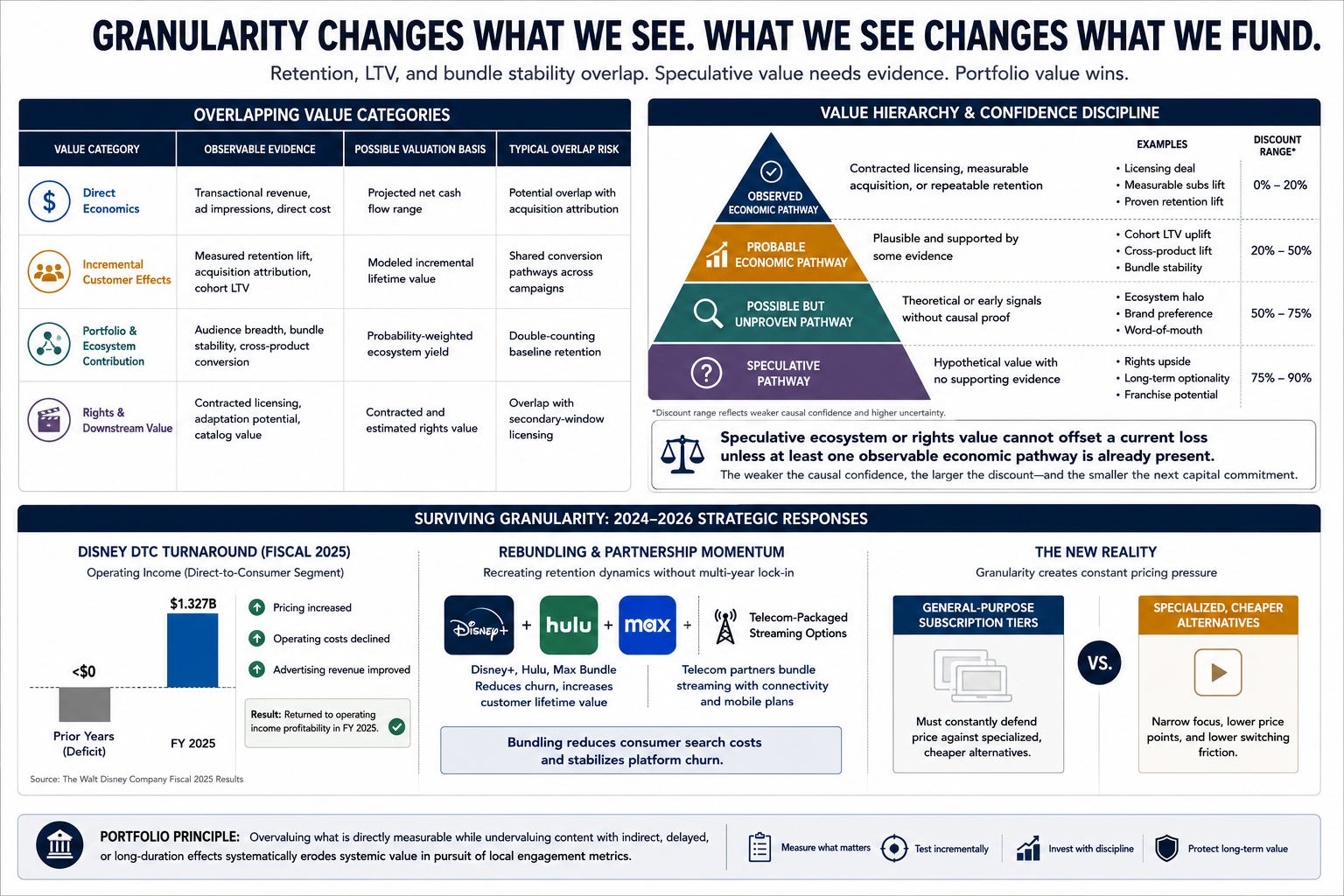
To survive this exposure, streaming platforms altered their operating strategies between 2024 and 2026. The Walt Disney Company reported an operating income of $1.327 billion for its Direct-to-Consumer segment in fiscal 2025, up from prior deficits as pricing increased, operating costs declined, and advertising revenue improved.
At the same time, rebundling strategies re-emerged across the sector. Partnerships like the Disney+, Hulu, and Max bundle, alongside telecom-packaged streaming options, represent an effort to recreate the retention dynamics of the cable era without the multi-year lock-in. Bundling can reduce consumer search costs and stabilize platform churn. In a granular environment, general-purpose subscription tiers must constantly defend their pricing against specialized, cheaper alternatives.
Rebundling Through Telecom
The assumption that granularity inevitably destroys the bundle is largely a Western narrative shaped by high-revenue subscription markets. In India, standalone direct-to-consumer subscriptions face severe affordability barriers due to low monthly streaming revenue per user, despite inexpensive mobile data.
In the United States, streaming broke cable into separate subscriptions. In India, telecom companies reassembled media inside mobile-data packages because the consumer could not economically support standalone subscriptions. Evaluating the market solely on standalone direct subscription revenue per user overlooks the telecom ecosystem’s distribution, advertising yield, and the scale of bundled access.
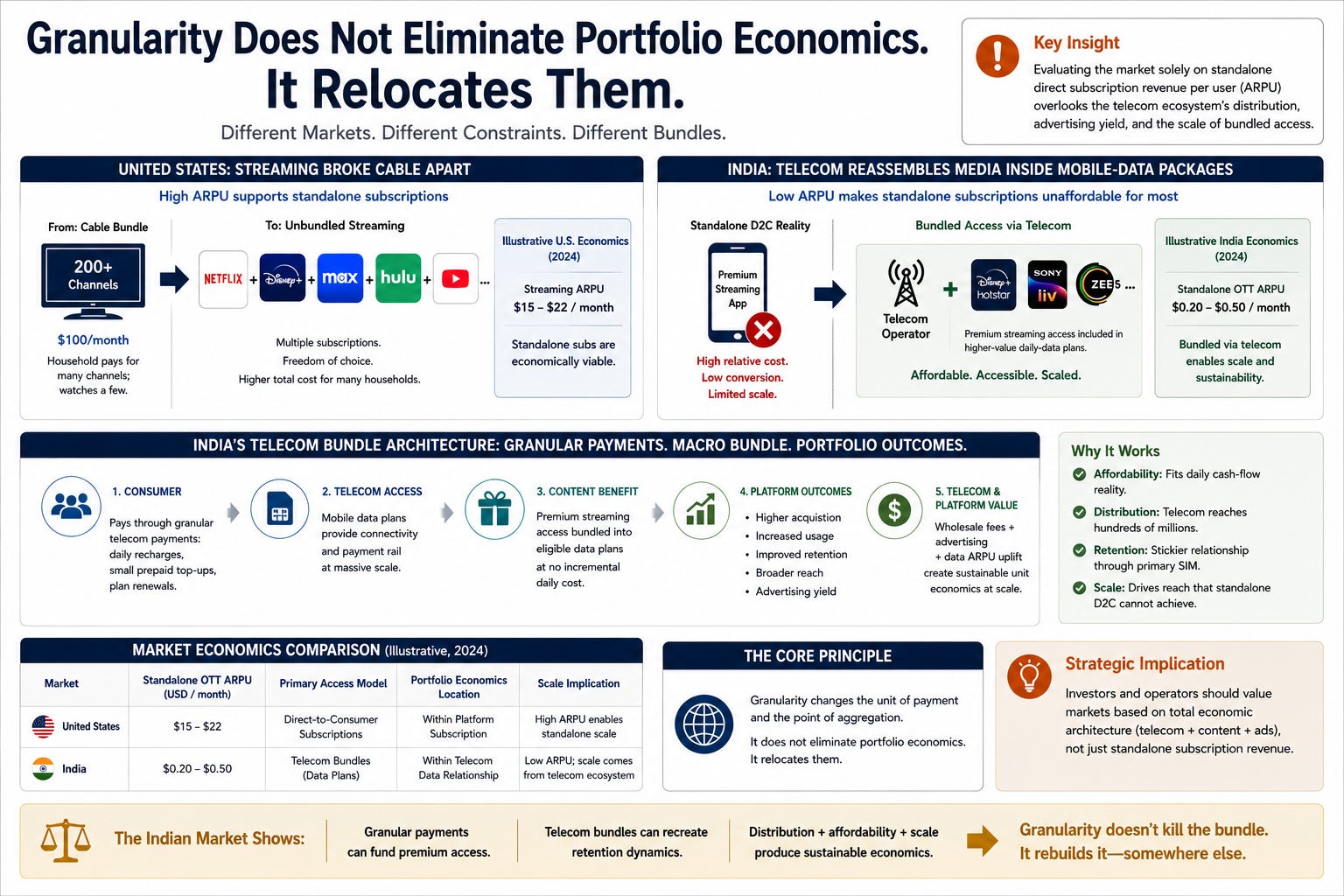
Major Indian streaming services frequently rely on telecom bundles rather than standalone recurring subscriptions. Mobile operators integrate premium streaming access into higher-value daily-data plans, with the aim of supporting acquisition, usage, and retention, although wholesale terms vary across carriers. The consumer funds access through granular telecom payments, such as daily recharges and small prepaid top-ups, while telecom distribution provides a macro-bundle that stabilizes platform scale.
The Indian market suggests that granularity does not eliminate portfolio economics. It relocates them from the cable bundle to the mobile-data relationship.
The Two-Minute Drama Machine
No format illustrates the mechanics of extreme content granularity more clearly than vertical short dramas.
Originating in China as duanju and expanding globally through platforms such as ReelShort, operated by Crazy Maples Studio, and DramaBox, operated by StoryMatrix, this format structures serialized narratives into episodes running 60 to 120 seconds, engineered for mobile micro-intervals with monetization tied directly to episode micropayments, coin unlocks, or ad views.
Where a traditional series commits millions of dollars upfront before a single viewer sees a frame, short drama is an exercise in performance marketing and rapid creative iteration. Low initial production costs and fast in-app coin spending make it look like the format is very profitable, but that measure ignores acquisition costs, platform commissions, churn, and localization overhead. Assuming that low physical creation costs automatically produce high operating margins is the central error.
The primary capital expenditure in vertical drama is user acquisition. For aggressively scaling platforms, acquisition and app-store costs can materially compress contribution margins on social channels. Sensor Tower market estimates show that cumulative in-app consumer spending across top vertical short-drama applications surpassed $2.3 billion by early 2025, driven heavily by Western markets like the United States. However, these figures reflect gross in-app store spending across tracked stores, excluding third-party web checkout systems and advertising revenue.
How These 1-Minute Movies Are Making Billions
In China, domestic mini-programs utilize local payment rails and integrated social discovery within Douyin and WeChat. Mini-program distribution can reduce installation and payment friction, although platform dependence and revenue-sharing terms still shape margins. Conversely, international apps operating in Western markets face heavy advertising expenses alongside platform commissions from Apple and Google. China’s National Radio and Television Administration introduced regulatory notices requiring filing systems, content review, and copyright traceability for micro-dramas, raising the operational threshold for production houses. Exporting the format does not automatically transfer its domestic unit economics. As production becomes cheaper, competitive advantage migrates toward acquisition, distribution, and platform position.
The Price of Watching Together
If short dramas demonstrate the hyper-fragmentation of media, then live events illustrate the opposite economic pole: the monetization of real-time synchronization.
In July 2024, the National Basketball Association finalized 11-year domestic media rights agreements with The Walt Disney Company, NBCUniversal, and Amazon Prime Video, running from the 2025–26 through 2035–36 seasons. According to widespread industry reporting, the packages carry an estimated aggregate value of $76 billion.
The scale of this rights commitment reflects a specific economic function. Live sports is one of the few remaining media properties capable of aggregating millions of viewers within the same narrow live window. Measured strictly as rights costs against direct advertising revenue, the package can look unsustainable; that evaluation misses subscriber retention, pay-TV carriage fees, bundling stability, and cross-platform ecosystem activity. Evaluating a synchronized live event property as if it were a standalone linear broadcast misinterprets its economic role.
In an ecosystem characterized by asynchronous, highly individualized consumption, live sports creates synchronized attention. Each partner uses that attention to support a broader corporate ecosystem. For broadcast networks like Disney and NBCUniversal, live sports provides essential programming to maintain traditional pay-TV distribution fees, drive sign-ups for ad-supported streaming tiers, and generate live advertising inventory. For ecosystem platforms like Amazon, sports programming acts as an acquisition engine: Amazon stated that its debut exclusive Thursday Night Football game produced the largest three-hour period of Prime sign-ups in company history, illustrating how sports can support membership acquisition beyond direct advertising revenue.
Sports Streaming Is Here. Will TV Break?
A similar dynamic governs live music. Digital recordings are abundant, but particular masters, compositions, catalogs, and artist identities remain scarce assets. Participation in the original event, among that particular crowd and at that moment, remains inherently scarce. Live Nation Entertainment reported record revenue of $25.2 billion across its concert, ticketing, and sponsorship operations for full-year 2025, driven by strong global demand for stadium and arena tours.
Yet synchronized scarcity carries its own operational risks. Aggregating live audiences requires immense upfront capital. Sports rights inflation, venue operations, artist guarantees, security costs, and production overhead can strip profitability from live events if consumer willingness to pay hits an affordability ceiling or if broadcast partners overbid. Scarcity creates bargaining power somewhere in the value chain, but it does not guarantee that every distributor or promoter will capture attractive margins.
When the Source Disappears
In the publishing and creator economy, the battle over granularity centers on audience access and information extraction.
When a generative AI platform synthesizes an investigative report or analytical essay into a direct conversational response, it intensifies a longer-running zero-click trend by weakening the need to visit the originating publication. Optimizing for pageviews and algorithmic referrals can undervalue domain authority, institutional trust, and direct audience relationships, encouraging publishers to maximize rented reach while undermining the reporting engine that produced it.
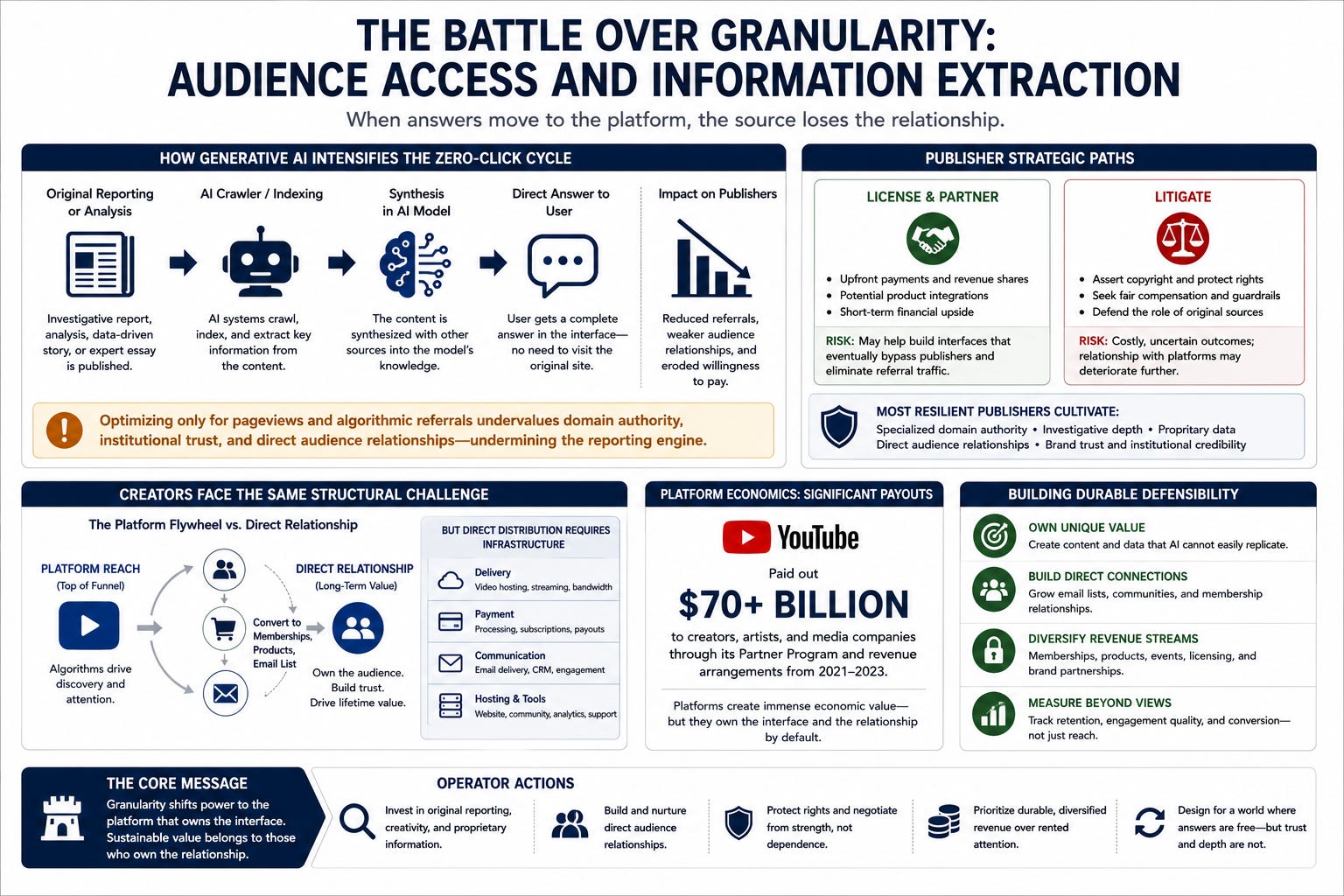
Some publishers have pursued paid licensing or product partnerships with AI developers; others, including The New York Times, have pursued litigation asserting copyright infringement. The strategic risk of licensing is that short-term payments may help build interfaces that eventually eliminate referral traffic to the publisher’s core properties. Publications that cultivate specialized domain authority, investigative depth, proprietary data, or direct relationships are far more resilient.
Creators face the same structural problem. Platform reach can be converted into memberships, products, and email relationships, but direct distribution still relies on delivery, payment, and hosting infrastructure. YouTube reported paying out over $70 billion to creators, artists, and media companies across a three-year window from 2021 through 2023 through its Partner Program and revenue arrangements.
MrBeast Reveals His Biggest Project Ever” / “What Is MrBeast’s Biggest Project on Amazon Prime?”
A creator who relies entirely on platform ad-share lives in a fragile environment. A creator who controls a direct audience channel, product line, and intellectual property controls a resilient enterprise.
Cost Floors and Durable Rights
Across each market, the error remains the same: treating the most visible unit of engagement as the complete unit of economic value.
Contractual labor rules establish financial baselines that limit how granular physical production can become. SAG-AFTRA agreements establish minimum compensation and residual obligations for covered streaming productions, preventing studios from reducing covered labor compensation to purely per-second or per-view pricing. Technology enables fragmentation, but labor contracts set a minimum cost floor, while controlled rights determine downstream value capture.
Initial viewing metrics also miss decades of downstream rights value. Holding territorial, adaptation, and sequel rights determines who captures downstream returns. A company that controls durable properties can afford higher initial production costs because the asset monetizes across video games, consumer products, theme parks, licensing, and sequels over decades. An expense must purchase defensible leverage, incremental retention, synchronized scarcity, a direct relationship, or controlled rights. Without one of those mechanisms, high-cost content occupies the most dangerous position in the modern media economy.
What Capital to Commit
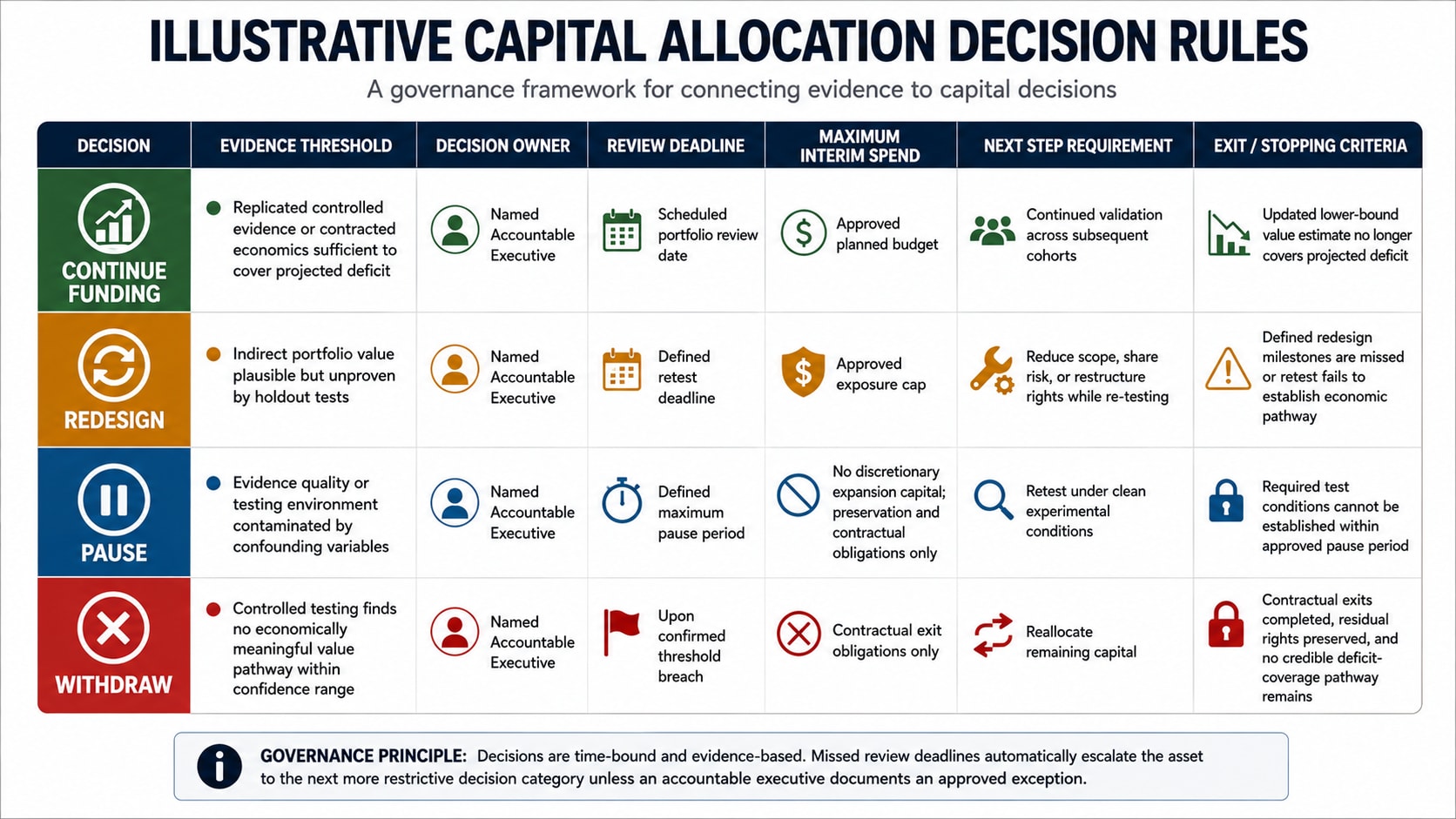
Capital should be committed only after management identifies the expected form of value, how it will be tested, and what evidence would stop funding.
Controlled statistical analysis requires a defined treatment and comparison group, measured exposure, selection-bias controls, and replication across subscriber cohorts. Measurable portfolio value requires an observable economic pathway, such as repeatable incremental retention, contracted licensing revenue, or measured acquisition lift. Without an observable economic pathway, completion rates, awards, social conversation, and executive enthusiasm do not translate into portfolio value.
These rules are governance templates, not universal numerical thresholds; each business must set its exposure limits, deadlines, and evidentiary standards before approving capital.
Illustrative Capital Allocation Decision Rules
Netflix’s reporting shift marked the point at which audience scale could no longer substitute for economic quality.
The modern media dashboard can describe behavior with extraordinary precision. It cannot tell executives, on its own, what caused a customer to stay, pay, trust, or return. Attention can be rented from an algorithm.
The defining question is what a media company still controls after that attention leaves.