

The Mirror in the Machine
Why Your Best Performance Is AI’s Greatest Lesson

In the high-rise offices of Manila and Bengaluru, a strange inversion is underway. Workers are building the systems that may eliminate them.

For years, the lights in Manila never really went out. At 2:13 in the morning, entire districts stayed awake for American customers they would never meet. Coffee shops stayed full. Ride-share drivers circled office towers. Young workers in headsets practiced neutral accents while apologizing for delayed shipments in Ohio, refund disputes in Texas, or internet outages somewhere outside London.
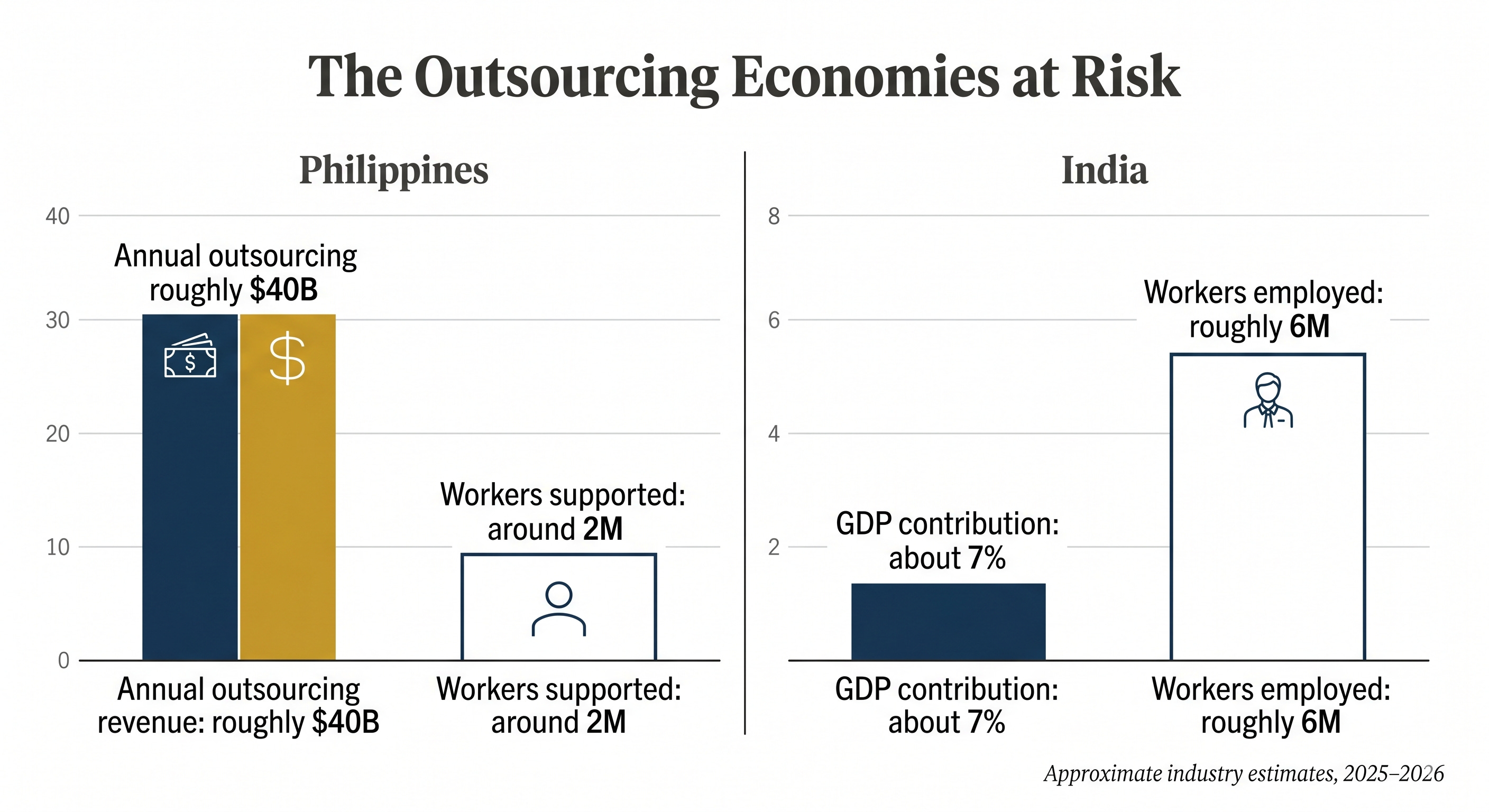
The night shift became an economic engine. In the Philippines alone, outsourcing now generates roughly $40 billion annually and supports around 2 million workers. In India, about 7% of GDP comes from the broader outsourcing economy, which also employs roughly 6 million people.
For millions of families, the formula felt stable: Learn the system. Master the script. Stay employable. Then something strange happened. The better workers became at their jobs, the more valuable they became to the machines replacing them. That is the real AI story unfolding across the outsourcing capitals of the world. Not killer robots. A quiet transfer of human judgment into software, trained by the very people whose livelihoods now sit in the blast radius.
Outsourcing Jobs In India and Philippines Are Changing - And Workers Are Feeling It
The Industry Built While America Slept
To understand why this moment feels so destabilizing, you have to go back to the late 1990s. Western corporations were panicking over Y2K, or the “Millennium Bug.” Computer systems built around two-digit years looked fragile, and the world needed an army of programmers to inspect millions of lines of code.
India stepped into that gap. It was not just cheap labor; it was a realization that high-volume, repetitive work could be offshored. The Philippines followed with high English proficiency and a workforce deeply familiar with American culture and communication styles.
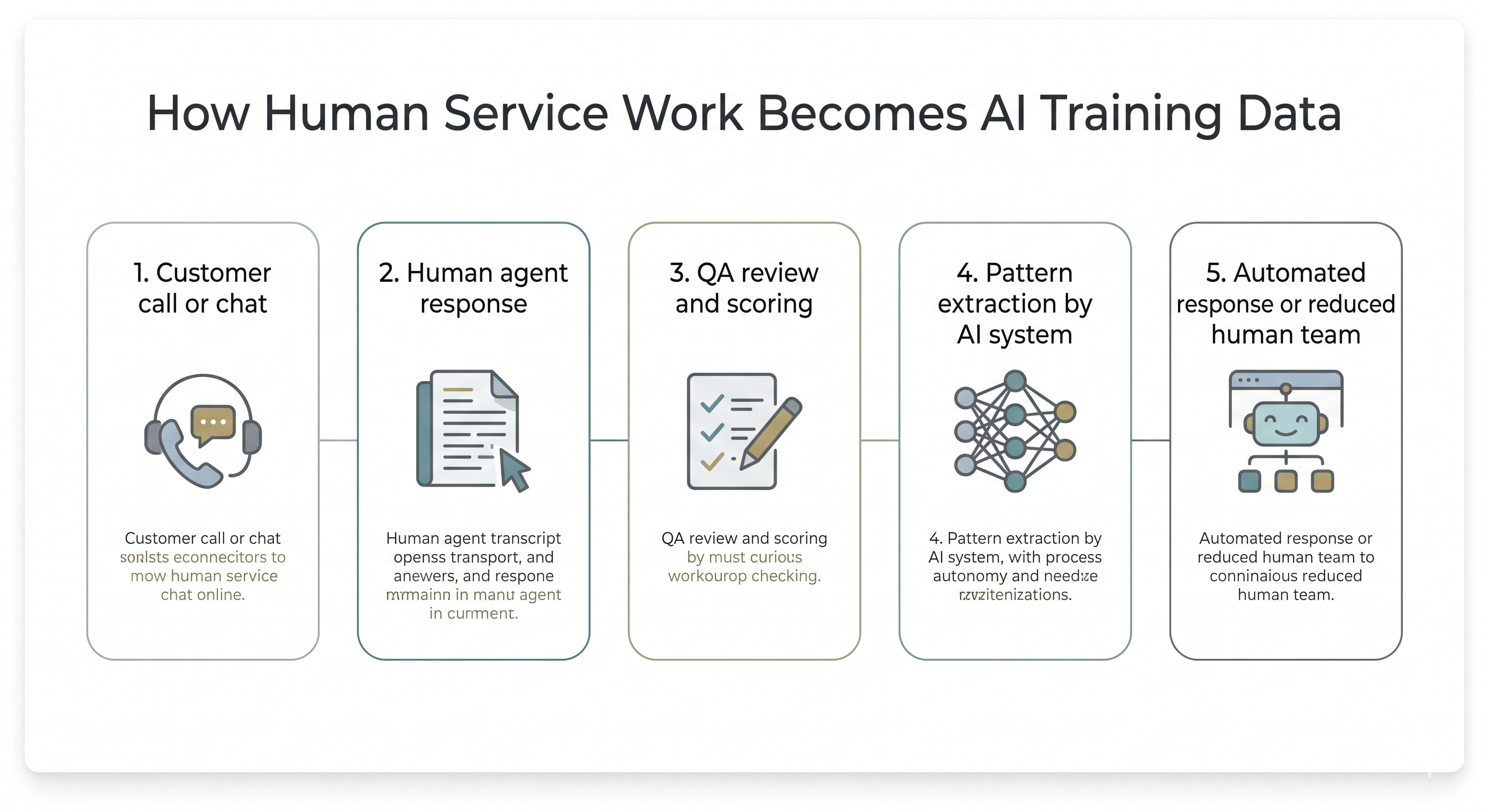
Outsourcing was never just about answering phones. It was about learning how to calm human beings at scale. For twenty years, companies recorded nearly everything: calls, transcripts, and resolution patterns. Those interactions became one of the largest reservoirs of machine-readable service behavior in modern labor history. Now, AI systems are learning from them. Not metaphorically. Literally.
The Teacher and the Replacement
One quality analyst described a process that is becoming a standard template for displacement. Ivan worked at a call center monitoring and improving the performance of customer service agents. When AI tools first appeared, they were imperfect and required human intervention to “double-check” the output.
Ivan effectively became the teacher, helping the AI improve by auditing its errors. Once the machine absorbed the patterns of tone, pitch, and resolution, the company realized it no longer needed human analysts. Ivan was replaced by the very system he helped train.
How AI Is Transforming the BPO Industry
This progression is appearing everywhere. In some departments, teams that once required ten people now handle a fraction of that number. Unlike previous software waves, generative AI improves by watching experts work. A factory machine does not learn your personality before replacing you. This one does.
The New Geography of Power
This area is where the conversation stops being technological and starts becoming geopolitical. For two decades, outsourcing helped redistribute opportunity from wealthy nations to emerging economies. Now, the next productivity revolution may recentralize power.
When a small number of countries control the models, the chips, and the cloud infrastructure, everyone else operates downstream from their decisions. A new kind of polarization is emerging. Some observers describe it as a new empire of algorithmic governance.
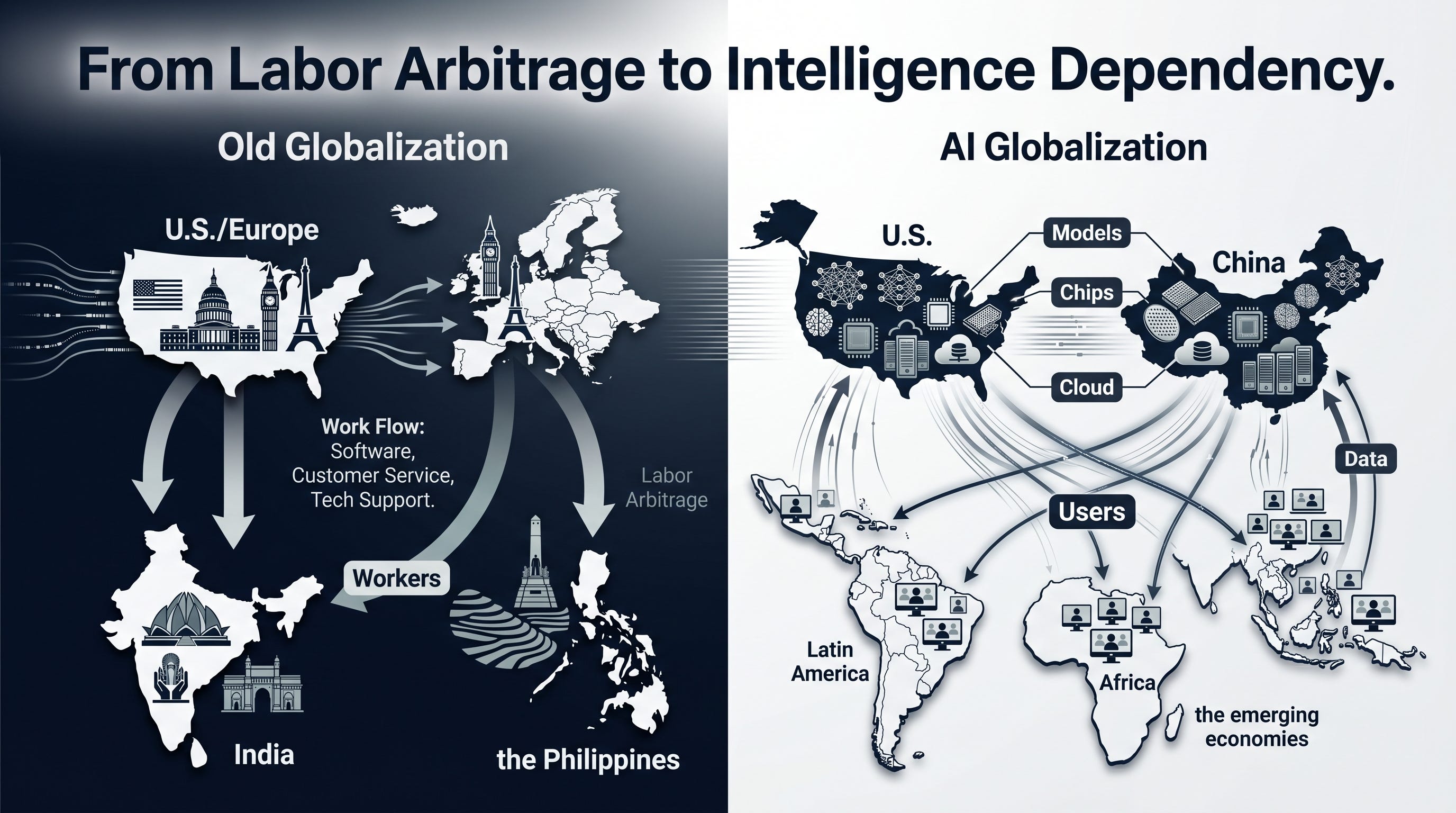
A UN report warns that while the income gap between rich and poor nations has narrowed over the past 20 years, AI could entrench new divides, ushering in an age of unequal progress. The risk is that countries that built middle classes on labor arbitrage may become captive users of technologies they no longer help manage.
The Next Great Divergence: Why AI May Widen Inequality Between Countries
The Reality Is Messier Than the Headlines
And yet, the story is not entirely bleak. The technology still struggles with nuance and cultural context in ways executives usually keep private. For now, humans are still required to oversee the “human layer” above the AI to ensure the experience is actually correct.
Some sectors are even adding jobs while deploying AI. “Global Capability Centers,” the offshore innovation hubs run directly by multinational corporations, continue to hire for more complex, high-value functions. But there is a catch. These jobs require senior talent and advanced skills that are not immediately accessible to the thousands of workers currently doing repetitive tasks.
The Real Product Was Never the Call
Underneath all of this discussion sits an uncomfortable moral question: Who owns the value created from human behavioral data?
The outsourcing workforce did not just answer customer calls. They manufactured training data. They turned patience, judgment, and emotional intelligence into a machine-readable format. Now that data is becoming capital. Human expertise is being converted into software, often without any residual benefit for the teachers.
So What Would a Fairer Bargain Look Like?
This transition is not a sudden explosion; it is a gradual erosion disguised as efficiency. If we are to avoid a global “race to the bottom” where humans are asked to work longer for less just to compete with a machine, we must rethink the structure of this digital economy.
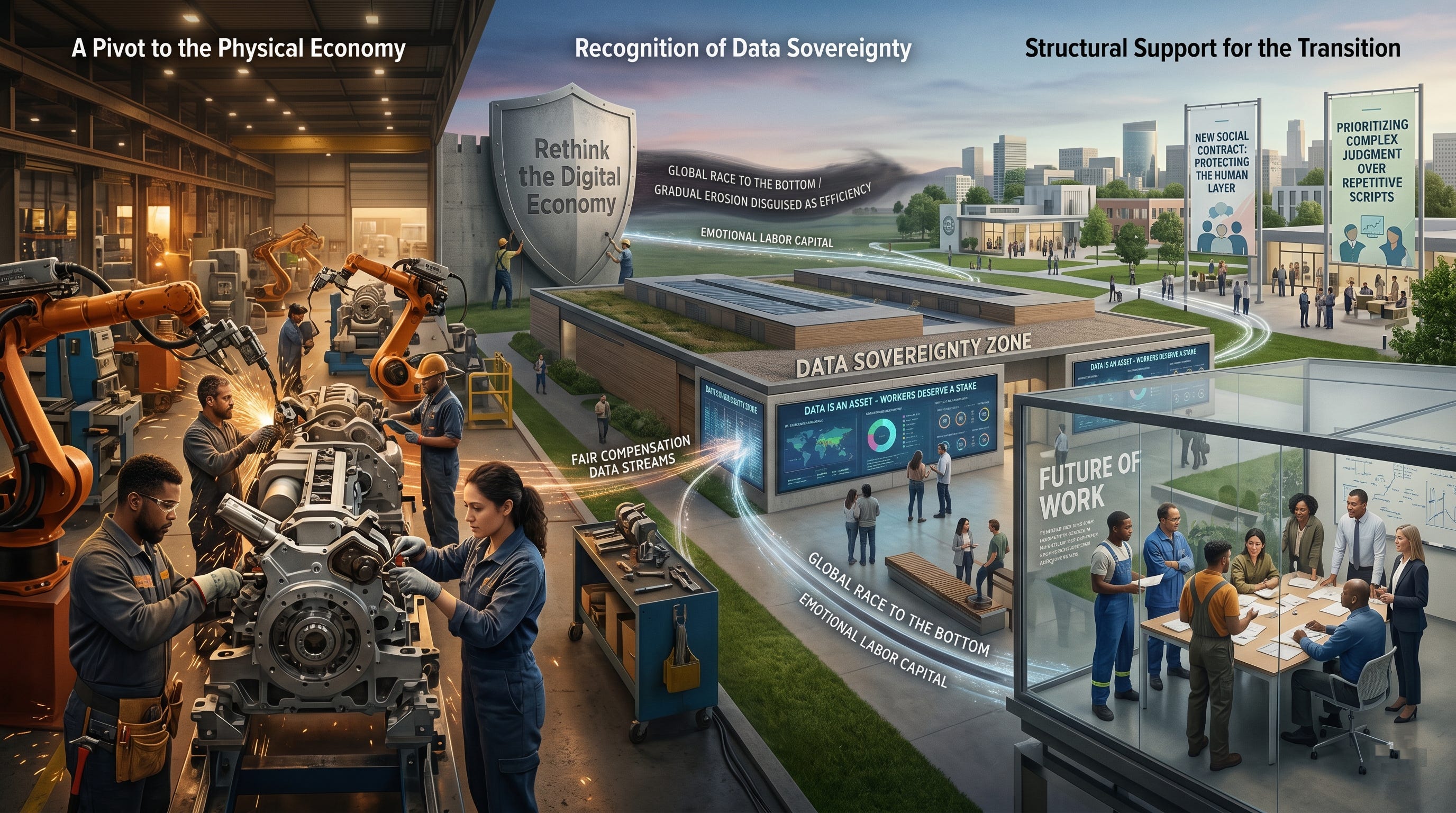
Recognition of Data Sovereignty: We must treat the behavioral data generated by workers as an intellectual asset. Workers and the nations that host them deserve a stake in the AI models built on their “emotional labor.”
A Pivot to the Physical Economy: Governments should prioritize investment in roles involving heavy industry, manufacturing, and technical tasks requiring fine motor skills that are more resilient to AI disruption.
Structural Support for the Transition: Moving beyond the “upskilling” myth, we need a social contract that protects the “human layer” by supporting workers as they move into roles that prioritize complex judgment over repetitive scripts.
Somewhere tonight, under fluorescent lights in an office tower, a worker is still practicing their best empathetic voice. I’m still calming strangers. I’m still turning patience, judgment, and emotional intelligence into machine-readable data.
The machine is learning from them.
The question is whether anyone will remember to pay the teacher.