

The Nile Mirage
Egypt Is Turning the Desert Green. The Water Math Is Brutal

Egypt is spending billions to reclaim desert, recycle drainage water, and reduce food insecurity. But satellite evidence, crop choices, groundwater depletion, and wheat dependence suggest the New Delta may be moving scarcity into the desert, not escaping it.
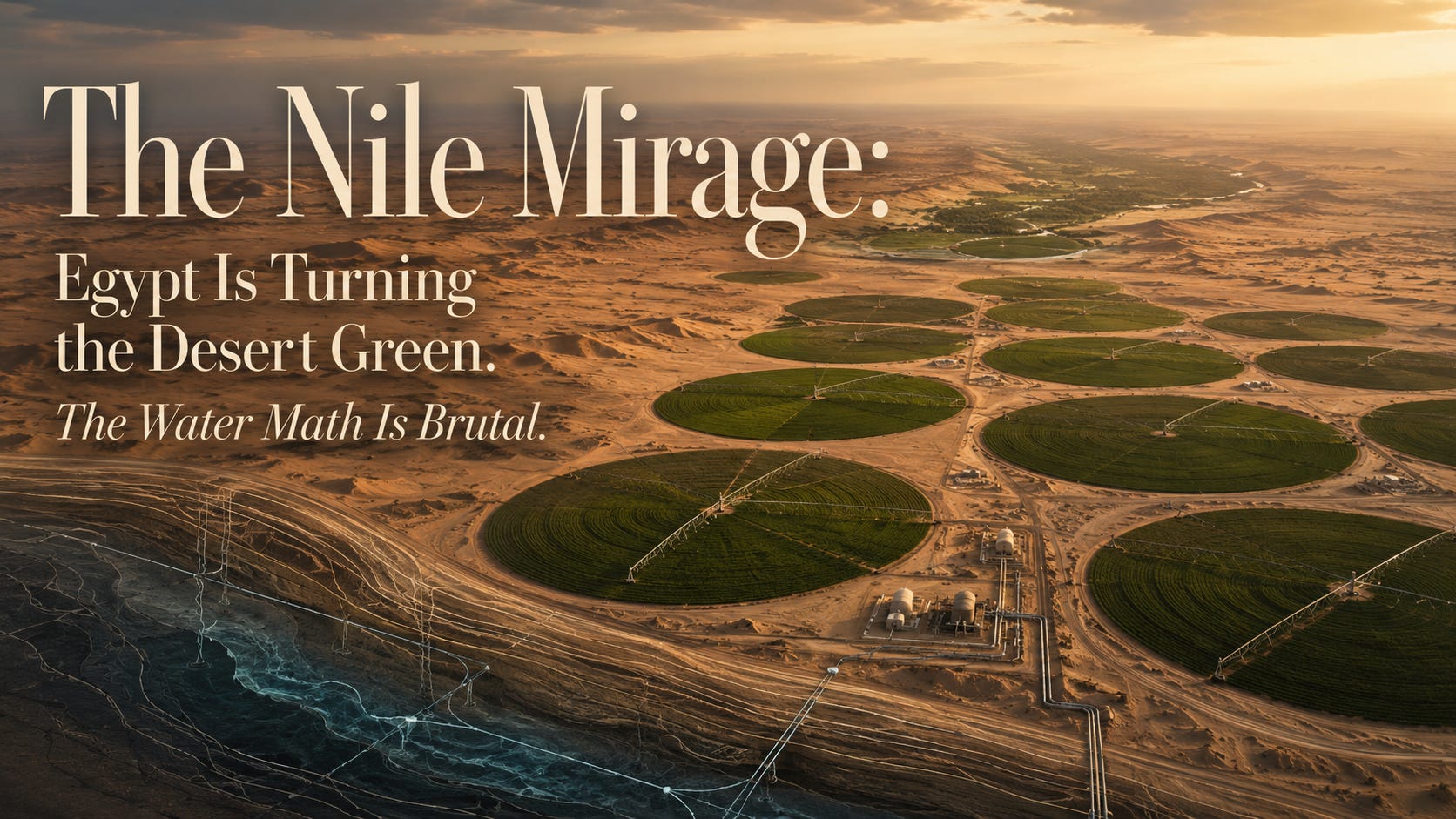
A green circle in the Western Desert can look like proof. From above, Egypt’s center-pivot farms appear as perfect disks pressed into sand, drawn by rotating irrigation arms. In a country with little spare water, limited arable land, and chronic foreign-currency pressure, the image carries a political message: the state can still make land where the map says there should be none. The harder question is what Egypt must spend to keep that image true.
That is the central tension behind Egypt’s New Delta. The project is not imaginary. The concrete is real; the pumps are real; the fields are real. The risk is not that Egypt would fail to make the desert bloom. It can. The risk is that the country may be producing visible abundance by spending hidden reserves: groundwater, public money, foreign currency, energy, and time.
The names can blur together. The New Delta is the broader reclamation and irrigation vision. The Future of Egypt is the state-backed agricultural development effort that is part of that westward push. Al-Hammam is the treatment plant built to process agricultural drainage water for reuse. Together, they form Egypt’s attempt to create a second farming frontier west of the old Nile Delta.
Egypt is Building a $9.7BN New Nile Delta
The timing is not incidental. Egypt has a population nearing 120 million, imports roughly 12 to 13 million metric tons of wheat a year, relies heavily on Nile water, and now faces a river system whose upstream politics changed after Ethiopia inaugurated the Grand Ethiopian Renaissance Dam (GERD) in September 2025. The New Delta is not just a farm project. It is Egypt’s answer to a tightening national equation.
When the River Became a Machine
For thousands of years, Egypt’s agriculture was built around a river that behaved like a clock. Seasonal rains in the Ethiopian highlands fed the Nile’s annual flood, sending water and sediment north. In ordinary years, the flood renewed the soil with silt and minerals. The result was not merely land with water on it. It was an agricultural inheritance built over generations: soil, drainage, labor, canals, markets, settlements, and reuse patterns. Desert land begins without most of that.
That old rhythm ended in the modern era. The Aswan High Dam, completed in 1970, allowed more reliable, year-round irrigation and higher crop intensity. It genuinely solved immediate flooding risks, but it also trapped sediment and shifted fertility from a river function to a managed-input problem. Chemical fertilizers, drainage systems, and managed canals had to replace work the river once did for free. The Nile became less a seasonal force and more a managed system.
Once the river became a managed system, control of timing became power. Aswan moved much of that power downstream into Egyptian hands. GERD moves part of it upstream into Ethiopian hands.
Inaugurated in September 2025 with an installed capacity of 5,150 megawatts, GERD is a hydropower project, not an irrigation scheme, and it does not directly consume water in the way a vast agricultural diversion would. GERD is not a giant upstream faucet. It is more unsettling than that: a structural change in who helps set the river’s timing. Egypt is especially worried about downstream flows during droughts and unilateral reservoir operations, and this worry is made worse by the lack of a binding operating agreement among the basin states.
Ethiopia’s new mega dam is causing tensions with Egypt
Climate change does not have to make the Nile disappear to make Egypt more fragile. It only has to make droughts, heat, and rainfall timing harder to predict in a system already operating with little spare room. Population growth does not only mean more mouths to feed. It divides the same river into smaller shares. Egypt’s population has grown from roughly 60 million in 1990 to about 120 million today.
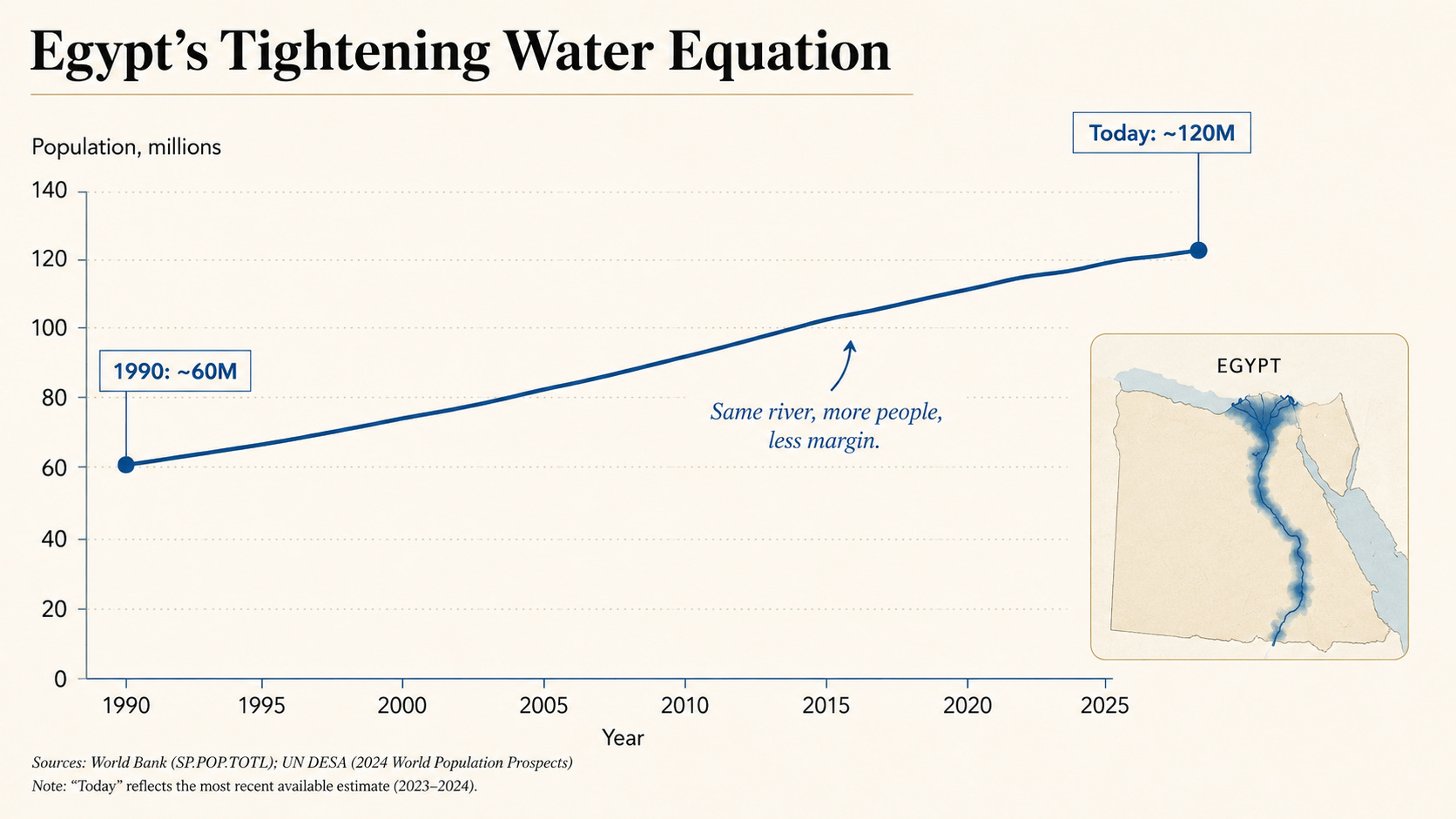
The overwhelming majority of those people are packed into the Nile Valley and Delta, a thin inhabitable strip running through a country that is mostly desert. Each acre of old agricultural land lost to urban expansion is not merely a housing fact. It is a permanent conversion of some of Egypt’s most valuable soil.
Bread, Dollars, and the Wheat Trap
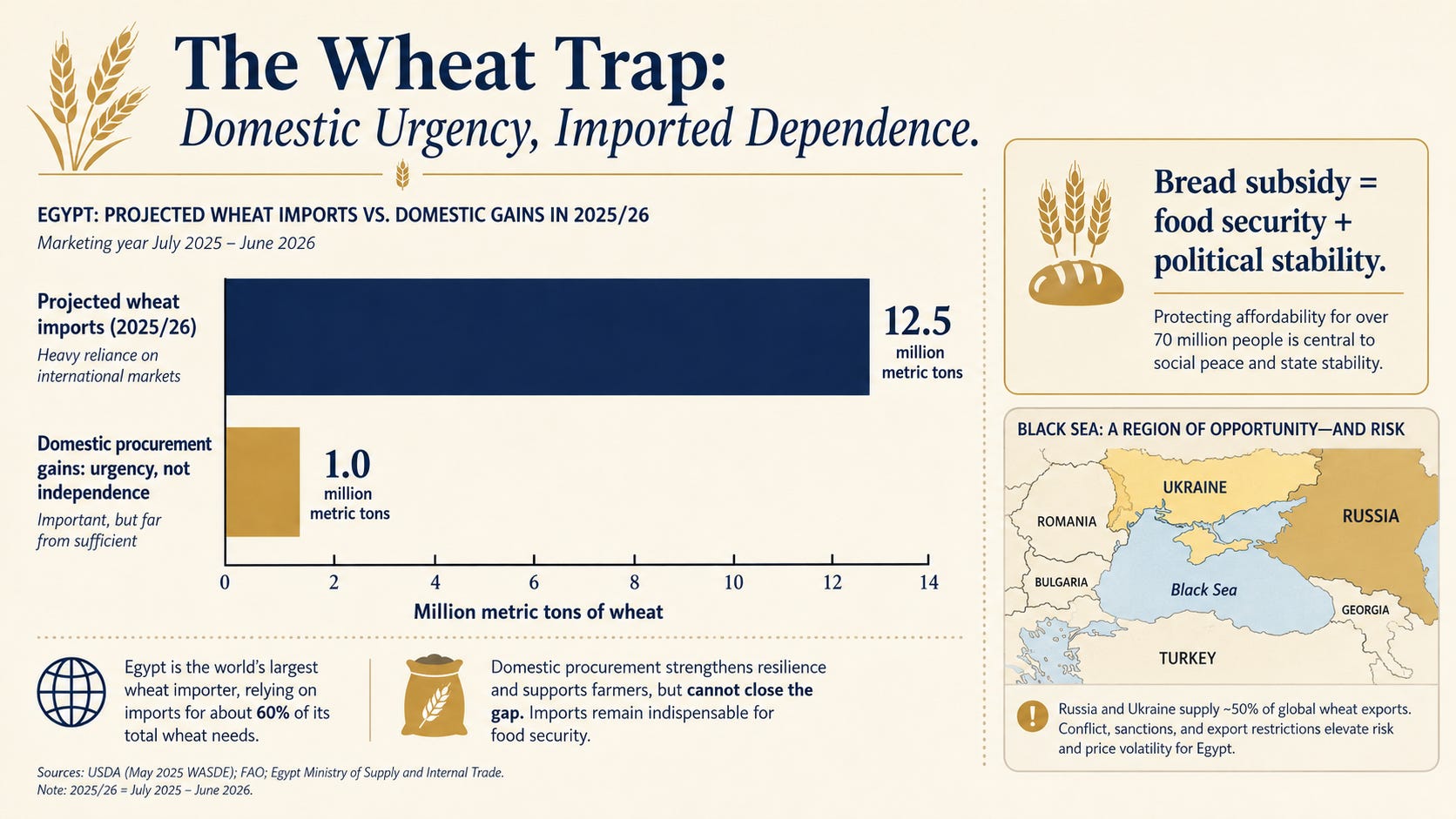
Water scarcity is compounding a structural food crisis. Egypt is one of the world’s largest wheat importers. U.S. agricultural reporting projected Egypt’s wheat imports at roughly 12 to 13 million metric tons for the 2025 to 2026 marketing year.
Wheat matters because it is not simply one crop among many. It is the basis of subsidized bread, the daily calorie floor for millions of Egyptians, and one of the commodities through which state legitimacy is felt at the street level. Egypt’s bread subsidy is not simply a welfare program. It is a stability mechanism. When wheat prices move, the pressure shows up in the budget, the currency, and eventually the street.
The danger of import reliance became impossible to ignore after Russia’s full-scale invasion of Ukraine in February 2022. In the five years before that conflict, Russia and Ukraine together supplied the overwhelming majority of Egypt’s imported wheat. When Black Sea grain flows became uncertain and global prices spiked, Egypt faced an immediate shock to its food system, budget, and currency position. Recent domestic procurement gains were a sign of urgency, not independence; they do not erase Egypt’s dependence on imported wheat.
A country that cannot easily expand its old farmland starts looking for new geography. This is where the desert starts looking irresistible.
The Artificial River and the Operating Expense
The New Delta system addresses this vulnerability through a vast water-reuse effort. Agricultural drainage water from the North Delta is collected and sent toward the Al-Hammam treatment plant on the North Coast. The plant has a design capacity of 7.5 million cubic meters per day, intended to serve national food-security goals.
But treated water is not the same as new water. Reuse improves quality and expands options, but it can be double-counted politically when treated as an entirely new supply. Unless the water would otherwise have been lost to the sea, recycling it means moving a resource from one part of the national ledger to another.
The physical system is not a single canal but a network of channels, buried pipe sections, and pumping stations, including a long artificial-river route described in some project accounts as roughly 170 kilometers. One critical segment moves water underground through large-diameter pipes to reduce losses across a difficult stretch.
Desert farming requires lifting, filtering, pressurizing, transporting, and distributing water through an unforgiving landscape. Some project descriptions place the reclaimed plateau roughly 100 meters above the collection zone, which helps explain why the system depends on a chain of 13 pumping stations.
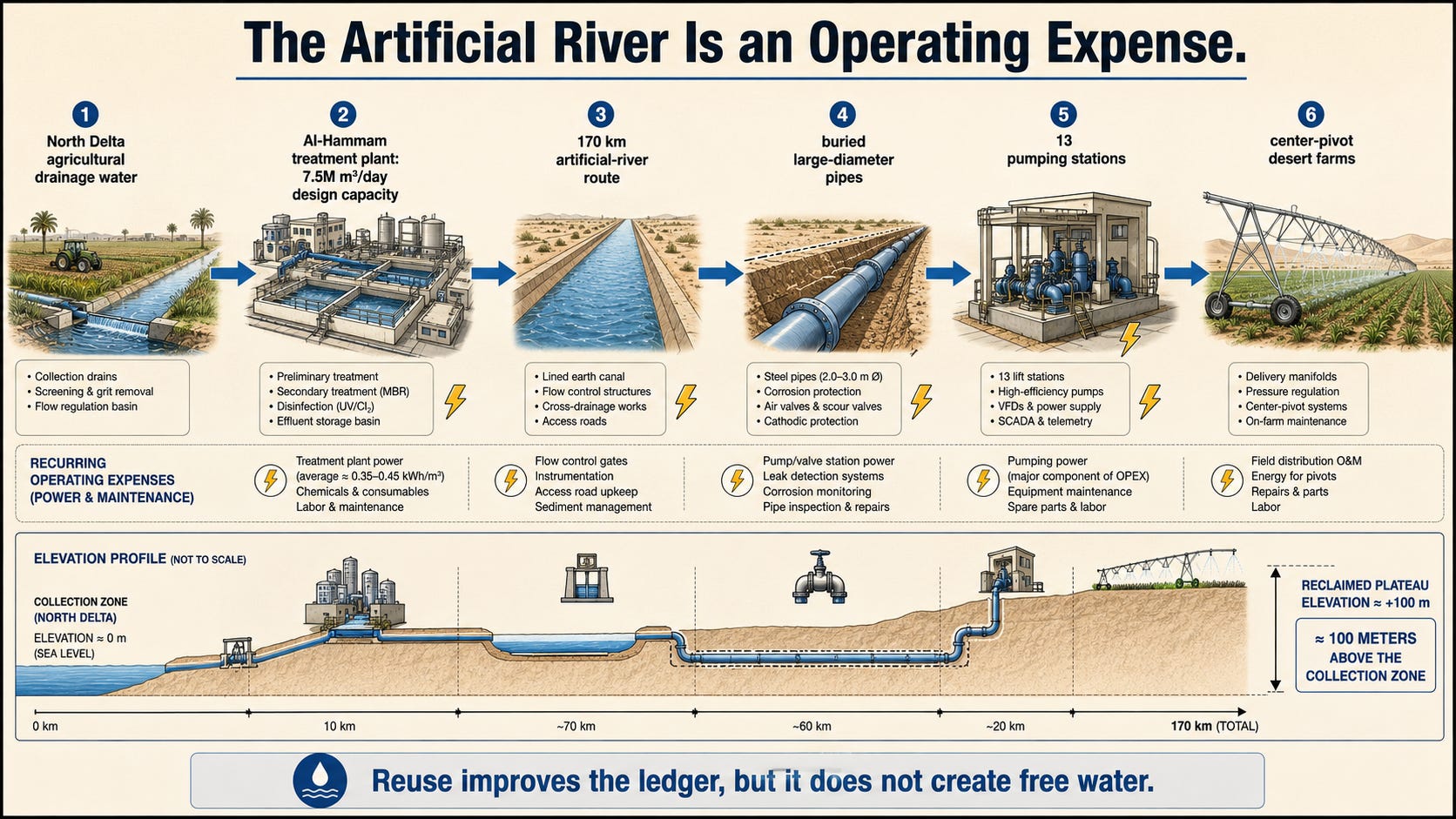
A canal is a capital expense. A pumped desert water system is a permanent operating expense. It has to be powered, repaired, monitored, and financed every year. The farther agriculture moves from the old valley’s gravity-fed inheritance, the more food production depends on machinery and maintenance. If power costs rise, pumps fail, pipes clog, or budgets tighten, the field does not care how inevitable the project once looked.
Desert reclamation is not a one-time triumph of construction. It is an ongoing struggle against soil chemistry. Without careful drainage, irrigation in hot, dry zones can leave salts behind, turning early productivity into harder farming over time.
The Hidden Siphon
The official story is about recycled drainage water. The early visual evidence tells a more complicated story about groundwater.
Satellite imagery has shown hundreds of center-pivot fields already operating in the Western Desert. Yet satellite analysis and expert reporting suggest groundwater may have supplied a substantial share of the early irrigation before the drainage-water reuse system was fully complete. Some of it appears to come from deep groundwater reserves that recharge slowly, if at all. That distinction matters because a river can be politically contested and still return next season. Fossil groundwater, once spent, belongs to a different clock.
The Nile River: The water crisis in Egypt
Early reliance matters because temporary water sources have a way of becoming permanent dependencies once farms, investors, workers, and export contracts are built around them. Groundwater is politically convenient because it is invisible. A canal can be photographed. A treatment plant can be inaugurated. A center-pivot field can be shown from space. A falling aquifer announces itself more slowly. Because groundwater depletion is hard to see at a national scale, satellites have become one of the main ways to detect the loss the landscape hides.
Satellite-based research suggests groundwater loss beneath parts of the Western Desert has accelerated sharply over the past decade, including in aquifers near areas of heavy reclamation. The aquifer is Egypt’s underground balance sheet. The crop circles are only the spending receipt.
Water for Dollars
A cubic meter of water used for wheat buys calories. A cubic meter of exported fruit buys dollars. Egypt needs both, but they are not the same form of security.
That is why crop choice matters. Food security means reducing vulnerability; export agriculture means earning money. In the New Delta, those goals may be pulling in different directions. Higher-value crops such as fruit, vegetables, and nuts, often associated with export markets, can better justify the cost of desert farming than staples such as wheat. The Egyptian government defends this logic, arguing that higher-value crops can narrow the trade deficit and generate foreign currency to pay for imported food.
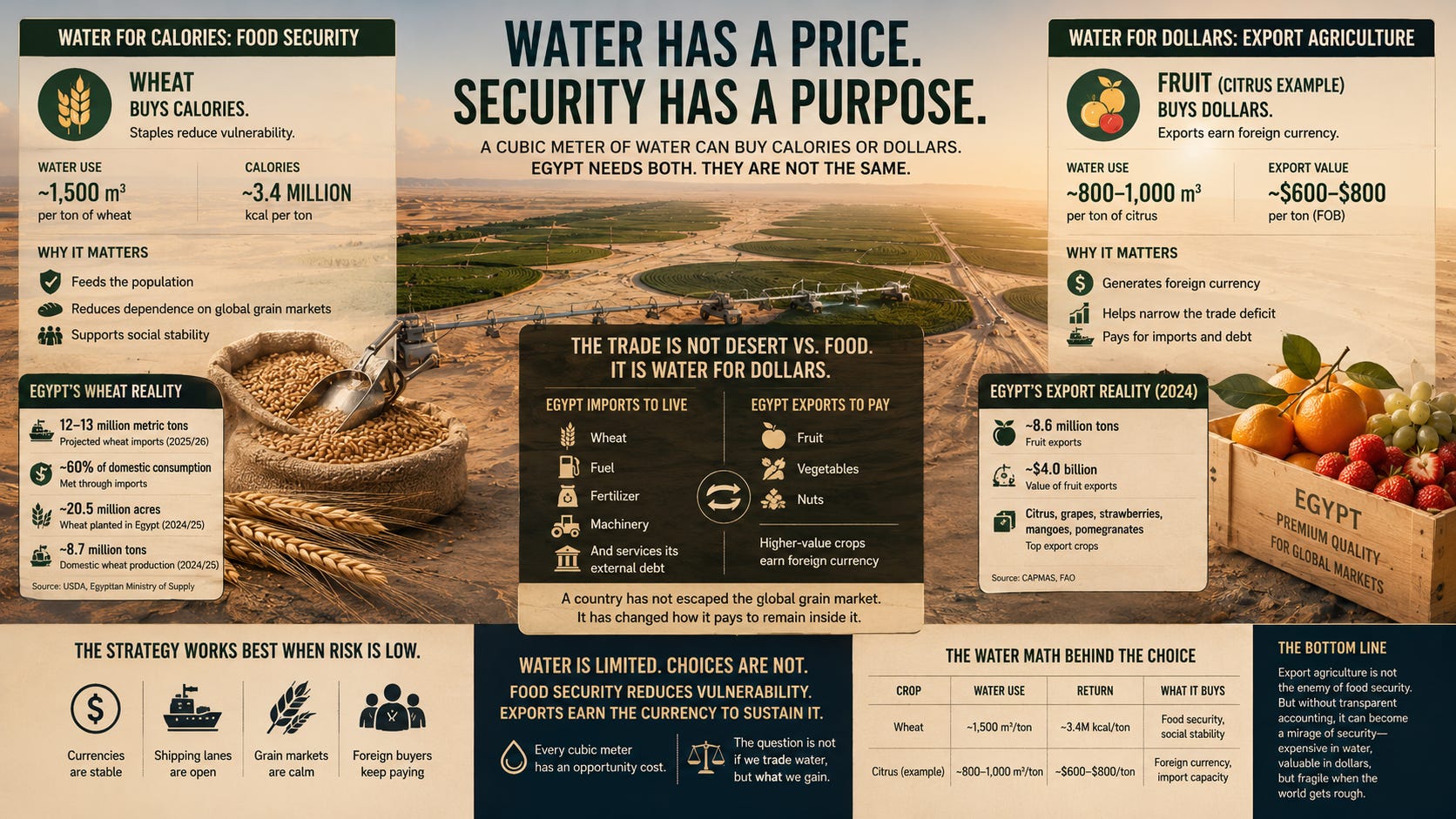
None of this means export agriculture is inherently flawed. A crop can strengthen the balance of payments without making dinner cheaper for a local family. The problem appears when export crops are presented as food security without a transparent accounting of whether the foreign currency gained is worth the water consumed. Egypt needs foreign currency to import wheat, fuel, fertilizer, and machinery and to service its external debt. The trade is not desert versus food. It is water for dollars.
The strategy works best when it is least needed: when currencies are stable, shipping lanes are open, grain markets are calm, and foreign buyers keep paying. It becomes fragile precisely when food security matters most. A country has not escaped the global grain market simply because it grows more export crops. It has changed how it pays to remain inside it.
The Megaproject Reflex
The New Delta belongs to a familiar pattern in modern Egyptian statecraft: when pressure builds inside the old geography, the state turns toward the desert.
The desert is Egypt’s preferred political canvas because it appears empty. Empty land can make failure look like a design problem rather than a distribution problem. That does not make desert development irrational. It makes the accounting more important.
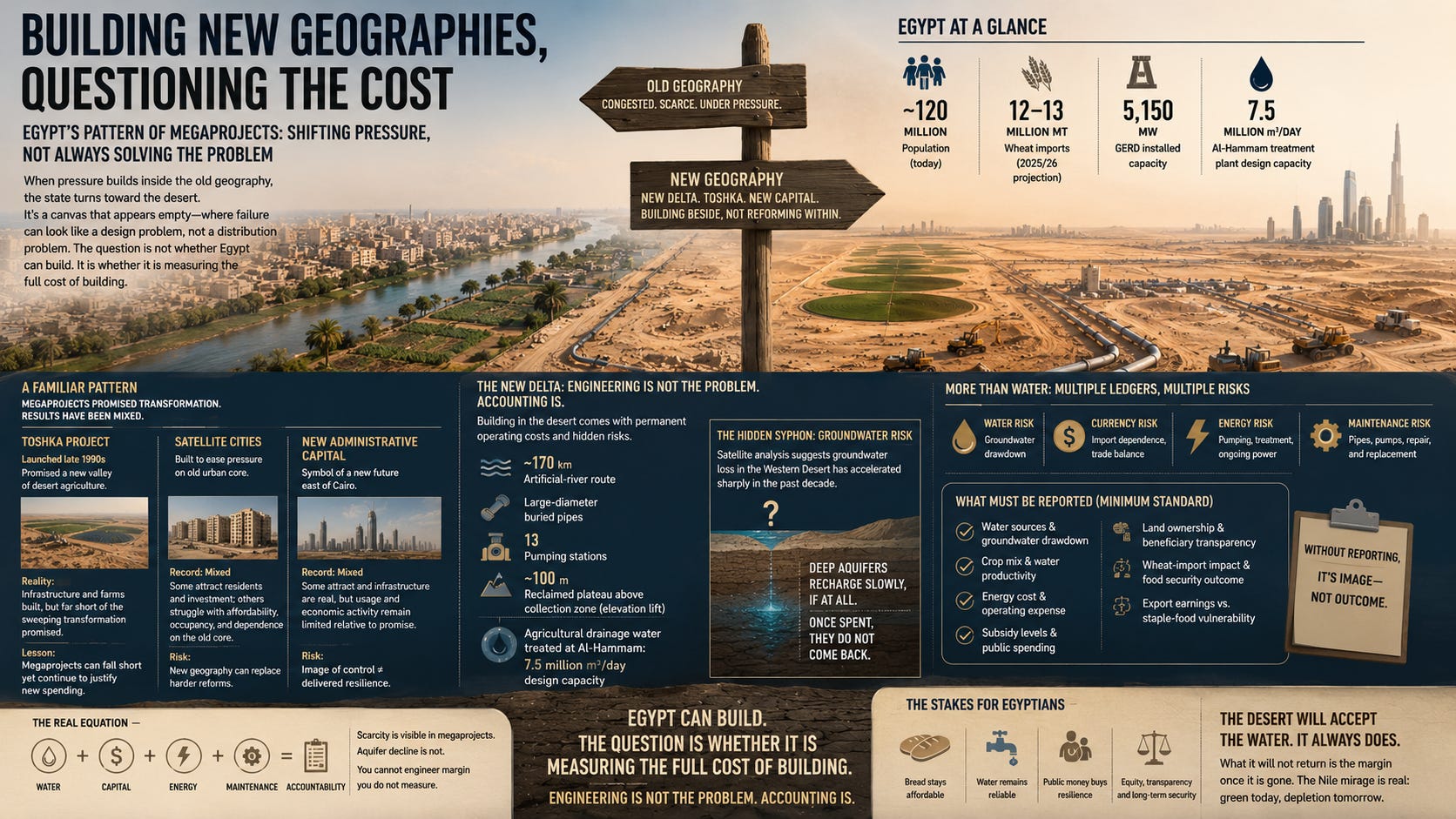
The precedent is Toshka, launched in the late 1990s as a desert-agriculture breakthrough that would create a new valley beyond the Nile. It produced infrastructure and farms but fell short of the sweeping transformation promised at its birth. Toshka matters because it shows how long a desert megaproject can survive as a national idea after falling short of its original promise. The problem with many megaprojects is not that they collapse. It is that they can fall short of their original promise while continuing to justify new spending.
The same instinct appears in Egypt’s satellite cities and the New Administrative Capital. They reflect the same governing habit: when existing systems become politically congested, build a new geography beside them. The record has been mixed: some have attracted residents and investment, while others have struggled with affordability, occupancy, or dependence on the old urban core. The danger is that new geography becomes a substitute for harder reforms rather than a complement to them.
Water accounting is only one ledger. Ownership is another. Large-scale land reclamation often requires capital, water access, logistics, and state relationships. That makes procurement transparency and local equity central to whether the New Delta serves broad food security or becomes a concentrated investment platform.
Megaprojects make scarcity visible. Aquifers do not. They decline offstage, beneath the politics of ribbon cuttings. Egypt can build. The question is whether it is measuring the full cost of building. Engineering is not the problem. Accounting is.
The Scorecard
The real question is not how many hectares Egypt reclaims. It is what each cubic meter of water buys.
The project should be judged by five measures: groundwater drawdown relative to recharge, calories or staple-food output per cubic meter, export dollars per cubic meter, public subsidy per reclaimed hectare, and the net change in Egypt’s wheat-import exposure. Without those numbers, green acreage is evidence of activity, not proof of resilience. Acreage is not food security.
The final test is whether the project reduces Egypt’s net vulnerability or merely converts water risk into currency risk, energy risk, and maintenance risk. The minimum standard should be public reporting on water sources, groundwater drawdown, crop mix, energy cost, subsidy levels, land ownership, and wheat-import impact. Without that, the project is being sold by image rather than audited by outcome.
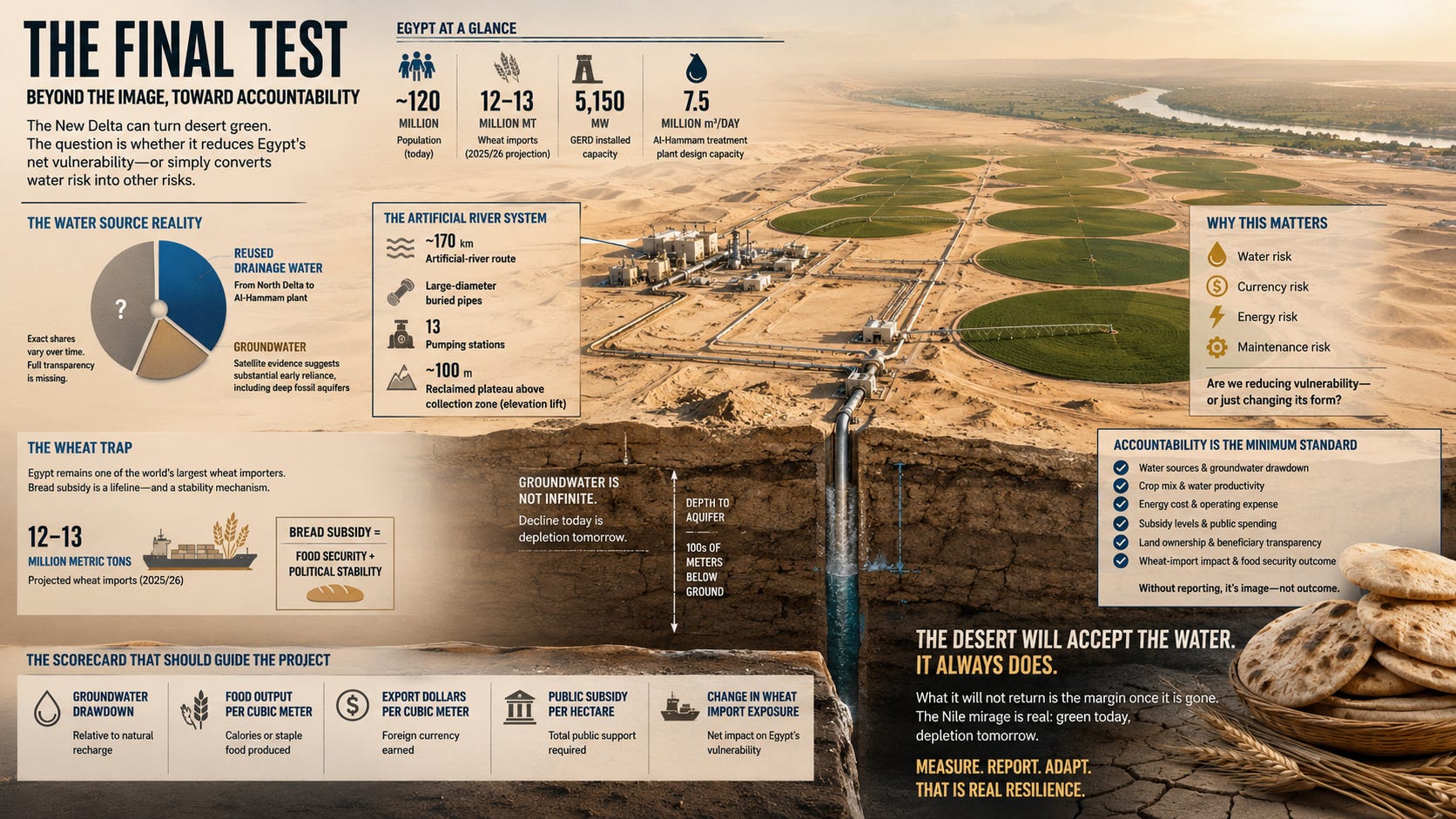
The best version of the New Delta would be disciplined and transparent: treated drainage water used where it produces the highest national return, groundwater withdrawals capped and reported, crops chosen by water productivity rather than political optics, and export earnings measured against staple-food vulnerability. That would be adaptation. Anything less risks becoming infrastructure that performs resilience without delivering it.
For most Egyptians, the test is not whether the desert looks greener from space. It is whether bread stays affordable, water remains reliable, and public money buys resilience rather than another image of control.
The desert will accept the water. It always does. It will accept the pumps, the pipes, the subsidy, and the story. What it will not return is the margin once it is gone. That is the Nile mirage: not that Egypt cannot make the desert green, but that green can become the color of depletion before anyone is ready to call it a loss.
I love stories like this because they remind us that innovation isn't always about inventing something new. Sometimes it's about looking at old technology with a new perspective.
I've spent more than 30 years developing products, and one lesson has stayed with me. The best ideas often come from combining proven technologies in ways no one thought to before.
I recently read about similar approaches being used in parts of China's deserts, where older engineering concepts, modern materials, and smart water management are helping transform land once thought unusable into productive farmland.
We don't have a shortage of ideas. We have a shortage of people willing to rethink what's already in front of them.
Whether it's farming, manufacturing, or product development, I believe the future belongs to those who can blend yesterday's knowledge with today's technology to solve tomorrow's problems.
That's the kind of innovation that changes lives.
#Innovation #Agriculture #Technology #Sustainability #ProductDevelopment #FutureThinking #NeverQuit #DesignDevelopDeliver #EddyPham