

The Power Crunch
How AI's Insatiable Hunger is Rewiring the World's Energy Map

The digital revolution has always been built on invisible foundations—vast networks of servers humming away in remote warehouses, quietly powering our emails, streams, and searches. But now, with artificial intelligence exploding into every corner of life, those foundations are cracking under the strain.
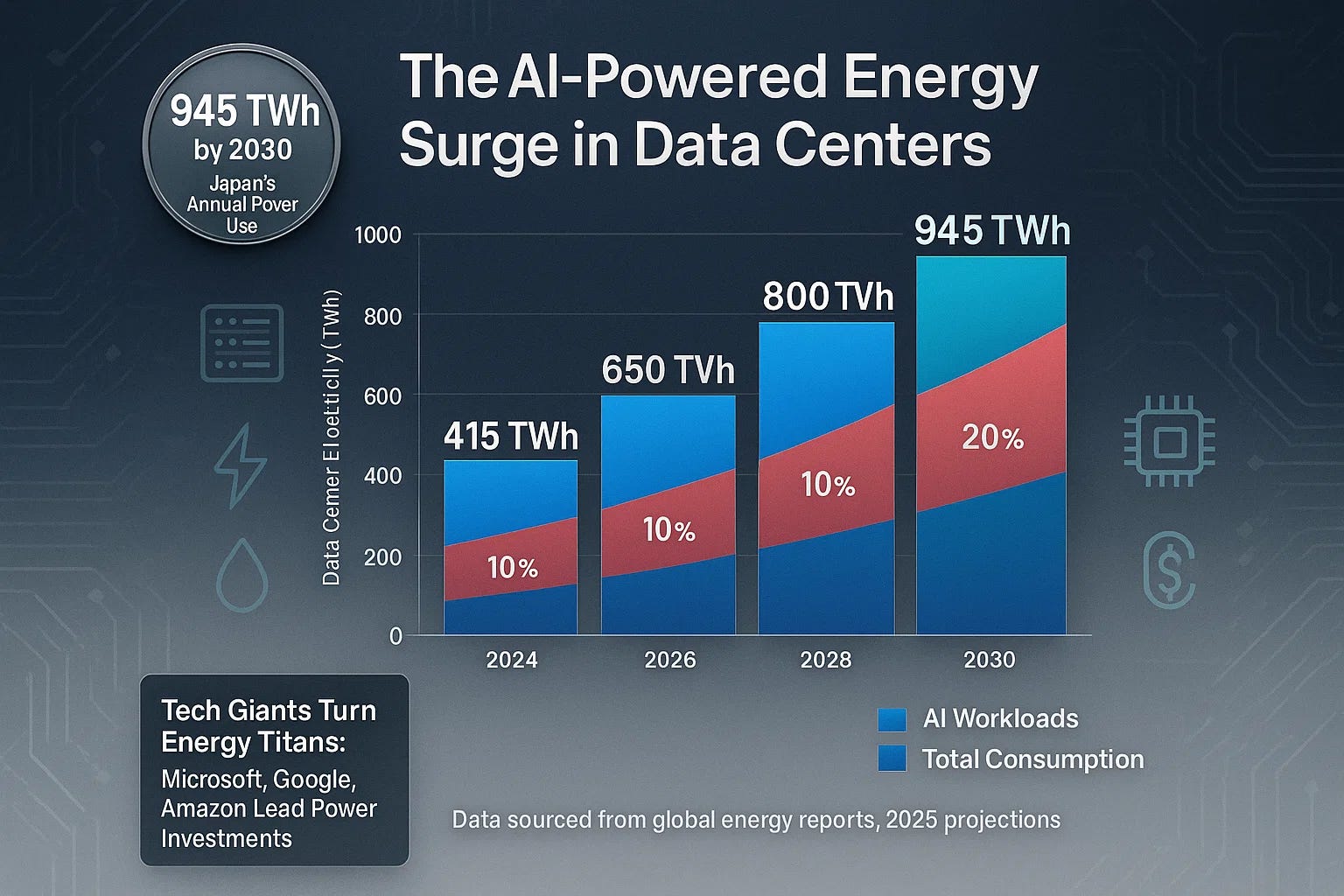
Data centers, once efficient marvels that kept energy use flat for years, are morphing into energy behemoths. In 2024, they gulped down about 415 terawatt-hours (TWh) of electricity globally, roughly 1.5% of the world's total. By 2030, that could more than double to 945 TWh, equivalent to Japan's entire annual power consumption today.
This isn't just a tech story; it's an energy saga that's forcing giants like Microsoft, Google, and Amazon to become major players in power generation while exposing vulnerabilities in grids, finances, and even national security.
What makes this shift so profound is the way AI workloads amplify everything. A single ChatGPT query might sip just five to ten times more juice than a Google search, but scale that to billions of interactions—plus image generation, video creation, and model training—and the numbers balloon. Training a beast like GPT-3 can burn 50 gigawatt-hours, enough to run a nuclear reactor at full tilt for two days. Image generation clocks in at 0.477 watt-hours per task, while a short AI video might match the energy for grilling a steak on an electric cooker—around 110 watt-hours. Multiply that by the generative AI boom, and if every Google search incorporated it, we'd need an extra 29.2 TWh yearly, akin to four or five nuclear reactors.
