

The Shattered Barrel

I have had the unusual privilege of seeing Washington from more than one angle.
I worked for President Obama. I worked for President Trump during his first term. I also ran in the 2016 election as John McAfee’s vice presidential running mate on the Cyber Party ticket, which means I have seen politics from inside the machine, beside the machine, and sometimes from a place so strange that the machine did not quite know what to do with us.

For the past five years, I have lived outside the United States. I have kept my distance from the daily tribal warfare of American politics while securing my golden visa in the United Arab Emirates. That distance matters. I am not writing this as a Democrat. I am not writing this piece as a Republican. I am writing this as someone who has been close enough to the machinery to know how narratives are built and far enough away to watch how the game is actually played.
And right now, the game is about oil.
In the winter of 1973, a group of men gathered in a stark, modern boardroom in Vienna. The fluorescent lights buzzed overhead. Coffee cups cooled on the table. Outside, most of the world had no idea that anything important was happening.
But inside that room, they did something with consequences that would echo for half a century.
They changed the price of the world.
How the 1973 oil crisis changed the world
This video gives readers historical context for the 1973 oil shock before the article moves into the modern geopolitical argument. It reinforces the idea that oil became a political weapon, not just a commodity.
The men in that room understood something governments were only beginning to grasp: whoever controlled the flow of oil could exert pressure on entire civilizations without firing a shot. OPEC had discovered what every truck driver, farmer, factory owner, airline executive, and parent pushing a grocery cart already understood in their bones: modern life runs on oil. Control its flow, and you influence almost everything downstream from it. The cost of the morning commute. The price of food. The expense of shipping. The cost of plastics, fertilizer, electricity, construction, air travel, and keeping a house warm in winter or cool in summer is high.
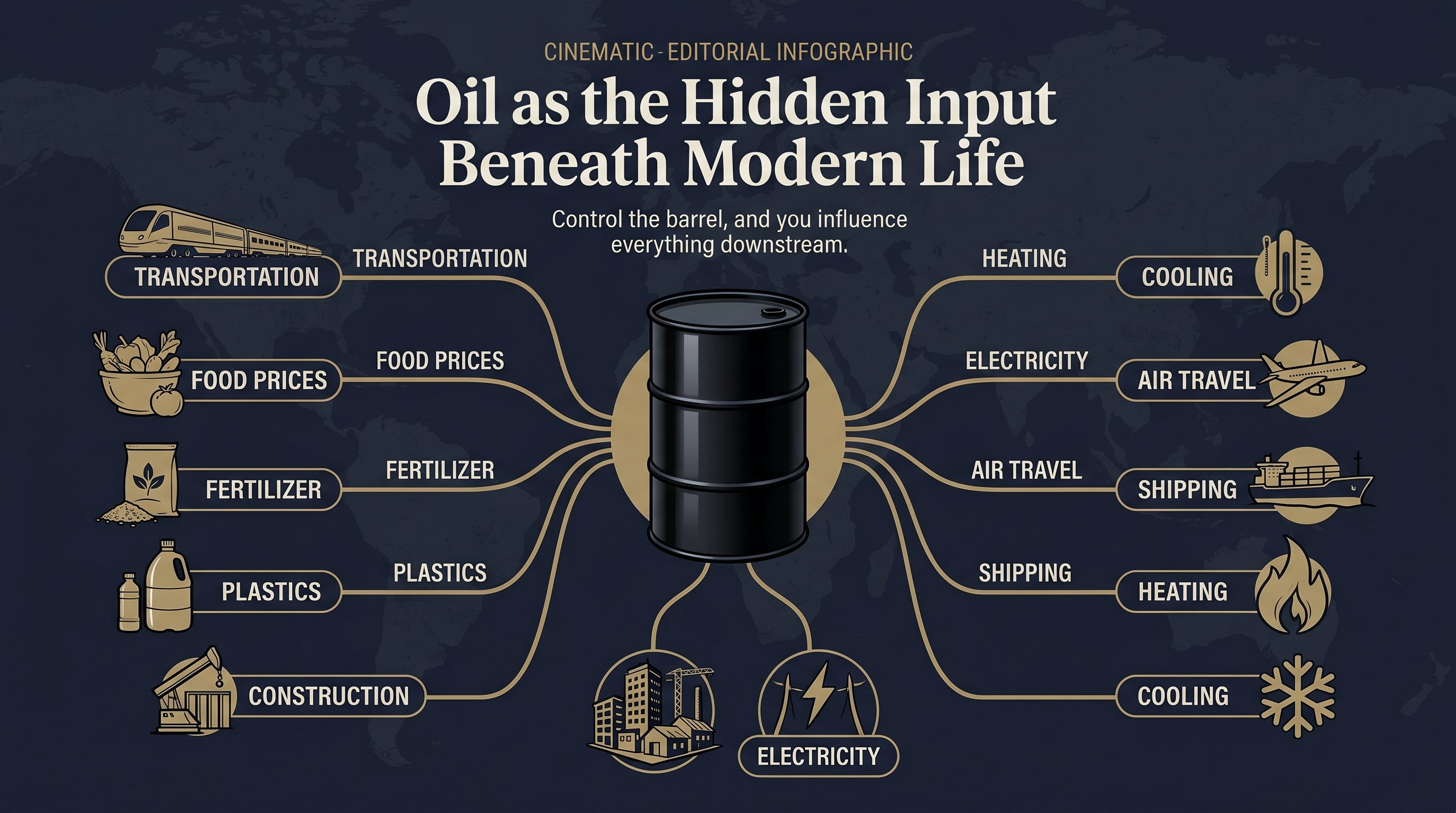
For more than fifty years, this principle was treated as one of the iron laws of modern economics. Inflation was whether. It arrived mysteriously, spread unevenly, and punished everyone. Central bankers responded the way central bankers always respond: they raised interest rates, made borrowing more painful, slowed demand, and hoped the fever would break.
It was indirect.
It was brutal.
And often, it did not touch the root.
But what if the model was incomplete? What if, at certain moments, the most effective way to cool an overheated economy is not to keep turning the monetary dial but to walk over to the machinery of supply and start breaking the structures that keep scarcity in place?
The Diversion in Caracas
To understand the sequence taking shape during Donald Trump’s second term, it helps to look past the press conferences and watch what those press conferences quietly displaced.
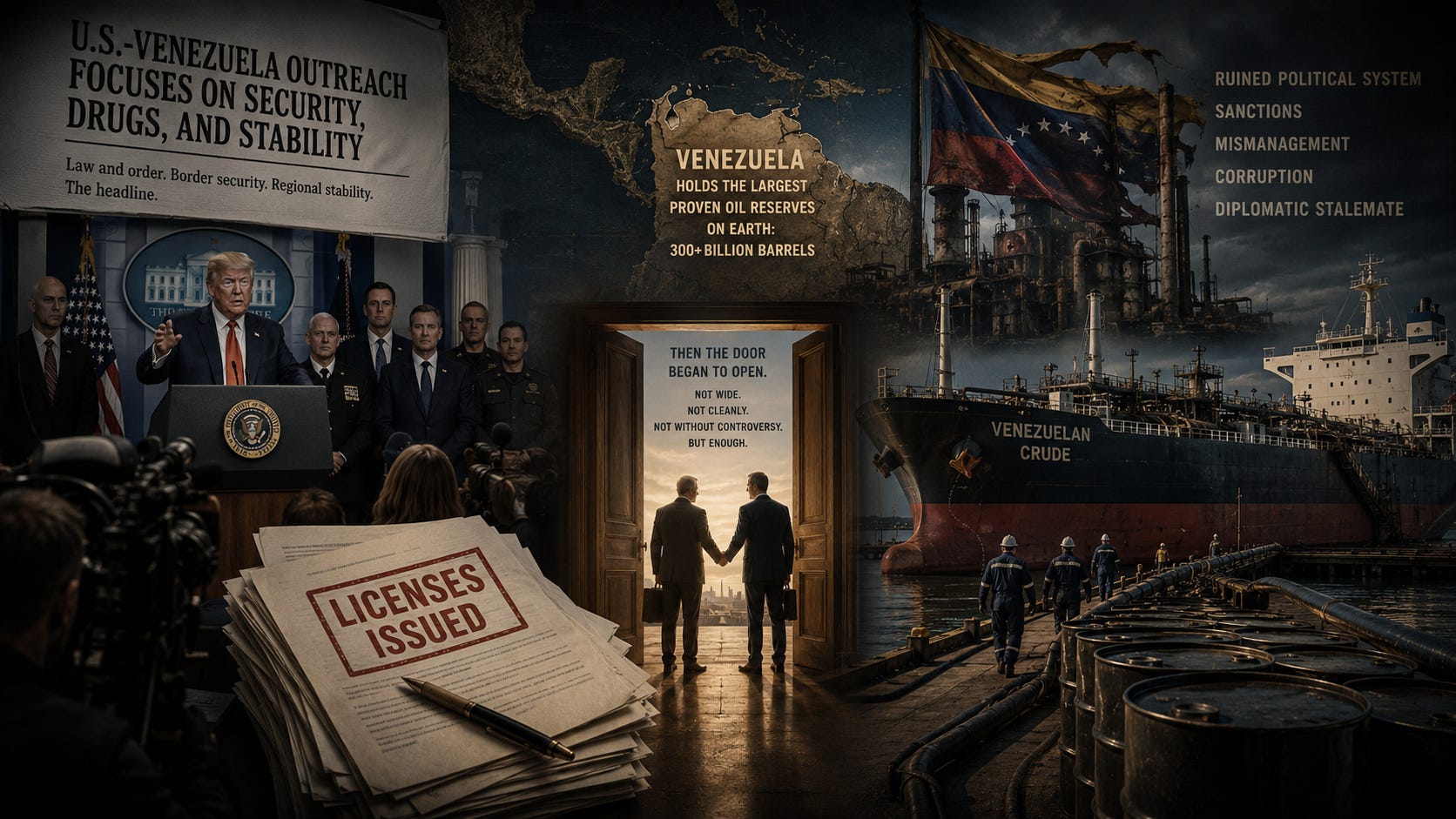
Several months ago, the administration began a significant diplomatic and economic push involving Venezuela. Publicly, the story was familiar: narcotics trafficking, regional instability, border security, and law and order. That was the headline.
But beneath that headline, something larger was unfolding. Venezuela holds the largest proven oil reserves on earth. Well over 300 billion barrels. For years, that oil lay trapped beneath a ruined political system, strangled by sanctions, mismanagement, corruption, and diplomatic stalemate.
Then the door began to open. Not wide. Not cleanly. Not without controversy. But enough. Licenses were issued. American companies began returning. Venezuelan barrels started finding their way back into the system.
Chevron executive says Venezuelan crude oil is helping lower prices amid Iran war
To most people, it looked like a drug policy story. To an energy strategist, it looked like something else entirely: a country with the planet’s largest oil reserves was being slowly reintroduced into the global supply conversation.
Everyone was watching the drug war. Almost no one was watching the spigot.
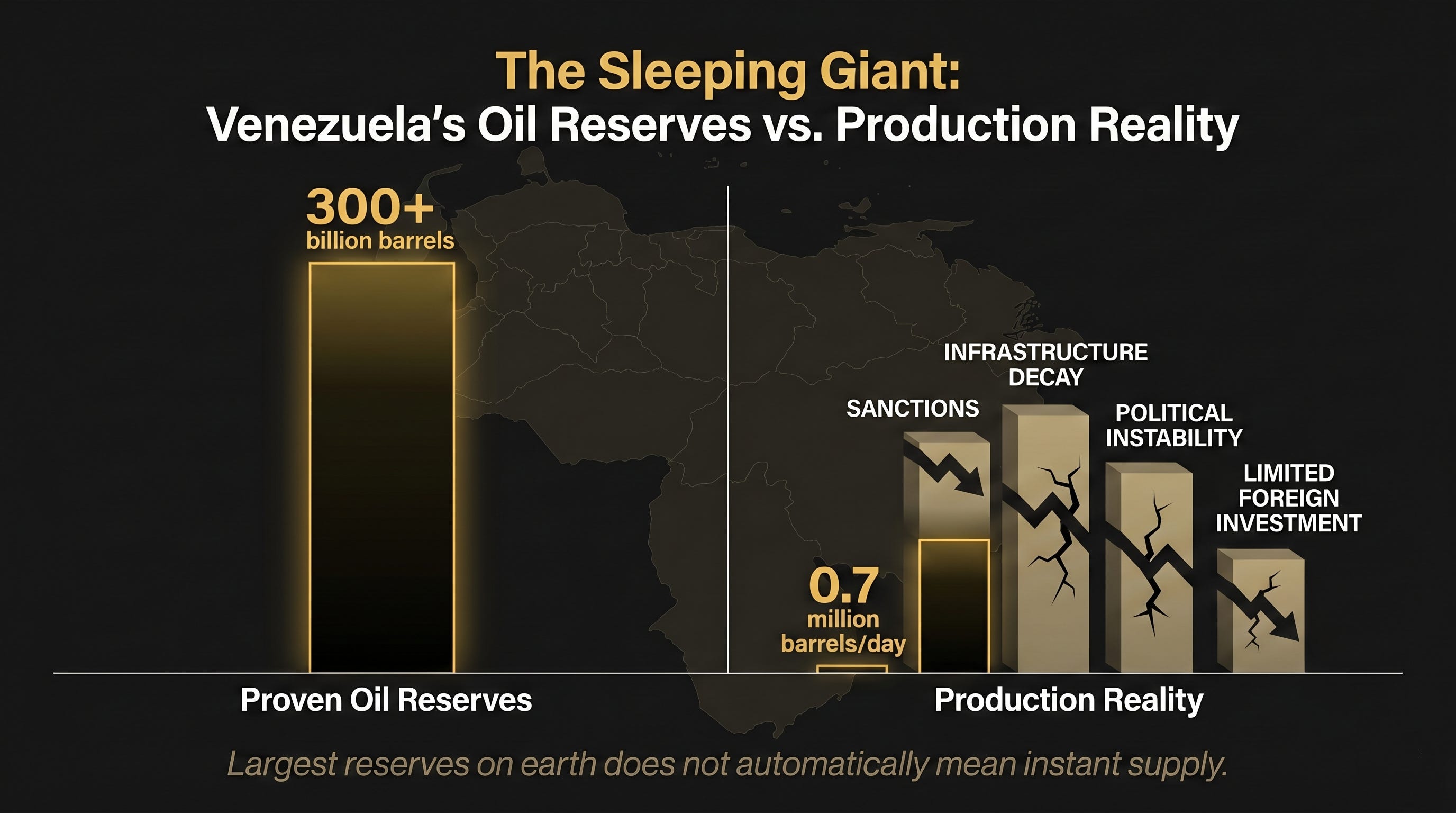
Still, Venezuelan oil alone could not break the old order. One new source of supply is useful. It is not enough to shatter a cartel. For that, the cartel itself had to crack.
The Geopolitical Pivot
That brings us to one of the more confusing developments of the past year: the escalation of tensions with Iran.
Most foreign-policy analysts looked at the situation through the obvious lenses: nuclear risk, regional stability, military deterrence, shipping lanes, and the old shadow war between Tehran and Washington. All of that matters.
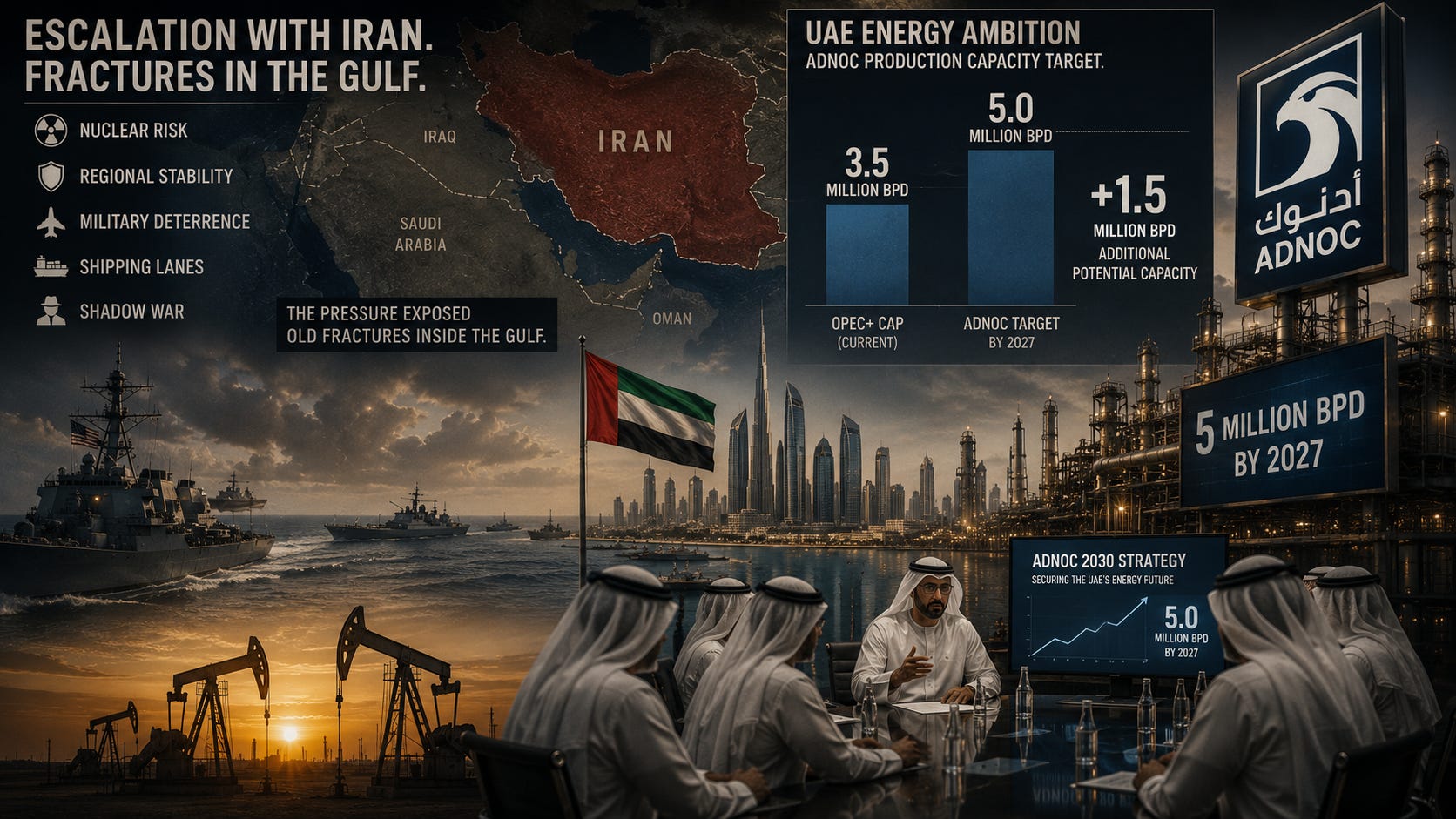
But there was another effect, one that received far less attention. The pressure exposed old fractures inside the Gulf.
For years, the United Arab Emirates has been positioning itself as the region’s most forward-looking energy power. Abu Dhabi has poured enormous ambition into ADNOC, its national oil company, racing toward a production capacity of five million barrels per day by 2027. Abu Dhabi had spent years chafing under an OPEC+ cap that choked its production to roughly 3.5 million barrels per day. By walking out the door, the UAE potentially opened the door to roughly 1.5 million additional barrels per day of future production capacity. That number is not just an energy target. It is a clock.
United Arab Emirates leaves OPEC, Elon Musk vs Sam Altman and attempted assassination
The UAE understands something many Western policymakers prefer to discuss in slogans: the world may be moving toward cleaner energy, but the transition will take time, and the countries that monetize their reserves before the next energy order fully arrives will have more money, more leverage, and more room to reinvent themselves.
But OPEC has always been a club built on discipline. Members agree to production limits in the name of price stability. In practice, ambitious producers often feel trapped by quotas shaped around someone else’s priorities. In this case, often Saudi priorities.
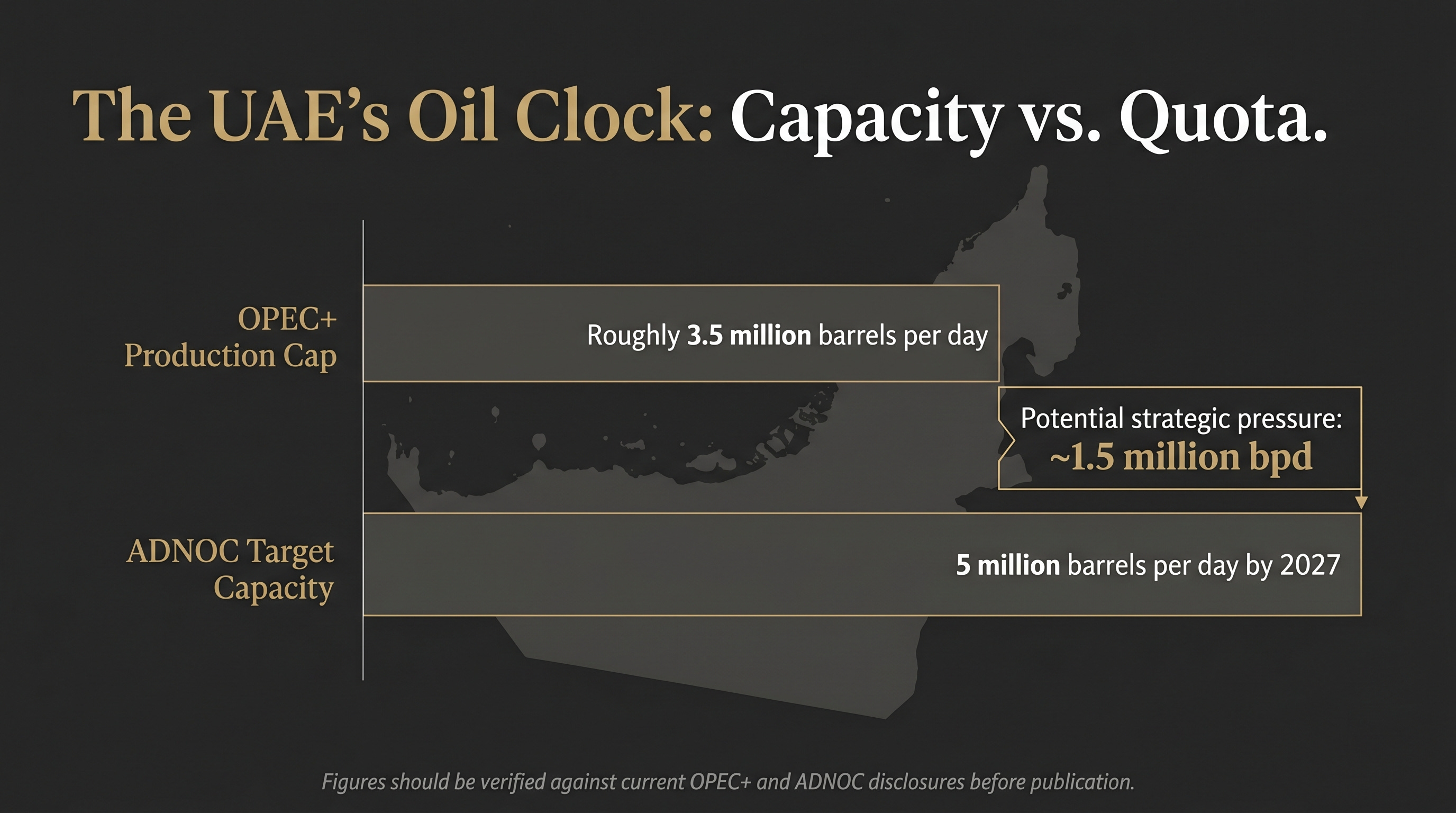
As tensions involving Iran intensified, the old fault lines widened. The UAE felt exposed and insufficiently protected. It also had its economic reasons to question why it should keep accepting constraints that limited its future.
Then came the shift. Whispers began filtering out of Abu Dhabi that the UAE was quietly preparing the groundwork to do the unthinkable: walk away from the cartel entirely. Whether that threat is an active diplomatic bluff or an impending economic exit, the mere presence of the option began to crack a sixty-year status quo.
That is not a minor bureaucratic adjustment. That is one of the cartel’s most important producers openly questioning whether it still belongs in the room.
Whether the departure was directly caused by the regional conflict, accelerated by it, or simply arrived at the moment when long-building incentives finally aligned is impossible to say with certainty. But the effect was clear. The old supply discipline weakened. The cartel no longer felt permanent.
The Chain Reaction
Layer the pieces together. Venezuela is re-entering the oil conversation. Gulf tensions reshaping incentives. The UAE is walking away from the cartel. The foundations of the old scarcity model began to loosen.
Of course, no serious person would claim that oil alone controls inflation. The Federal Reserve matters. Interest rates matter. Wages, fiscal policy, consumer demand, and global manufacturing cycles all matter. But energy is different.
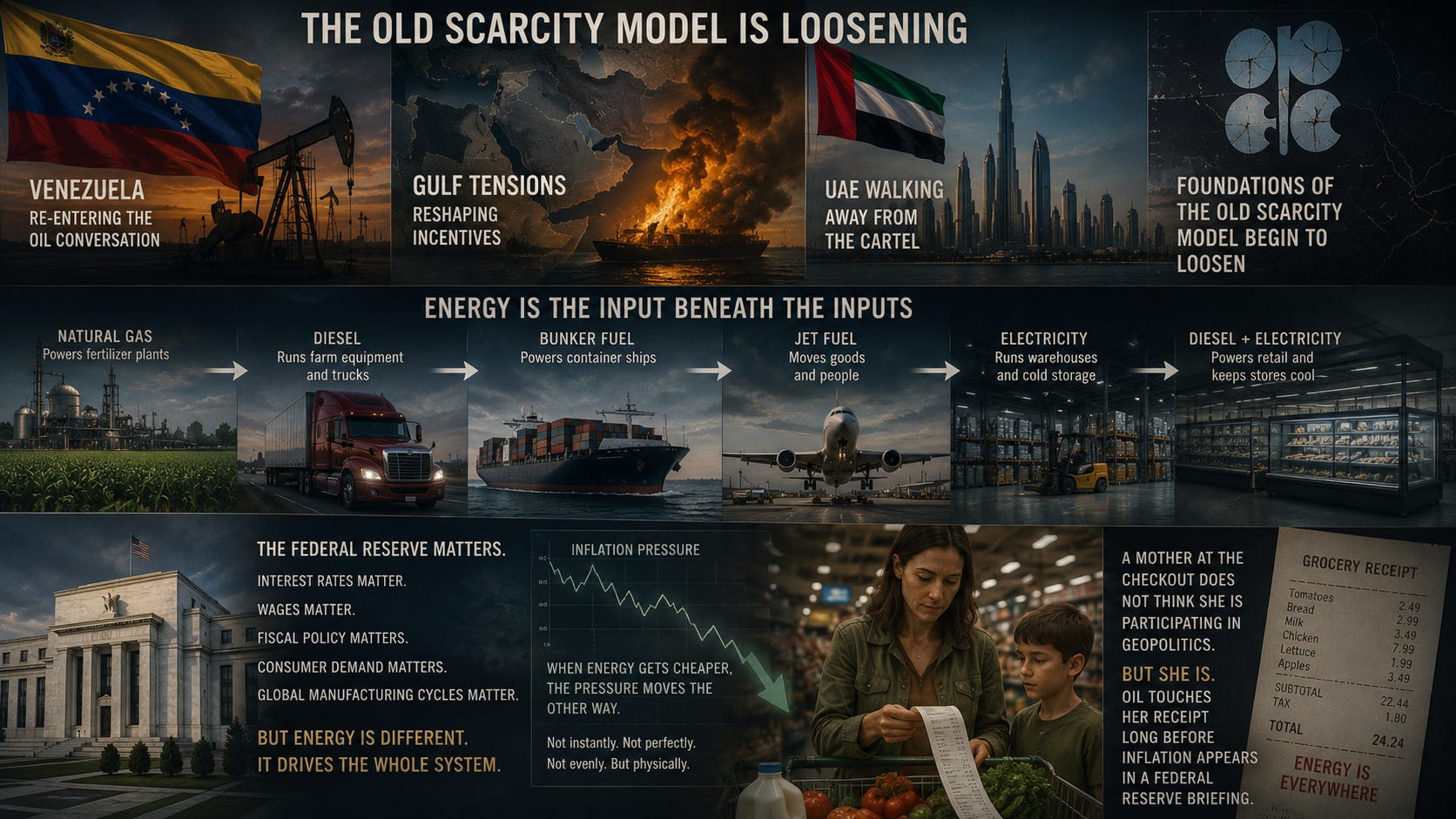
Energy is the underlying factor that drives all other inputs.
It is the diesel in the truck bringing tomatoes to the market. It is the natural gas in the fertilizer that grew the tomatoes before they ever met the truck. It is the bunker fuel in the container ship, the jet fuel in the cargo plane, the electricity in the automated warehouse, and the air conditioning keeping the whole supply chain from melting in July. When energy gets cheaper, the pressure starts moving the other way. Not instantly. Not perfectly. Not evenly. But physically.
A mother standing at a grocery store checkout does not think she is participating in geopolitics. But she is. Oil touches her receipt long before inflation appears in a Federal Reserve briefing.
Chaos as Policy
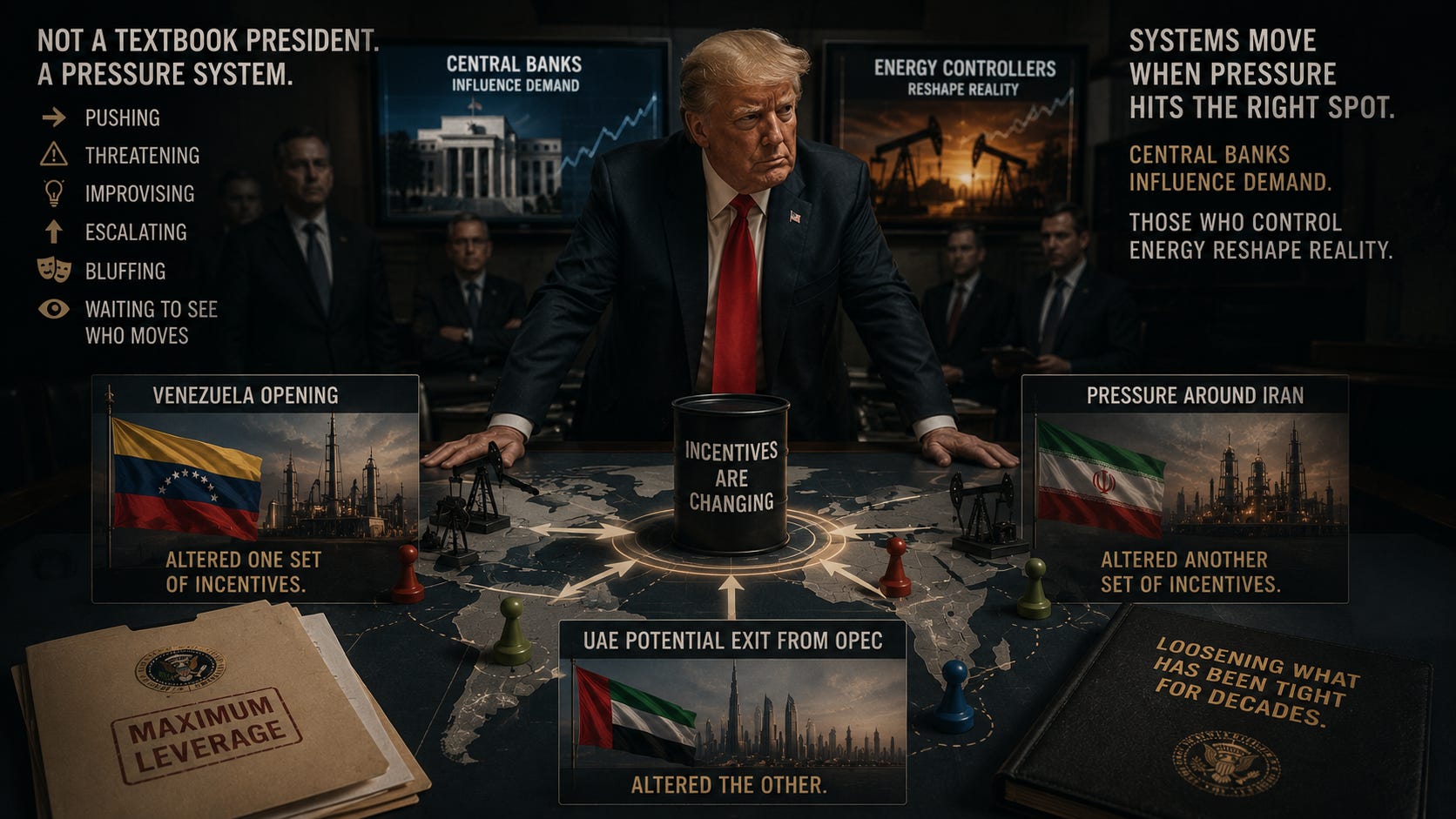
This is where Trump becomes difficult for traditional analysts to process. They keep looking for a clean doctrine. But Trump has never acted like a typical president. He operates more like a pressure system. They are pushing, threatening, improvising, escalating, bluffing, and waiting to see who moves.
To his critics, that is recklessness. To his supporters, it is strength. But maybe the more useful question is not whether it is admirable, but whether it changes incentives.
Systems do not always function as intended, even when someone writes a perfect plan. Occasionally they move because pressure appears in the right place at the right time.
Central banks can influence demand. Those who control energy can reshape reality.
The Venezuelan opening altered one set of incentives. Pressure around Iran altered another. The possibility of a UAE break from OPEC altered the other. Together, these moves loosened something that had been tight for decades.
Was this a master plan? Maybe.
Was it opportunistic chaos that produced a useful result? Maybe.
Was it a mixture of instinct, pressure, timing, and geopolitical luck? Probably.
But from outside the United States, away from the daily emotional weather of American politics, the pattern is hard to ignore. Something happened to the old oil order. And once the oil order moved, the inflation story changed with it.
The Shattered Barrel
For decades, central bankers in suits told the public to think about inflation as something they managed by adjusting rates by a quarter point. But underneath all of that, the physical economy kept moving. Ships burned fuel. Trucks burned diesel. Factories burned power. Farmers bought fertilizer. Families filled gas tanks.
The real economy never stopped being real.
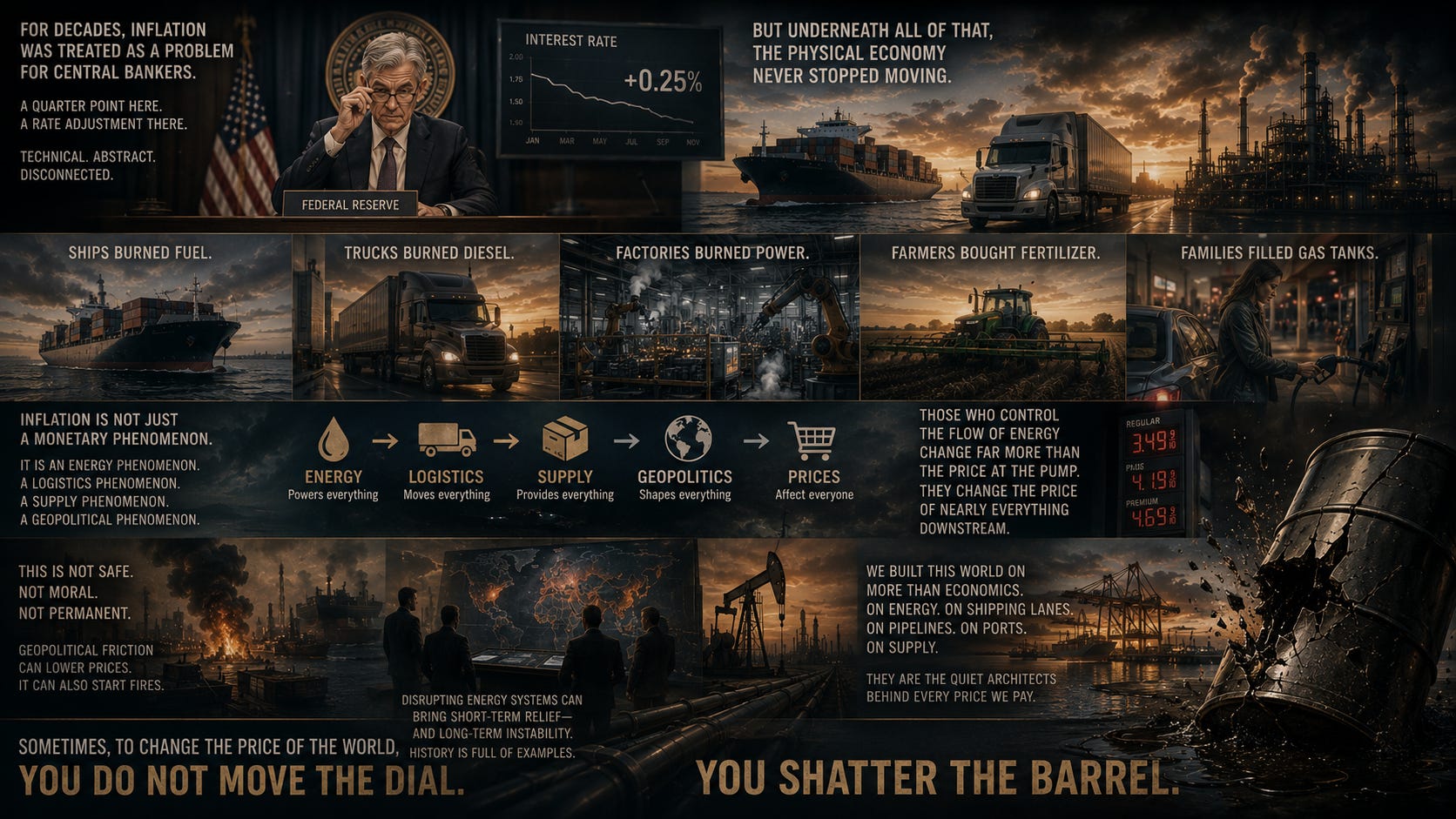
That is the lesson hidden inside this moment. Inflation is not only a monetary phenomenon. It is also an energy phenomenon, a logistics phenomenon, a supply phenomenon, and a geopolitical phenomenon.
If so, those who change energy flow can change much more than pump prices. They can change the price of nearly everything downstream.
This does not mean the strategy is safe. It does not mean it is moral. It does not mean it is permanent. Geopolitical friction can lower prices. It can also start fires. History is filled with leaders who discovered that disrupting energy systems can lower prices in the short term while creating instability that lasts for generations.
That is what makes this story so unsettling.
For decades, we treated inflation as a technical problem that economists managed. But economists never built the modern world alone. It was built by the people who controlled energy, shipping lanes, pipelines, ports, and supply itself.
Sometimes, to change the price of the world, you do not move the dial.
You shatter the barrel.
Doesn’t this power (pun intended) struggle point to the desirability of the decentralization of energy production? Leave climate change and environmental concerns aside for a moment and consider what greater energy independence and autonomy could mean for the world.
It’s been said that if we were supposed to use solar energy there would be a huge nuclear reactor in the sky. Oh. Wait.
BTW, it’s not just energy. Petroleum shows up in everything from plastics to pharmaceuticals. Couple that with the fact that it is also a finite resource I’ve always wondered why we haven’t invested in a future that reduces dependence on oil as energy.
This was a great piece, Ken. Really detailed and I appreciate the analysis.
All of the above and we are moving into a place where energy is going to be in higher demand to move the economy. We’ve needed to invest in Nuclear for 40 years, we are behind other nations in solar, wind and hydro power. Essentially, from what I read we reach “Peak Oil” in 15 years. Given that infrastructure projects take a long while and investment to build, we should start now.