

The Suitcase Economy
Why Britain’s Wealth Creators Are Quietly Leaving

A quiet exodus is reshaping Britain’s relationship with ambition, taxation, and mobility.
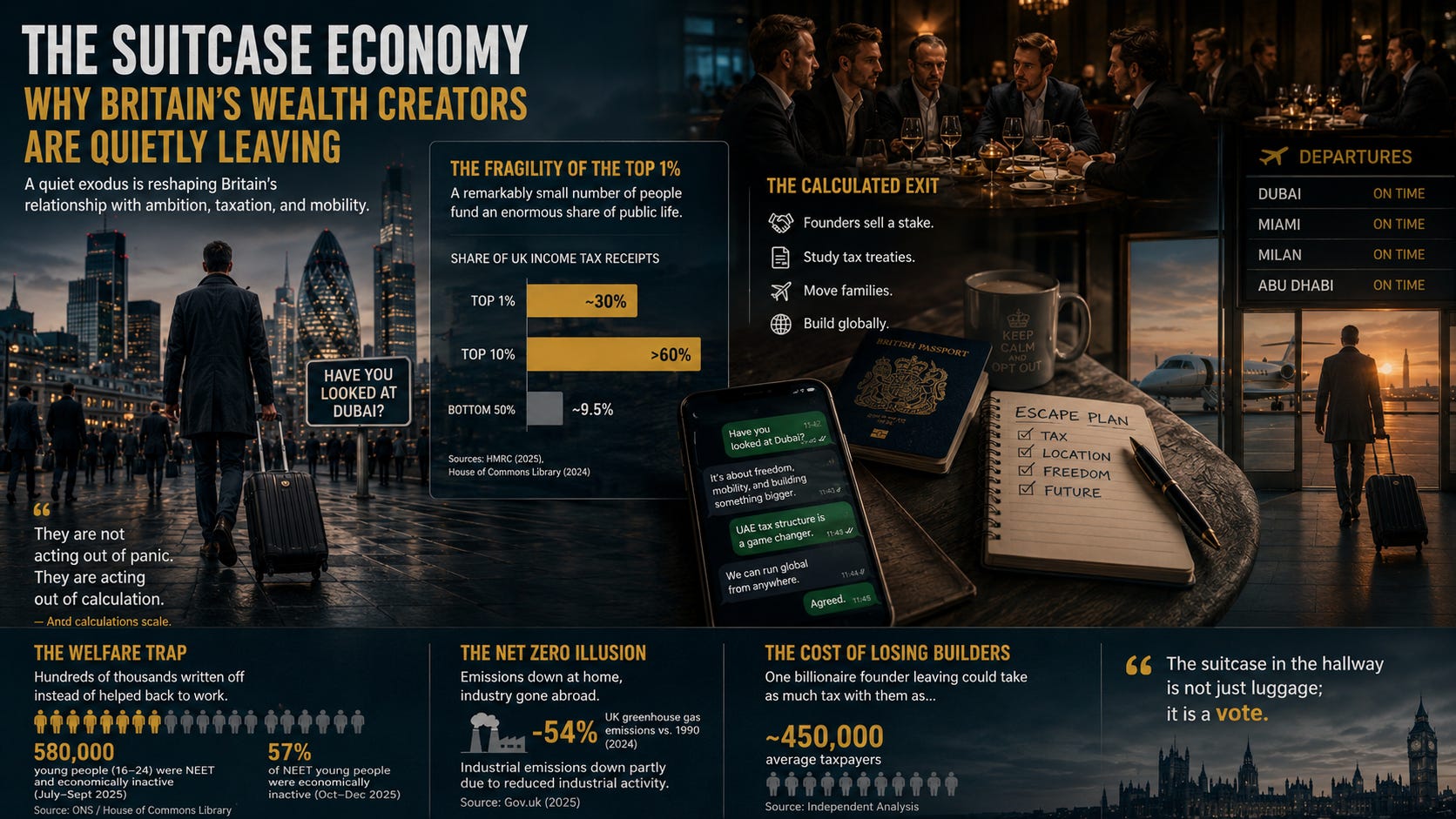
There is a particular kind of conversation happening quietly across London right now. It does not take place in Parliament or on the evening news. It happens around dinner tables, inside encrypted WhatsApp groups, over long lunches in Mayfair, and over quick coffees near Liverpool Street. It usually begins with a simple, practical question: “Have you looked at Dubai?”
Five years ago, that question carried a whiff of fantasy. Today, it sounds ordinary. A founder sells ten percent of his business and immediately begins discussing an escape plan. More time is spent by a software entrepreneur studying international tax treaties than hiring engineers. One family leaves for Milan, another for Miami, and another for Abu Dhabi. These individuals are not fleeing catastrophe. Britain remains safe, civilized, and globally relevant. What makes this shift so easy to miss is that they are not acting out of panic. They are acting out of calculation.
And calculations scale.
The UK is a Warning to the Rest of the World
The Fragility of the Top One Percent
For decades, the modern Western state operated on an implicit bargain: build, earn, and succeed, and in return, you would receive stability and social legitimacy. You might be taxed heavily, but you would still feel wanted. That last part matters more than politicians realize. In Britain, the top 1% of income taxpayers contribute roughly 30% of all income tax receipts. The top 10% contribute over 60%. HMRC’s latest bulletin puts the top 1%’s projected share at 26.6% for 2025 to 2026, while the House of Commons Library notes that the top 10 percent contribute over 60%.
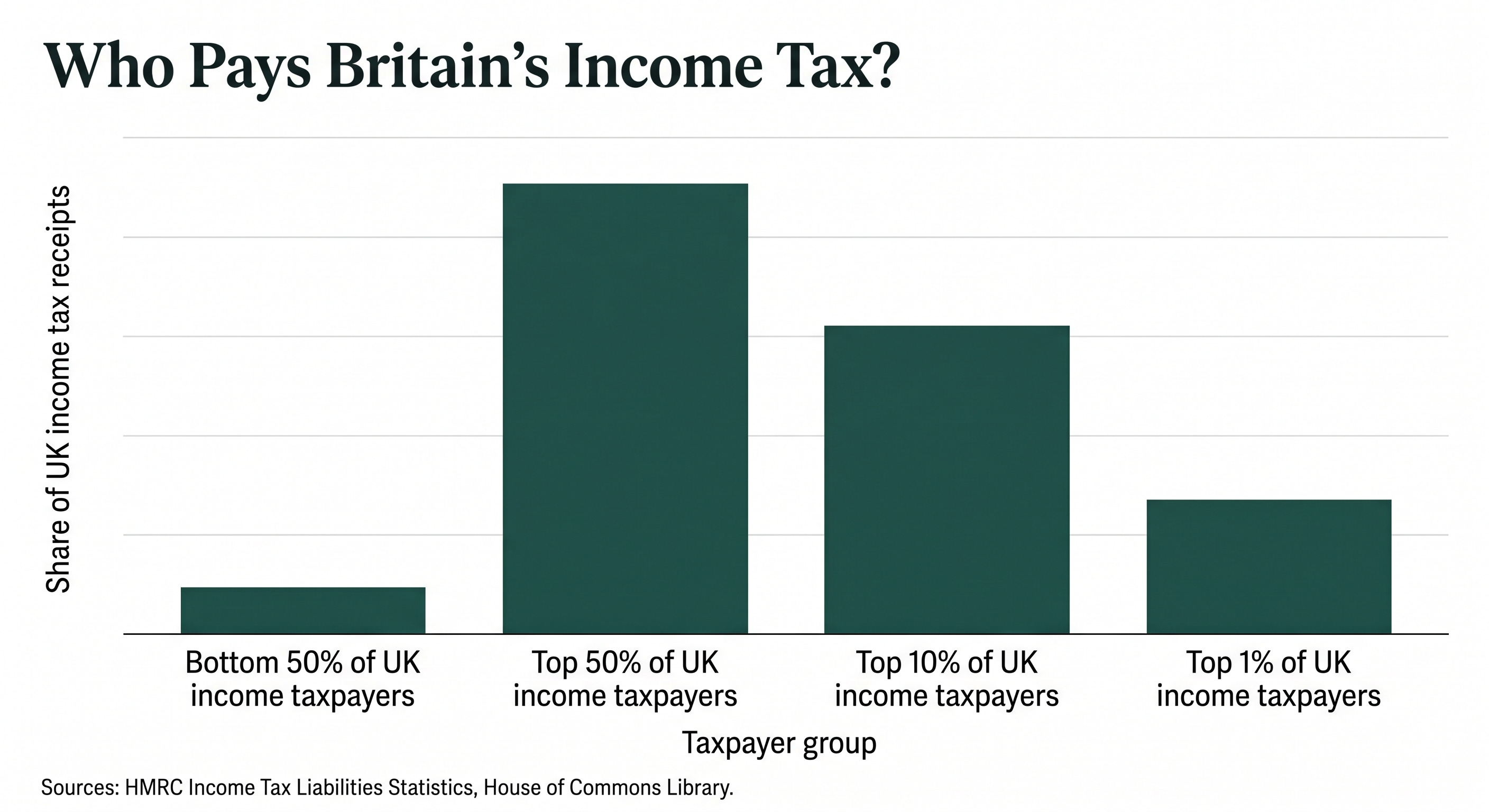
This reveals an uncomfortable systemic reality. A remarkably small number of highly productive people fund an enormous share of public life, from the NHS to the welfare system. Nevertheless the public rhetoric around wealth often sounds less like stewardship and more like suspicion. When the government pushes taxation to punitive levels while simultaneously framing success as a product of ill-gotten privilege, the emotional cost of staying begins to outweigh the logistical cost of leaving.
The departure of a single billionaire founder can represent an extraordinary fiscal loss. In some cases, analysts estimate the foregone tax revenue from one major exit could rival the annual contributions of hundreds of thousands of average taxpayers. When the founder of a major firm relocates to the UAE, they are removing a disproportionately valuable contributor to the national tax base, one that, by some calculations, would require the combined contributions of nearly 450,000 average taxpayers to replace.
The Welfare Trap and National Drag
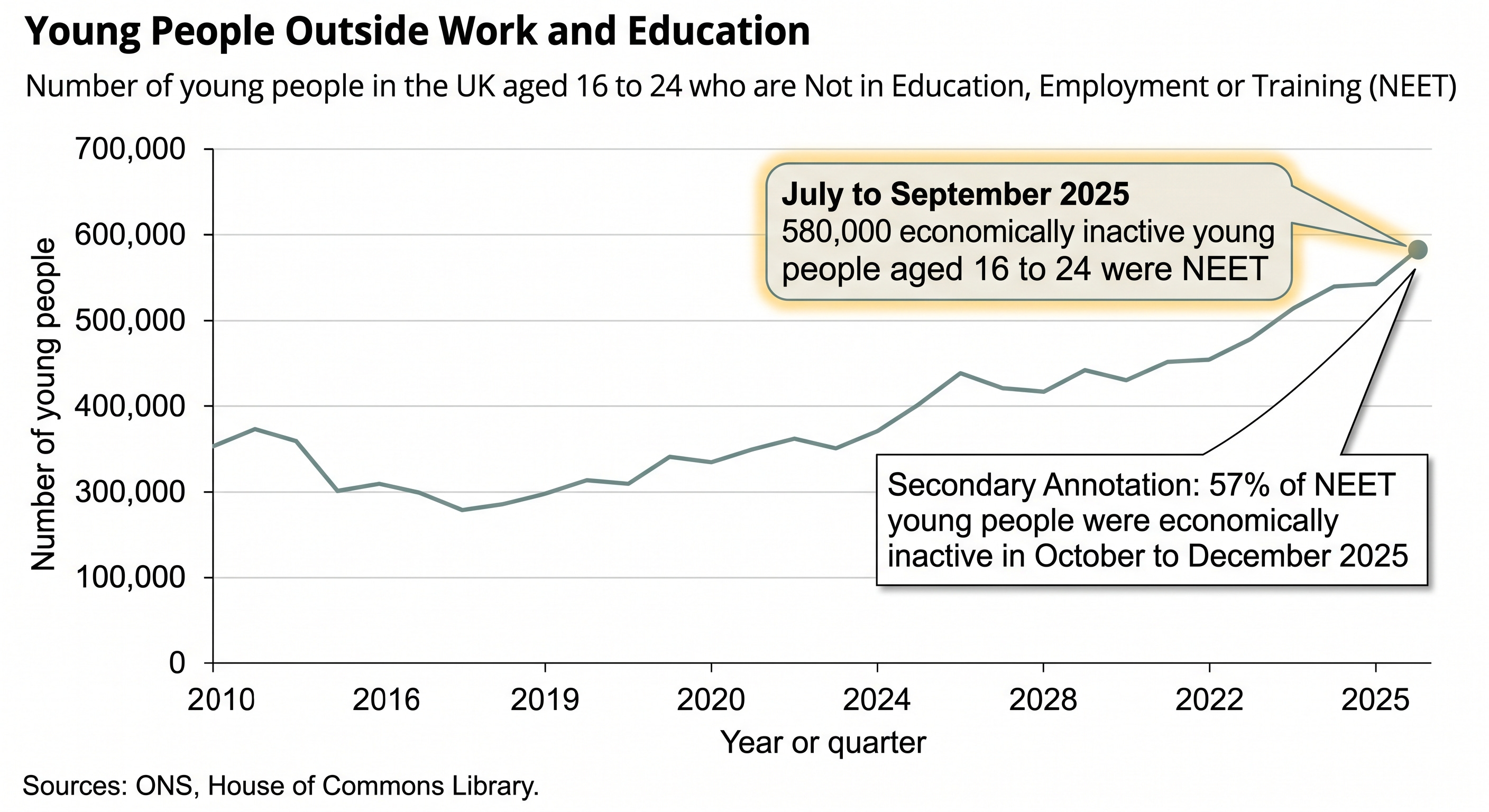
While the wealth creators are eyeing the exits, a different crisis is unfolding at the other end of the economic spectrum. This crisis is arguably more heartbreaking. There is a growing concern that the UK welfare system has become a place where hundreds of thousands of people who could be finding meaning and purpose through work are instead being written off.
Why the UK’s Unemployment Crisis Just Keeps Getting Worse
The current framework often finds it easier to provide a payout and forget about people rather than helping them navigate the challenges of the modern world. For a young person struggling with anxiety or depression, the path toward employment is often arduous. Over time, the system can unintentionally reward withdrawal more easily than reintegration. By doing so, the state is not just spending money it lacks; it is effectively robbing a generation of the agency that comes from participation. This situation has created a welfare bill that many argue has become both unsustainable and politically untouchable.
The Industrial Exodus and the Net Zero Illusion
Critics argue that the national drag is further exacerbated by an energy policy that is more performative than productive. Britain has undeniably reduced domestic emissions over the last three decades. The debate is whether those reductions came with a corresponding hollowing-out of industrial capacity. For many energy-intensive businesses, Net Zero rules and high energy costs have made Britain a harder place to operate.
We are not necessarily saving the planet. We are shipping our manufacturing capacity overseas and then importing the finished goods back on cargo ships powered by heavy bunker fuel. This strategy may reduce Britain’s domestic emissions while doing less to cut global emissions than the headline numbers suggest. Meanwhile, British pensioners face escalating heating bills in a first-world country because of these policy choices. Britain’s greenhouse gas emissions were about 54% below 1990 levels in 2024, while industrial emissions fell partly because of reduced industrial activity, including steel closures.
The Real Cost of Net Zero: The shocking truth of the renewable energy push
The Psychology of Portability
The competition between nations has fundamentally changed. Countries are no longer just competing for factories; they are competing for highly mobile talent. A software founder can run a company from Dubai just as easily as from London. In the 1990s, Britain possessed a go-getter business climate, but that has been replaced by a culture that often assumes success is a product of privilege rather than drive.
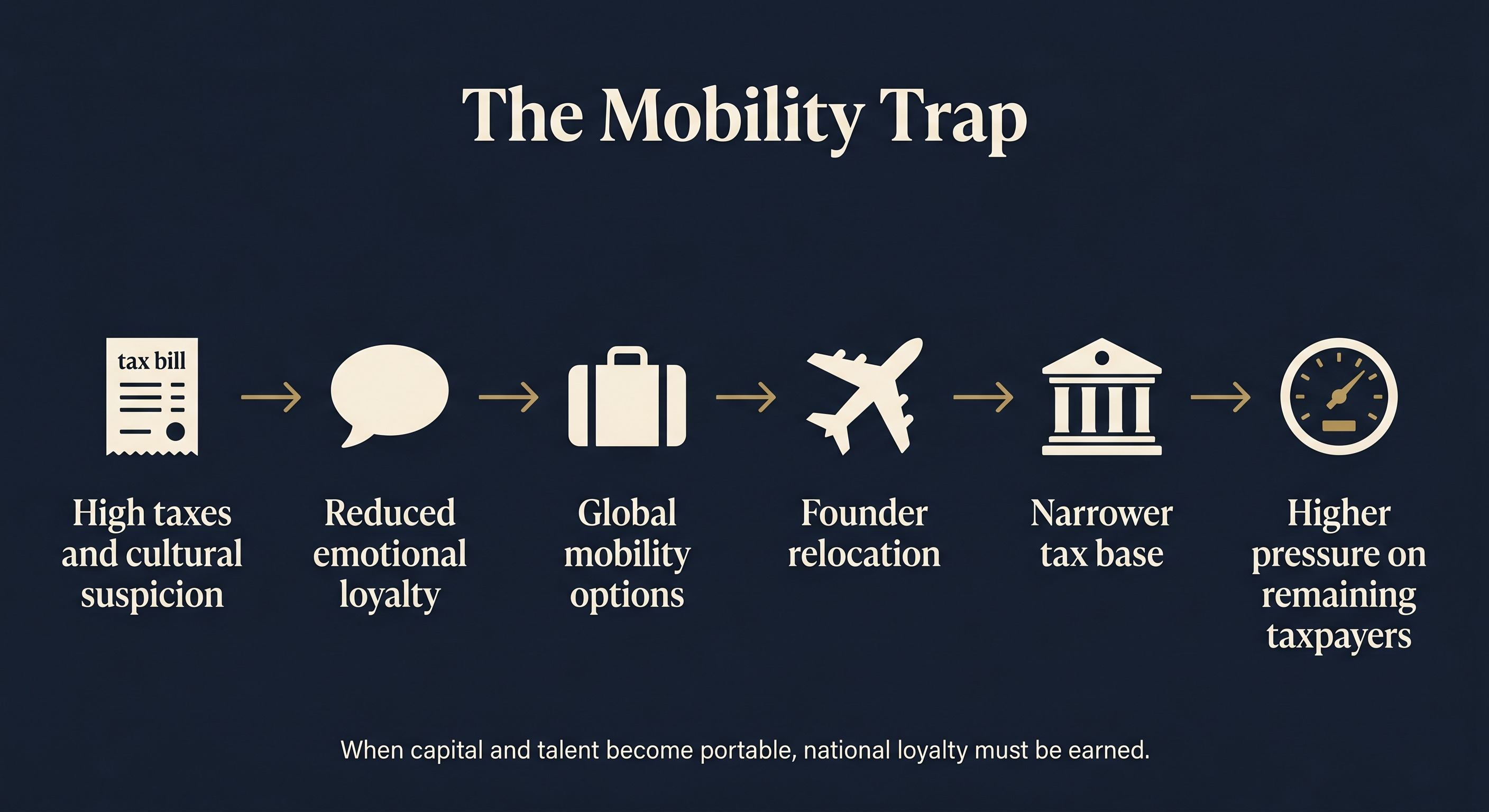
This shift is why debates around policy now feel strangely cultural. America still retains a mythology of celebrating success, whereas Britain has reverted to a mindset reminiscent of the landed gentry. The underlying assumption is that success must have come from some form of unfair advantage rather than effort, risk, or drive.
A Warning in the Suitcase
Some have begun to believe the system will not change until the decline becomes impossible to ignore. Many people feel poorer than they expected to be by now, and in some ways they are right. They do not yet feel the full weight of the fiscal crisis, but the mood is spreading.
The most dangerous moment for a nation is not when its citizens are furious, but when its most capable people stop believing that improvement is possible. They stop trying to change the system and simply opt out.
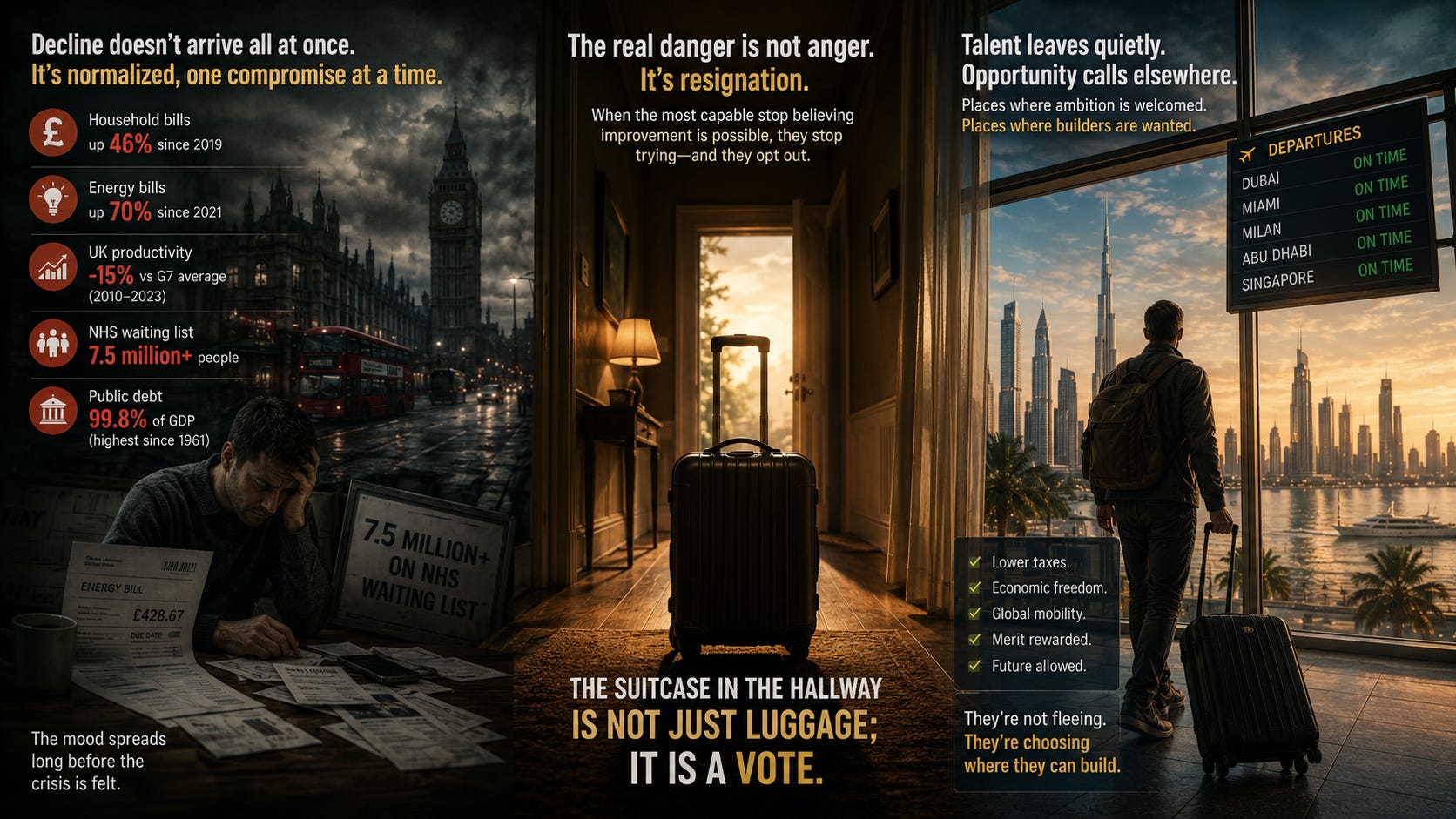
History suggests that civilizations often fail to notice stagnation immediately. They normalize it one compromise at a time. The energy bill gets higher, the talent quietly leaves, and the country eventually discovers that losing momentum is not a single event. It is a mood. Currently, many of Britain’s most driven people are gravitating toward places that still feel like they want builders. Places where ambition is treated less like a liability and more like a contribution. They are looking for a future where they are allowed to build and where they do not have to pack a suitcase to find it.
The suitcase in the hallway is not just luggage; it is a vote.