

The Sunshine Fallacy
Why Good Governance Dies in the Light

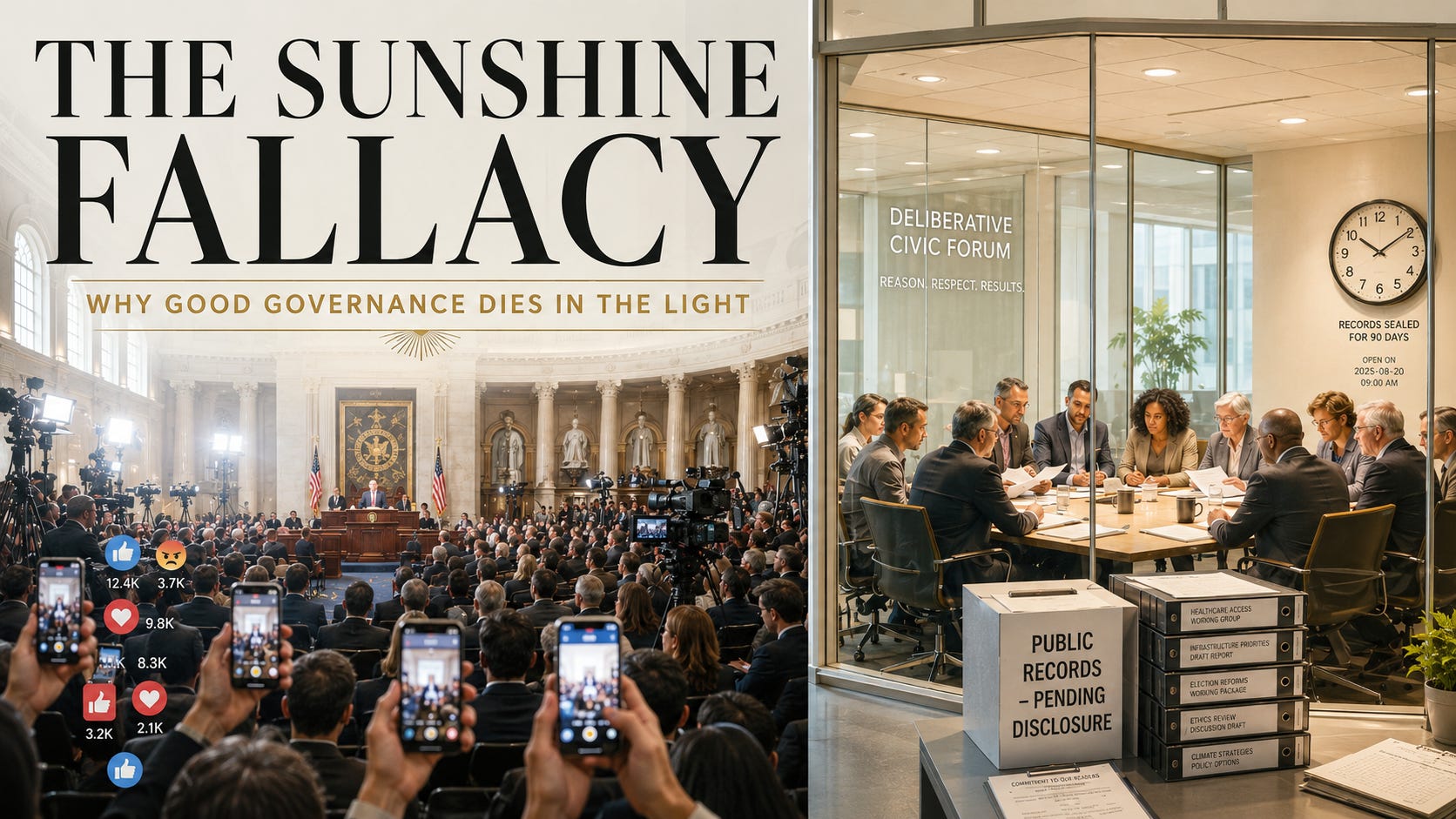
Democracy depends on public scrutiny. But when every tentative question, concession, and revision is exposed in real time, accountability can become performance. Effective governance does not need permanent darkness. It needs carefully designed moments of shelter.
On March 19, 1979, the United States House of Representatives opened its floor proceedings to regular live television coverage. The House controlled the cameras and the feed, so viewers saw the chamber through an official institutional lens rather than an independently directed broadcast. Al Gore, then a thirty-year-old representative from Tennessee, stepped to the microphone to deliver the first televised address, presenting televised proceedings as one possible response to declining public confidence in Congress.
The cameras expanded public visibility, but they also created a new audience. Much of the promise of that moment was real: public records exposed misconduct and made responsibility easier to assign. Yet immediate observation changes behavior. Put every exchange before an audience, and uncertainty starts to look like weakness, concession like surrender, and preliminary ideas like irrevocable commitments.
The alternative is layered transparency: open participation and evidence, narrowly protected exploration, and final decisions whose authors, reasons, and consequences are public.
Why Transparency Won
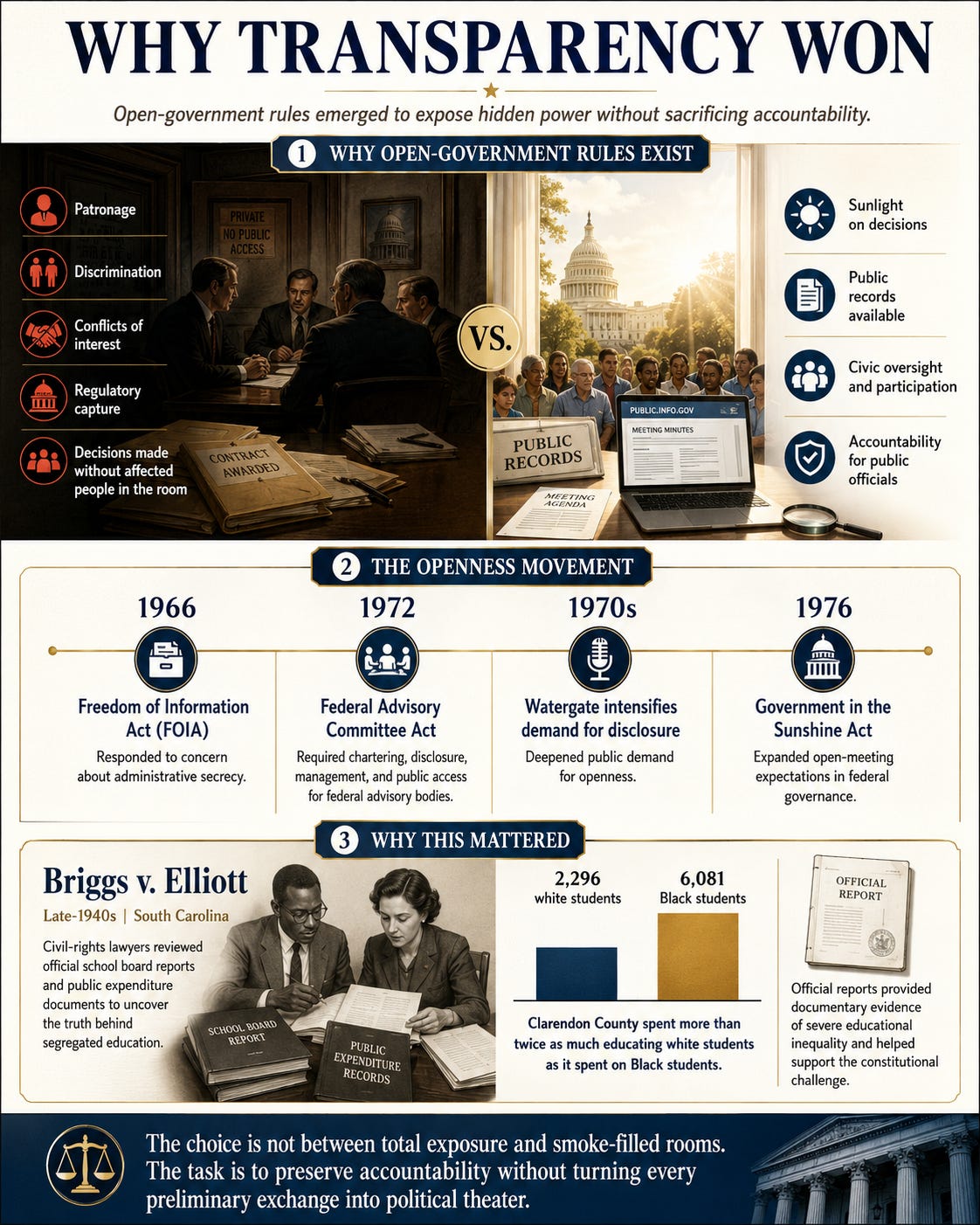
Any argument for private deliberation must begin with an honest account of why open-government rules exist. Closed political systems usually avoid thoughtful, bipartisan discussion. They have also concealed patronage, discrimination, conflicts of interest, regulatory capture, and decisions made for people who were not involved.
The openness movement in the United States unfolded over more than a decade. The Freedom of Information Act emerged amid growing concern about administrative secrecy in 1966. The Federal Advisory Committee Act followed in 1972, imposing chartering, disclosure, management, and public-access requirements on federal advisory bodies. Watergate then intensified the demand for stronger disclosure and helped create the political climate for the Government in the Sunshine Act of 1976.
These reforms did not simply interrupt a golden age of statesmanship. They challenged institutions in which seniority, party machines, powerful committee chairs, and organized interests often exercised authority with limited public scrutiny. Secrecy can make compromise easier. It can also make exclusion easier.
Historically, marginalized groups relied on public records and open access to expose systemic inequalities. Consider the legal campaign against segregated public education in South Carolina during the late 1940s. In the lead-up to the landmark lawsuit Briggs v. Elliott, civil rights attorneys sponsored by the NAACP relied on state-mandated school board annual reports to audit public expenditures.
Official school board reports gave civil rights lawyers documentary evidence of the severe inequality they were challenging. Investigators documented that Clarendon County spent more than twice as much educating 2,296 white students as it spent on 6,081 Black students. These official reports helped document the severe inequality that underpinned the constitutional challenge that eventually reached the Supreme Court.
That is why the choice cannot be between opening every conversation and returning to the smoke-filled room. The serious task is to preserve accountability without turning every preliminary exchange into campaign material.
Transparency Is Not One Thing
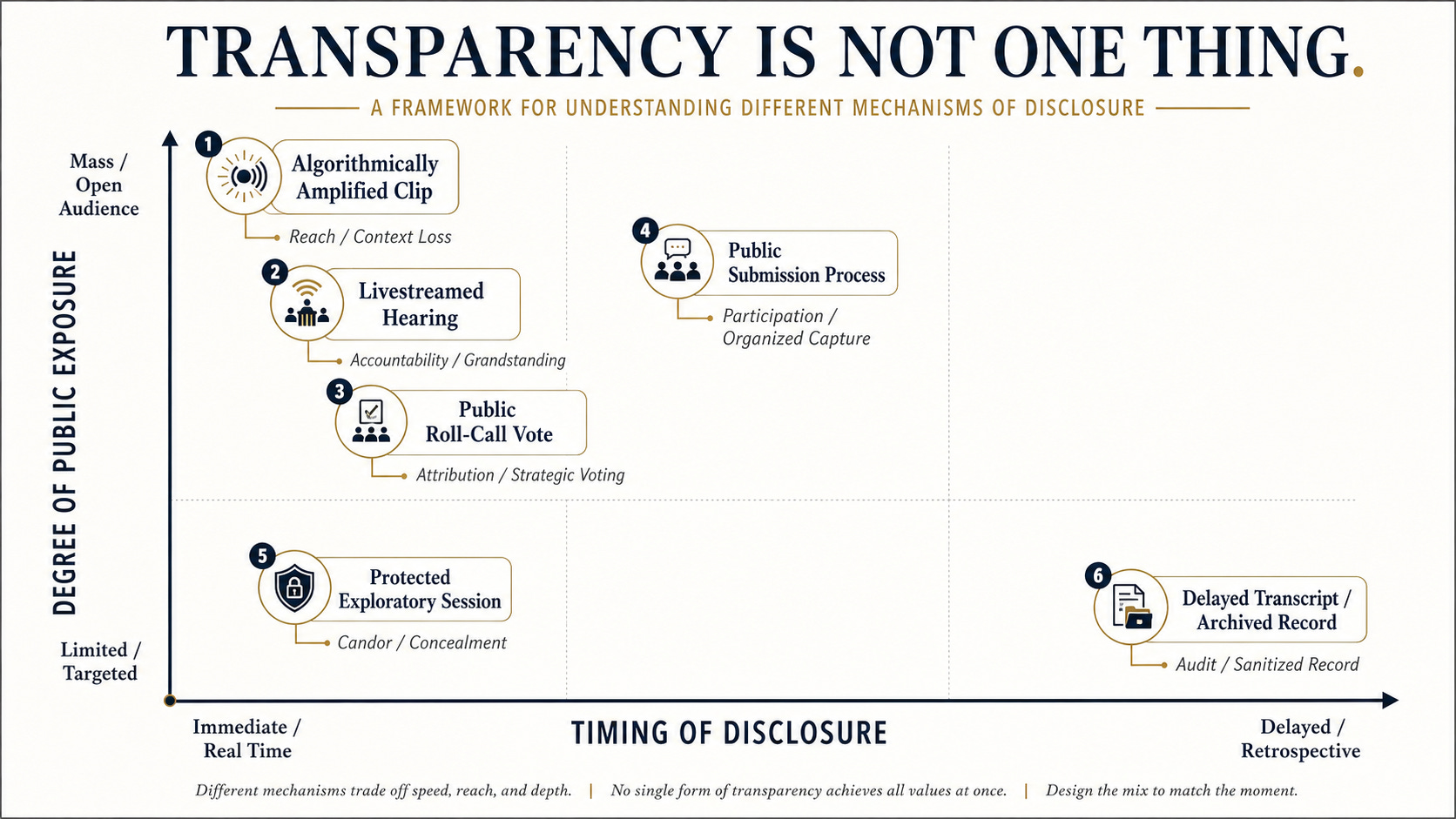
Transparency can mean access to records, participation, identifiable votes, live broadcast, delayed disclosure, or algorithmic redistribution. These mechanisms are not interchangeable. A delayed transcript, a livestream, a roll-call vote, and a leaked draft create different forms of accountability and different political incentives.
An institution can be highly visible but minimally participatory. Conversely, a process can include affected communities without broadcasting every exchange. When we conflate these distinct mechanisms under the broad banner of transparency, we fail to see the distinct behavioral effects that each mechanism produces.
What the Audience Changes
Deliberation and bargaining are related but distinct. Deliberation asks what should be done and why, evaluating reasons, values, and consequences. Bargaining asks what each side will accept, exchanging concessions among parties with competing interests. Public scrutiny can expose weak evidence and excluded interests, while also creating incentives for posturing. A credible disclosure system must distinguish between them.
The aim of a robust deliberative process is not to maximize agreement for its own sake. It is to create a process in which participants can test evidence, identify trade-offs, revise claims, represent affected interests, and remain answerable for the final choice. Revision is valuable only when it follows stronger evidence or reasoning. Private groups can also generate conformity, deference, and pressure disguised as consensus. Some disputes concern facts, while others concern who pays, benefits, or holds authority. Temporary confidentiality within an accountable process, rather than generic privacy or permanent secrecy, may clarify both, but it cannot eliminate conflicts of interest or turn an unjust bargain into a good one.
Political scientist David Stasavage modeled this trade-off directly in his research on bargaining and public visibility. His model suggests that openness can strengthen public monitoring but may also harden positions when representatives answer to polarized audiences that can observe concessions and impose political costs on those who make them. The model identifies an incentive; it does not imply that every public negotiation produces the same result.
One parliamentary study offers evidence that public attribution can alter formal voting behavior. In a study of the Swiss Parliament published by the Department of Economics at the University of St. Gallen, researchers Christine Benesch, Monika Bütler, and Katharina E. Hofer exploited a unique institutional reform in the Upper House, the Council of States. Until 2013, the chamber voted exclusively by a show of hands, meaning individual decisions could only be verified after the fact through a time-consuming screening of online videos. In 2014, halfway through the legislative period, the chamber switched to an electronic voting system with automatic online publication of individual decisions.
By analyzing individual voting records across final passage votes, the authors estimated a 2.9-percentage-point reduction in deviations from party positions. It does not show that legislators negotiated differently before the vote. It shows that making final choices is automatically attributable to the altered cost of departing from one’s party position.
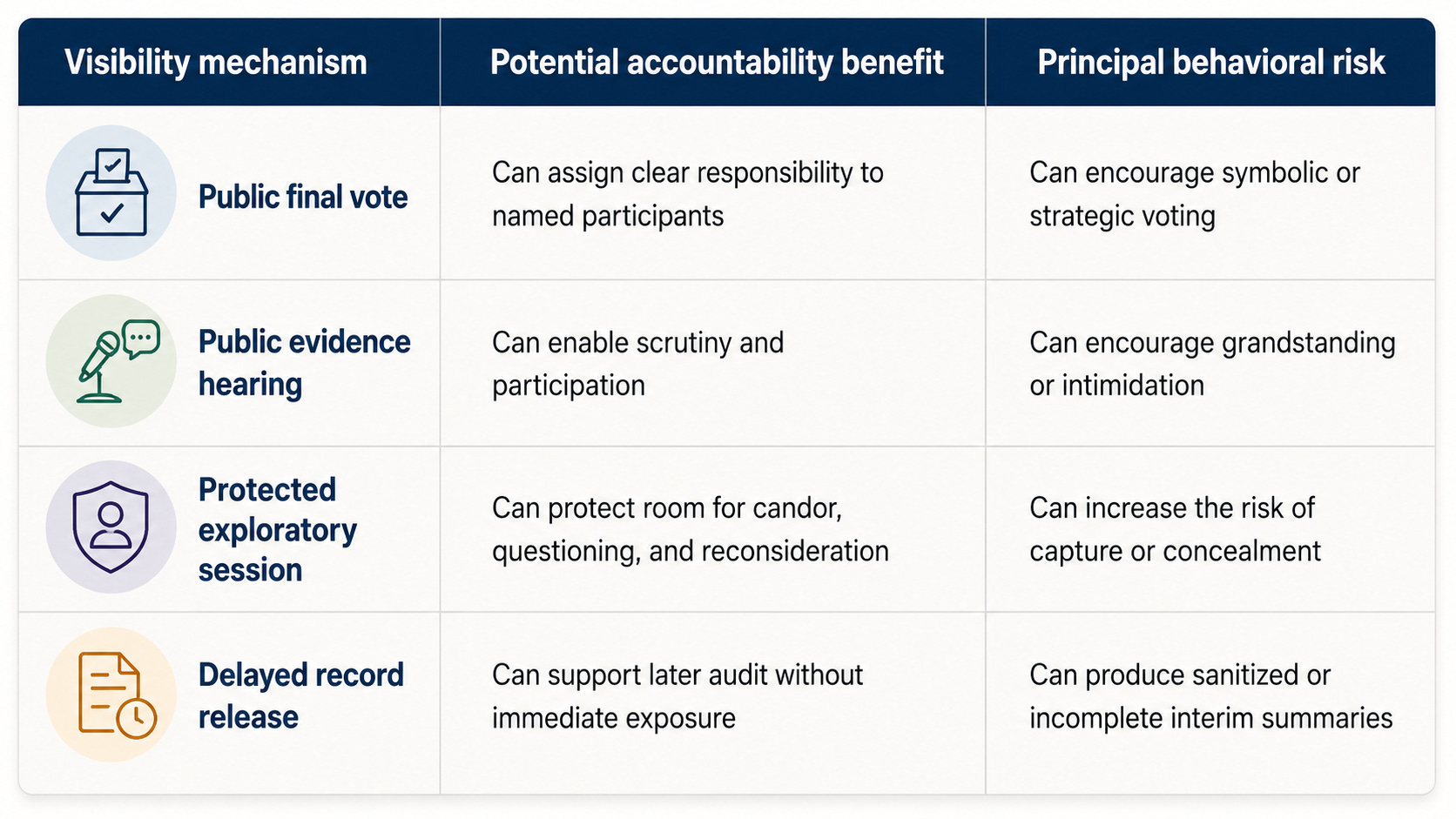
These findings suggest a recurring set of benefits and risks:
How to restore trust in politics” — The Economist
What Privacy Could Not Solve
The 1990 budget negotiations reveal the limits of confidentiality. In early 1990, the projected federal deficit substantially exceeded the statutory ceiling established by the Gramm-Rudman-Hollings Act. Negotiators moved part of the talks to Andrews Air Force Base, meeting outside the routine pressures of Capitol Hill. Participants described the isolated military setting as an attempt to reduce daily political and media pressure. The House rejected the initial agreement on October 5, and a revised package finally became law as the Omnibus Budget Reconciliation Act on November 5.
The historical record cannot isolate what confidentiality changed inside the talks. It does show that private bargaining may widen the range of discussable options without securing the support needed to turn a bargain into policy, leaving the harder problem of political ratification untouched.
How Recorded Votes Conceal as Well as Reveal
Michael S. Lynch and Anthony J. Madonna show that roll-call records are not neutral mirrors of legislative activity. In their 2025 book, Broken Record: The Origins and Evolution of Recorded Voting in the U.S. Congress, they illustrate that leaders determine which questions reach the floor and in what form; campaigns and interest groups then select individual votes to score or attack legislators. The record reveals the final position but conceals abandoned alternatives, blocked amendments, and issues that never received a vote. Public exposure did not create American polarization, but it can increase the cost of visible deviation and make selected votes easier to weaponize.
What Ireland Actually Built
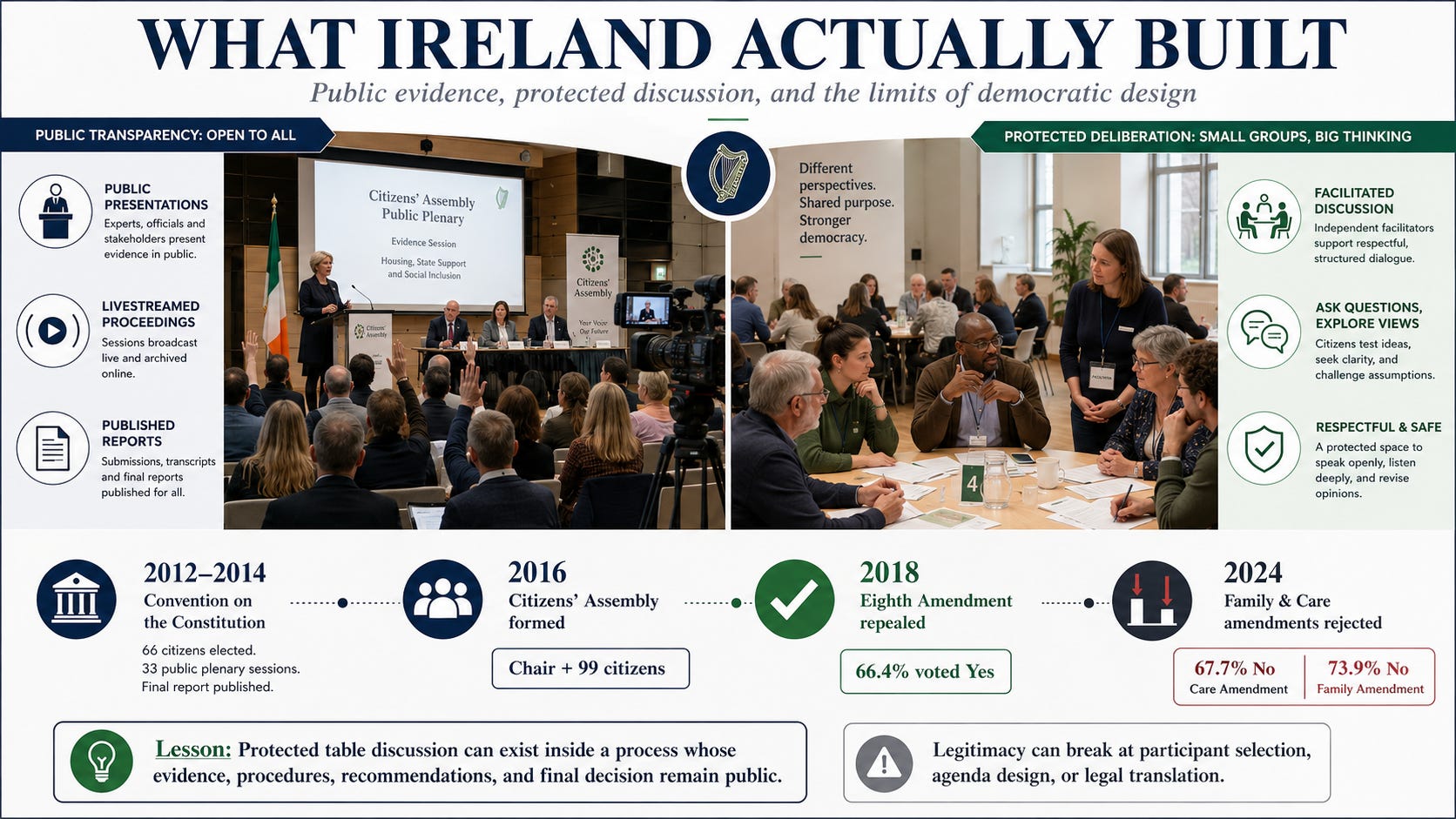
Ireland offers a rare example of an institution that combined public evidence and published recommendations with protected small-group discussion.
Between 2012 and 2014, the country convened a Convention on the Constitution. The convention helped establish an institutional precedent for the Citizens’ Assembly convened in 2016. The two bodies were not identical. The Constitutional Convention combined citizens and elected politicians, while the later Citizens’ Assembly placed citizen members at the center of the process, bringing together a chair and 99 citizen members selected through a process designed to reflect the wider electorate.
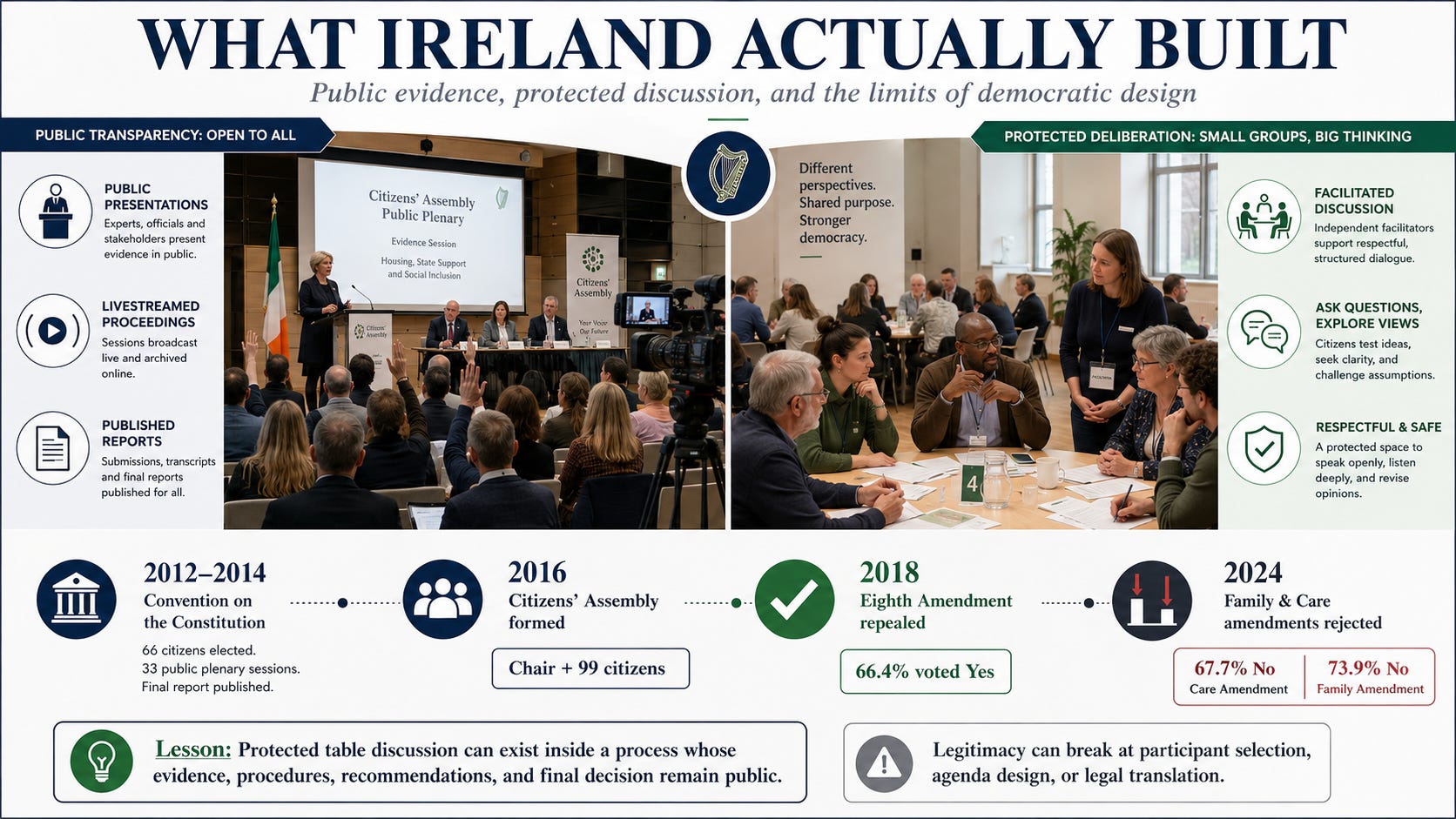
The assemblies did not operate in complete secrecy. Expert presentations and plenary sessions were made public. Proceedings were livestreamed. Documents, submissions, and reports were published. Advocacy groups and specialists presented competing views.
At the same time, the table discussions were facilitated and were not broadcast, giving members a protected setting within an otherwise extensively documented process. This structural separation allowed participants to examine evidence, ask questions, and work through disagreement without turning every moment of uncertainty into a public spectacle. Trained facilitators structured the small-group discussions under the Assembly’s published procedures.
The Assembly’s recommendations were considered by a parliamentary committee and helped establish the pathway to the May 2018 referendum, in which 66.4% voted to repeal the Eighth Amendment. Ireland does not isolate confidentiality as the sole cause of better deliberation. It shows that protected table discussion can be embedded inside a process whose evidence, procedures, recommendations, and final constitutional decision remain public.
Nor was the model magical. In 2024, voters rejected the proposed Family and Care amendments by 67.7% and 73.9%, respectively. Explanations for the defeat ranged from opposition to the government’s ballot wording and the difficulty of translating fluid assembly consensus into rigid constitutional prose to analytical assessments questioning whether the recruitment process produced a body whose conclusions carried sufficient legitimacy beyond the assembly itself. This illustrates that legitimacy can break at several points, from participant selection and agenda design to the translation of deliberative recommendations into legal text.
When Citizens Assemble” — Patrick Chalmers
Who Controls the Quiet Room?
Any proposal to protect deliberation must confront the objection that closed spaces naturally advantage those who already hold power. If we allow public officials to negotiate in private, how do we prevent the quiet room from becoming a tool for corporate lobbyists, senior party leaders, and technical experts to exclude the public interest?
This is a serious design risk. In any private negotiation, the primary vulnerabilities concern access, agenda control, evidence control, record control, internal conformity, and the internal coercion of weaker participants. Expertise becomes a capture risk when one institution controls the evidence, when it cannot challenge assumptions, or when experts’ material interests remain hidden.
In the early 2000s, this risk materialized during the development of the National Energy Policy Development Group, chaired by Vice President Dick Cheney. Available records showed numerous early meetings with energy-industry representatives, while environmental organizations received more limited consultation later in the process. The episode showed how confidentiality, without balanced access or a reviewable record, can erode legitimacy by obscuring whose evidence and interests shaped the result. Protected deliberation therefore requires enforceable rules governing access, evidence, records, dissent, and disclosure.
The question, then, is not whether a room should be open or closed. It is what rules must govern the door, the record, and the eventual return to public accountability.
The Layered Transparency Model
Accountability means that citizens can identify who exercised authority, inspect the evidence and interests involved, understand the stated reasons, and challenge the result. Legitimacy asks whether the process followed accepted rules and gave affected interests meaningful recourse. Neither concept is the same as popularity.
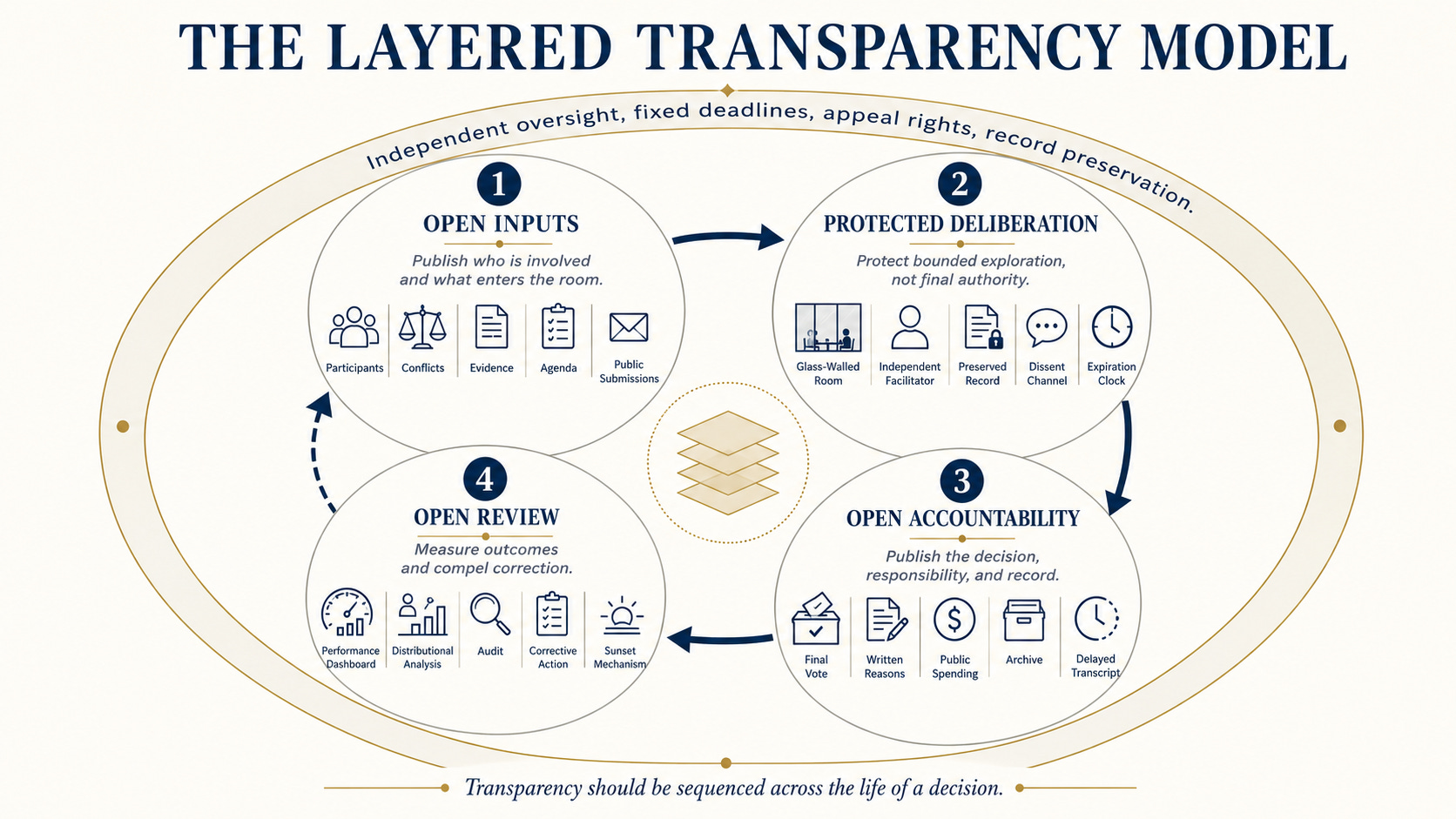
To fulfill both criteria, we can structure public institutions around a four-stage framework that treats transparency as a sequence rather than an all-or-nothing condition.
Stage 1: Open Inputs
Publish participants, interests, evidence, and rules.
Inputs should be subject to a strong presumption of disclosure, with narrow, reviewable exceptions for personal privacy, legal privilege, security, and demonstrable public harm. In ordinary legislative and administrative deliberation, the identities, affiliations, and financial and institutional conflicts that could affect judgment should be public.
Furthermore, deliberators should ordinarily make the data and analyses they consider public, subject to the same narrow exceptions. To reduce the exclusion of politically marginalized groups, this stage should require active stakeholder mapping, public submissions, and independent advocacy or direct representation for underrepresented affected parties. Institutions should report the volume of submissions separately from the arguments and evidence they contain.
Stage 2: Protected Deliberation
Protect narrowly defined exploratory discussion.
Bargaining, exploratory questioning, and preliminary option development may receive temporary confidentiality. Officials should not be able to close a meeting simply by claiming that candor is at risk. They should have to name the harm, disclose who will participate, preserve the record, and commit to a release date. Entering this stage should require an independent officer who does not report to the meeting organizer to issue a written determination under a clear set of safeguards.
A protected session should require independent authorization, a specific public explanation for confidentiality, meaningful representation of affected interests, preserved records, protected dissent, a fixed expiration date, and an expedited appeal process.
Minimum safeguards for temporary confidentiality
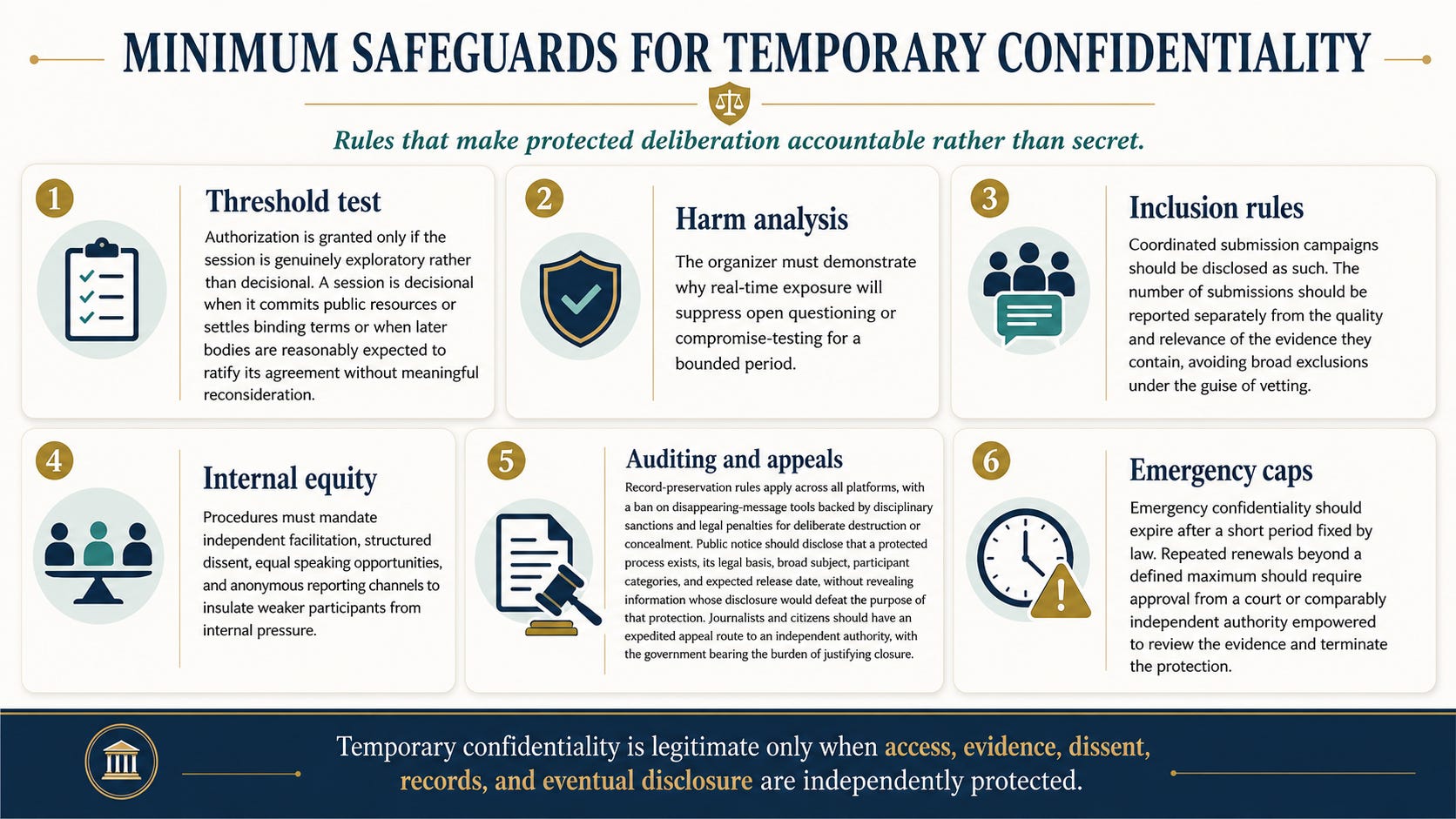
Threshold test: Authorization is granted only if the session is genuinely exploratory rather than decisional. A session is decisional when it commits public resources or settles binding terms or when later bodies are reasonably expected to ratify its agreement without meaningful reconsideration.
Harm analysis: The organizer must demonstrate why real-time exposure will suppress open questioning or compromise-testing for a bounded period.
Inclusion rules: Coordinated submission campaigns should be disclosed as such. The number of submissions should be reported separately from the quality and relevance of the evidence they contain, avoiding broad exclusions under the guise of vetting.
Internal equity: Procedures must mandate independent facilitation, structured dissent, equal speaking opportunities, and anonymous reporting channels to insulate weaker participants from internal pressure.
Auditing and appeals: Record-preservation rules apply across all platforms, with a ban on disappearing-message tools backed by disciplinary sanctions and legal penalties for deliberate destruction or concealment. Public notice should disclose that a protected process exists, its legal basis, broad subject, participant categories, and expected release date, without revealing information whose disclosure would defeat the purpose of that protection. Journalists and citizens should have an expedited appeal route to an independent authority, with the government bearing the burden of justifying closure.
Emergency caps: Emergency confidentiality should expire after a short period fixed by law. Repeated renewals beyond a defined maximum should require approval from a court or comparably independent authority empowered to review the evidence and terminate the protection.
Stage 3: Open Accountability
Publish decisions, reasons, votes, and scheduled records.
Final authority, formal decisions, voting responsibility, reasons, and public expenditure should be disclosed to the fullest extent compatible with narrowly defined legal protections. The tension can be managed, though not eliminated, through a system of staged disclosure tiers.
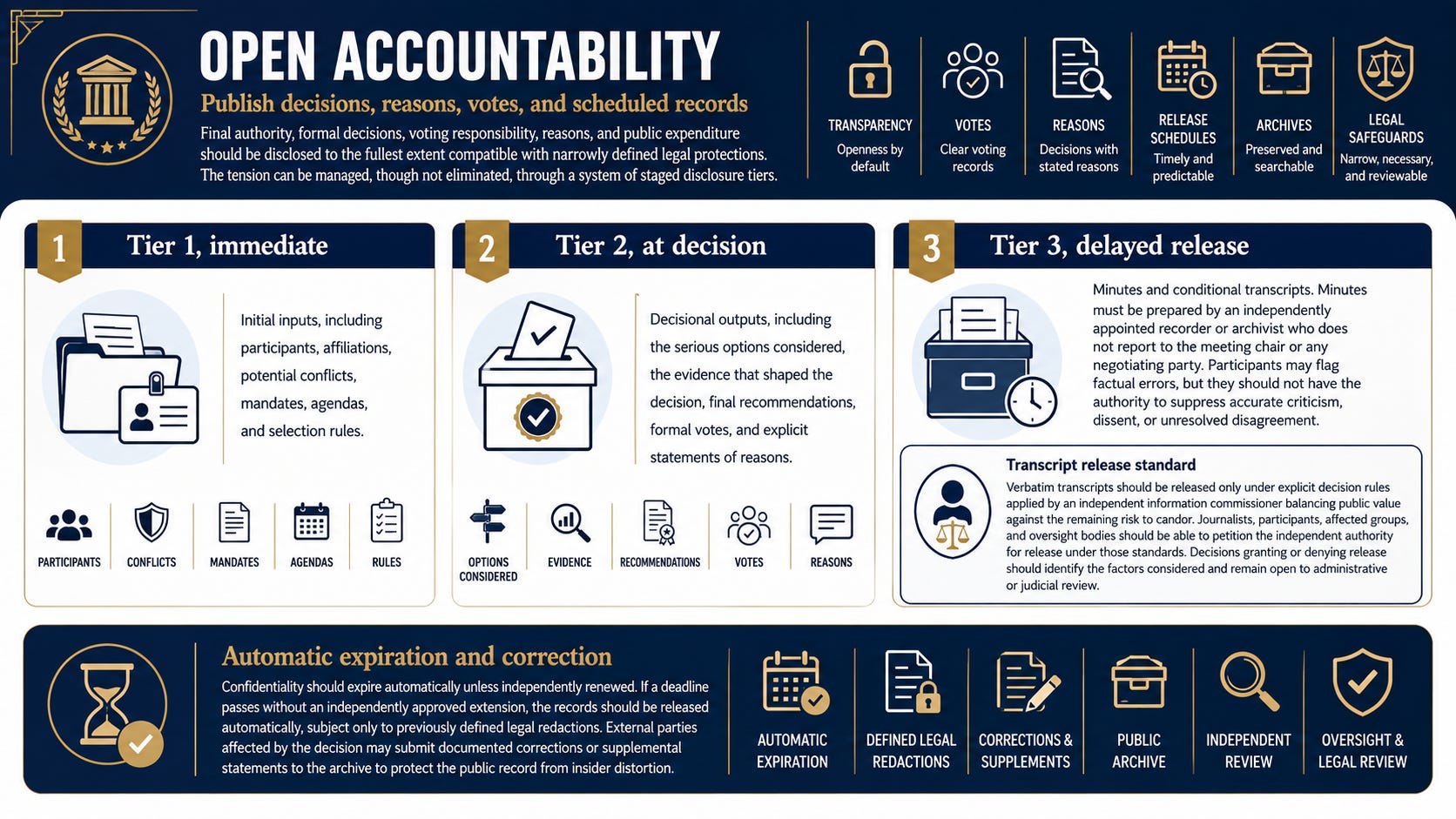
Tier 1, immediate: Initial inputs, including participants, affiliations, potential conflicts, mandates, agendas, and selection rules.
Tier 2, at decision: Decisional outputs include serious options considered, the evidence that shaped the decision, final recommendations, formal votes, and explicit statements of reasons.
Tier 3, delayed release: Minutes and conditional transcripts. Minutes must be prepared by an independently appointed recorder or archivist who does not report to the meeting chair or any negotiating party. Participants may flag factual errors, but they should not have the authority to suppress accurate criticism, dissent, or unresolved disagreement.
Verbatim transcripts should be released only under explicit decision rules applied by an independent information commissioner balancing public value against the remaining risk to candor. Journalists, participants, affected groups, and oversight bodies should be able to petition the independent authority for release under those standards. Decisions granting or denying release should identify the factors considered and remain open to administrative or judicial review.
Confidentiality should expire automatically unless independently renewed. If a deadline passes without an independently approved extension, the records should be released automatically, subject only to previously defined legal redactions. External parties affected by the decision may submit documented corrections or supplemental statements to the archive to protect the public record from insider distortion.
Stage 4: Open Review
Measure results and require correction when needed.
Accountability is incomplete when a decision is made. A robust framework requires an ongoing feedback loop to review whether the policy actually worked. The Open Review stage requires a named responsible institution to publish regular, public disclosures across four dimensions.
Measurement: Compare real outcomes and actual public expenditures against baseline metrics established before implementation. Review should distinguish outcomes that followed implementation from those that can reasonably be attributed to the policy itself. Where causal attribution remains uncertain, the reviewing body should state the uncertainty rather than presenting correlation as proof.
Distribution: Use the best available evidence to identify who bore the costs and who received the benefits.
Correction: When results materially diverge from the stated objectives, baseline assumptions, or expected distribution of costs and benefits, the responsible body should publish either a corrective plan or a reasoned explanation for continuing without one.
Enforcement: Where the implementing body fails to act, the review must trigger oversight by a legislature, court, inspector general, or another institution with authority to compel reconsideration. The review should culminate in renewal, amendment, suspension, or expiration. Not every public decision can be reduced to a performance metric; review may also require qualitative analysis, testimony from affected communities, and institutional audits of unintended harm.
Deliberation in the Age of the Clip
The need for layered transparency has become urgent because we are no longer living in the media environment of 1979. An algorithmically ranked attention system shapes modern politics.
In a study of political messages on Twitter published in the Proceedings of the National Academy of Sciences, each additional moral-emotional word was associated with roughly a 20% increase in retweeting within ideological networks. The finding is not a universal formula, but it helps explain why moralized conflict can be highly compatible with platform incentives.
For example, during the December 2023 congressional oversight hearing on campus antisemitism, an exchange between Representative Elise Stefanik and university presidents went viral. Stefanik and other political actors rapidly redistributed the exchange through social channels, where the brief confrontation circulated far beyond the audience that watched the full hearing.
The viral clips removed the exchanges from the broader hearing record, including the witnesses’ earlier explanations and the committee’s other lines of questioning. A long hearing became known for a short exchange, and the clip circulated independently of the full record. Platform incentives elevated confrontation over context.
The camera makes the event observable. The platform turns one fragment into the event’s public meaning.
Delay has costs. So does immediate disclosure. During public-health emergencies, financial disruptions, or other fast-moving crises, broadcasting every tentative judgment may intensify public panic or market volatility. Journalists may nevertheless need immediate access because a record released months later can arrive after money has been spent, rights altered, or policy hardened. Public hearings therefore remain indispensable. The task is to match the form and timing of disclosure to the institution’s purpose.
Jonathan Haidt: How Social Media Drives Polarization” — Amanpour and Company
Public institutions should protect exploratory discussion only under narrow, reviewable conditions, then disclose who participated, what evidence mattered, why the decision was made, and whether it worked. Journalists should hold them to every part of that bargain.
The purpose of transparency is to make power answerable, not thought impossible. Democracy needs public decisions. It also needs a room in which people are allowed to change their minds.
Ken, I really enjoyed this piece because it challenges the idea that optimism alone is enough.
The funny thing is, I am probably the most optimistic person I know. I can almost always find the sunshine through the storm. That mindset has carried me through some of the hardest moments of my life. But I have also learned that seeing the sunshine does not mean you stop working. You still have to put in the effort. You have to make the hard decisions, put in the long hours, and keep moving even when nothing seems to be happening.
I have experienced incredible personal loss. Those losses taught me that hope is powerful, but hope without action changes nothing and also I am not a Liberal - Hopey Changey…
The biggest challenge I have today is raising capital for Infortum. I have sat through countless investor meetings that begin with excitement and end with what my bestie Paul used to call the “LA Long No.” Nobody wants to tell you no. They tell you how much they love the vision, how exciting it is, and how they will circle back. Weeks become months, and months become silence.
Growing up in New England, I never understood that approach. I’d rather hear a respectful no than spend months chasing a maybe. A direct answer allows you to adjust, improve, and move on. There is respect in honesty.
Your article is a great reminder that optimism is not a strategy. Optimism gives us the courage to begin. Discipline, effort, and honest feedback are what carry us across the finish line.
I will never stop looking for the sunshine. I just know that if I want to enjoy it, I have to keep walking through the storm to reach it.