

The Trust Recession
Why Verification May Become the Most Valuable Layer of the Digital Economy

In 2024, a finance worker at a multinational firm in Hong Kong received a video call from the company’s Chief Financial Officer.
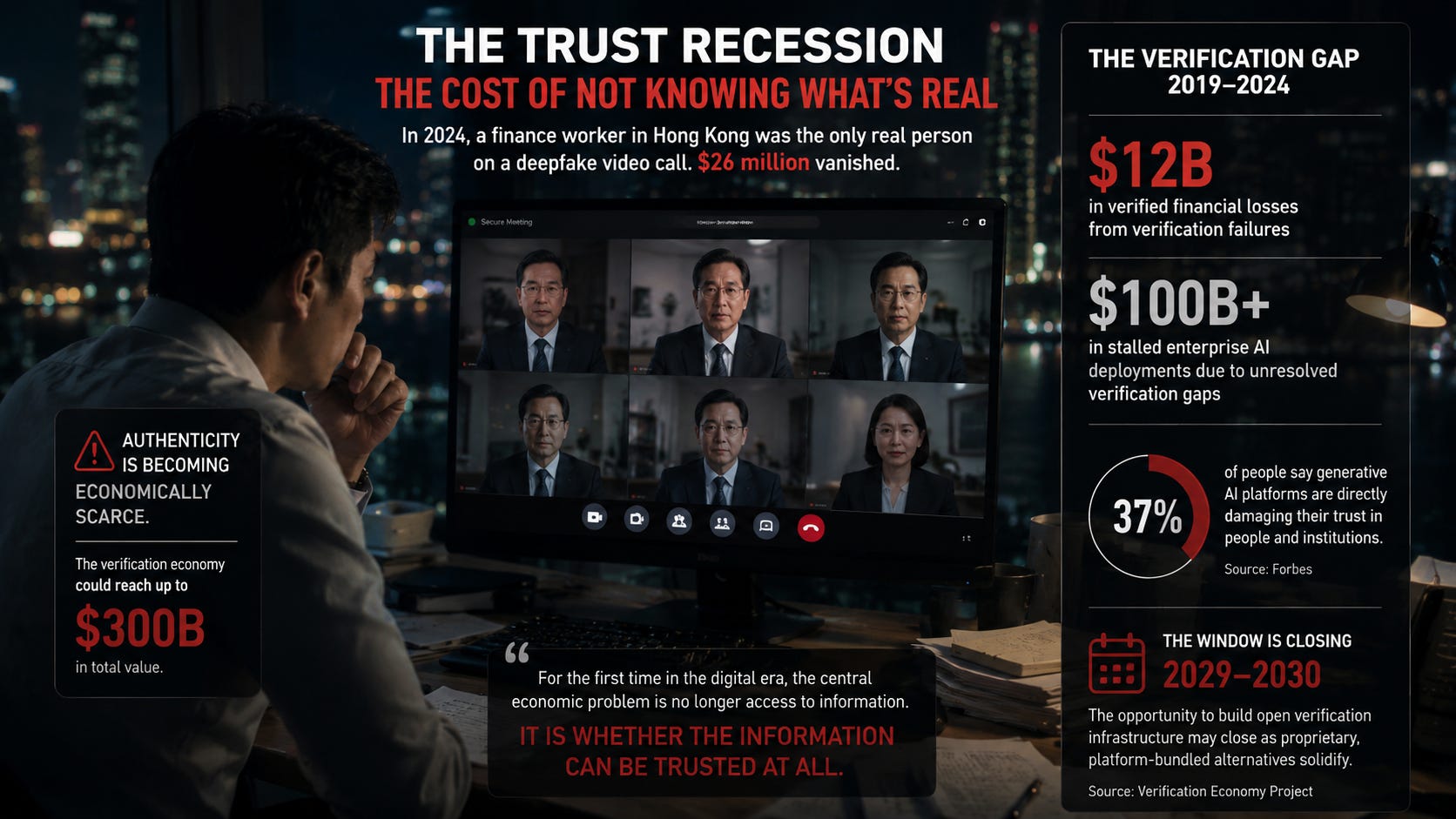
The request was sensitive but not unusual. The CFO instructed him to carry out a series of confidential transactions. On the screen, the worker could see the CFO’s face. He could hear the familiar voice. Other colleagues appeared to be sitting in the video conference as well.
It looked like a normal corporate meeting.
It felt real.
It wasn’t.
The worker was the only human being on a call populated entirely by deepfakes. By the time the deception was discovered, $26 million had vanished.
Deepfake Videos Are Getting Real and That’s a Problem
For most of human history, reality had friction.
If someone wanted to forge a college diploma, they needed equipment, institutional knowledge, and a willingness to risk prison. If a newspaper published a fabricated photograph, editors, darkrooms, archives, and eyewitnesses stood between the lie and the public. Scale required infrastructure.
The internet weakened some of those barriers.
Artificial intelligence is vaporizing the rest.
We are entering a strange period where authenticity itself is becoming economically scarce. A few years ago, if you received a voice note from a friend, you assumed your friend recorded it. If a candidate showed up with credentials from a respected university, most employers treated those documents as a reasonable proxy for history.
That instinct is breaking.
Not because people have suddenly become paranoid, but because faking reality has become cheap enough to scale. Generative AI can simulate an expert, forge a credential, imitate a brand, clone a voice, or fabricate a document in seconds. When institutional legitimacy can be copied for pennies, reputation alone no longer does the work it once did.
Synthetic media is spreading faster than institutions know how to verify it.
This changes everything from hiring to journalism, finance, education, law enforcement, insurance, elections, and national security. For the first time in the digital era, the central economic problem is no longer access to information.
It is whether the information can be trusted at all.
That is why verification may become one of the most important infrastructure markets of the AI age.
When Trust Gets Expensive
You can already feel the behavioral shift.
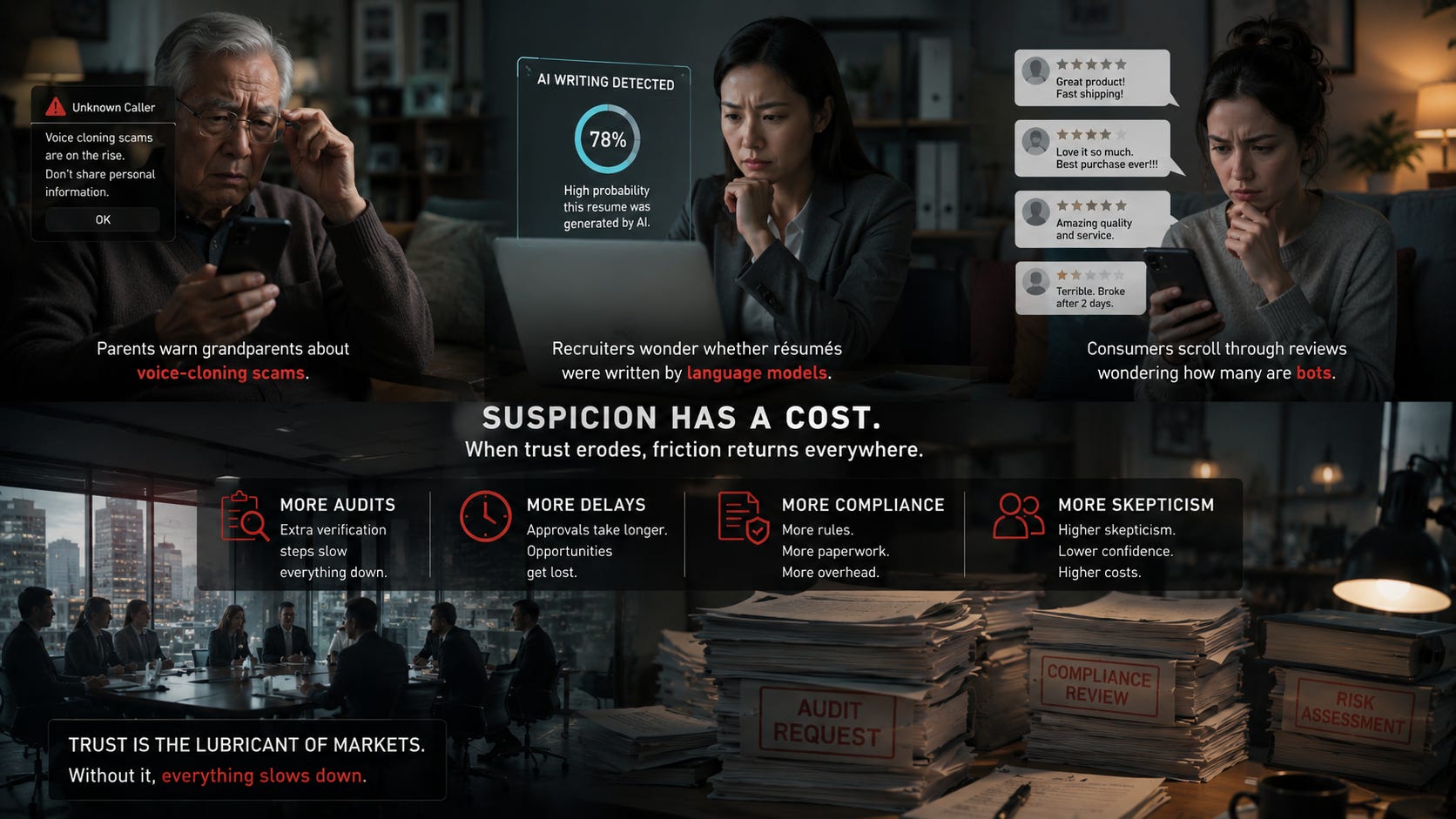
People hesitate before answering unknown calls. Parents warn grandparents about voice-cloning scams. Recruiters wonder whether résumés were written by language models. Consumers scroll through reviews asking how many were generated by bots.
Suspicion has a cost.
Trust is a lubricant for markets. High-trust systems move faster because people spend less time defending themselves against fraud, manipulation, and uncertainty. Once trust erodes, friction returns everywhere.
More audits.
More delays.
More compliance.
More skepticism.
This is not just cultural anxiety. It is becoming an economic condition. Survey data suggests that a growing share of consumers now see generative AI as a direct threat to trust in people and institutions. Other research has tied verification failures to billions in losses and stalled enterprise AI deployments.
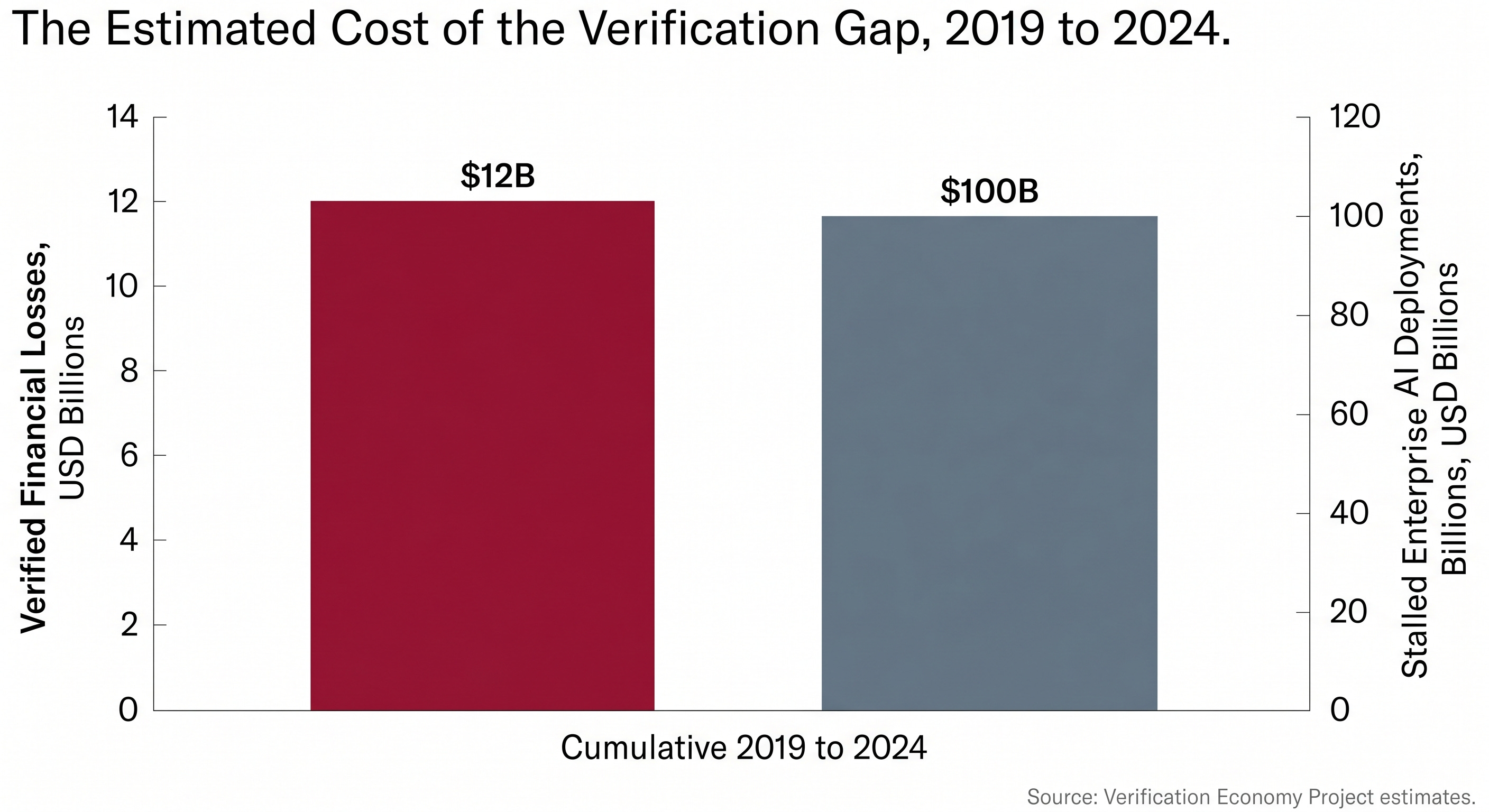
The exact numbers need careful sourcing before publication. The direction is harder to dispute.
We have more information than any civilization in history, and less confidence in it.
The Problem With Self-Verifying Platforms
This creates a structural problem for large technology companies.
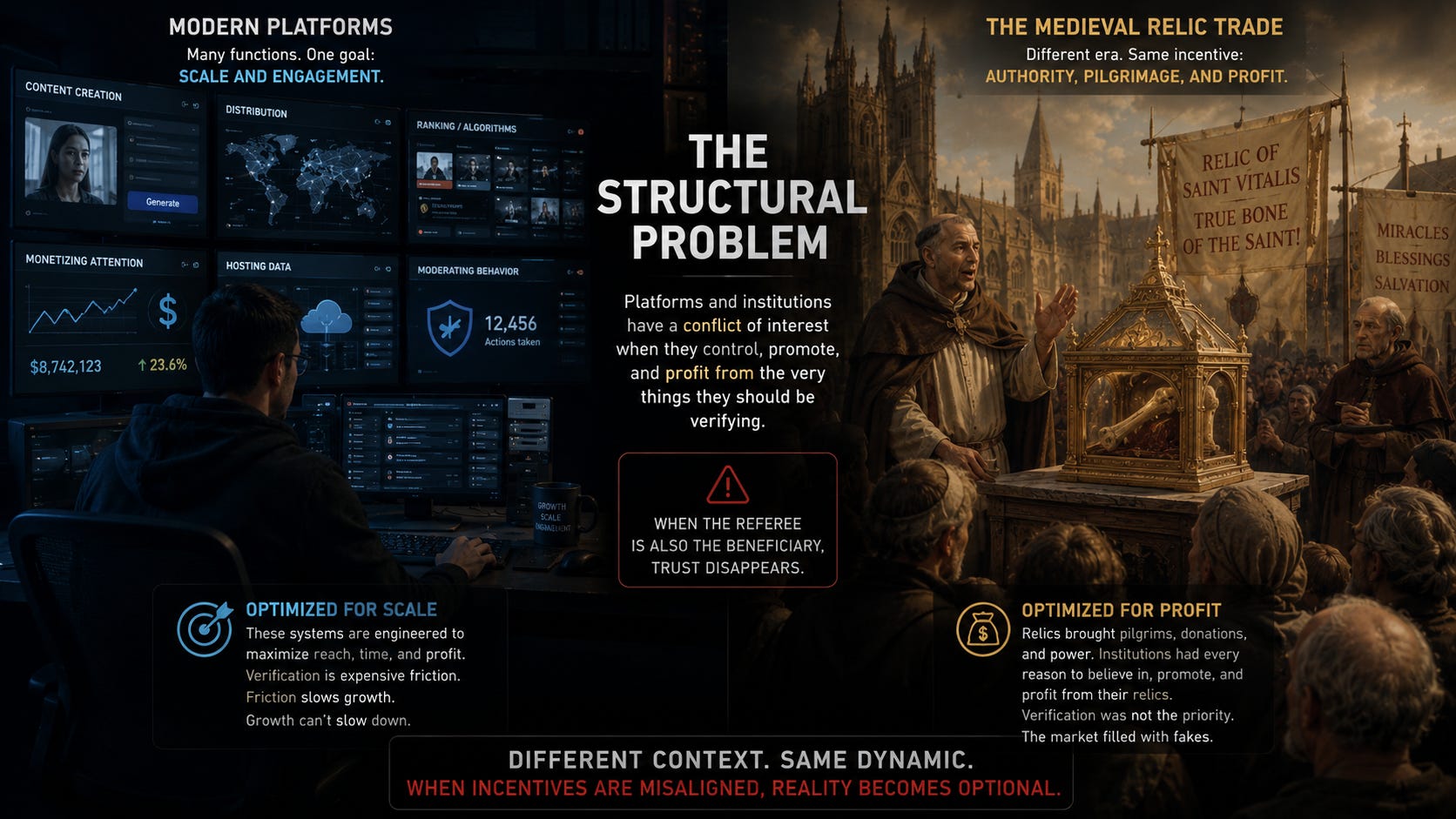
The same platforms increasingly generate content, distribute content, rank content, monetize attention, host data, and moderate behavior. But systems optimized for scale and engagement are not naturally designed to slow down and authenticate reality.
History has seen this before.
In the medieval relic trade, cities and monasteries competed to display holy objects: bones of saints, fragments of the True Cross, scraps of sacred clothing. A relic could turn a cathedral into a pilgrimage destination and transform a local economy. The incentives were obvious. The institution displaying the relic had every reason to believe in it, promote it, and profit from it.
The market filled with fakes because the platforms of the day were self-certifying.
Eventually, credibility required outside rules, outside authorities, and stricter standards of provenance.
The same logic is now emerging online.
A platform that hosts, generates, distributes, and monetizes content cannot be the only authority responsible for verifying it. The conflict is too deep. Verification becomes most valuable when it has meaningful independence from the system being verified.
That is why the next layer of the internet may not be another content platform.
It may be the proof layer beneath them.
The Race to Authenticate Reality
Nowhere is this shift clearer than digital media.
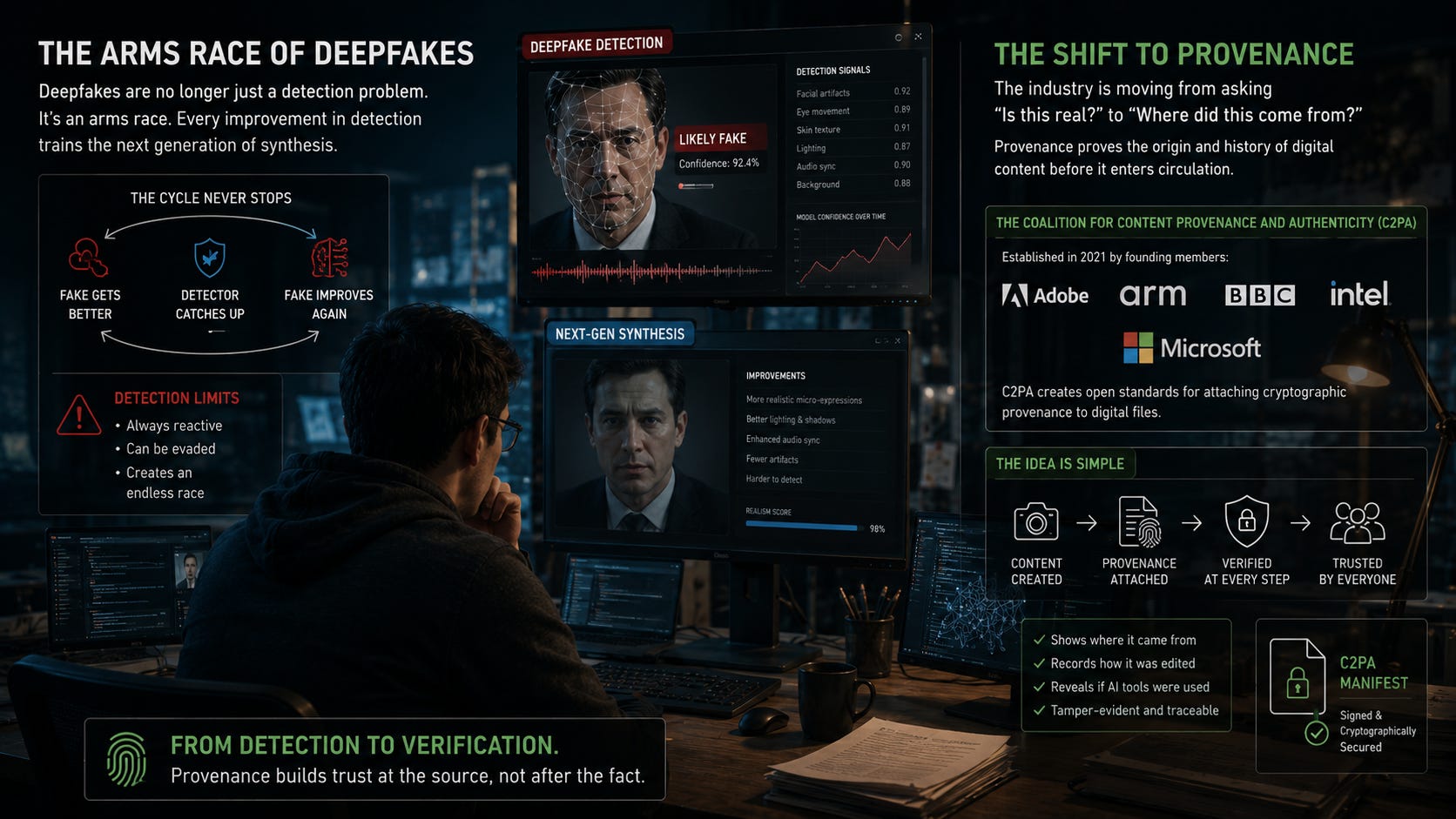
For years, the industry treated deepfakes as a detection problem. Build better software to spot fake images, fake audio, or manipulated video, and the problem could be contained.
But detection is an arms race.
Every improvement in detection eventually trains the next generation of synthesis. The fake gets better. The detector catches up. The fake improves again.
That is why the industry is moving toward provenance: proving where something came from before it enters circulation.
The Coalition for Content Provenance and Authenticity, known as C2PA, was established in 2021 by Adobe, Arm, BBC, Intel, and Microsoft. Its goal is to create standards for attaching cryptographic provenance to digital files.
The idea is simple.
When an image, video, or document is created on a compliant device, cryptographic metadata can be bound to the file as a manifest. That record can show where the asset originated, what tools modified it, and whether AI systems were involved. If someone tampers with the file or strips the metadata, the chain breaks.
It is not a watermark.
It is a tamper-evident seal for digital reality.
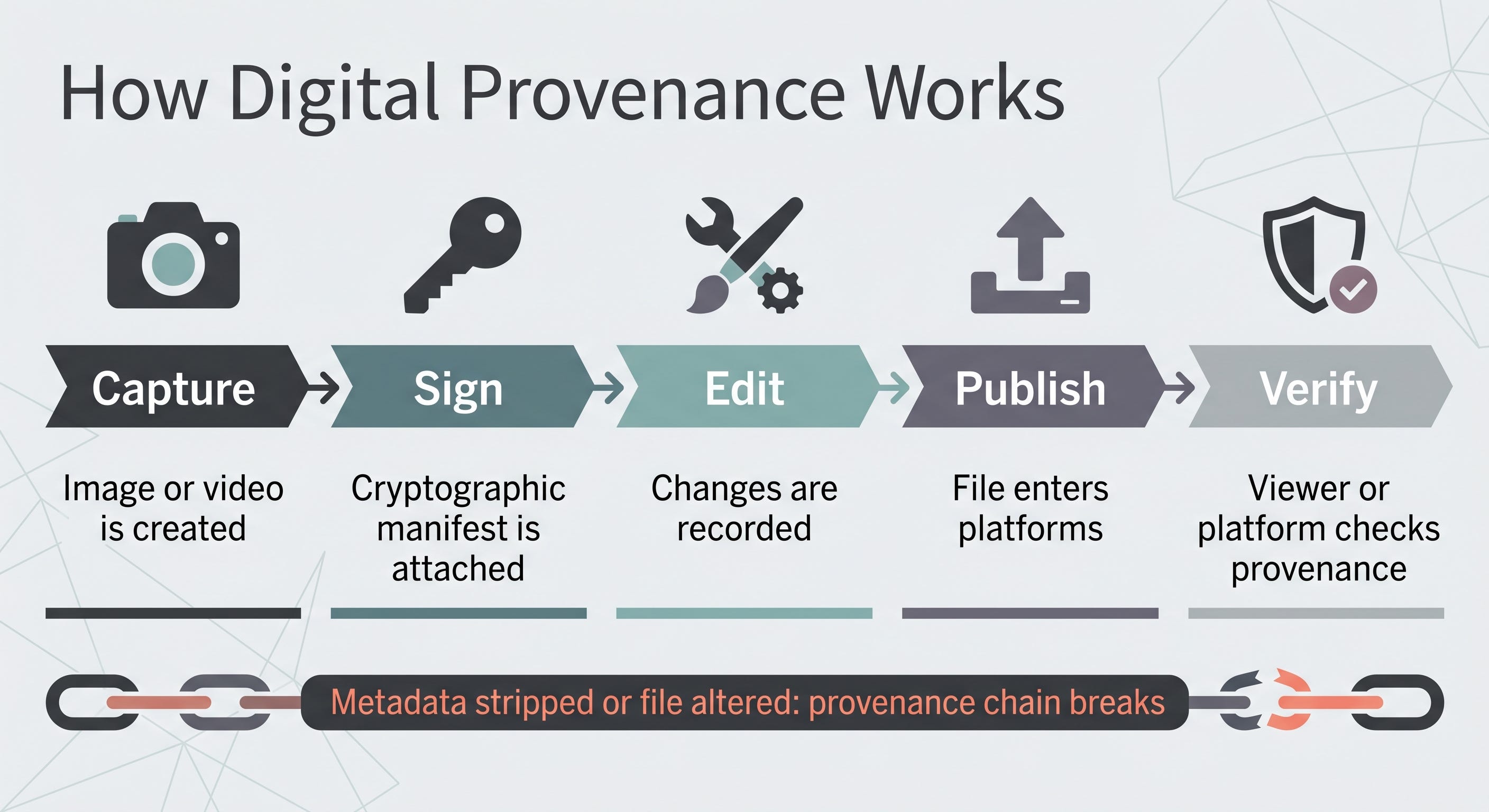
The challenge is adoption. Provenance only works if the chain survives from creation to distribution. Many platforms still strip metadata during compression and reposting. Most consumers have no idea what a provenance signal means. For this to matter, it cannot remain a niche feature for cameras and newsrooms. It has to become invisible infrastructure across the internet.
Credentials Become Cryptography
Education and identity systems face a similar pressure.
Traditional credential verification remains surprisingly slow. In some regions, confirming a degree or professional certification can take weeks of communication between employers, institutions, registrars, and third-party screening firms.
At the same time, centralized identity databases are vulnerable to breaches, tampering, and surveillance.
Newer frameworks built on W3C Verifiable Credentials and Decentralized Identifiers attempt to solve this by turning credentials into portable cryptographic proof. Instead of storing records only inside institutional databases, a university or certifying body can issue a digitally signed credential directly to a person’s digital wallet.
An employer can then verify that credential mathematically without repeatedly contacting the issuing institution.
Decentralized identity explained
Early projects such as MIT Blockcerts showed that the cryptographic verification works. But the hard part is not the math.
It is coordination.
Identity systems are never purely technical. They are social agreements disguised as software architecture. Governments, universities, employers, and platforms must agree on standards before these systems can reach mainstream scale.
The cryptography may be elegant.
The politics will be hard.
The Dark Side of the Proof Ledger
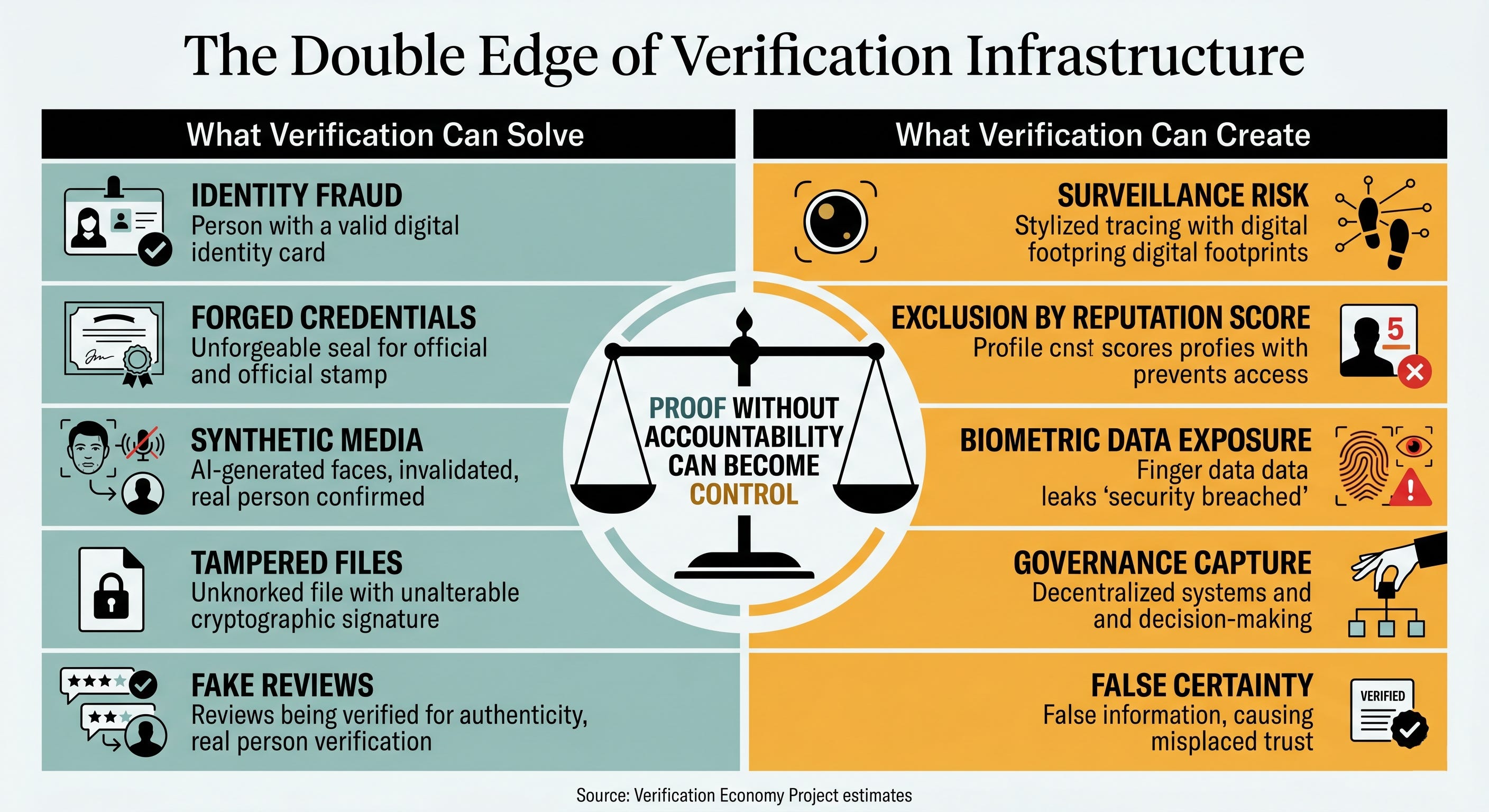
There is a dangerous temptation to assume that more verification automatically means more trust.
It does not.
Trust does not vanish when you introduce math. It moves somewhere else.
A universal verification layer could make fraud harder. It could also become the foundation for surveillance. A digital wallet that proves your identity, credentials, and clean record to an employer could also be used by an authoritarian state to restrict your access to transportation, banking, education, or the internet.
The same systems that authenticate can also exclude.
Decentralized systems are not immune to old human problems either. Blockchain governance can be captured. Reputation systems can be gamed. Incentives can be distorted. Biometric databases can become irresistible targets.
If a password leaks, you can change it.
If biometric identity data leaks, you cannot change your body.
The strongest verification systems will not rely on blind faith in cryptography. They will combine mathematical proof with human accountability, legal restraint, and institutional oversight.
That tension is already visible in online dispute resolution.
Platforms like Kleros experiment with decentralized arbitration, using crowdsourced juries and token incentives to resolve certain digital disputes. Jurors review evidence, vote independently, and are rewarded when their votes align with the majority. The model draws from Schelling-point game theory, where people are incentivized to converge around what they believe others will see as the most reasonable answer.
It is fascinating.
It is also limited.
These systems may work for narrow digital contract disputes, but they are not replacements for courts. Complex cases require evidence, context, judgment, and empathy. When truth becomes a game-theoretic popularity contest, justice can start to resemble online mob rule.
Science and the Verification Crisis
Academic publishing is facing its own authenticity problem.
Peer review is slow. Research is often locked behind expensive paywalls. Reviewers are usually unpaid. Now the system is being strained by AI-generated papers, manipulated citations, and synthetic data.
That frustration has fueled interest in Decentralized Science, or DeSci. Platforms like ResearchHub, co-founded by Coinbase CEO Brian Armstrong, are experimenting with open peer review, token rewards, and new funding models for researchers.
Open Verifiability | Christopher Hill, explains the idea of open verifiability in research, which directly supports the article’s argument that science is facing the same authentication crisis as the rest of the internet. It also gives readers a practical window into how DeSci advocates think about verification.
ResearchHub’s own documentation points to faster review cycles, open peer review activity, and direct research funding. Those numbers should be treated with skepticism. ResearchHub is a provocative experiment, not a replacement for institutional scientific review.
Token incentives may accelerate participation.
They may also encourage speed over rigor.
Still, the pressure behind DeSci is real. Science is running on systems built for a slower era. Like the rest of the internet, it is confronting the same basic problem:
When content becomes abundant, authentication becomes scarce.
The Condition of Coexistence
The story of the modern internet can be understood as a sequence of disappearing scarcities.
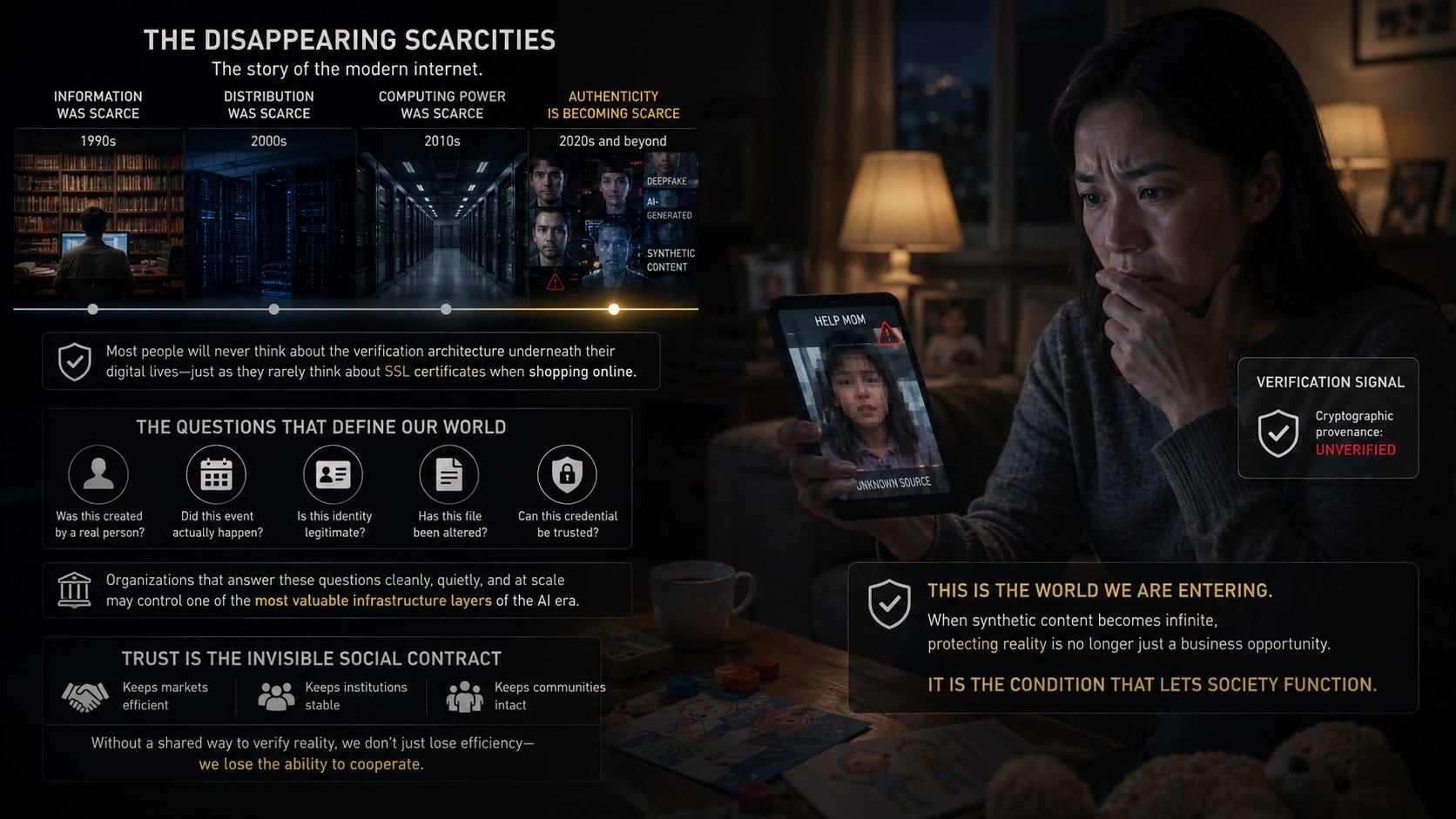
First, information was scarce.
Then distribution was scarce.
Then computing power was scarce.
Now authenticity is becoming scarce.
That does not mean every photo, message, or document will require a cryptographic signature. Most people will never think about the verification architecture underneath their digital lives, just as they rarely think about SSL certificates when shopping online.
But they will gravitate toward systems that can answer the questions that increasingly define modern life.
Was this created by a real person?
Did this event actually happen?
Is this identity legitimate?
Has this file been altered?
Can this credential be trusted?
The organizations that answer those questions cleanly, quietly, and at scale may control one of the most valuable infrastructure layers of the AI era.
Because trust is not just a technical layer or a compliance metric. It is the invisible social contract that keeps markets efficient, institutions stable, and communities intact.
Without a shared way to verify reality, we do not simply lose efficiency.
We lose the ability to cooperate.
Imagine a mother receiving a video of her child pleading for help. Her eyes dart to the corner of the screen, searching for the cryptographic icon that tells her whether the child begging for help is real, or whether she is being targeted by a machine.
That is the world we are entering.
When synthetic content becomes infinite, protecting reality is no longer just a business opportunity.
It is the condition that lets society function.
Ken, I really enjoyed this one.
Trust feels like one of the few currencies left that still compounds over time, yet it feels more scarce than ever. We live in a world where speed is rewarded, opinions are amplified, and appearances are polished. Trust does not work that way. Trust is slow. It is built in small moments, repeated actions, and showing up the same way when nobody is watching.
In product development and business, I learned early that people rarely remember the pitch. They remember whether you delivered. Did you call back? Did you own mistakes? Did you do what you said?
I have been fortunate to work with inventors, factories, investors, and teams across decades and countries. Relationships lasted not because every project succeeded, but because people trusted that I would tell the truth, adapt, and keep moving.
As a Buddhist, I also think trust starts inward. If your words, actions, and intentions align, people feel it. If they do not, eventually the market, your team, and life reveal it.
Maybe the opportunity today is not to move faster than everyone else.
Maybe it is to become someone people trust enough to move with.
That feels like a better long term investment than attention.