

When Evidence Stops Settling the Argument
Institutions opened their records and exposed their methods. They did not build a trusted process for deciding what the evidence means.


The scandal ignited because the number was not hidden inside a classified weapons program. It was the listed price of an egg.
In January 2023, the Ukrainian investigative newspaper ZN.UA published details from an internal Ministry of Defense contract showing prices for basic catering items destined for military units substantially above ordinary retail benchmarks. The report noted that eggs were being purchased at 17 hryvnias each, compared with a prevailing retail rate of roughly 7 hryvnias. Watchdogs presented the contract records as clear evidence of systemic corruption. Defense officials responded that retail comparisons were misleading, arguing that the contract covered far more than the food itself, factoring in long-term storage, fuel security, and the complex logistics of front-line delivery under constant military risk.
The report triggered immediate public outrage and official scrutiny. The controversy was followed by senior personnel changes, including the resignation of Deputy Defense Minister Vyacheslav Shapovalov, and parliamentary action via Law 2958-IX to restore non-weapons procurement disclosure requirements.
For years, ProZorro had been celebrated for making procurement records searchable. Early Harvard Kennedy School and OECD assessments credited it with widening competition and generating substantial savings. Wartime security exceptions, however, had temporarily removed parts of defense procurement from ordinary automated publication.
Yet the food-pricing scandal exposed a deeper structural paradox. The contract itself emerged through investigative reporting rather than ordinary public search because emergency wartime exemptions had temporarily shielded certain non-weapons military purchasing from automated publication. The scandal did not reveal a failure of ProZorro. It exposed the gap between publishing a document and establishing what it proves.
Once the contract entered public view, access to the document did not settle what its prices meant, whether logistical explanations were adequate, or which irregularities warranted prosecution. ProZorro shows what searchable records can accomplish. The food-contract controversy shows what happens after a document enters a contested public sphere.
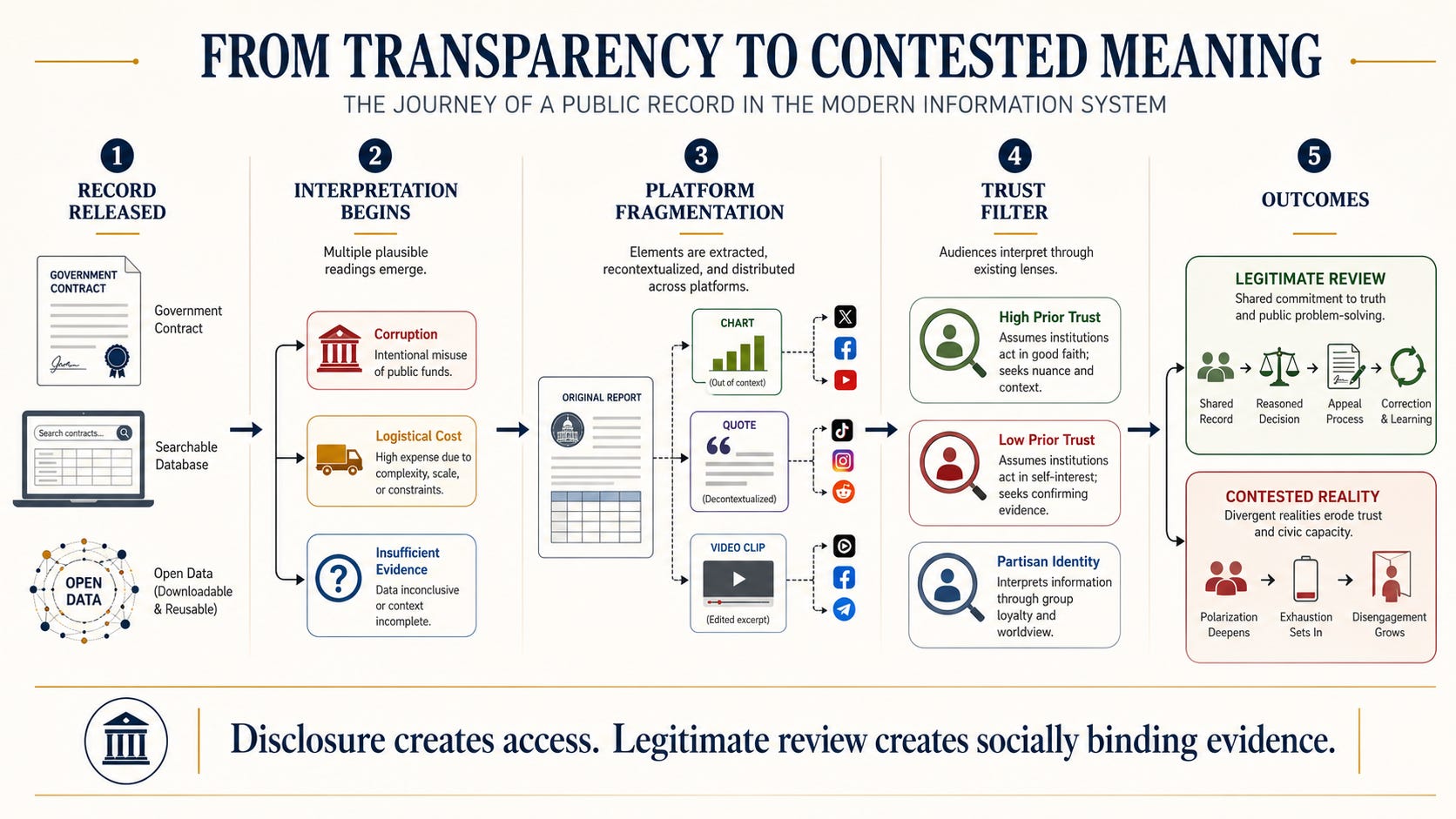
The crisis confronting modern governance and journalism is no longer a shortage of evidence. It is the disappearance of institutions capable of making evidence socially binding.
Evidence becomes socially binding when competing groups recognize a legitimate process for testing it, challenging its interpretation, and correcting the result. The process may still be wrong and need not eliminate dissent. Its value is that disagreement can continue without collapsing into rejection of the entire system.
Formal openness is insufficient when challengers lack money, expertise, language access, legal standing, or protection. A process can also be widely accepted while privileging powerful participants.
This concept rests on an established tradition of research into procedural justice and institutional legitimacy, spanning psychology, criminology, law, and organizational research. Tom Tyler’s research indicated that people were more willing to accept adverse outcomes when they had a voice, believed standards were applied neutrally, and received an explanation. Procedural fairness can explain why a ruling is accepted; it cannot establish that the ruling is true or just.
Why Procedural Justice Matters: Tom R. Tyler” — Center for Justice Innovation
Over the past two decades, institutions have increasingly used greater visibility as one response to declining trust. Yet the expansion of accessible records has not reversed the slide. Data from the Reuters Institute’s 2026 survey across 48 online markets found that only 37% of respondents trusted most news most of the time, the lowest average since 2015. Meanwhile, the OECD’s 2023 trust survey reported that 39% of citizens expressed high or moderately high trust in their national government, while 44% reported low or no trust.
These figures do not show that transparency caused distrust. They show that greater access has not restored it by itself. Credibility concerns whether a claim is believed; trust concerns whether a source is relied upon under uncertainty; and authority concerns whether an institution is accepted as having a legitimate process for resolving competing claims.
In low-trust environments, disclosure can supply new material for suspicion as easily as it supplies material for accountability.
Information has become abundant. Shared judgment has become scarce.
Four ways institutions show their work
Transparency is not one practice. Different forms of openness solve different problems, and each affects trust and accountability differently:
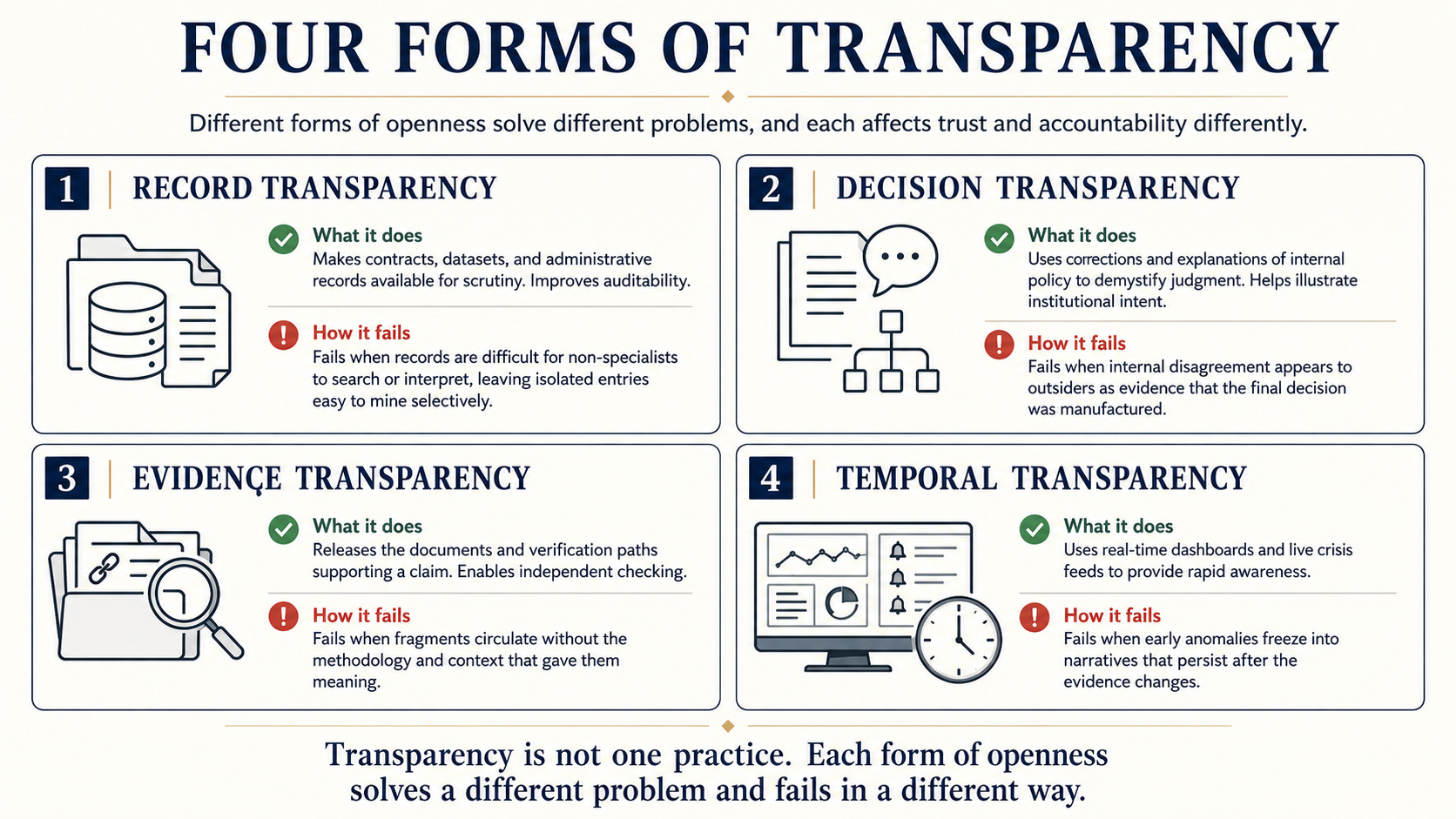
Record transparency makes contracts, datasets, and administrative records available for scrutiny. It improves auditability but fails when records are difficult for non-specialists to search or interpret, leaving isolated entries easy to mine selectively.
Decision transparency encompasses corrections and explanations of internal policy, demystifying judgment. It helps by illustrating institutional intent but fails when internal disagreement appears to outsiders as evidence that the final decision was manufactured.
Evidence transparency releases the documents and verification paths supporting a claim. It allows for independent verification, but it doesn’t work when pieces of information are shared without the method and context that gave them meaning.
Temporal transparency relies on real-time dashboards and live crisis feeds to provide rapid awareness but can freeze early anomalies into narratives that persist after the evidence changes.
The trap often develops through a recognizable sequence. Disclosure increases the volume of data. Platforms may preserve the link to the source, but their feeds reward the fragment. A chart, quotation, or clip travels farther and faster than the report that gave it meaning, while manipulators and partisan interpreters select the pieces most useful to their audiences.
When contradictory interpretations arrive faster than institutions can review them, disagreement begins to look less like an ordinary dispute and more like proof that factual resolution is impossible, driving audiences to cognitive exhaustion or retreat into a familiar partisan or creator-led community.
Distrust is not always a failure
Not every loss of trust is a failure. When records expose genuine misconduct, distrust is the proper democratic response. The public exposure of hidden commercial incentives represents transparency working exactly as intended, correcting misplaced trust to protect the public interest.
For instance, a study published in Marketing Science tracked American newspaper coverage between 2000 and 2014 and found less reporting on vehicle-safety recalls involving manufacturers that advertised more regularly with the paper, particularly when those recalls were severe. While the study noted that intense market competition for readers significantly reduced this advertising effect, it demonstrated why external scrutiny remains necessary.
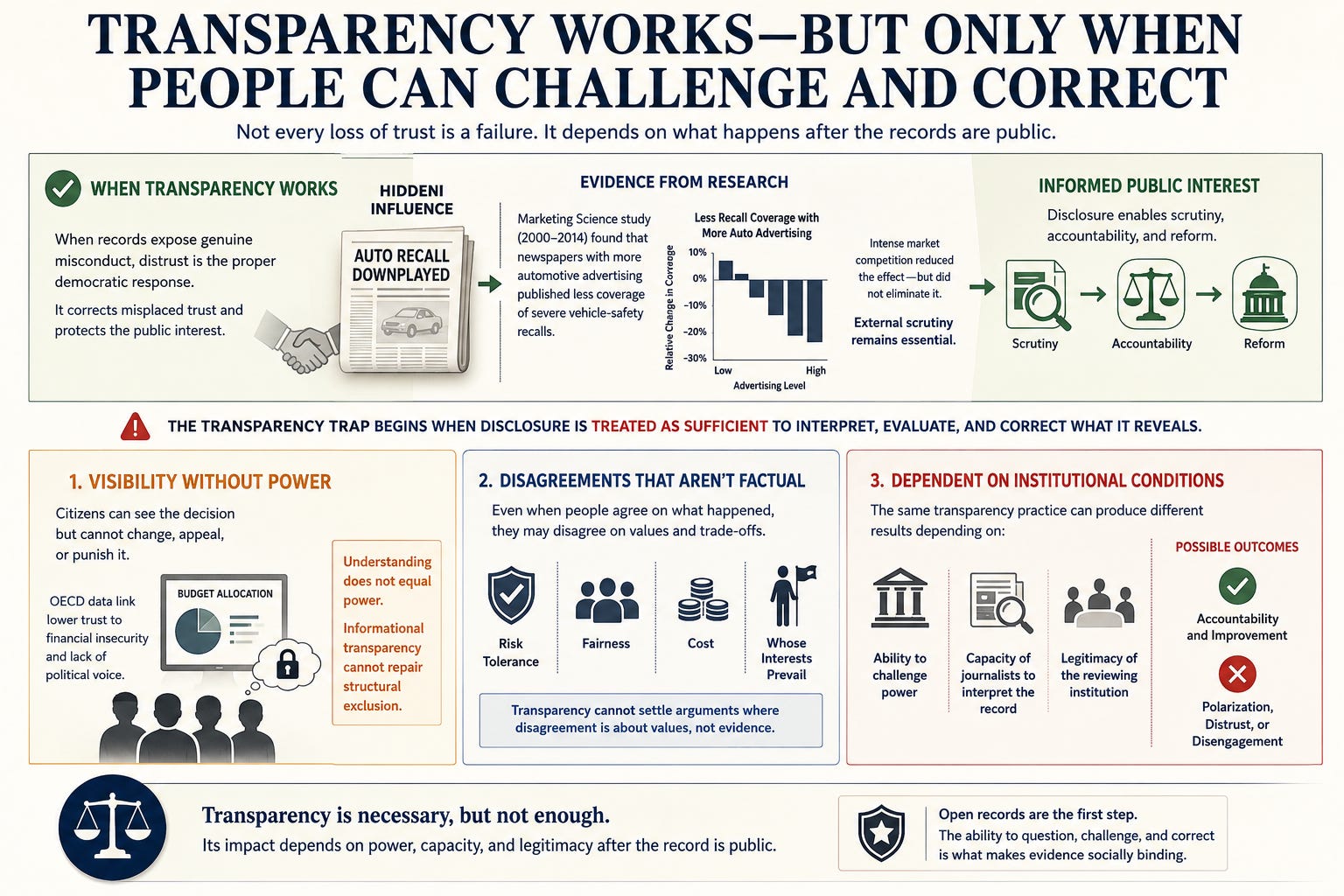
The transparency trap begins not when disclosure creates warranted scrutiny, but when it is treated as sufficient to interpret, evaluate, and correct what it reveals.
This dynamic arises from a mismatch between visibility and political power: citizens can see the decision but cannot change, appeal, or punish it. Data from the OECD’s tracking of public institutions associate lower trust with financial insecurity and a perceived lack of political voice. A community may understand exactly how a budget was allocated and still have no meaningful way to contest it. Informational transparency cannot repair structural exclusion.
Furthermore, even a trusted process cannot eliminate every disagreement. People can agree entirely on what happened and still disagree over risk, fairness, cost, or whose interests should prevail. Transparency cannot settle an argument whose disagreement lacks evidence.
The same transparency practice can therefore produce different results depending on whether citizens can challenge power, whether journalists can interpret the record, and whether the reviewing institution retains legitimacy.
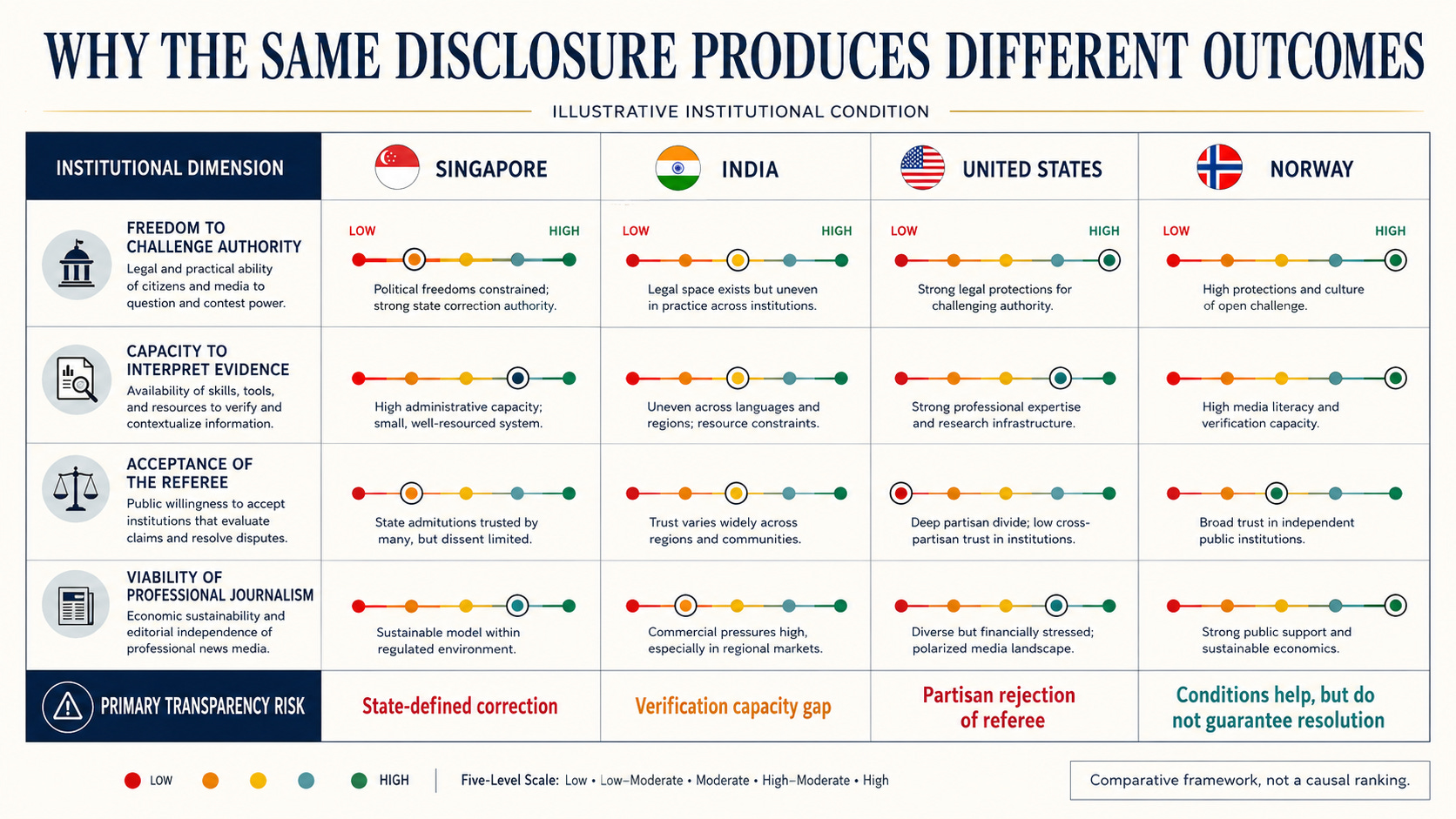
The same crisis behaves differently across systems
What disclosure can accomplish depends on four conditions: freedom to challenge authority, capacity to interpret evidence, acceptance of the reviewing institution, and the viability of professional journalism.
Singapore combines extensive administrative data publication with a tightly regulated political-media environment. The state provides high-quality municipal, environmental, and public-spending data through open portals yet maintains significant authority over political reporting and cross-examination through POFMA.
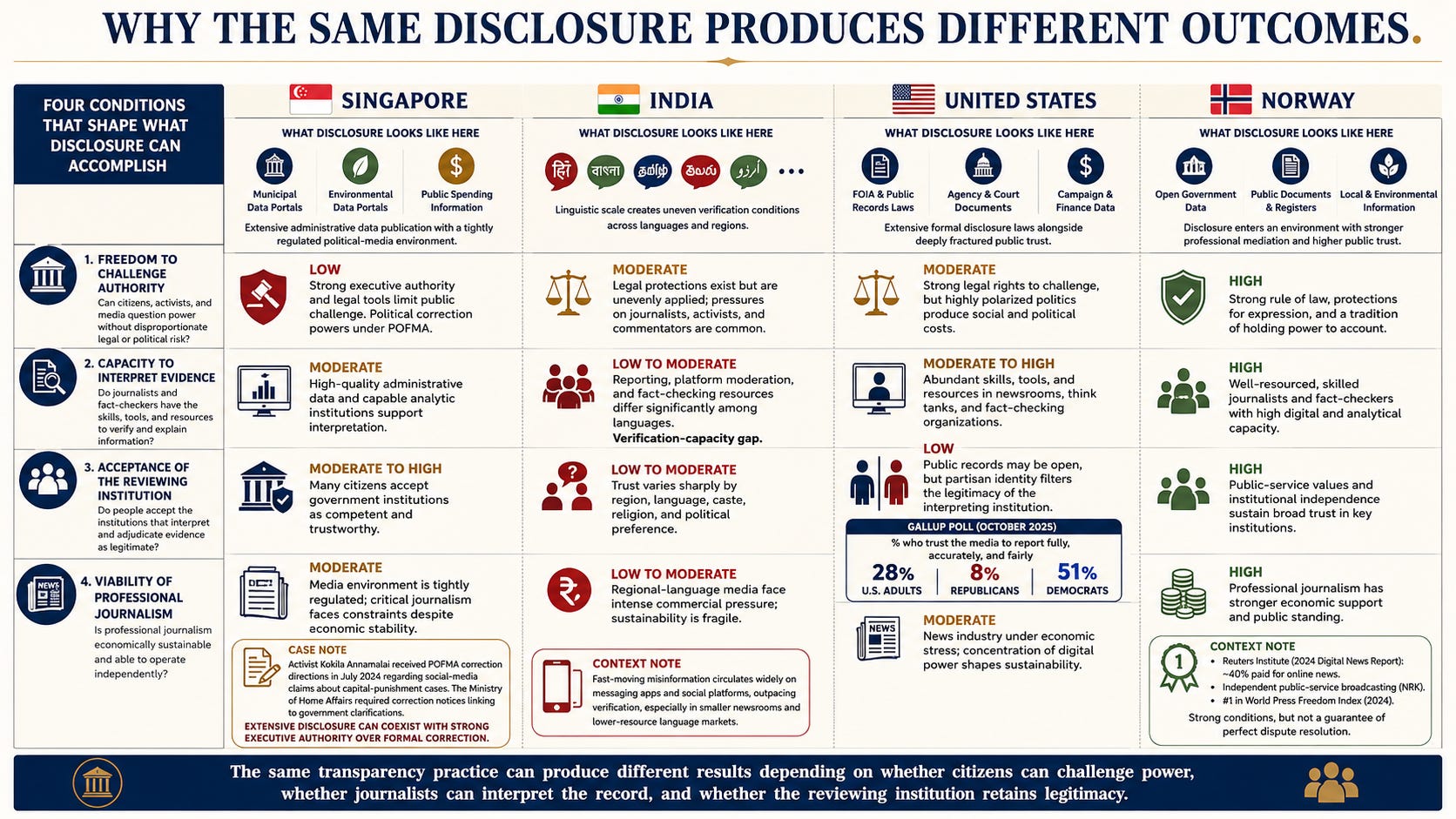
Under this law, government ministers can issue correction directions to digital platforms and publishers, compelling them to post a notice stating that their content contains false statements of fact alongside the government’s alternative account. The case illustrates this tension, as activist Kokila Annamalai received POFMA correction directions in July 2024 concerning her social-media claims about capital-punishment cases. The Ministry of Home Affairs required her posts to carry correction notices linking directly to the government’s clarifications. The case illustrates how extensive administrative disclosure can coexist with strong executive authority over the formal correction of political claims.
India’s linguistic scale creates uneven verification conditions. Reporting, platform moderation, and fact-checking resources differ significantly among languages. Where regional newsrooms and fact-checking desks have limited resources, misleading material can circulate faster than reliable correction, leaving some language communities with substantially less capacity to verify and contextualize fast-moving claims.
The 2026 World Press Freedom Index highlights that independent newsrooms face severe commercial pressure. In this landscape, regional-language media face intense survival constraints, turning language-market fragmentation into a structural vulnerability for verified facts.
In the United States, extensive formal disclosure laws exist alongside deeply fractured public trust. Gallup’s October 2025 report found that 28% of Americans trusted the media to report fully, accurately, and fairly, driven by a deep divide where trust among Republicans stood at 8% compared with 51% among Democrats.
The gap illustrates how deeply prior political identity conditions institutional trust. The records may be public, but partisan identity filters the legitimacy of the institution interpreting them.
Norway offers a useful contrast. In the Reuters Institute’s survey, roughly 40% of respondents reported paying for online news, indicating that professional journalism retains economic value for a large share of the public. Independent public-service broadcasting and a consistent number-one ranking in the World Press Freedom Index support this economic baseline.
These indicators show that disclosure enters an environment where independent public broadcasters and professional newsrooms retain greater economic support and public standing. These conditions do not prove that Norwegian institutions always resolve factual disputes successfully; they indicate that professional intermediaries retain greater capacity and public standing.
The gatekeeper moved
These systems differ in law, resources, and political legitimacy, but the evidence they generate increasingly passes through the same global distribution infrastructure. That shared layer can erase the distinctions among a state record, a reported finding, an activist claim, and a creator’s interpretation.
A primary treasury report, a legacy news broadcast, an independent creator’s critique, and an AI-generated summary all appear within similar feed units with little visual indication of their differing evidentiary status.
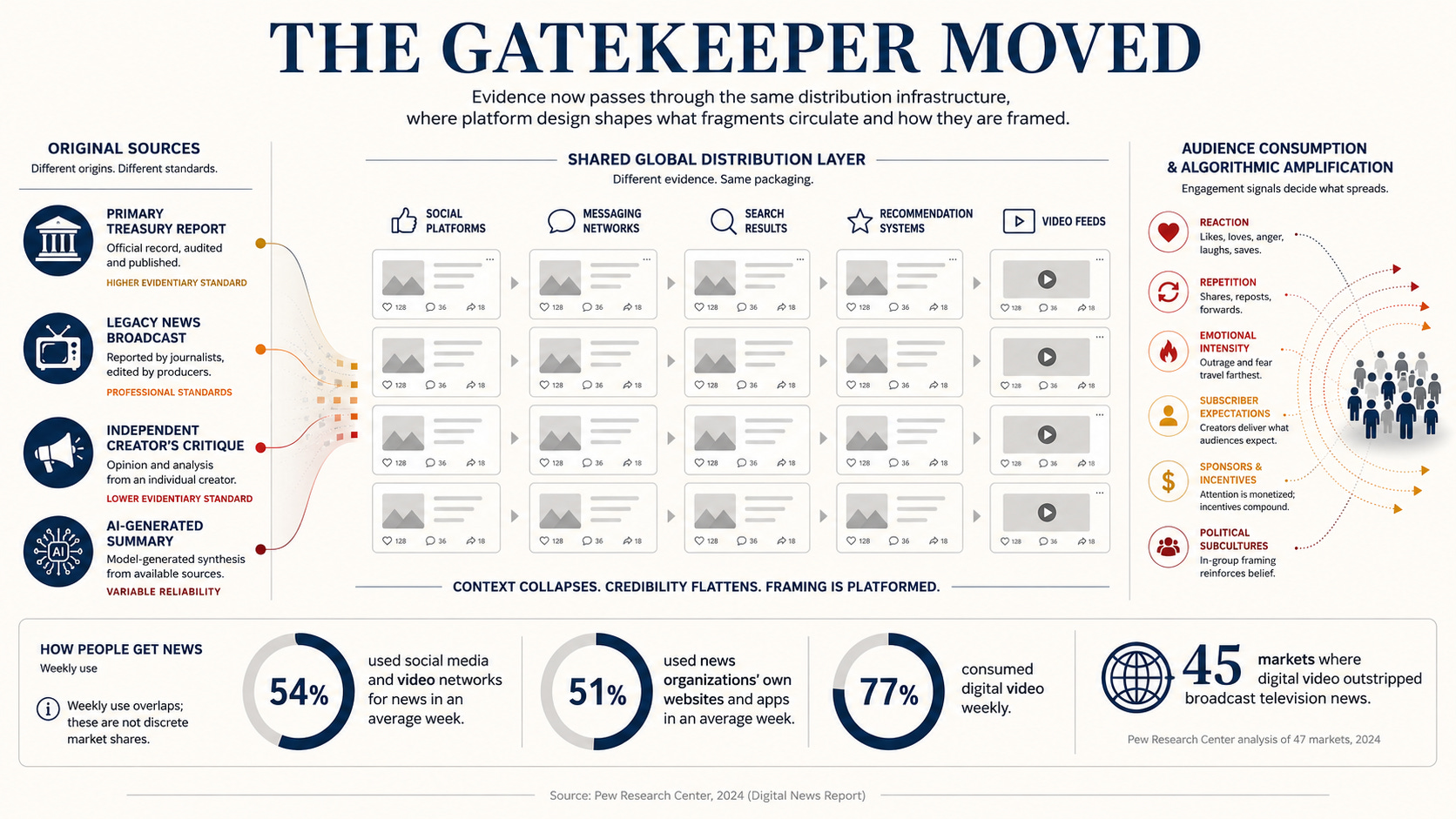
Across the surveyed markets, 54% of respondents used social media and video networks for news in an average week, while 51% used news organizations’ own websites and apps. Because many respondents used both, these figures reflect overlapping weekly use rather than discrete market shares. The transition is most distinct in the rapid rise of digital video, which is consumed weekly by 77% of respondents, outstripping the reach of broadcast television news in 45 of those markets.
The old gatekeeper did not disappear. It was joined by recommendation systems, messaging networks, search engines, creators, and AI summaries that influence which fragments circulate and how they are framed.
These systems appear less institutional because users see a person or feed rather than an editorial hierarchy. Their incentives are still consequential, even if they are less visible. The creator remains dependent on subscriber expectations, sponsors, political subcultures, or the incentives of platforms that reward reaction, repetition, and emotional intensity.
Why visible bias can feel more honest
The rise of creator-led news reveals a peculiar contradiction: audiences can distrust a personality’s impartiality while finding that person’s visible viewpoint easier to evaluate than an institution’s hidden assumptions.
Across the surveyed markets, 27% of respondents received some news from current-affairs creators, while 13% said creators met most or all of their news needs. Furthermore, respondents more often associated creators with relatability and entertainment, while established news organizations scored more strongly on trustworthiness and impartiality.
Traditional journalism often presents reporting through a detached, third-person voice intended to signal independence from the reporter’s preferences, leaving the editorial deliberation behind it largely invisible.
At their best, creators make part of their interpretive process visible by showing sources, highlighting disputed passages, and declaring their viewpoint. Creators do not eliminate selection; they expose part of it, even while sponsorships, algorithmic incentives, omissions, and audience expectations remain hidden.
In a low-trust environment, that visible viewpoint may feel easier to correct for than an institutional judgment whose assumptions are harder to inspect. Authority increasingly flows not only to whoever establishes the fact, but to whoever makes it emotionally and linguistically usable for a community.
Interpretation becomes socially binding inside communities before institutions can respond.
What Is Procedural Justice?” — Center for Justice Innovation
Why the same disclosure produces opposite conclusions
Two cognitive mechanisms reinforce the pattern in which transparency deepens polarization rather than curing it. Motivated reasoning can lead people to interpret evidence through existing loyalties.
A separate phenomenon, the continued-influence effect, extensively documented by cognitive scientists such as Stephan Lewandowsky, helps explain what happens afterward: corrections often fail to erase the influence of an earlier false claim on memory and judgment.
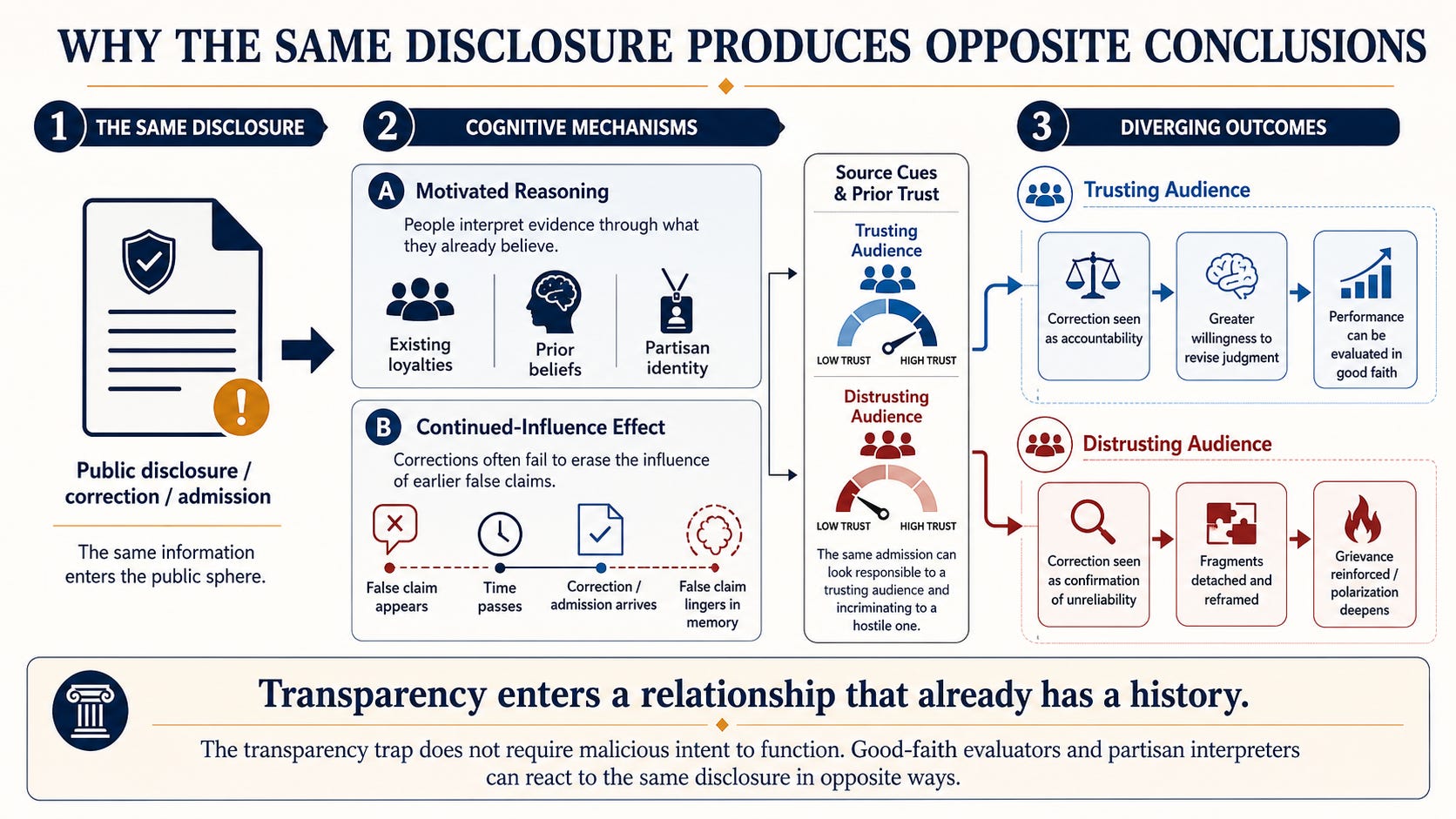
Prior trust can substantially alter the meaning audiences assign to the same act. Political-communication experiments indicate that audiences evaluate identical information differently depending on its attributed source. This body of work is supported by reputation studies in crisis communication on trust repair, which suggest that an organization’s existing reputation strongly shapes how audiences interpret its later corrections.
Applied to institutional transparency, the evidence is suggestive rather than universal: an admission may appear responsible to a trusting audience and incriminating to a hostile one.
A correction looks like accountability to a trusting audience and like confirmation of unreliability to a distrusting one. Transparency therefore enters a relationship that already has a history.
It provides good-faith evaluators with data to evaluate performance, but it simultaneously gives deliberate manipulators and partisan interpreters a continuous supply of fragments that can be detached, reframed, and distributed to validate a grievance.
The transparency trap does not require malicious intent to function.
When seeing is no longer enough
Photography and video once carried an unusually strong presumption of authenticity when provenance, place, and time could be verified. Generative AI has weakened the inference that geographic consistency means the scene was physically recorded there.
Modern video models can produce increasingly impressive scenes and manipulate authentic footage in ways that preserve enough geographic detail to complicate rapid verification.
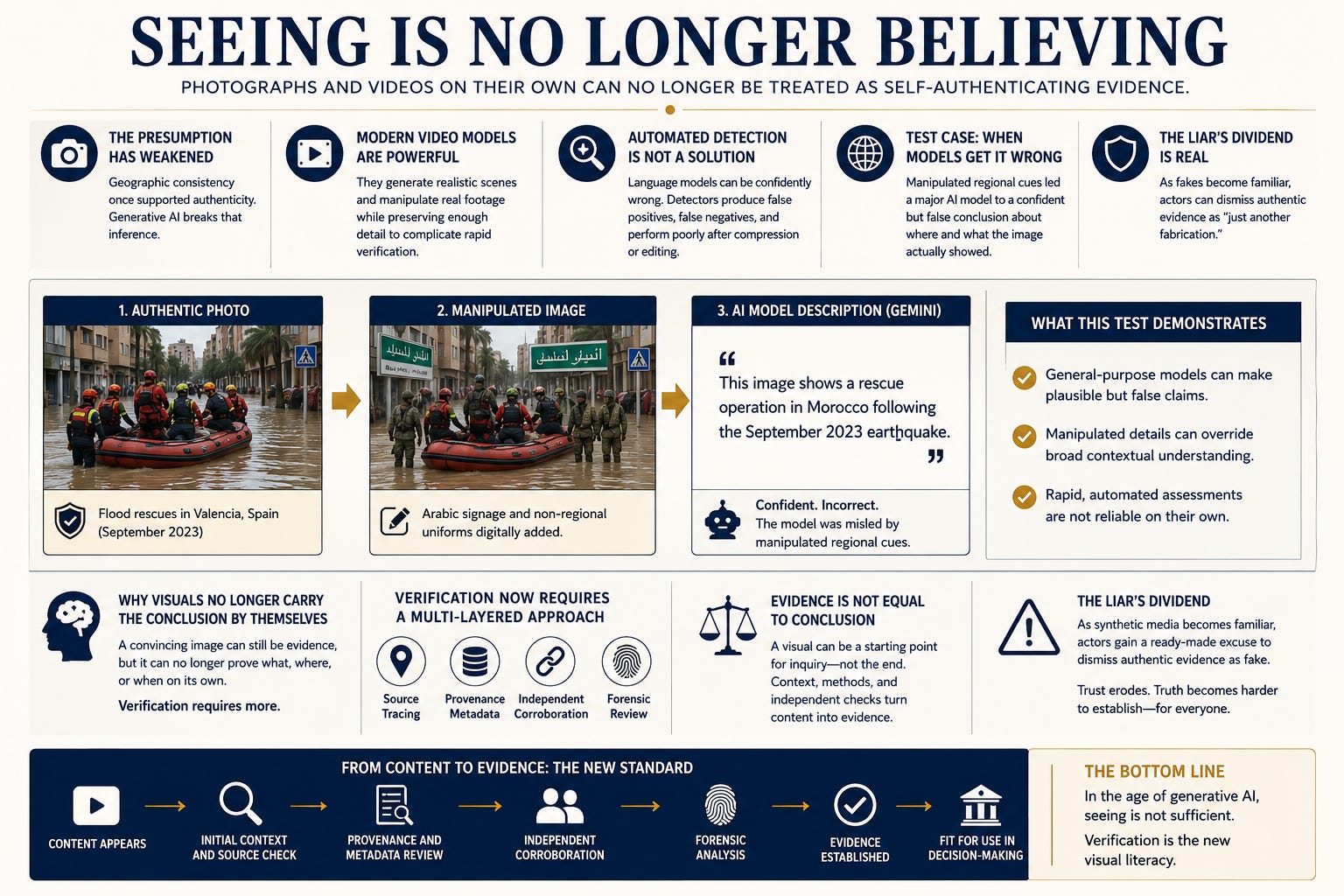
Automated detection does not solve the problem. General-purpose language models can produce confident but unsupported claims, while synthetic-media detectors face false positives, false negatives, and degraded performance when media have been compressed or edited.
In one test conducted for the Reuters Institute, researchers took an authentic photograph of flood rescues in Spain and digitally added Arabic street signage and non-regional military uniforms. When the manipulated file was uploaded to evaluate its descriptive performance, Gemini confidently identified the asset as a genuine rescue operation in Morocco following the September 2023 earthquake.
The test shows how manipulated regional cues can lead a general-purpose model to produce a confident but false description.
The deeper danger is the liar’s dividend: as synthetic media becomes familiar, perpetrators gain a ready-made excuse to dismiss authentic evidence as fabricated.
A convincing image can still be evidence; it can no longer carry the conclusion by itself. Verification now requires independent corroboration, source tracing, provenance, and forensic review.
How Deepfakes Undermine Truth and Threaten Democracy” — TED, featuring Danielle Citron
Disbelief as an outcome
For deliberate propagandists, the goal is to overwhelm citizens with enough contradiction that adjudication itself appears impossible.
Platform systems can produce a similar outcome without any central plan, as thousands of uncoordinated actors compete to publish, react, reinterpret, and accuse. This decentralized overload can contribute to disengagement.
News avoidance is now widespread rather than marginal. Across the markets surveyed by the Reuters Institute, 42% of respondents said they sometimes or often avoided news, up from 29% in 2017.
Contradictory and weakly mediated information may contribute to this disengagement, alongside negativity, repetition, emotional strain, and a sense that news offers little agency.
In this sense, avoidance can become a withdrawal from adjudication itself.
When disagreement remains inside the system
A contrasting case shows how a trusted process can keep disagreement inside a common evidentiary system, as seen in the independent investigations run by the National Transportation Safety Board.
When a commercial airliner crashes, airlines, pilots’ unions, and manufacturers possess vast, conflicting financial and reputational interests.
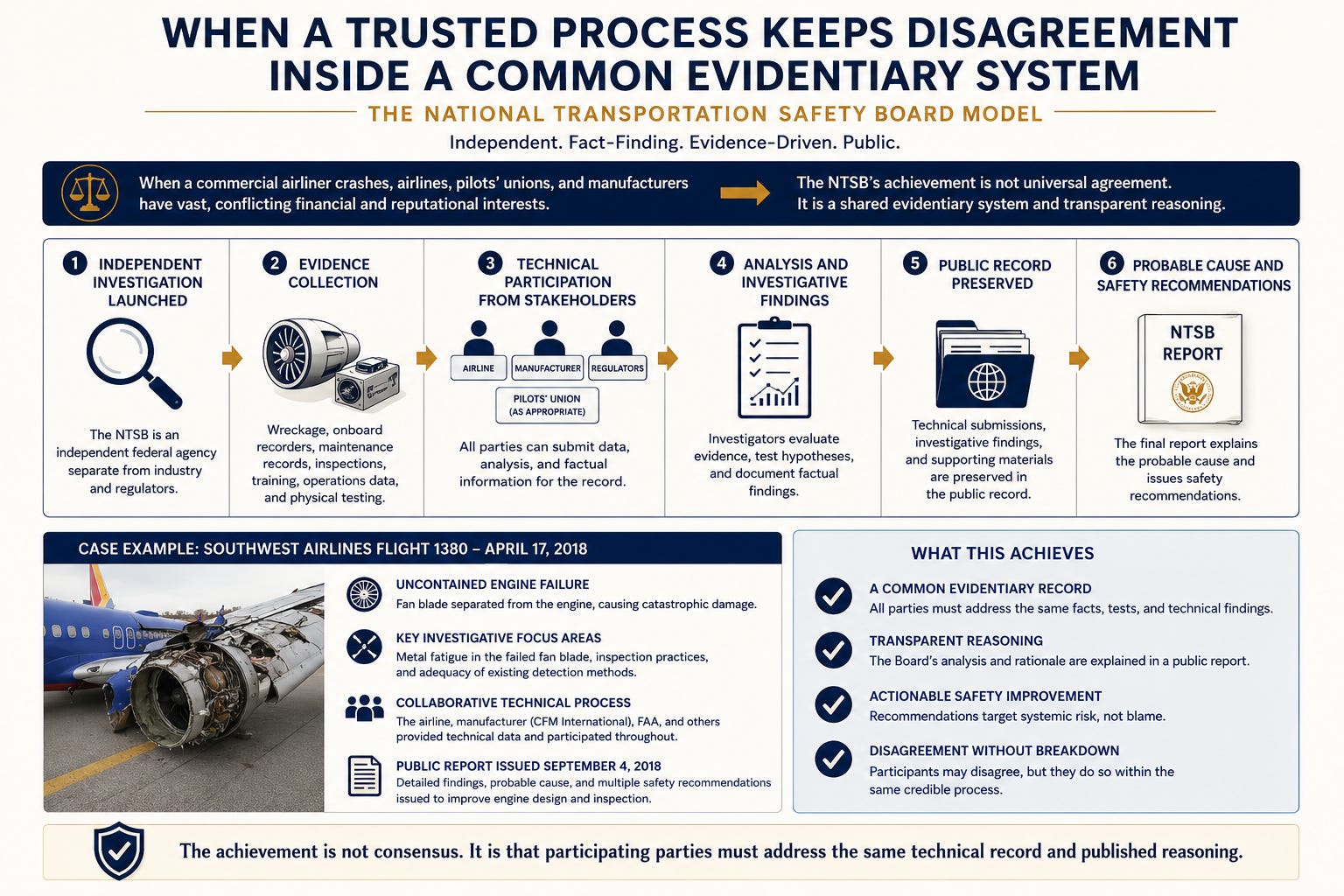
The NTSB’s achievement is not universal agreement. Consider the 2018 investigation into the uncontained engine failure on Southwest Airlines Flight 1380. Investigators examined metal fatigue in the failed fan blade, inspection practices, and the adequacy of existing detection methods with technical participation from the airline, manufacturer, and regulators.
Technical submissions, investigative findings, and the board’s reasoning were preserved in the public record, while the final report explained the probable-cause determination and resulting safety recommendations.
The achievement is not consensus. It is that participating parties must address the same technical record and published reasoning.
The Legible Disclosure Standard
Credible disclosure requires more than releasing data. It requires a shared record, meaningful challenge, published reasoning, named responsibility, and a path to correction.
Scrutiny should rise with the stakes. Routine records need clear sources and update dates. Consequential releases should add context, methodology, limits, and a review channel. The highest-stakes disclosures should answer all ten questions fully.
A process is not meaningfully open when cost, language, expertise, delay, standing, restricted evidence access, or fear of retaliation prevents affected people from using it.
A review process is meaningful only when challengers can obtain the evidence, publish dissent, receive a reasoned response, and trigger correction or remedy.
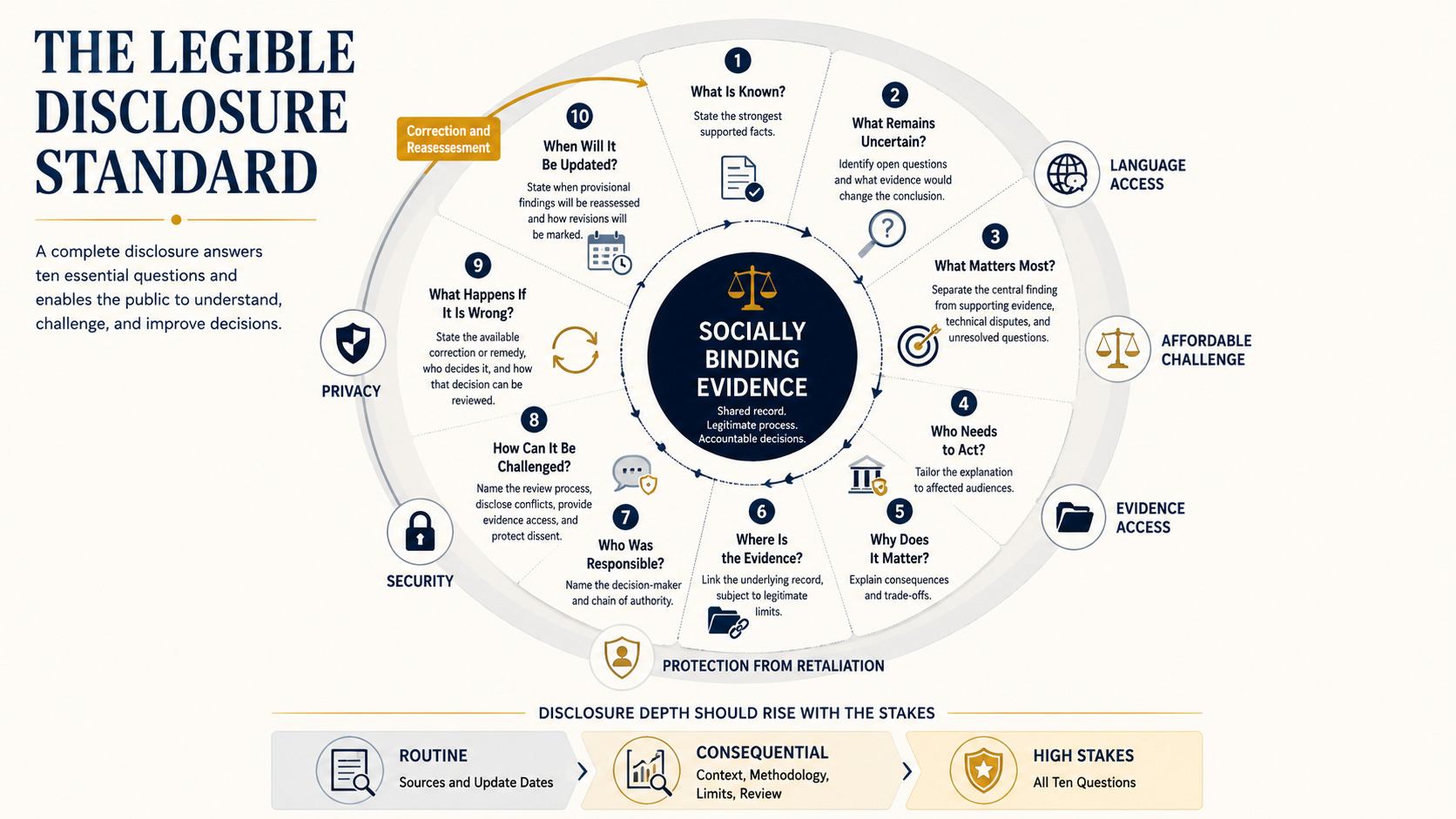
What is known? State the strongest supported facts.
What remains uncertain? Identify open questions and the evidence that would change the conclusion.
What matters most? Separate the central finding from supporting evidence, technical disputes, and unresolved questions.
Who needs to act? Tailor the explanation to affected audiences.
Why does this matter? Explain consequences and trade-offs.
Where is the evidence? Link the underlying record, subject to legitimate privacy, security, legal, and evidentiary limits.
Who was responsible? Name the decision-maker and chain of authority.
How can it be challenged? Name the review process, disclose conflicts, provide evidence access, and protect dissent.
What happens if the conclusion is wrong? State the available correction or remedy, who decides it, and how that decision can be reviewed.
When will this be updated? State when provisional findings will be reassessed and how revisions will be marked.
In practice, the standard changes both public procurement and journalism.
When a tender triggers a complaint, audit, investigation, or sanction, its public record should link directly to that proceeding and show its status. The framework builds on, rather than dismisses, what open procurement already does well.
In journalism, a newsroom publishing disputed conflict footage should provide the original upload history and geolocation evidence, state what remains unverifiable, and identify what new evidence would cause the assessment to change.
We have spent twenty years opening doors and unlocking files under the assumption that light is the best disinfectant.
But light without form is just a glare.
Evidence becomes public through disclosure. It becomes socially binding only through institutions people can question, test, and hold responsible.
Ken, this struck a chord with me because I recently wrote about the collapse of shared reality and the erosion of institutional legitimacy.
Your distinction between making evidence public and establishing what that evidence actually proves adds an important dimension to those questions. The Ukrainian egg contract made the numbers visible, but determining whether they reflected corruption, wartime logistics, or some combination required investigation, interpretation, and a credible process for challenging the conclusion.
“Information has become abundant. Shared judgment has become scarce” captures something I’ve been struggling to articulate. Facts alone cannot sustain a shared reality when no process is broadly trusted to interpret them.
Ken, this really gets to the heart of where we are today. For most of my life, I believed evidence was how intelligent people settled disagreements. You presented the facts, showed your work, and even if people disagreed, there was at least a shared respect for reality.
Today, it feels different. Evidence has become optional if it conflicts with someone’s identity, politics, or tribe. People often defend a conclusion first and then search for evidence that supports it later.
As someone who has spent more than three decades bringing products to market, I learned very early that the market doesn’t care about opinions. Consumers, sales, margins, and data are brutally honest. You can argue with them for a while, but eventually reality wins.
I am an optimist by nature. I always believe there is a solution. But optimism without evidence is just hope. The best decisions I have ever made came from combining conviction with the willingness to change my mind when the facts proved me wrong.
That, to me, is not weakness. It is intellectual maturity.
Excellent piece, Ken. It reminds us that if evidence can no longer settle an argument, then we have to ask a much harder question. Are people searching for truth, or are they simply searching for validation?