

When Journalism Lost First Contact
Journalism still verifies the record. But the feed now shapes the first version of reality many people receive.

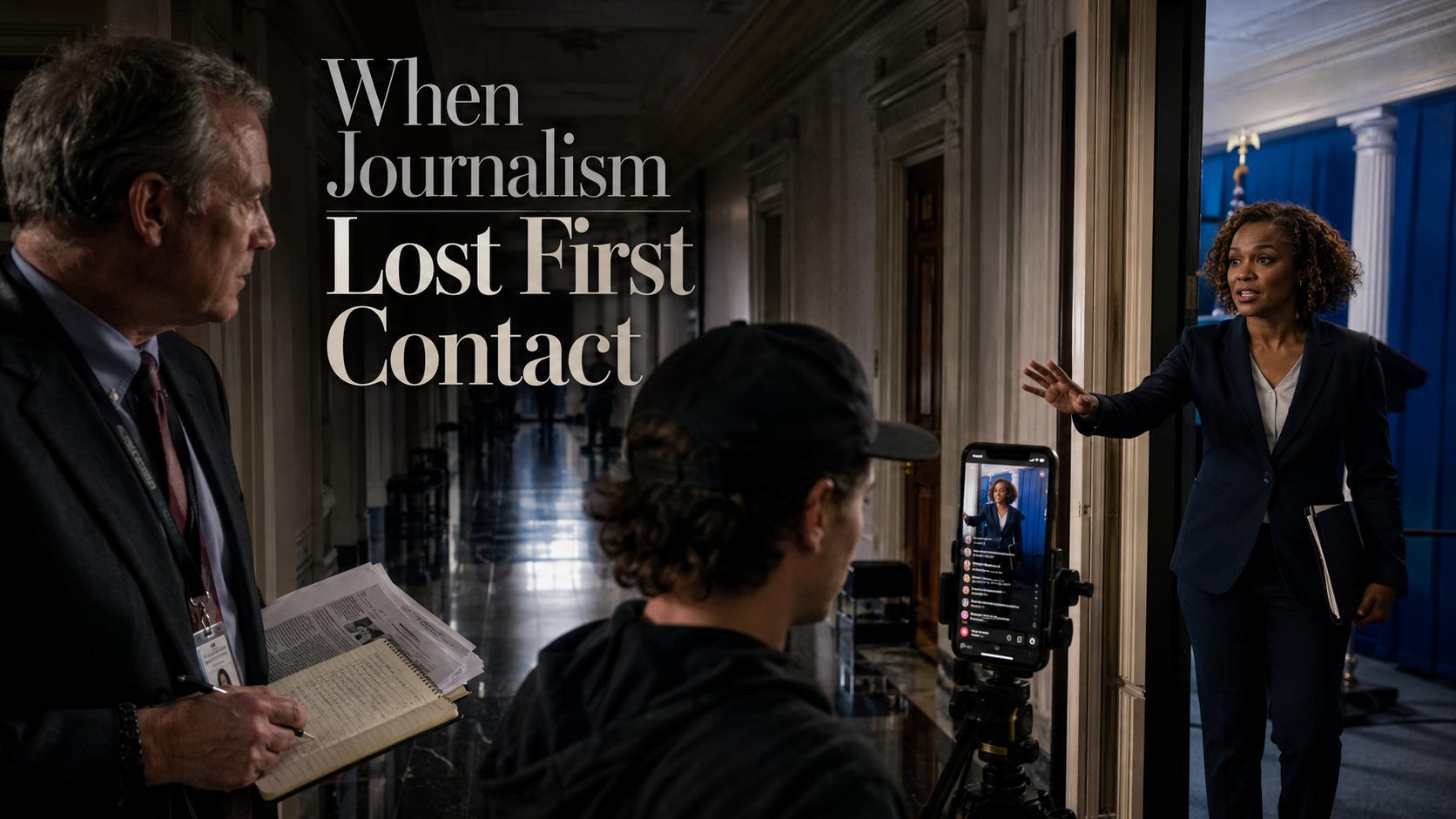
Imagine standing outside a security checkpoint in the West Wing on a quiet Tuesday afternoon. The scene is composite, but the displacement it captures is real. A tripod stands in the hallway, a phone mounted to its top, its screen glowing with a live chat feed scrolling too fast for the human eye to track. Next to the tripod stands a young man with a small lapel microphone adjusted to his collar. He is talking quietly, casually, directly to the camera lens, explaining the subtle shift in the mood of the building to an audience far larger than the physical hallway.
A few feet away, leaning against the wall, is a veteran correspondent for a national wire service. She has a notebook in her hand, a printed briefing paper covered in her own scribbled shorthand, and a press credential hanging from a plastic lanyard around her neck. When a public communications official finally emerges into the hall to deliver an update, he does something revealing. He glances right past the reporter with the notebook. He looks straight into the lens of the phone. He addresses the streamer first.
The White House made this operational shift explicit in January 2025, when Press Secretary Karoline Leavitt used her debut briefing to announce that the administration would welcome “independent journalists, podcasters, social media influencers, and content creators” to apply for credentials. Axios reported that two front-row seats in the James S. Brady Press Briefing Room were opened to independent journalists, podcasters, influencers, and creators. Digital-native personalities were no longer operating outside the official communications perimeter. The permanent press corps had not disappeared, but it no longer held exclusive control over political first contact.
Trump White House Press Secretary Karoline Leavitt delivers first briefing
This transition reflects a structural inversion in how political authority reaches the public. For much of the twentieth century, political communication moved through a narrow set of pipes: newspapers, radio networks, cable news, and wire services. Those pipes were gatekept and imperfect, but they created a shared arena where public figures had to pass through institutions built to challenge, contextualize, and verify.
Professional journalism has not lost all authority; it has lost first contact. First contact is not simply where a citizen learns a fact. It is where the fact first receives a frame: what happened, who caused it, who can be trusted, who is lying, and how the audience should feel. The platform feed increasingly frames public emotion before professional outlets arrive to verify the record.
The order matters. A correction that arrives second is not competing with ignorance. It is competing with identity, emotion, and a story the audience may already have shared. By the time the institution enters, the public is not asking, “What happened?” It is often asking, “Was my side right?”
The Screen Has Already Moved
Political power follows the room where attention gathers. Increasingly, that room is not a formal press room, a newspaper homepage, or a cable-news set. It is the platform video feed, often watched on the same television screen that once belonged entirely to broadcasters. The creator is the face of the platform. The platform is the architecture of the feed.
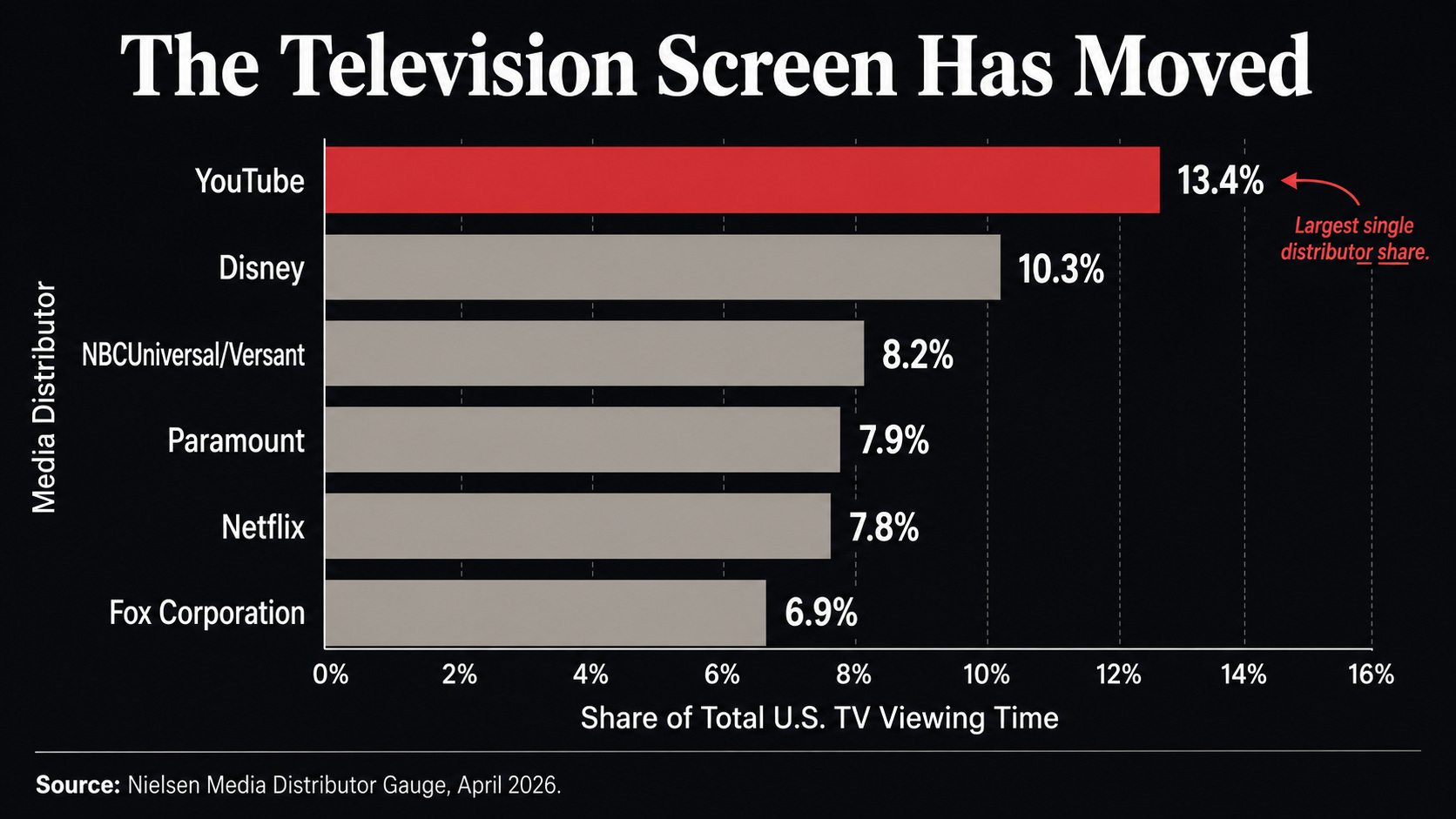
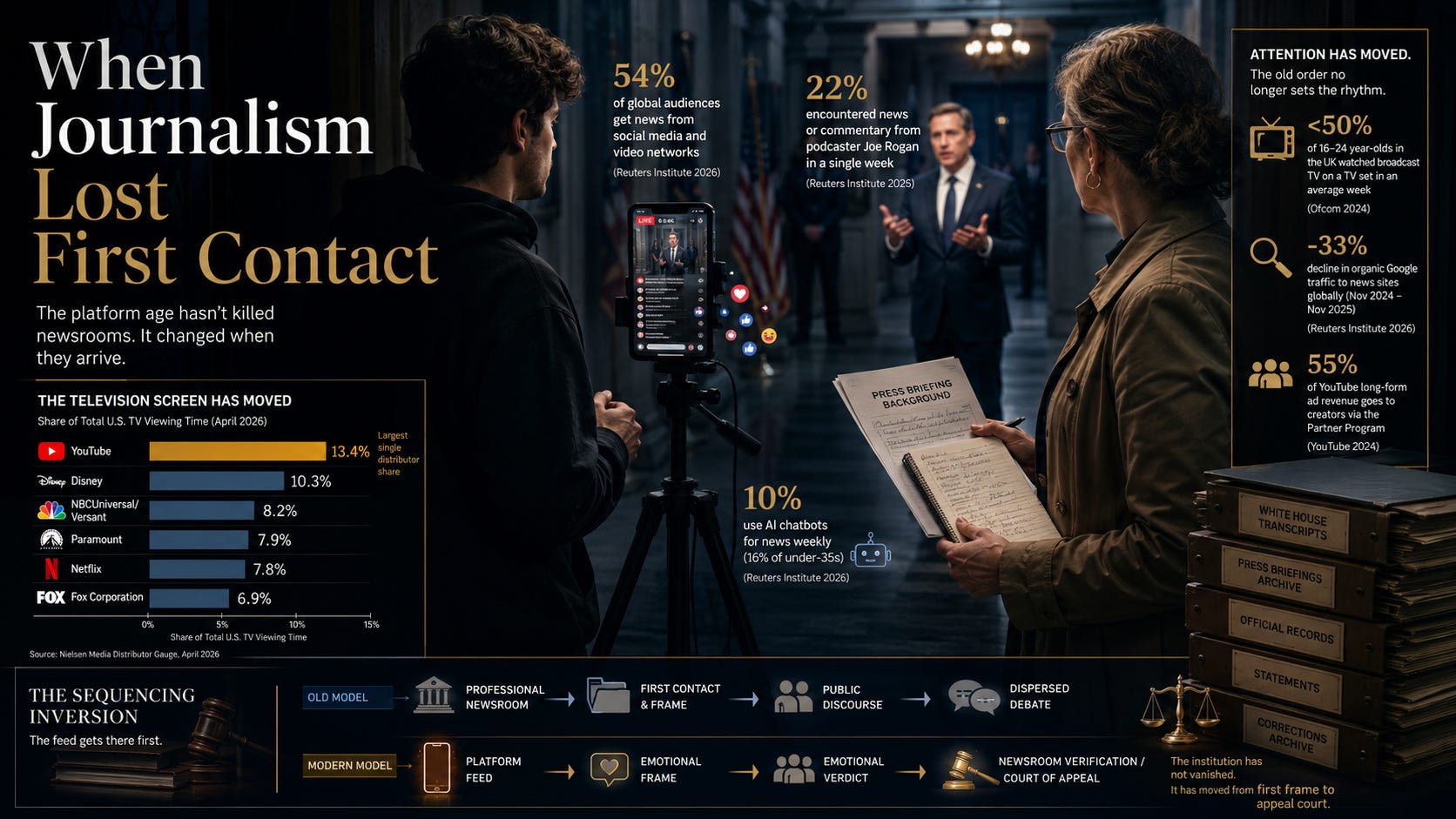
The baseline of media power is shifting from subscriber reach to watch time and habit. In Nielsen’s April 2026 Media Distributor Gauge, YouTube accounted for the largest single share of U.S. television viewing time at 13.4%. Other major distributors followed: Disney at 10.3%, NBCUniversal/Versant at 8.2%, Paramount at 7.9%, Netflix at 7.8%, and Fox Corporation at 6.9%. Major broadcast events can temporarily disrupt the monthly ranking, as when heavy live programming briefly pushes network numbers up, but the underlying pattern remains intact. A platform once treated as a repository for amateur uploads now competes directly for prime evening hours and advertising budgets.
Among younger demographics, the old broadcast schedule no longer sets the rhythm. In the United Kingdom, Ofcom data from 2024 showed that fewer than half of 16-to-24-year-olds watched broadcast TV on a television set in an average week. For many of these viewers, the television set increasingly functions as a monitor for platform video. News consumption has followed a similar trend. According to the Reuters Institute’s 2026 Digital News Report, social media and video networks reached 54% of global audiences as a source of news, narrowly ahead of television news at 52% and standalone news apps or sites at 51%.
The numbers point in one direction: attention, discovery, trust, payment, and verification no longer reside in the same institutions. Platform video commands the screen, social and video networks shape discovery, trust and payment remain depressed, and AI chatbots are beginning to answer news questions before users reach the source.
The Economic Drag of Virtue
The conventional explanation is that the internet made information free and traditional newsrooms failed to adapt. That is only the surface explanation. Journalism’s problem is that verification did not become cheaper just because distribution did.
The advantage enjoyed by personality-driven media is commercial before it is ideological. Traditional news and broadcast companies operate as heavy institutional machines. They carry the permanent costs of bureaus, legal review, standards, labor agreements, distribution contracts, and content or sports rights. Some of these costs reflect democratic virtues. They are the capital-intensive structures that make verifiable reporting possible. But in a market optimized for immediate engagement, these virtues become an economic drag.
A newsroom pays before it speaks. It pays for the reporter, the editor, the lawyer, the archive, the correction policy, the bureau, the standards desk, and the risk of getting sued. Legacy journalism is not slow because it is lazy. It is slow because accuracy requires a production chain.
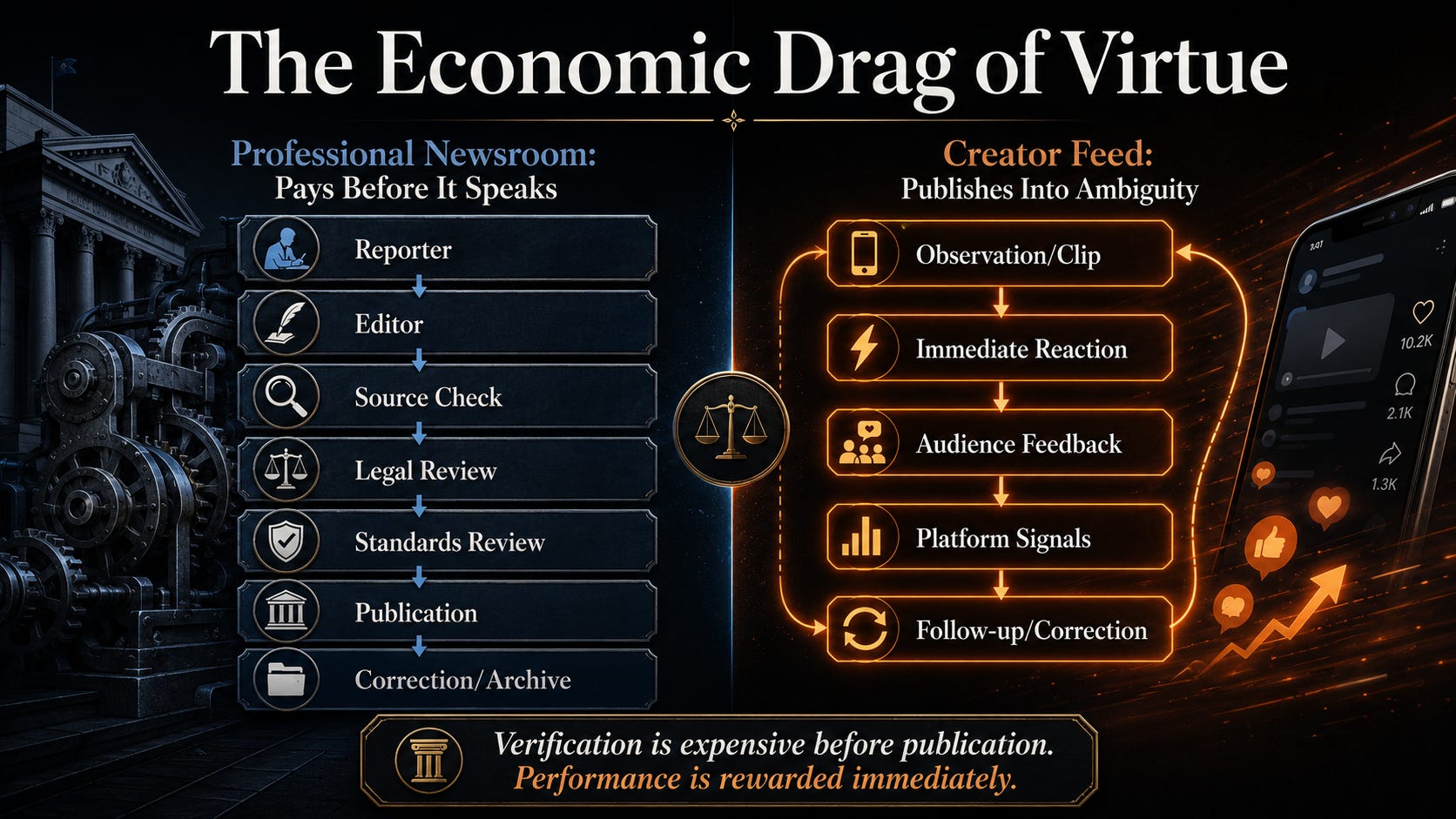
The creator feed collapses production into performance. A newsroom separates those functions. One person may report, another edits, another checks, another reviews risk, another publishes, and another corrects the archive. That chain looks inefficient until the story is wrong, defamatory, manipulated, or strategically planted. Then the chain is the product.
Many creators can publish into ambiguity and let audience response, platform feedback, or reputational pressure do the work that institutions traditionally tried to do before publication. This does not make creators inherently illegitimate, but it explains why they are faster. Platforms do not reward verification as such; they reward retention, recurrence, velocity, and reaction. Verification can succeed there, but it has to compete as a format, not as a civic duty.
The very costs that make journalism reliable also make it slower and heavier in a retention market. A foreign correspondent bureau may look inefficient next to a creator filming from a hotel room until a coup, invasion, disaster, or contested election requires local sources, language knowledge, security judgment, and legal accountability.
The top of the creator economy is no longer a single person with a camera. It is a company with payroll, production facilities, managers, lawyers, commerce arms, and investors. But even then, the business is organized around audience-first distribution rather than carriage contracts, affiliate fees, or fixed broadcast schedules. The platform mechanics reinforce this advantage: YouTube’s Partner Program distributes 55% of long-form advertising revenue directly to eligible channels. It funds programming through distribution, not institutional approval. That changes who can accumulate influence.
Politicians noticed.
The Intimacy Trap
The pattern appears differently in each country, but the incentive is consistent: political figures seek formats where the host’s relationship with the audience participates in the persuasion for them. The long-form podcast is almost perfectly designed for political image management. It gives a public figure time to seem nuanced, informality to seem human, and enough looseness to avoid the rhythm of formal interrogation. The best moments are clipped for TikTok, Instagram, and YouTube Shorts. One appearance becomes a week of content.
The friendly room does not eliminate accountability. It converts accountability into atmosphere. It lets a politician look exposed without being endangered. The questions can be long, personal, and apparently unscripted, while the deeper structure remains safe: the host wants the conversation to work, the audience wants the guest to be legible, and the clips need emotional coherence more than factual pressure. The danger is that political power learns it can borrow intimacy while avoiding scrutiny.
AI, influencers, and a public that’s losing interest
The word “creator” hides more than it reveals. It can mean an independent reporter, a podcast host, a lifestyle influencer, a partisan commentator, or a studio-backed company with a face at the center. Some independents report, verify, and correct with more discipline than established outlets. Others are interpreters, entertainers, or political entrepreneurs. The platform interface places a documented investigation and a confident reaction video side by side in the same visual grammar: face, feed, clip, comment, share.
The power of this environment is trust through repetition. Creators often win relational trust: the audience feels it knows the person. Institutional journalism was built around procedural trust: the audience believes a method exists behind the claim. Relational trust is warm, immediate, and personal. Procedural trust is colder, slower, and institutional. The first travels better in clips. The second holds up better under scrutiny. Modern politics increasingly prefers the first.
None of this absolves professional news organizations, which for years often confused their institutional status with public trust. They fell into their traps of visible ideological sorting, class blindness, and sensational cable formats that alienated massive portions of the population. The platform feed did not create public distrust out of thin air. It simply found an audience that was already looking for the door.
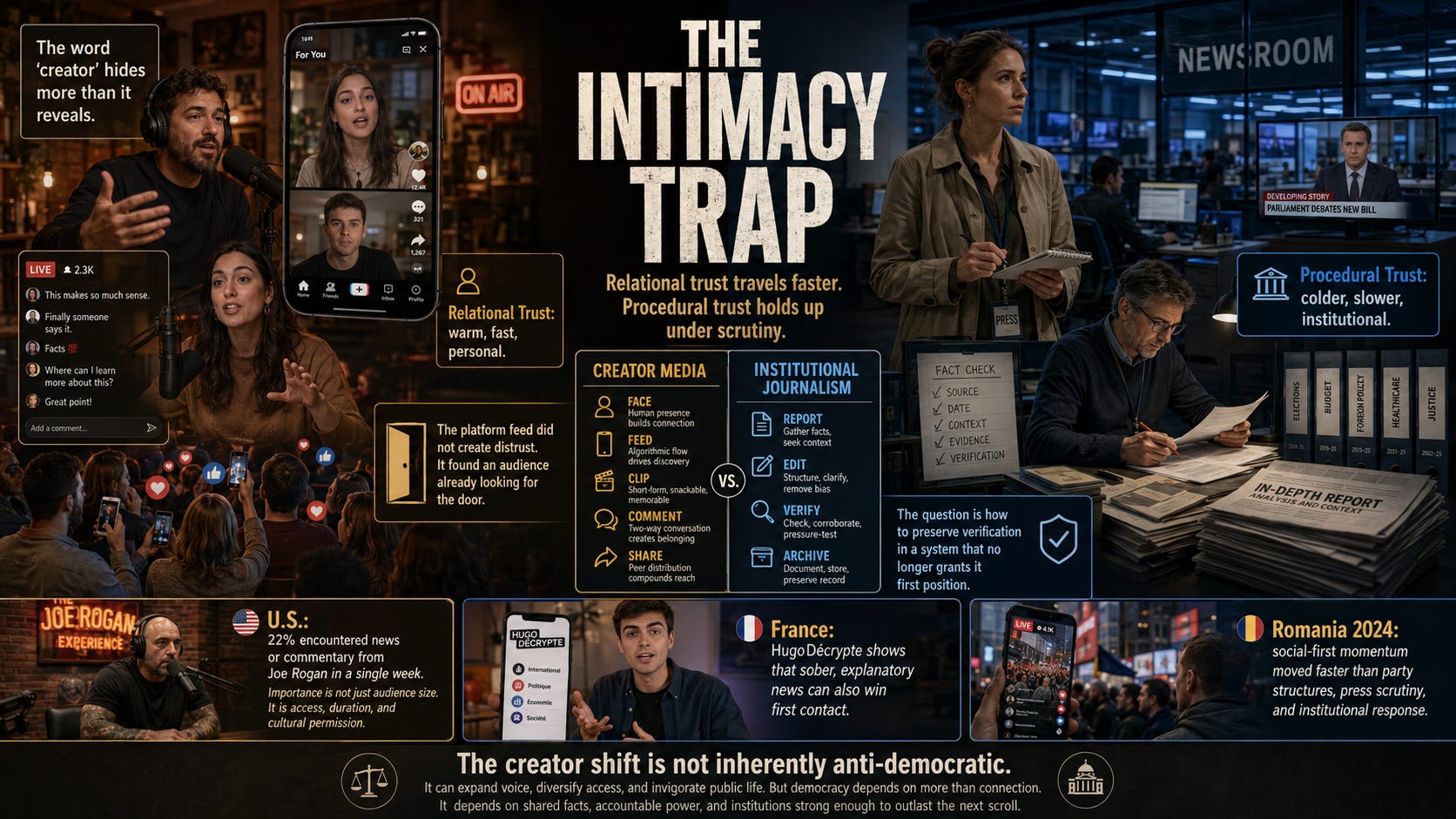
The same architecture produces different political effects in different countries: intimacy in the United States, creator-native explanation in France, and institutional shock in Romania.
The United States: The Reuters Institute’s 2025 tracking found that 22% of respondents encountered news or commentary from podcaster Joe Rogan in a single week. Rogan’s importance is not simply audience size. It is the permission his format grants: duration, looseness, cultural credibility, and access to voters who often reject standard political media and are difficult to reach through standard broadcast interviews.
France: Hugo Travers, through HugoDécrypte, has become a clear example of creator-native news for younger audiences. His short daily explainers show that outrage does not always drive the sequencing shift. Even sober, explanatory news can weaken institutional first contact when it reaches the audience first.
Romania: Romania’s 2024 presidential crisis helped show the political volatility of campaigning built for platforms. Călin Georgescu’s surprise first-round win in November 2024, followed by the election’s annulment in December and legal battles into 2025, became a stark warning that social-first momentum can move faster than party structures, press scrutiny, and institutional response.
The creator shift is not inherently anti-democratic. Some creators ask better questions than television hosts, possess deeper subject-matter expertise, or bring public figures into longer, less performative conversations than cable news allows. The answer is not to restore the old gatekeeping regime. Too many people were locked out of it for too long. The question is how to preserve verification in a system that no longer grants it first position.
The Court of Appeal
Many people now assemble hybrid news diets: podcasts for interpretation, TikTok for discovery, search for confirmation, and established newsrooms when something feels serious enough to check.
If the first exposure comes from a creator feed, the professional news institution becomes the place citizens go to verify the feed’s first draft. It still matters, but less like the trial court than the court of appeal. By the time it enters, the public has already argued the case, the emotional verdict has already formed, and correction has to fight uphill.
The old sequence ran from newsroom to public discourse to dispersed debate. The new sequence runs from platform feed to emotional verdict to newsroom verification. The institution has not vanished. It has moved from the first frame to the appeal court.
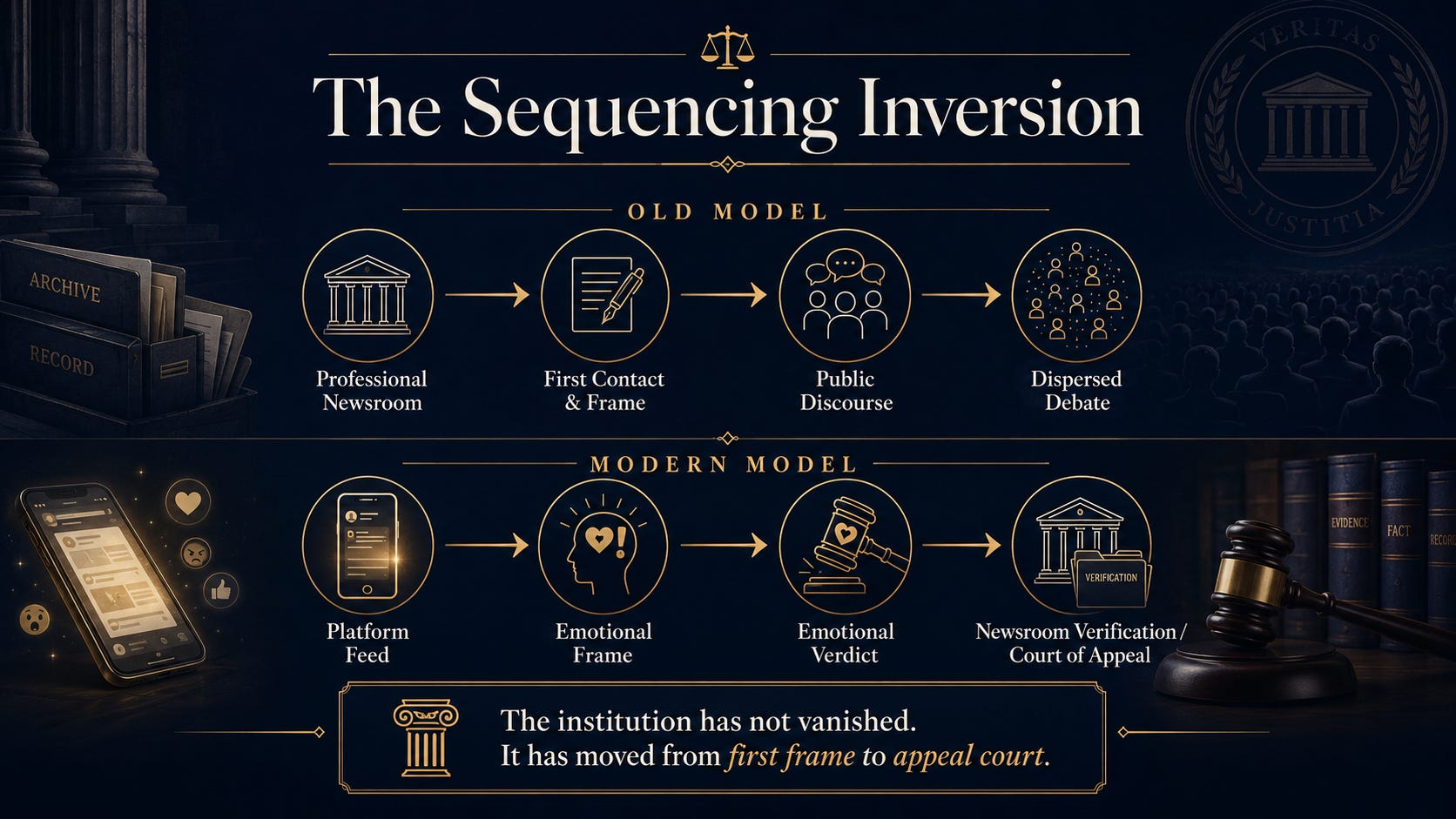
The first trial now happens in the feed. The witness is clipped. The jury is the audience. The verdict is emotional, and it is delivered before the record is complete.
Corrections rarely travel with the same force as first impressions. A creator’s original clip carries tone, suspense, identity, and outrage. The institutional correction often arrives as a link, a statement, or a paragraph of context. It is more accurate, but it is less alive.
Media is distribution. Journalism is verification. The creator era made the first cheaper, faster, and more profitable. It made the second harder to fund. Many citizens still want an institutional referee. Fewer want to buy a ticket to the stadium. They enter through someone else’s gate.
Moderation as Political Evidence
This environment creates a strange emotional bargain: citizens worry deeply about misinformation, yet convenience and habit drive them to remain on the platforms where they believe misinformation is common.
Moderation becomes explosive because platform enforcement is no longer experienced as neutral administration. To a creator’s audience, a label on a post can feel like a label on the community itself. A removed clip becomes proof of suppression. Once the feed owns first contact, moderation becomes a fight over who gets to frame reality first.
In the United States, this conflict is framed by speech and censorship. Major platforms have moved in that direction in different ways: X built Community Notes around crowdsourced context, while Meta announced a shift away from third-party fact-checking toward a similar user-driven model in the United States. In Europe, the Digital Services Act has turned parts of platform moderation, transparency, and risk management into legal obligations.
AI Turns the Source Into Raw Material
Artificial intelligence does not replace the creator shift; it compounds it. The Reuters Institute reported 10% global weekly use of AI chatbots for news, with adoption rising to 16% among under-35s. AI inserts a new intermediary between the citizen and the source. It does not merely distribute links. It summarizes, ranks, and rewrites. AI is not just another distribution channel. It is another first-contact machine.
How Google’s AI Search Tool Threatens News Publishers
The source becomes raw material. The answer becomes the product. A link asks for a click. An answer ends the search.
The publisher’s problem is not only lost traffic. It is a lost sequence. The reader may receive the summary before seeing the reporting, the answer before seeing the source, and the conclusion before seeing the method.
The traffic decline is already measurable. The Reuters Institute, citing Chartbeat data, noted that organic Google traffic to more than 2,500 sites fell by roughly a third globally between November 2024 and November 2025, and by even more in the United States, as search products integrated automated answers directly into the user interface. AI does not need to destroy journalism to damage it; it only has to answer enough of the user’s question before the user reaches the source.
Yet, a fundamental paradox remains: while audiences use AI for speed and summarization, their trust in AI-generated news and automated summaries remains low. Provenance remains the institution’s deepest advantage. Provenance, the ability to show where information came from and who is accountable for it, still means something in a system flooded with synthetic summaries and recycled clips. A verified byline, an accountable editor, a correction policy, a legal address, and an archive still matter. But provenance does not guarantee arrival. The most credible source in the world still has to reach the citizen before the citizen stops looking.
The Assimilation Trap
Legacy media’s response is not retreat. It is assimilation. Broadcasters are moving full episodes, clips, podcasts, and personalities into the same platform environments that weakened their first-contact power. The strategy is understandable: go where the audience already is. The danger is that institutions become fluent in the feed while forgetting why they were trusted outside it. That is the convergence trap.
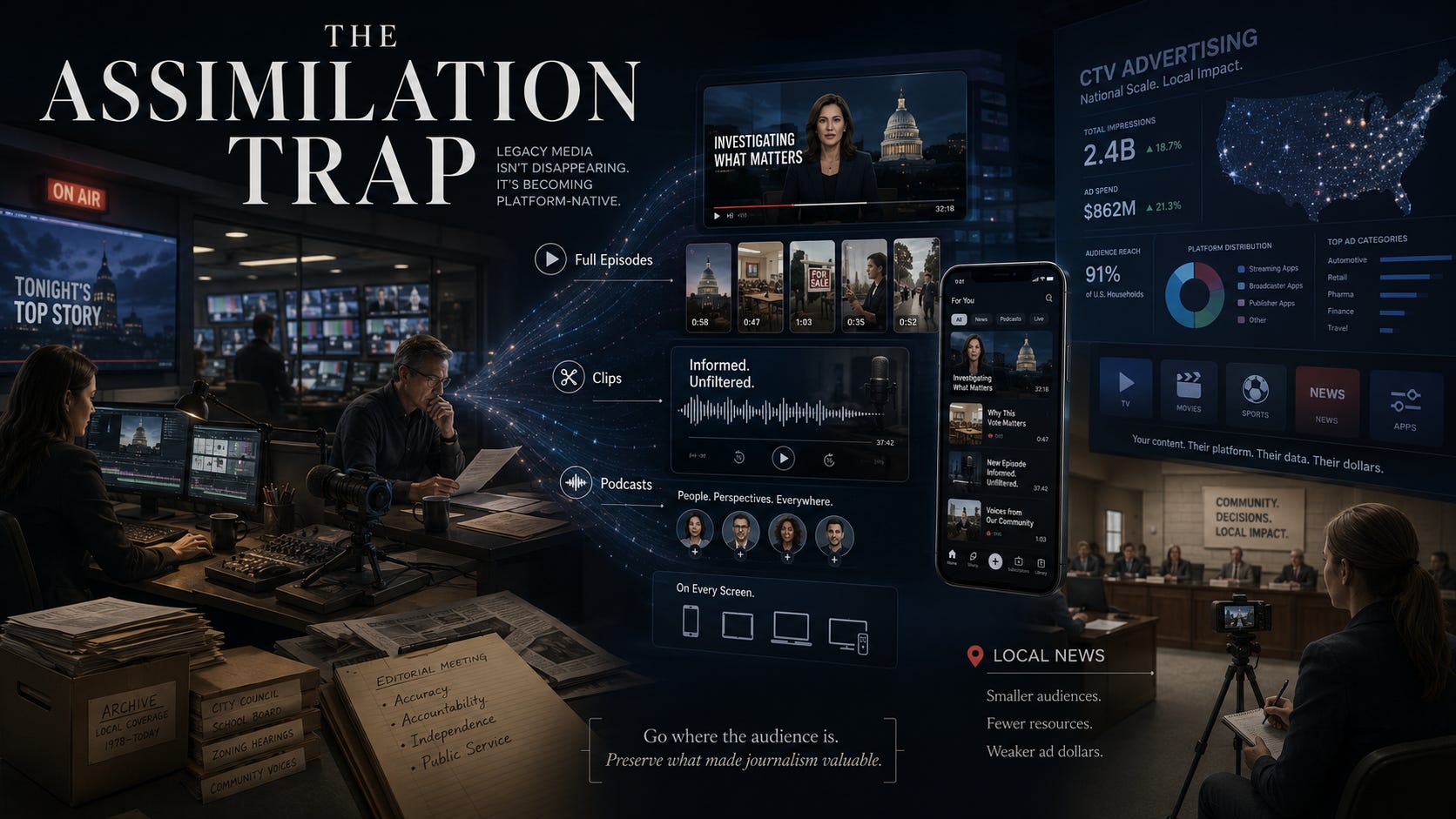
The adaptation is visible everywhere: in full episodes uploaded to third-party platforms, in podcast studios and creator labs inside old newsrooms, in independent hosts recruited into institutional formats, and in television groups seeking scale in connected-TV advertising markets. Channel 4, for example, has treated platform-native ecosystems as primary spaces for long-form full episodes rather than secondary marketing outposts. Consolidation is also shaping corporate structures, as television groups try to gain scale in connected-TV advertising markets increasingly dominated by large technology platforms.
Local news is especially exposed because it still holds civic value but increasingly depends on advertising markets that national platforms are reorganizing. A local newsroom may still be the only institution that sends a reporter to cover a school-board fight, a zoning dispute, or a county corruption case. But the advertising market that once helped fund that coverage is being absorbed into national-scale digital systems that do not care whether anyone attends the school-board meeting. Broadcast groups are trying to become more platform-native and clip-ready while preserving the editorial infrastructure that makes their verification valuable.
When Authority Becomes a Format
The platform age has not killed professional newsrooms. It has changed when they arrive.
The first draft of public emotion is written elsewhere. Political authority now has to appear in the shapes the feed understands. Authority has become a format. A president becomes a podcast guest. A minister becomes a clip. A campaign becomes a content calendar. A government announcement becomes a thumbnail, a reaction video, a stitched rebuttal, and a group-chat argument before the official transcript is even read.
Political power has learned the language of the creator economy: intimacy, speed, repetition, directness, and constant output. Democratic authority was built for a slower grammar: records, procedure, adversarial questioning, and delayed judgment. That collision now sits at the center of the fight over political communication.
Return to the hallway press checkpoint. The reporter still has the notebook. The institution still has the archive. The official transcript will still exist. But the first audience has already gathered around the glowing phone. The feed got there first. Democracy now has to decide whether verification can still matter when it arrives second.
The second news report is dismally under noticed. Often tragically.